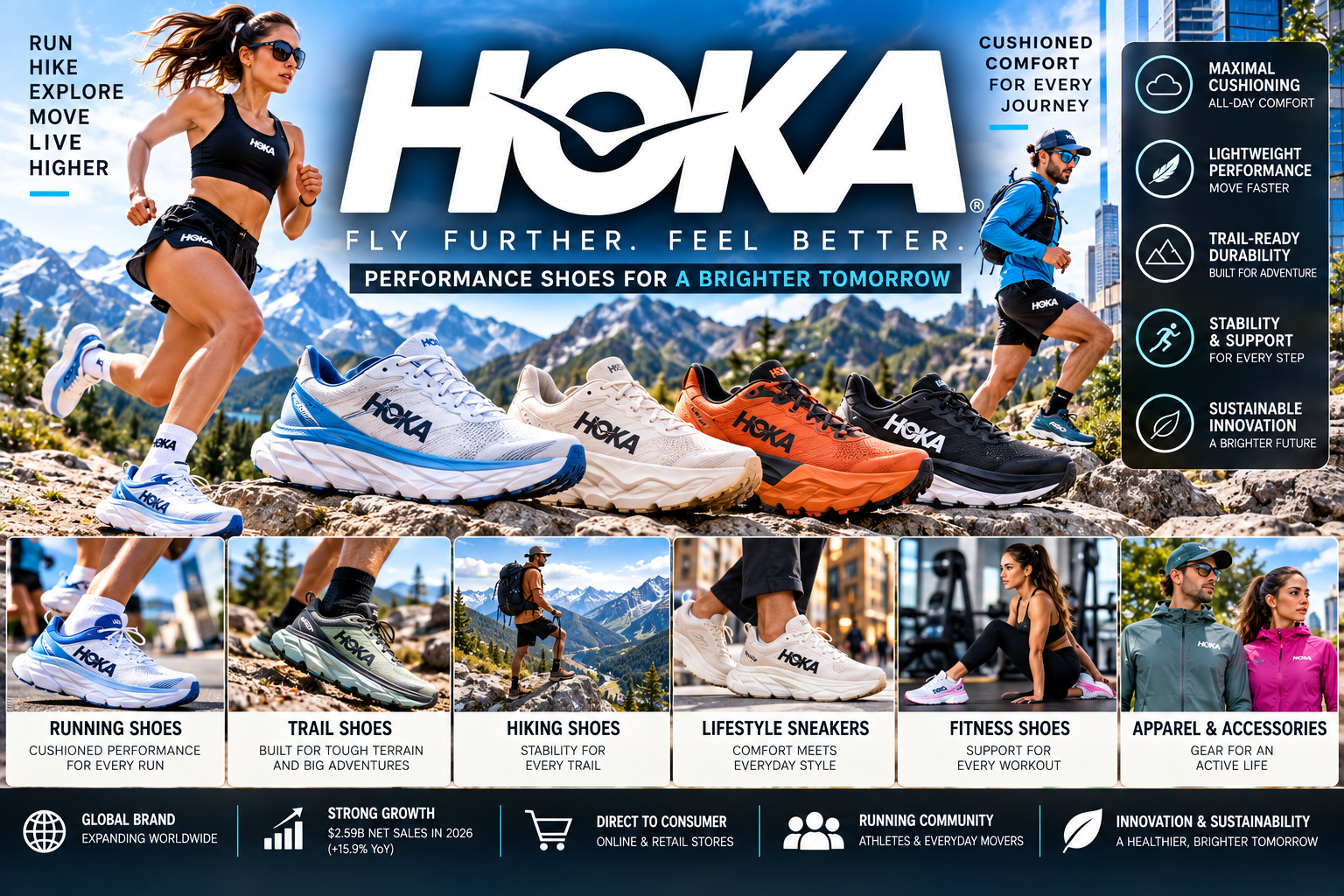
HOKA has evolved from a niche running-shoe concept into a globally recognized performance and lifestyle footwear brand. Known for its distinctive maximal cushioning, lightweight construction, stability, and bold silhouette, HOKA has expanded well beyond its original ultra-running audience.
Today, HOKA operates as one of the flagship brands of Deckers Brands, alongside UGG and other footwear businesses. Its product range includes running, trail, hiking, fitness, lifestyle footwear, apparel, and accessories.
The brand's combination of performance technology, comfort, distinctive design, and growing lifestyle appeal has helped it reach professional athletes, recreational runners, outdoor consumers, and everyday customers.
What Is HOKA?
HOKA is a premium footwear brand focused primarily on running and performance footwear.
The brand is particularly associated with:
Cushioned running shoes
Lightweight construction
Stability
Trail running
Hiking
Walking
Fitness
Lifestyle footwear
Apparel
Accessories
Deckers describes HOKA as a premium, year-round performance brand offering enhanced cushioning and inherent stability while maintaining relatively low weight. The company says HOKA was originally designed for ultra-runners but has expanded to world-class athletes, tastemakers, and everyday athletes.
The HOKA Story
HOKA's roots are closely connected to performance running and the needs of athletes seeking efficient movement over long distances.
The brand's distinctive design approach helped separate it from conventional running shoes. Instead of focusing primarily on thin, traditional midsoles, HOKA became associated with a highly cushioned platform and recognizable geometry.
Over time, the brand expanded its product range and audience.
Its development illustrates a broader trend in footwear: performance technology can move from specialist sports categories into mainstream lifestyle culture.
Why HOKA Shoes Look Different
One of HOKA's most recognizable characteristics is its thick midsole.
The visual design is not simply intended to make the shoe look larger. HOKA's performance philosophy focuses on cushioning, stability, weight management, and efficient movement.
Different HOKA models are designed for different activities, so features vary by shoe.
Depending on the model, consumers may find features designed around:
Road running
Trail running
Long-distance training
Daily walking
Hiking
Recovery
Fitness
Lifestyle use
This broad product strategy allows HOKA to address consumers with different footwear requirements.
HOKA Running Shoes
Running remains the core of HOKA's identity.
The brand offers footwear designed for both everyday training and more specialized running needs.
HOKA's running portfolio includes shoes for:
Daily Training
Daily trainers are designed for regular running and general training. They typically emphasize a combination of comfort, cushioning, durability, and stability.
Long-Distance Running
Long-distance runners often prioritize cushioning and comfort over extended periods of use.
Racing
Performance-oriented models are designed for runners looking for speed and efficiency.
Trail Running
Trail models are designed for outdoor terrain and can incorporate specialized traction and protection.
HOKA Trail and Outdoor Footwear
HOKA has expanded beyond road running into trail and outdoor categories.
Trail footwear is designed for surfaces that can include:
Dirt
Rocks
Gravel
Mud
Uneven terrain
Mountain trails
This expansion allows the brand to reach hiking and outdoor consumers in addition to traditional runners.
Deckers identifies running, trail, hiking, fitness, and lifestyle footwear among HOKA's product categories.
HOKA and Lifestyle Fashion
One of the most significant developments for HOKA has been the movement of performance footwear into everyday fashion.
Consumers increasingly wear running-inspired footwear for:
Travel
Walking
Commuting
Casual outfits
Everyday errands
Athleisure
Streetwear
HOKA's distinctive silhouette gives the shoes a recognizable visual identity, helping the brand participate in both performance and lifestyle markets.
Deckers has specifically identified expanding HOKA's lifestyle appeal as part of its long-term strategy.
HOKA's Global Growth
HOKA has become an important part of Deckers Brands' overall business.
For fiscal year 2026, HOKA generated approximately $2.59 billion in net sales, representing a 15.9% increase from the previous fiscal year. Deckers reported that HOKA's growth was supported by product innovation, increased global awareness, and broader marketplace presence.
HOKA's growth also continued into the first quarter of fiscal 2027.
For the quarter ended June 30, 2026, HOKA net sales increased 7.7% to approximately $703.5 million.
These figures demonstrate the increasing importance of HOKA within Deckers' global brand portfolio.
HOKA's International Expansion
International markets have become an increasingly important part of HOKA's growth strategy.
Deckers reported that international sales across the company increased strongly in fiscal 2026, while HOKA continued expanding its global marketplace presence.
For HOKA, international expansion involves more than opening stores. It can include:
Local retail partnerships
E-commerce
Digital marketing
Regional campaigns
Athlete partnerships
Community events
Running clubs
Localized consumer experiences
This approach can help the brand build stronger relationships with runners and consumers in different markets.
HOKA's Direct-to-Consumer Strategy
HOKA sells products through both wholesale partners and Deckers' direct-to-consumer channels.
The DTC model includes:
E-commerce
Brand-owned retail
Digital customer experiences
Consumer data
Product discovery
Direct marketing
In the first quarter of fiscal 2027, Deckers' overall DTC sales increased 13%, while comparable DTC sales increased 6.8%.
Direct relationships can provide brands with greater control over product presentation and customer experience.
HOKA and Wholesale Retail
Wholesale remains another important distribution channel.
HOKA products are sold through specialty running stores, outdoor retailers, sporting-goods businesses, and other retail partners.
Specialty retailers can be particularly important for performance footwear because customers often want advice about:
Running style
Shoe fit
Cushioning
Stability
Terrain
Training requirements
Deckers reported that wholesale sales increased across its overall business in fiscal 2026, while HOKA continued to expand its presence within run and outdoor specialty wholesale accounts.
HOKA Product Innovation
Product innovation is central to HOKA's strategy.
Performance footwear requires continuous development in areas such as:
Cushioning
Weight
Stability
Durability
Traction
Fit
Upper construction
Material technology
Running geometry
HOKA has continued developing franchise product families rather than relying on a single shoe.
Deckers says HOKA's strategy includes innovation across performance franchises and expansion into lifestyle categories.
HOKA and Athletes
Athlete relationships play an important role in performance footwear marketing.
Professional and elite runners can help brands demonstrate how products perform in competitive environments.
At the same time, HOKA's positioning has expanded beyond professional athletes.
Deckers describes the brand's audience as including world champions, tastemakers, and everyday athletes.
This broader audience helps connect technical performance with mainstream consumer culture.
HOKA and Running Communities
Running is increasingly becoming a community-driven activity.
Running clubs, races, social media, local events, and online communities allow footwear brands to interact directly with consumers.
For HOKA, community engagement can support:
Brand awareness
Product discovery
Athlete relationships
Local marketing
Customer loyalty
Running culture
Community-based marketing can be particularly valuable because runners frequently share product recommendations and experiences.
HOKA and Sustainability
Sustainability has become an important consideration across the footwear industry.
Areas relevant to footwear sustainability include:
Material selection
Packaging
Manufacturing
Product durability
Supply-chain management
Waste reduction
Product lifecycle
HOKA's parent company, Deckers Brands, also reports on corporate responsibility and sustainability initiatives.
As consumers increasingly consider the environmental impact of products, footwear companies face pressure to improve materials, manufacturing processes, and transparency.
HOKA and Technology
Technology is influencing both product development and retail.
For footwear companies, technology can support:
Product design
Consumer analytics
Demand forecasting
Inventory management
Digital marketing
E-commerce
Personalization
Customer service
Deckers has identified technology and advanced analytics as strategic capabilities for improving productivity, efficiency, and consumer connection. The company has also referenced responsible AI use within its technology strategy.
HOKA's Lifestyle Opportunity
HOKA's expansion into lifestyle footwear represents an important opportunity for the brand.
Performance shoes increasingly overlap with fashion and everyday clothing.
Consumers may choose athletic footwear because it provides a combination of:
Comfort
Function
Recognizable design
Versatility
Fashion appeal
Deckers has explicitly identified enhanced lifestyle product appeal as part of HOKA's long-term strategy.
HOKA in the Fashion Market
HOKA's success reflects the broader convergence of sportswear and fashion.
The boundaries between running shoes, sneakers, lifestyle footwear, and fashion have become increasingly fluid.
This has created opportunities for performance brands to reach consumers who may not consider themselves serious athletes.
HOKA can therefore participate in several markets simultaneously:
Performance → Running → Outdoor → Wellness → Lifestyle → Fashion
HOKA's Competitive Landscape
HOKA competes in a highly competitive athletic-footwear industry.
Its competitive environment includes established global sportswear companies, specialist running brands, lifestyle sneaker companies, and emerging footwear businesses.
Competition occurs across several dimensions:
Cushioning
Performance
Design
Brand recognition
Athlete partnerships
Price
Distribution
Innovation
Digital experience
HOKA's distinctive visual identity and focus on cushioning help differentiate it within the running-footwear market.
HOKA's Business Model
HOKA's business model combines product innovation with multiple distribution channels.
The major components include:
Product Innovation
Continuous development of running, trail, hiking, fitness, and lifestyle products.
Wholesale
Distribution through retail partners and specialty stores.
Direct-to-Consumer
Brand-owned e-commerce and physical retail.
Global Expansion
Growing awareness and consumer adoption across international markets.
Lifestyle Expansion
Moving performance technologies into everyday footwear and apparel.
Community Marketing
Connecting with athletes, runners, and broader consumer communities.
HOKA's 2026 Trends
Several trends are shaping HOKA's business in 2026.
1. Performance Meets Lifestyle
Running footwear increasingly functions as everyday fashion.
2. Global Expansion
International markets remain an important opportunity for HOKA.
3. Direct-to-Consumer Growth
Digital and brand-owned channels allow closer consumer relationships.
4. Product Franchise Development
HOKA is investing in recognizable product families and continued innovation.
5. Lifestyle Categories
The company is expanding HOKA's appeal beyond traditional running.
6. Technology and AI
Analytics and responsible AI applications can support efficiency, consumer acquisition, and personalization.
7. Community-Based Marketing
Running communities and social platforms provide opportunities to build deeper brand relationships.
Challenges Facing HOKA
Despite its growth, HOKA operates in a competitive and constantly changing industry.
Potential challenges include:
Intense athletic-footwear competition
Changing consumer preferences
Fashion-cycle changes
Supply-chain disruption
Manufacturing costs
International economic conditions
Currency fluctuations
Inventory management
Brand positioning
Maintaining product innovation
Balancing performance and lifestyle expansion
Deckers also identifies macroeconomic conditions, supply-chain issues, consumer demand, competition, and other business risks in its regulatory filings.
The Future of HOKA
HOKA enters the next phase of its growth with a much broader consumer base than the ultra-running audience it originally served.
Its future strategy centers on several areas: innovative performance footwear, lifestyle expansion, global consumer adoption, direct-to-consumer capabilities, and stronger technology and analytics.
Deckers' stated long-term objective is to expand consumer adoption of HOKA and increase global market share through innovative performance footwear and enhanced lifestyle appeal.
If the brand continues to connect technical footwear with everyday comfort, fashion, outdoor activities, and running culture, its addressable consumer market can continue to broaden.
Frequently Asked Questions
What is HOKA known for?
HOKA is particularly known for cushioned performance footwear, lightweight construction, stability, running shoes, and distinctive footwear designs.
Is HOKA a running brand?
Yes. Running remains central to HOKA's identity, although the brand has expanded into trail, hiking, fitness, lifestyle footwear, apparel, and accessories.
Who owns HOKA?
HOKA is a brand of Deckers Brands, the publicly traded company that also owns UGG and other footwear brands.
Is HOKA growing in 2026?
Deckers reported that HOKA's fiscal 2026 net sales increased 15.9% to approximately $2.59 billion. HOKA sales also increased 7.7% year over year in the first quarter of fiscal 2027.
Does HOKA make shoes only for running?
No. HOKA's current product categories include running, trail, hiking, fitness, lifestyle footwear, apparel, and accessories.
Conclusion
HOKA has transformed from a specialized running concept into a globally recognized performance and lifestyle footwear brand.
Its identity is built around cushioning, lightweight performance, stability, innovation, and a distinctive design language. At the same time, its expansion into lifestyle products has helped broaden its consumer audience.
With HOKA generating approximately $2.59 billion in fiscal 2026 net sales and continuing to expand internationally and across product categories, the brand has become a major growth engine within Deckers Brands.
Looking ahead, HOKA's development will be shaped by product innovation, lifestyle adoption, international expansion, digital commerce, technology, and the continuing connection between athletic performance and everyday fashion.