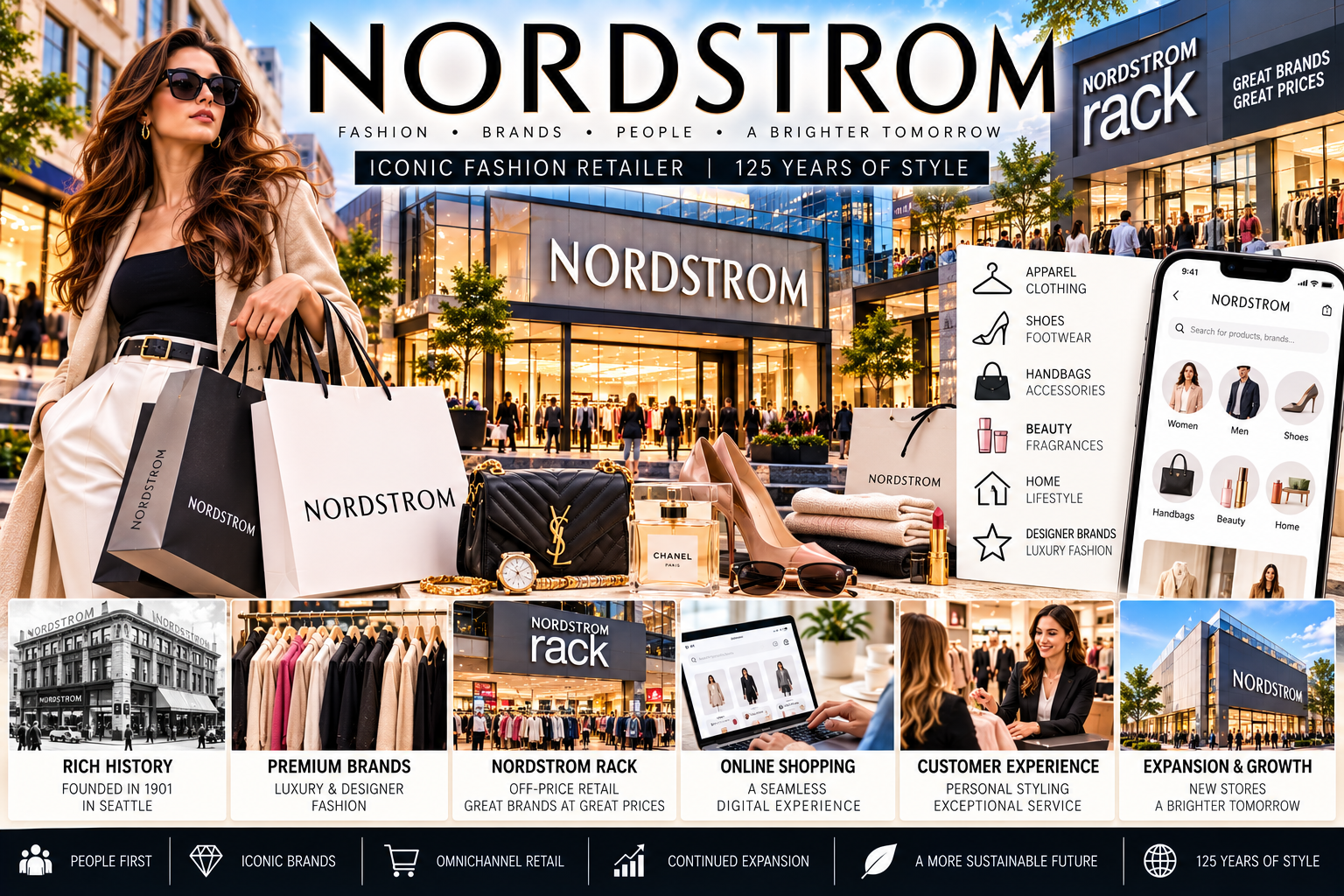
Nordstrom is one of the best-known names in American fashion retail, with a history stretching back more than a century. Founded in Seattle in 1901 as a shoe store, the company developed into a major fashion retailer known for designer merchandise, customer service, personal styling, digital commerce, and its off-price Nordstrom Rack business.
In 2025, Nordstrom entered a new phase when members of the Nordstrom family and El Puerto de Liverpool completed an acquisition that returned the company to private ownership. The company's common stock stopped trading on the New York Stock Exchange on May 21, 2025.
As Nordstrom reaches its 125th anniversary in 2026, the retailer is continuing to develop its stores, digital channels, partnerships, and Nordstrom Rack footprint.
What Is Nordstrom?
Nordstrom is a U.S.-based fashion retailer headquartered in Seattle, Washington. Its business focuses on apparel, shoes, accessories, beauty, home products, and other merchandise from a broad range of brands.
The company operates through two major retail banners:
Nordstrom
Nordstrom Rack
Nordstrom traditionally serves customers looking for premium and designer merchandise, while Nordstrom Rack provides an off-price shopping experience featuring branded products at discounted prices.
Nordstrom also operates Nordstrom Local locations and digital shopping channels as part of its broader customer-service ecosystem. The company says it has more than 350 Nordstrom and Nordstrom Rack stores across the United States, while its broader current company overview describes nearly 400 locations when Nordstrom Local is included.
The History of Nordstrom
Nordstrom began in 1901 when Swedish immigrant John W. Nordstrom opened a shoe store in Seattle.
Over the decades, the company expanded beyond footwear into a broader fashion and department-store business. Nordstrom became publicly traded in 1971.
The company also developed Nordstrom Rack. The first Rack location opened in 1973 in the basement of a Seattle Nordstrom store as a clearance center for merchandise from the full-line business.
The company later expanded across the United States and developed its online business, designer offerings, private-label products, services, and localized retail concepts.
In 2025, Nordstrom returned to private ownership following the acquisition by the Nordstrom family and El Puerto de Liverpool.
Nordstrom in 2026
2026 represents an important year for the retailer because Nordstrom is celebrating 125 years of business.
The company has continued announcing new Nordstrom Rack locations during 2026, including planned stores in locations such as Cypress, Texas; Glen Allen, Virginia; Athens, Georgia; Wellington, Florida; Victor, New York; and other markets. Several of these stores are scheduled to open in 2026 or 2027.
This expansion highlights the importance of the Rack business to Nordstrom's current retail strategy.
Nordstrom vs. Nordstrom Rack
Nordstrom and Nordstrom Rack operate under the same corporate umbrella but serve somewhat different shopping missions.
Nordstrom
Nordstrom's full-line business emphasizes:
Designer fashion
Premium apparel
Shoes
Handbags
Accessories
Beauty
Personal styling
Customer services
Digital shopping
The full-line format is designed around a more curated and service-oriented shopping experience.
Nordstrom Rack
Nordstrom Rack operates in the off-price segment, focusing on branded merchandise at lower prices.
Nordstrom has described Rack as a destination for "great brands at great prices." The company has also stated that 90% of its top brands at Nordstrom are sold through Nordstrom Rack, demonstrating the close relationship between the two banners.
Nordstrom's Business Model
Nordstrom's business model combines physical retail, digital commerce, branded merchandise, services, and off-price retail.
The company's approach is built around giving customers multiple ways to discover and purchase products.
1. Full-Price Retail
The Nordstrom banner provides premium and designer products across fashion categories.
2. Off-Price Retail
Nordstrom Rack attracts value-conscious consumers by offering branded merchandise at discounted prices.
3. E-Commerce
Online shopping has become an important part of modern fashion retail. Nordstrom and Nordstrom Rack operate digital shopping experiences that allow customers to browse merchandise beyond traditional physical stores.
4. Customer Services
Nordstrom has historically emphasized customer service as a central part of its brand identity.
Services can include alterations, styling, beauty services, pickup options, and other experiences depending on location.
5. Private-Label Brands
Nordstrom and Nordstrom Rack also offer Nordstrom Made brands. The company says it has more than 10 Nordstrom Made brands designed in-house.
Nordstrom's Fashion Categories
Nordstrom covers a wide range of fashion and lifestyle categories.
Women's Fashion
Women's merchandise includes:
Dresses
Tops
Denim
Outerwear
Shoes
Handbags
Accessories
Activewear
Men's Fashion
The men's assortment includes:
Suits
Shirts
Casual clothing
Denim
Sneakers
Dress shoes
Accessories
Grooming products
Children's Fashion
Nordstrom also carries clothing, footwear, accessories, and lifestyle products for children.
Shoes
Footwear has special historical significance for Nordstrom because the company began as a shoe retailer.
Today, its assortment spans athletic shoes, luxury footwear, boots, sandals, sneakers, and formal shoes.
Beauty
Beauty is another important category, including skincare, cosmetics, fragrances, haircare, and other personal-care products.
Designer and Luxury Brands
Nordstrom has built a reputation for carrying premium and designer brands.
Its merchandise strategy allows customers to shop across different price levels, from accessible fashion to luxury products.
This broad assortment gives Nordstrom a position between traditional department-store retail and more specialized luxury boutiques.
Nordstrom Rack and Value Shopping
Value-conscious shopping has become increasingly important in fashion retail.
Nordstrom Rack provides customers with a lower-price alternative while maintaining a connection with the broader Nordstrom brand.
The company recently refreshed the Nordstrom Rack brand identity, including its logo, visual system, digital presence, and marketing approach. Nordstrom said the updated identity was intended to better connect with Rack's customers and differentiate the banner within off-price retail.
Nordstrom's Digital Strategy
Fashion consumers increasingly combine online research with physical-store shopping.
Nordstrom's digital strategy supports this behavior through online product discovery, digital marketing, mobile shopping, and connections between stores and online channels.
For modern fashion retailers, digital commerce is more than simply selling products online. It also involves:
Personalized recommendations
Product discovery
Mobile commerce
Digital customer service
Social media
Online promotions
Store pickup
Inventory visibility
Customer data
These capabilities can help retailers create a more connected shopping experience.
Customer Experience as a Competitive Feature
Nordstrom has long emphasized customer service as part of its identity.
The company describes its mission around helping customers "feel good and look their best," and its leadership has continued to highlight service and merchandise as central priorities following the ownership transition.
Customer experience can include knowledgeable employees, styling assistance, alterations, convenient returns, digital services, and personalized interactions.
In fashion retail, these services can be especially important because consumers often want assistance with fit, styling, occasions, and product selection.
Nordstrom and Fashion Partnerships
Nordstrom has maintained relationships with fashion organizations and brands over its long history.
In 2026, the company is marking the 20th year of its partnership with the Council of Fashion Designers of America, according to its corporate history.
Nordstrom has also continued developing brand partnerships beyond traditional fashion. In June 2026, the company announced a partnership with FAO Schwarz to expand the toy brand nationwide.
Such partnerships allow retailers to create new shopping categories and experiences while strengthening relationships with customers.
Nordstrom and Technology
Technology is transforming the fashion-retail industry, and Nordstrom operates in a market where digital discovery and personalization are increasingly important.
Retail technology can support:
Online product discovery
Search
Personalized recommendations
Inventory management
Customer relationship management
Mobile commerce
Digital marketing
Supply-chain operations
Store management
Artificial intelligence is also becoming increasingly relevant to fashion retailers. Potential applications include product recommendations, customer-service automation, demand forecasting, content creation, search, and merchandising analytics.
The Importance of Nordstrom Rack Expansion
Recent company announcements show continued investment in Nordstrom Rack locations.
During 2026, Nordstrom announced multiple future Rack stores across the United States. These announcements include locations scheduled for 2026 and 2027.
The expansion reflects the role of off-price retail in reaching consumers who prioritize brand recognition and value.
For Nordstrom, the Rack format also provides a way to reach customers who may not shop frequently at full-price department stores.
Nordstrom's Private Ownership
One of the most important corporate developments for Nordstrom is its return to private ownership.
On May 20, 2025, Nordstrom announced that members of the Nordstrom family and El Puerto de Liverpool had completed the acquisition. Erik and Pete Nordstrom became co-CEOs, and Nordstrom's publicly traded shares were delisted from the NYSE.
The ownership structure gives the Nordstrom family a majority ownership position alongside Liverpool.
The company said the transition would allow greater flexibility in balancing short- and long-term priorities.
Nordstrom's Retail Strategy for 2026 and Beyond
Several themes are particularly relevant to Nordstrom's next phase.
Greater Value Orientation
Consumers continue to pay attention to price, promotions, and perceived value. Nordstrom Rack gives the company a direct presence in the off-price segment.
Digital and Physical Integration
The future of fashion retail is increasingly omnichannel, combining stores, websites, apps, social platforms, and customer-service channels.
Brand Partnerships
Collaborations can help retailers introduce new products, attract new audiences, and create differentiated shopping experiences.
Store Expansion
Nordstrom Rack's planned openings show continued investment in physical retail.
Personalized Shopping
Personalized recommendations and customer data can help retailers make product discovery more relevant.
AI and Retail Technology
AI may increasingly influence product search, recommendations, customer service, marketing, inventory planning, and other retail functions.
Challenges Facing Nordstrom
Nordstrom operates in a highly competitive retail market.
Key challenges include:
Competition from online retailers
Competition from luxury brands
Off-price competitors
Changing consumer preferences
Fashion-cycle volatility
Inventory management
Retail operating costs
Digital advertising costs
Supply-chain complexity
Economic uncertainty
Maintaining consistent customer experience across channels
The retailer must balance premium positioning with the growing consumer focus on value.
The Future of Nordstrom
Nordstrom enters its next chapter with a long retail history, a private ownership structure, two major retail banners, digital capabilities, and a continuing expansion of Nordstrom Rack.
Its 125th anniversary in 2026 provides an opportunity to connect the company's heritage with new retail strategies.
The future of Nordstrom is likely to be shaped by the combination of fashion, technology, value-focused shopping, physical stores, digital commerce, customer service, and brand partnerships.
Rather than relying on one channel, modern fashion retailers increasingly need to create connected experiences across stores, websites, mobile platforms, and customer-service touchpoints.
Frequently Asked Questions
Is Nordstrom still in business?
Yes. Nordstrom continues operating its Nordstrom and Nordstrom Rack businesses in 2026. The company is also continuing to announce new Rack locations.
Is Nordstrom publicly traded?
No. Nordstrom returned to private ownership in 2025 after its acquisition by members of the Nordstrom family and El Puerto de Liverpool. Its shares were delisted from the NYSE in May 2025.
Who owns Nordstrom?
Nordstrom is owned by members of the Nordstrom family and El Puerto de Liverpool, with the Nordstrom family holding the majority ownership stake following the 2025 acquisition.
What is Nordstrom Rack?
Nordstrom Rack is Nordstrom's off-price retail business. It offers branded merchandise at discounted prices through stores and digital channels.
When was Nordstrom founded?
Nordstrom was founded in 1901 in Seattle as a shoe store by John W. Nordstrom.
What is Nordstrom known for?
Nordstrom is particularly known for fashion, footwear, designer merchandise, customer service, digital retail, and its Nordstrom Rack off-price business.
Conclusion
Nordstrom has evolved from a small Seattle shoe store into a major fashion and lifestyle retailer with a nationwide footprint.
Its return to private ownership in 2025 represents a major change in corporate structure, while the company's ongoing Nordstrom Rack expansion, digital initiatives, partnerships, and 125th-anniversary activities demonstrate continued development of its retail business.
As fashion retail continues to change, Nordstrom's combination of premium merchandise, off-price shopping, customer service, digital commerce, and physical stores positions the company for another stage of transformation. Its ability to connect its heritage with evolving consumer expectations will remain an important part of its future.