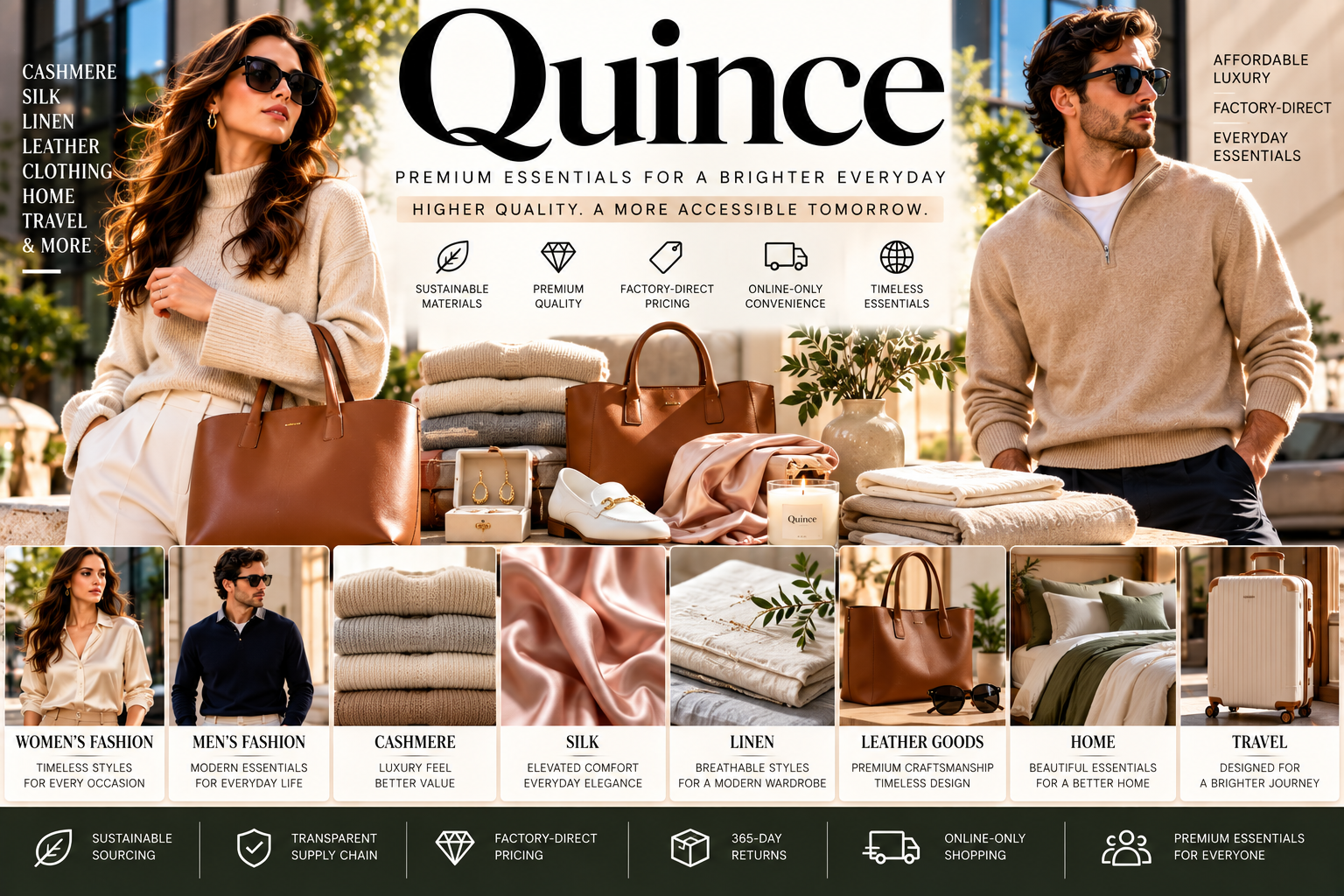
Quince has emerged as a notable direct-to-consumer fashion and lifestyle brand built around a simple proposition: offer high-quality essentials at more accessible prices by reducing traditional retail layers.
Based in San Francisco, Quince sells clothing, cashmere, silk, leather goods, accessories, home products, travel items, and other everyday essentials. The company says its factory-direct model helps reduce costs by removing traditional middlemen, including sourcing agents, wholesalers, and physical-store expenses.
The brand has positioned itself between conventional mass-market fashion and luxury, emphasizing premium materials, simple designs, transparency, affordability, and direct online shopping.
What Is Quince?
Quince is an online-first fashion and lifestyle company focused on premium-looking everyday products at comparatively accessible prices.
Its product assortment includes:
Women's clothing
Men's clothing
Cashmere
Silk
Linen
Leather goods
Shoes
Handbags
Jewelry
Accessories
Beauty and wellness products
Home furnishings
Bedding
Travel products
Pet products
Quince describes its mission around making quality products more accessible rather than treating quality as a luxury. Its current website says the company works directly with factories and ships products to customers without traditional retail layers.
The Quince Business Model
The most distinctive part of Quince's strategy is its direct-to-consumer model.
Traditional fashion supply chains can involve manufacturers, sourcing agents, importers, wholesalers, warehouses, distributors, brands, and physical retailers before a product reaches the customer.
Quince aims to shorten that chain.
Its stated model is essentially:
Factory → Quince → Customer
The company says reducing intermediaries, physical retail costs, and other overhead allows it to offer premium materials at lower prices.
This model is an important part of Quince's brand identity.
Why Quince Prices Its Products Differently
Quince says its prices are supported by several factors:
Factory-Direct Manufacturing
The company works directly with manufacturing partners rather than relying on multiple traditional supply-chain layers.
Online-Only Retail
Quince currently operates as an online-only business by design. The company says avoiding physical stores helps reduce overhead and keep prices accessible.
Low Design Costs
Quince focuses heavily on timeless essentials rather than constantly changing fashion collections.
Reduced Packaging and Overhead
The company says it aims to reduce packaging and corporate costs as part of its operating model.
Quince Cashmere
Cashmere is one of the categories most closely associated with Quince.
The company offers Mongolian cashmere products including:
Cashmere sweaters
Cashmere tees
Cashmere wraps
Cashmere scarves
Cashmere accessories
Quince says it sources Mongolian cashmere from Inner Mongolia. Its current assortment includes products such as Mongolian Cashmere Tees and washable cashmere designs.
Cashmere helps illustrate Quince's strategy of taking a traditionally premium material and positioning it at a more accessible price point.
Quince Silk
Silk is another important material in the brand's assortment.
The company offers:
Silk shirts
Silk dresses
Silk pajamas
Silk accessories
Silk bedding
Silk pillowcases
Quince says it sources Mulberry silk from China. Its current product assortment includes washable silk apparel and 100% Mulberry silk home products.
Quince Linen
Linen has become an important category for consumers looking for breathable, versatile clothing and home products.
Quince offers European linen clothing and home products, including bedding and curtains.
The company states that it sources European linen from Belgium and Lithuania.
Quince Leather Products
Quince has expanded beyond clothing into leather goods and accessories.
Its current assortment includes:
Leather handbags
Leather belts
Leather gloves
Leather shoes
Leather accessories
Suede products
The brand says it sources Italian leather from Tuscany.
This category allows Quince to compete for customers who might otherwise consider traditional premium accessories.
Quince Women's Fashion
Women's fashion represents a major part of Quince's assortment.
Categories include:
Dresses
Tops
Sweaters
Cardigans
Denim
Pants
Outerwear
Activewear
Loungewear
Pajamas
Maternity clothing
Extended sizes
The company also offers petite and extended-size options in parts of its women's assortment.
Quince Men's Fashion
Quince also offers a growing selection of men's clothing and accessories.
The assortment focuses heavily on everyday essentials, including:
Shirts
Sweaters
Pants
Denim
Outerwear
Activewear
Loungewear
Accessories
Shoes
The emphasis is generally on versatile pieces rather than highly seasonal runway fashion.
Quince Home
Quince has expanded significantly beyond apparel.
Its home assortment includes:
Bedding
Sheets
Duvet covers
Pillowcases
Blankets
Curtains
Rugs
Towels
Home accessories
Current home products include European linen sheets, Mulberry silk pillowcases, organic cotton bedding, and wool rugs.
This expansion makes Quince more than a traditional fashion company. It increasingly operates as a broader lifestyle brand.
Quince Travel Products
The company also sells products designed for travel and organization.
These can include:
Luggage
Carry-on bags
Packing cubes
Travel accessories
Clothing designed for travel
Its current core assortment includes carry-on luggage and travel-related accessories.
Quince and Sustainable Fashion
Sustainability is another major part of Quince's stated brand philosophy.
The company says it uses materials such as:
Organic cotton
Organic linen
Cashmere
Alpaca wool
Recycled polyester
Mulberry silk
Quince also says it works with factories that meet workplace and manufacturing standards and aims to reduce packaging waste.
The brand positions its classic designs as alternatives to disposable, highly trend-driven fashion.
Quince Supply Chain
Quince's supply chain is central to its business model.
The company says its manufacturing partners are located across Asia, Europe, and the Americas.
Its stated sourcing network includes:
Mongolian cashmere from Inner Mongolia
Italian leather from Tuscany
Mulberry silk from China
Organic cotton from India
European linen from Belgium and Lithuania
Wool from Australia and New Zealand
This global sourcing strategy allows Quince to access specialized materials and manufacturing expertise.
Quince and Transparency
Transparency is another element of the company's positioning.
Quince says it provides information about materials, manufacturing, and product origins.
The company also states that its products are designed in-house and produced at audited partner factories.
For modern consumers, supply-chain transparency can influence purchasing decisions, particularly in categories such as cashmere, leather, silk, and sustainable fashion.
Quince's Online-Only Strategy
Unlike traditional fashion retailers, Quince does not rely on a network of physical stores.
The company says remaining online-only is intentional because stores add significant costs to the traditional retail model.
This creates several advantages:
Lower physical retail overhead
Direct customer relationships
Centralized digital merchandising
Easier product testing
Direct customer feedback
Data-driven product development
It also creates challenges, particularly because customers cannot physically touch, try on, or inspect products before purchasing.
Quince and E-Commerce
E-commerce is fundamental to the Quince business model.
The company uses its website as its primary shopping environment, allowing customers to browse a large assortment across fashion, accessories, home, travel, and other categories.
Digital retail also allows Quince to collect customer feedback and understand which products, materials, colors, and designs are most popular.
Quince's 365-Day Return Policy
Quince currently advertises a 365-day return policy for eligible products, with free returns for most categories subject to specific terms.
A long return window can be particularly relevant for online fashion because customers cannot try products in a physical store before ordering.
It can also help reduce the perceived risk associated with purchasing unfamiliar products online.
Quince and Premium Materials
Quince's strategy is heavily connected to material selection.
Rather than competing primarily through complex seasonal designs, the brand emphasizes materials that consumers associate with premium products.
Examples include:
Cashmere — softness and warmth
Silk — lightweight and smooth texture
Linen — breathability and natural texture
Leather — durability and premium positioning
Organic cotton — everyday comfort and material-conscious sourcing
This materials-first approach gives the company a recognizable product proposition.
Quince and the Luxury Alternative Market
Quince operates in an increasingly interesting space between affordable fashion and traditional luxury.
The brand does not position itself as a conventional luxury house. Instead, it attempts to offer premium materials and elevated design at more accessible prices.
This creates a business proposition centered around:
Premium Materials + Direct Manufacturing + Lower Retail Overhead = Accessible Pricing
The company's own comparison examples emphasize the difference between factory-direct pricing and traditional retail markups.
Quince and Consumer Value
Value has become an important consideration in fashion.
Consumers increasingly evaluate purchases based on:
Material quality
Price
Durability
Versatility
Brand reputation
Sustainability
Cost per wear
Quince's product strategy directly addresses several of these considerations by focusing on everyday essentials and premium materials.
Quince's 2026 Product Strategy
Quince's current 2026 assortment shows continued expansion across categories.
Its fall 2026 collection includes clothing, outerwear, accessories, footwear, and other lifestyle products.
The brand's core collection also includes products such as cashmere, leather footwear, luggage, and outerwear.
This suggests a strategy centered on building a broad lifestyle ecosystem rather than remaining limited to a single fashion category.
Major Quince Trends for 2026
1. Affordable Premium Fashion
Consumers continue to seek products that combine elevated materials with accessible pricing.
2. Factory-Direct Retail
Quince's supply-chain model remains one of its most distinctive characteristics.
3. Timeless Essentials
Classic designs can help consumers build wardrobes that are less dependent on rapidly changing trends.
4. Expansion Beyond Apparel
Home, travel, accessories, beauty, and other lifestyle categories provide additional opportunities.
5. Sustainable Materials
Organic cotton, recycled materials, linen, cashmere, and other material choices remain important to the brand's sustainability positioning.
6. Digital-First Shopping
Quince continues to operate around an online-first customer experience.
7. Personalized E-Commerce
As digital fashion becomes more data-driven, personalization, product recommendations, reviews, and search are increasingly important.
Challenges Facing Quince
Despite its differentiated business model, Quince faces several challenges.
Online-Only Limitations
Customers cannot physically experience products before purchasing.
Competition
Quince competes with established fashion retailers, luxury brands, direct-to-consumer companies, marketplaces, and value-focused fashion brands.
Supply-Chain Complexity
A global manufacturing network creates exposure to logistics, tariffs, currency movements, production costs, and geopolitical disruptions.
Maintaining Quality
As a brand expands across more categories, maintaining consistent quality becomes increasingly important.
Sustainability Expectations
Consumers increasingly expect brands to provide evidence behind environmental and ethical claims.
The Future of Quince
Quince's future is closely connected to the continued growth of direct-to-consumer commerce and the consumer search for premium products at accessible prices.
The brand has already expanded beyond its original fashion focus into home, accessories, travel, and other lifestyle categories.
Its online-only model allows Quince to maintain a relatively direct relationship with consumers while using its manufacturing network to develop products across multiple categories.
Future growth opportunities could include:
More international markets
New product categories
Greater personalization
Technology-enabled shopping
Expanded sustainable materials
More accessories
Home expansion
Travel products
Men's fashion
Beauty and wellness
Frequently Asked Questions
What is Quince known for?
Quince is known for affordable premium essentials, particularly cashmere, silk, linen, leather goods, clothing, accessories, and home products.
Is Quince a luxury brand?
Quince is not a traditional luxury fashion house. Its business model focuses on premium materials and elevated essentials at comparatively accessible prices.
Is Quince online only?
Yes. Quince currently describes itself as online-only and says avoiding physical stores is part of its factory-direct business model.
Where is Quince based?
Quince is headquartered in San Francisco, California.
Where are Quince products made?
Quince works with manufacturing partners around the world. The company lists sourcing locations including Inner Mongolia, Italy, China, India, Belgium, Lithuania, Australia, and New Zealand depending on the material.
What products does Quince sell?
Quince sells clothing, cashmere, silk, leather goods, shoes, handbags, accessories, home products, travel products, and other lifestyle essentials.
Conclusion
Quince represents a modern approach to fashion and lifestyle retail.
Rather than relying on traditional department stores and multiple supply-chain intermediaries, the company has built its proposition around direct manufacturing, online-only retail, premium materials, classic designs, and accessible pricing.
Its expansion into home, accessories, travel, and other lifestyle categories has also broadened the brand beyond apparel.
As consumers continue to look for value, quality, transparency, and convenient digital shopping, Quince's factory-direct model provides an example of how fashion and lifestyle companies are adapting to a changing retail environment in 2026.