Artificial intelligence is becoming deeply integrated into business operations. Companies are using AI for customer service, analytics, software development, forecasting, cybersecurity, marketing, automation, and decision support. But as AI systems become more important, businesses are discovering a new challenge: deploying an AI model is only the beginning.
Organizations also need to understand how their AI systems perform after deployment.
Traditional software monitoring can show whether an application is running, but AI systems introduce additional questions. Is the model producing accurate results? Are responses becoming less reliable? Is the system using the right data? Are costs increasing? Are users receiving inconsistent outputs?
These questions are driving interest in AI observability.
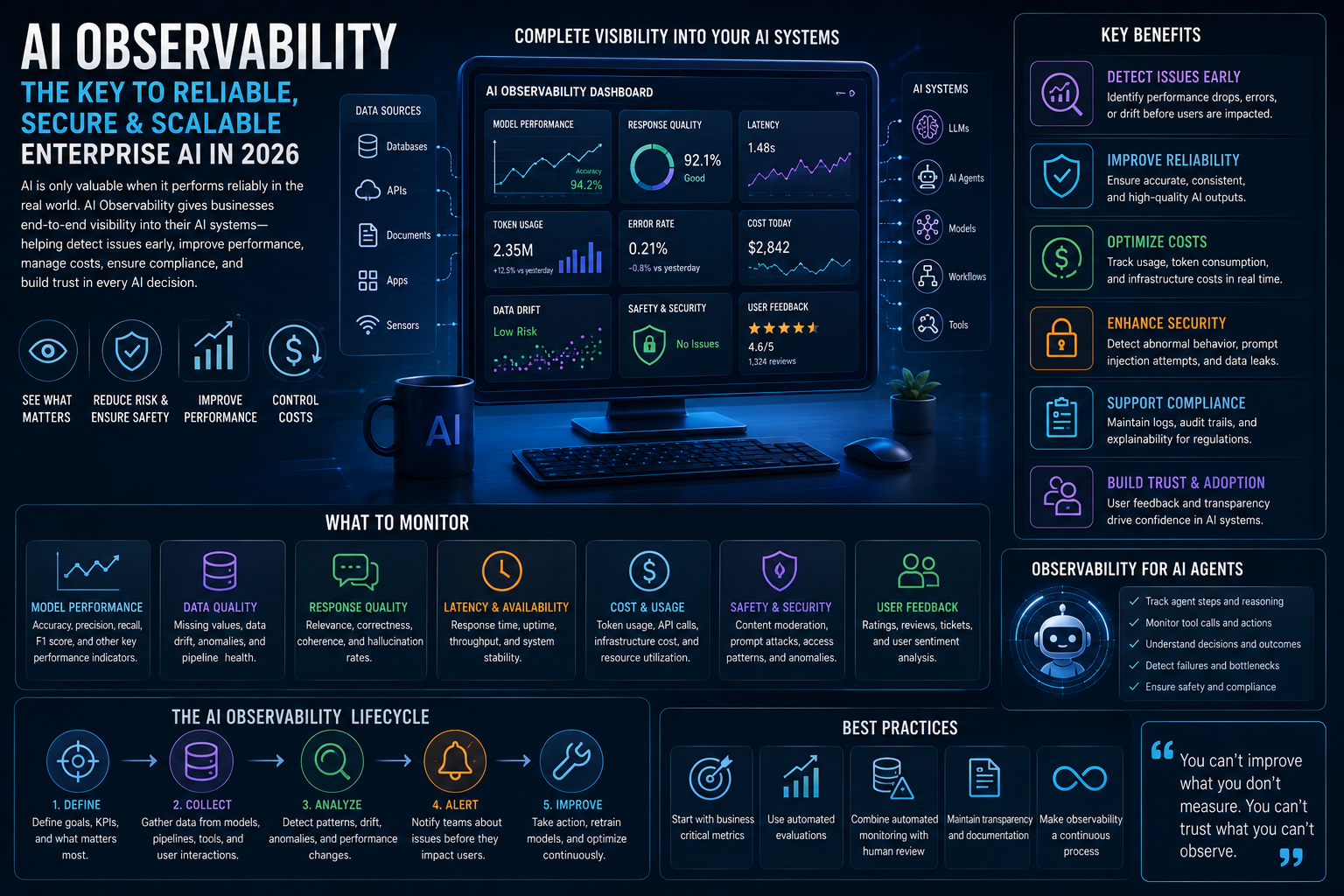
AI observability refers to the tools, processes, and practices used to monitor, analyze, and understand AI systems throughout their operational lifecycle. In 2026, it is becoming an increasingly important component of enterprise AI strategy.
What Is AI Observability?
AI observability provides businesses with visibility into how AI systems behave in real-world environments.
For a traditional application, monitoring may focus on uptime, latency, errors, and server performance.
AI applications require a broader set of measurements.
Businesses may need to track model accuracy, response quality, data changes, hallucination rates, latency, token usage, infrastructure costs, user feedback, and security events.
For AI agents, organizations may also need to understand which tools were accessed, what actions were taken, and why a particular workflow produced a specific outcome.
This creates a much more detailed monitoring requirement than conventional software.
Why Monitoring AI Is Different
AI systems are probabilistic rather than completely deterministic.
A traditional application may produce the same output whenever it receives the same input.
An AI system can sometimes produce different responses to similar prompts.
This flexibility creates value, but it also creates monitoring challenges.
A system can remain technically operational while the quality of its results gradually declines.
For example, an AI customer-service assistant may continue responding to users while providing increasingly inaccurate information because the underlying business data has changed.
Without appropriate observability, a company might not discover the problem immediately.
Detecting AI Model Drift
One important issue is model drift.
AI systems are often trained or configured using information that reflects a particular environment. Over time, customer behavior, market conditions, products, regulations, or business processes can change.
As the environment changes, model performance can decline.
AI observability tools can help organizations identify these changes.
Businesses can monitor performance indicators and compare current results with historical benchmarks.
If an AI system begins producing significantly different results, the organization can investigate whether changes in data, user behavior, or the operating environment are responsible.
Monitoring Data Quality
AI performance depends heavily on data quality.
If the information provided to an AI model becomes incomplete, outdated, inconsistent, or inaccurate, the model's output may also become less useful.
Observability therefore needs to include the data pipeline.
Organizations can monitor whether expected data sources are available, whether data volumes have changed unexpectedly, and whether important fields contain unusual values.
This creates a connection between data engineering and AI operations.
Instead of discovering an AI problem after users complain, businesses can potentially detect problems earlier in the data pipeline.
Measuring AI Response Quality
Technical metrics alone are not enough.
An AI system can have excellent uptime and fast response times while still producing poor answers.
Businesses therefore need ways to evaluate output quality.
Depending on the application, this may involve automated evaluation, human review, user feedback, or comparison against known reference answers.
For a customer-service AI, companies might measure whether responses correctly answer questions and follow company policies.
For a coding assistant, they could evaluate whether generated code works correctly.
For an enterprise search system, they might measure whether users receive relevant information.
The appropriate metrics depend on the purpose of the AI system.
AI Observability and Cost Control
AI can introduce significant computing costs.
Large models may require substantial processing resources, while high-volume applications can generate large numbers of requests.
Observability can help businesses understand where these costs originate.
Companies can track model usage, request volumes, response sizes, infrastructure consumption, and application-level costs.
This information can help organizations determine whether a particular AI application is delivering enough value to justify its expenses.
Businesses can also compare different models and configurations to determine which provides the best balance between performance and cost.
Monitoring AI Agents
AI agents create another layer of complexity.
Unlike simple chatbots, agents can perform multiple steps and interact with external tools.
An agent might retrieve information from a database, call an API, create a document, update a business system, and communicate the result to a user.
If something goes wrong, businesses need to understand what happened.
AI observability can provide visibility into an agent's workflow, including the sequence of actions, tools used, errors encountered, and final outcome.
This can make troubleshooting significantly easier.
Security and AI Observability
AI systems can also create new cybersecurity risks.
Attackers may attempt prompt injection, manipulate data, exploit connected tools, or gain unauthorized access to sensitive information.
Observability can help security teams detect unusual behavior.
For example, an AI agent suddenly accessing an application it has never previously used could trigger an investigation.
Similarly, unusual patterns in prompts, API calls, or data access could indicate potential misuse.
AI observability can therefore become part of a broader enterprise security strategy.
Improving Compliance
As organizations deploy AI in sensitive areas, they may need to demonstrate that systems are being used responsibly.
Observability can help create records of system activity.
Businesses can document model versions, data sources, system changes, evaluation results, and important AI interactions.
This can make it easier to investigate incidents and demonstrate internal controls.
The exact requirements depend on the industry and jurisdiction, but maintaining appropriate records is becoming increasingly important as AI regulation evolves.
Human Feedback Is Still Important
Not every AI problem can be detected automatically.
Human users can identify issues that automated monitoring systems may miss.
An AI assistant might technically follow a rule while producing an answer that is confusing or inappropriate for customers.
User feedback can therefore become an important part of AI observability.
Companies can collect feedback through ratings, reviews, support tickets, employee reports, or structured evaluations.
This creates a feedback loop that allows organizations to continuously improve AI systems.
AI Observability and Enterprise Search
Enterprise AI search systems are another important application.
Businesses are increasingly connecting AI to internal documents, knowledge bases, and company data.
If an employee receives an incorrect answer, the organization needs to understand why.
Observability can help determine whether the system retrieved the wrong document, misunderstood the question, used outdated information, or generated an unsupported conclusion.
This visibility can improve trust in enterprise AI systems.
The Role of AI Evaluation
AI evaluation is becoming a major part of observability.
Organizations can establish benchmarks for their AI systems and continuously test them against those benchmarks.
Evaluations can examine accuracy, relevance, safety, consistency, reasoning quality, and other application-specific characteristics.
Regular evaluation helps businesses identify performance changes before they become serious operational problems.
For organizations deploying many AI applications, automated evaluation pipelines can make this process more scalable.
Building an AI Observability Strategy
Businesses do not need to monitor every possible metric from day one.
A practical approach is to begin with the most important AI applications.
Organizations can identify what could go wrong and determine which measurements would reveal those problems.
For example, a financial AI system may require strong accuracy and auditability.
A customer-service system may prioritize response quality and user satisfaction.
An AI coding assistant may focus on correctness, security, and developer productivity.
The monitoring strategy should therefore reflect business objectives.
AI Observability Will Become Part of AI Operations
As enterprise AI adoption grows, observability is likely to become a standard part of AI operations.
Organizations will increasingly treat AI systems as continuously evolving business infrastructure rather than static software projects.
This means companies will need processes for monitoring, evaluating, updating, and retiring AI systems.
AI observability can provide the visibility necessary to manage that lifecycle.
It can also help executives understand whether AI investments are actually producing measurable business value.
The Future of Enterprise AI
The future of AI will not be defined only by increasingly powerful models.
Businesses will also need systems that are reliable, measurable, secure, and understandable.
AI observability can provide the foundation for that operational maturity.
As companies deploy AI agents, multimodal systems, enterprise copilots, and automated workflows, the number of AI interactions will increase dramatically.
Without appropriate visibility, organizations may struggle to understand what their AI systems are doing.
With strong observability, businesses can identify problems earlier, control costs, improve performance, strengthen security, and build greater confidence in AI adoption.
Conclusion
AI observability is becoming an essential part of enterprise AI strategy in 2026.
As businesses move from AI experimentation toward large-scale deployment, simply knowing that an AI system is running is no longer enough. Organizations need to understand whether the system is accurate, secure, cost-effective, compliant, and delivering useful outcomes.
Monitoring data quality, model performance, AI agents, security events, costs, and user feedback can provide that visibility.
The most successful businesses will likely be those that treat AI as a continuously managed system rather than a one-time technology investment.
AI observability can help create that foundation, allowing organizations to scale artificial intelligence while maintaining control, accountability, and confidence.