
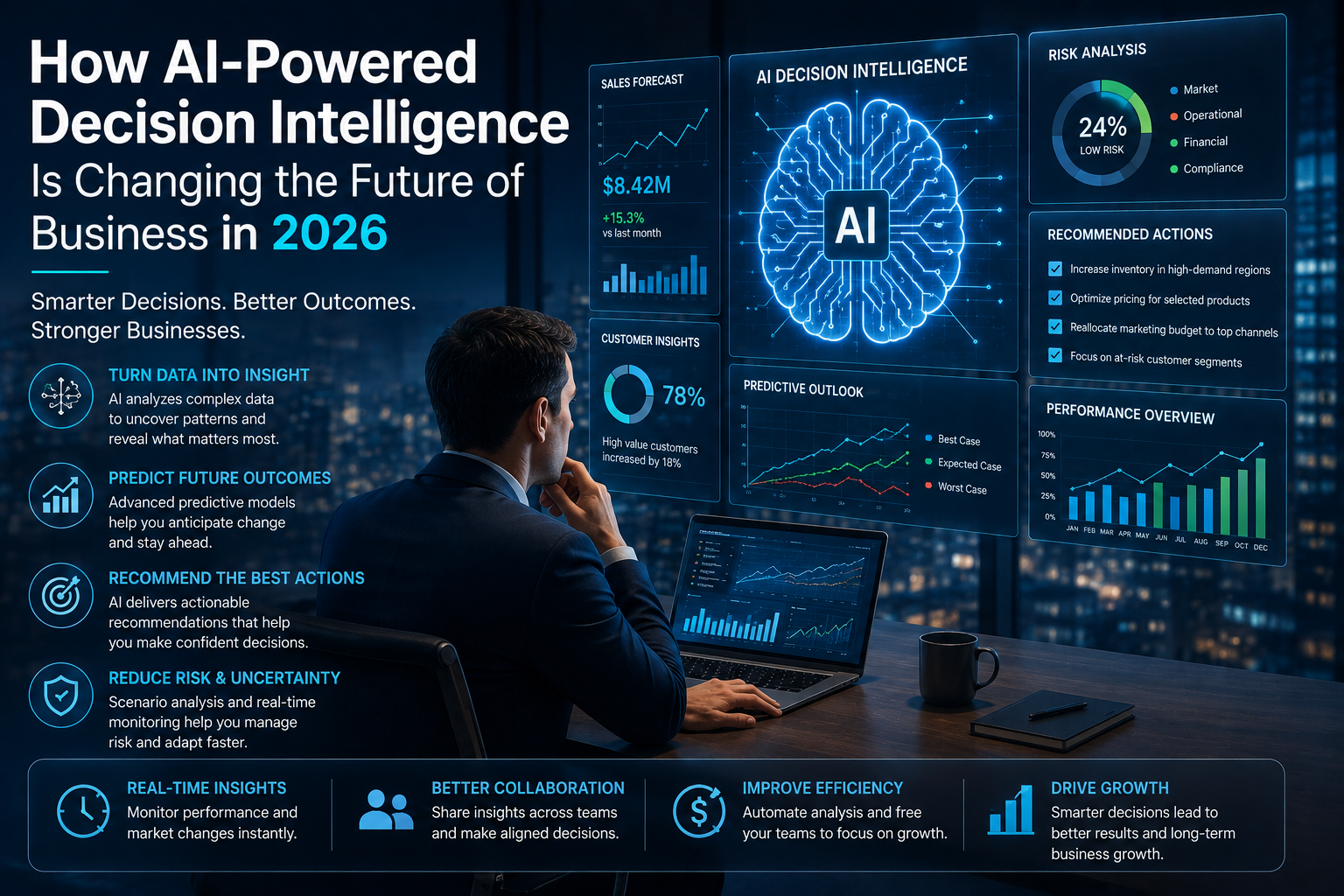
Businesses have always depended on information to make important decisions. Executives examine sales reports, financial statements, customer feedback, market research, and operational data before deciding where to invest, what products to launch, or how to respond to changing conditions.
In 2026, however, the traditional approach to business decision-making is changing rapidly.
Artificial intelligence is giving organizations the ability to process enormous amounts of information, identify patterns, evaluate scenarios, and generate recommendations at a speed that traditional analytical methods cannot match. This emerging approach is often described as AI-powered decision intelligence.
Rather than simply presenting data in dashboards, decision-intelligence systems can help businesses understand what is happening, why it is happening, what could happen next, and which actions may produce the best results.
For companies operating in increasingly competitive markets, this capability could become an important source of strategic advantage.
What Is AI-Powered Decision Intelligence?
Decision intelligence combines data, analytics, artificial intelligence, and business processes to improve organizational decision-making.
Traditional business intelligence generally focuses on describing historical performance. A dashboard might show how many products were sold last quarter or how revenue changed during a particular period.
AI-powered decision intelligence goes further.
An intelligent system can analyze historical information, monitor current conditions, identify patterns, estimate possible future outcomes, and recommend actions.
For example, a retailer could use AI to examine sales history, customer behavior, inventory levels, seasonal trends, and market conditions. Instead of simply reporting that demand for a product is increasing, an AI system could recommend increasing inventory before a potential shortage occurs.
This shift from reporting information to supporting action is one of the most important developments in modern business analytics.
Why Businesses Need Faster Decisions
Markets are moving faster than many traditional decision-making processes.
Customer preferences can change quickly. Competitors can introduce new products within weeks. Supply chains can experience unexpected disruptions, while economic conditions can influence purchasing behavior almost immediately.
When companies rely exclusively on monthly or quarterly reporting, important changes may be detected too late.
AI can continuously process information and identify unusual developments.
A sales team, for example, could receive an alert when a previously strong customer segment begins showing declining engagement. Management could then investigate the issue before the decline significantly affects revenue.
Faster access to meaningful information can help businesses become more responsive and adaptable.
Turning Data Into Actionable Insights
Many organizations already possess enormous amounts of data. The challenge is turning that information into useful decisions.
AI-powered systems can analyze multiple datasets simultaneously and uncover relationships that may be difficult for humans to identify manually.
Consider a manufacturing company monitoring production performance. A traditional system might show that output has declined.
An AI system could examine machine performance, maintenance records, employee schedules, environmental conditions, and production history to identify potential causes.
It could then recommend preventive maintenance or workflow adjustments.
The value is not simply the amount of data being analyzed. It is the ability to connect information and transform it into practical business recommendations.
Predictive Decision-Making
One of the most valuable capabilities of AI decision intelligence is predictive analysis.
Businesses increasingly want to know what could happen next rather than simply understanding what happened in the past.
AI models can analyze historical patterns and current signals to estimate potential outcomes.
Retailers can forecast demand. Financial organizations can identify potential risk patterns. Manufacturers can anticipate equipment problems. Marketing teams can estimate campaign performance.
Predictions are not guarantees, and businesses should avoid treating AI forecasts as absolute answers. However, predictive intelligence can provide decision-makers with additional evidence when evaluating uncertain situations.
The ability to consider multiple possible scenarios can make strategic planning more flexible.
AI Decision Support for Executives
Senior executives often have to make decisions involving incomplete information.
AI can act as a decision-support layer by summarizing large volumes of information and highlighting the factors most relevant to a particular business question.
An executive considering expansion into a new market could use AI to evaluate customer demand, competitive activity, pricing conditions, operational requirements, and potential risks.
Rather than replacing leadership judgment, AI can reduce the amount of time executives spend collecting and organizing information.
This allows leaders to focus more heavily on strategy, risk assessment, and execution.
Personalized Decision Intelligence Across Departments
AI-powered decision intelligence is not limited to the executive level.
Different departments can use intelligent recommendations for different purposes.
Sales teams can identify high-value prospects.
Marketing departments can determine which campaigns deserve additional investment.
Finance teams can monitor spending patterns and forecast cash requirements.
Human resources departments can analyze workforce trends and identify areas requiring attention.
Operations teams can optimize workflows and resource allocation.
The result is an organization where decision support becomes part of everyday work rather than a specialized activity reserved for analysts.
AI and Scenario Planning
Another important application is scenario analysis.
Businesses frequently face questions such as:
What happens if demand falls by 15 percent?
What happens if operating costs increase?
What happens if a new competitor enters the market?
What happens if supply becomes limited?
AI can help organizations model different scenarios using historical data, business assumptions, and current market information.
This does not eliminate uncertainty, but it allows businesses to explore possible outcomes before making major commitments.
Scenario planning can therefore become more dynamic and continuous.
Instead of creating one annual strategy and revisiting it months later, companies can continually evaluate whether changing conditions require adjustments.
Improving Customer Decisions
Decision intelligence can also improve the customer experience.
Businesses can analyze customer interactions across multiple channels to understand preferences, behaviors, and potential needs.
AI can then recommend relevant products, services, content, or support options.
For example, an online retailer could identify customers who are likely to purchase a complementary product based on previous transactions.
A customer-service platform could recognize that a particular issue is becoming common and recommend a proactive response.
These capabilities allow organizations to make customer-facing decisions using real-time information rather than generic assumptions.
The Human Role Remains Important
Despite the growing capabilities of AI, human judgment remains essential.
AI systems can process information quickly, but they can also produce incorrect recommendations when data is incomplete, biased, outdated, or misunderstood.
Business leaders therefore need to establish appropriate review processes.
High-impact decisions should not automatically be delegated to an algorithm. Human experts should understand why an AI system produced a recommendation and determine whether the recommendation makes sense within the broader business context.
The strongest model is likely to be human-led, AI-supported decision-making.
Data Quality Determines AI Quality
Decision intelligence is only as reliable as the information behind it.
Poor-quality data can lead to misleading recommendations. Duplicate records, outdated information, inconsistent measurements, and missing data can all affect AI performance.
Businesses therefore need strong data-management practices before expanding intelligent decision systems.
Organizations should establish processes for data validation, integration, security, and governance.
This is particularly important when AI systems are connected to financial, customer, employee, or operational information.
Building Trust in AI Recommendations
Employees may initially hesitate to rely on AI-generated recommendations.
Trust is more likely to develop when organizations make AI systems understandable and transparent.
Employees should know what information an AI system uses, what its recommendation means, and when human review is required.
Businesses can also track the performance of AI recommendations over time.
If an AI system repeatedly produces useful forecasts or recommendations, confidence can increase naturally.
Transparency and accountability will therefore be important components of successful AI adoption.
The Competitive Advantage of Intelligent Organizations
As AI becomes more accessible, simply owning AI technology will not necessarily create a lasting competitive advantage.
The difference may come from how effectively companies integrate AI into their decision-making processes.
Organizations that connect high-quality data with experienced employees and well-designed AI systems can potentially make decisions faster and adapt more effectively.
A competitor may have access to the same AI model but achieve weaker results because its data is fragmented or its employees lack the skills needed to interpret AI recommendations.
This means competitive advantage increasingly depends on implementation rather than technology alone.
Preparing for the Next Stage of Business Intelligence
The future of business intelligence is likely to become increasingly interactive.
Instead of asking employees to search through dashboards and reports, organizations may allow employees to ask AI systems direct questions.
A manager could ask:
“Why did regional sales decline this month?”
The AI system could analyze relevant information and explain the major contributing factors.
The manager could then ask:
“What could reverse the trend?”
The system could evaluate possible strategies and present potential outcomes.
This conversational approach could make advanced analytics accessible to a much broader group of employees.
Conclusion
AI-powered decision intelligence is changing how businesses understand information and respond to opportunities in 2026.
Traditional analytics helped organizations understand what happened. Modern AI systems can increasingly help companies understand why something happened, what could happen next, and which actions deserve consideration.
The technology does not eliminate uncertainty or replace human leadership. Instead, it gives decision-makers a more powerful analytical foundation.
Companies that combine reliable data, intelligent systems, strong governance, and human expertise can create faster and more responsive decision-making processes.
As markets become increasingly complex, the ability to transform information into timely action may become one of the most important capabilities separating adaptable businesses from those that struggle to keep pace.
The future of business intelligence is therefore not simply about more data. It is about better decisions, made faster, with intelligent technology supporting human judgment.