Corporate finance is entering a new era in which financial teams are expected to move faster, manage more data, control risk, and make decisions with greater precision. At the center of this transformation is treasury management.
Treasury teams traditionally focus on cash, liquidity, payments, investments, financing, and financial risk. Much of this work has historically depended on spreadsheets, banking portals, manual reconciliation, and periodic forecasting.
Artificial intelligence is changing that model.
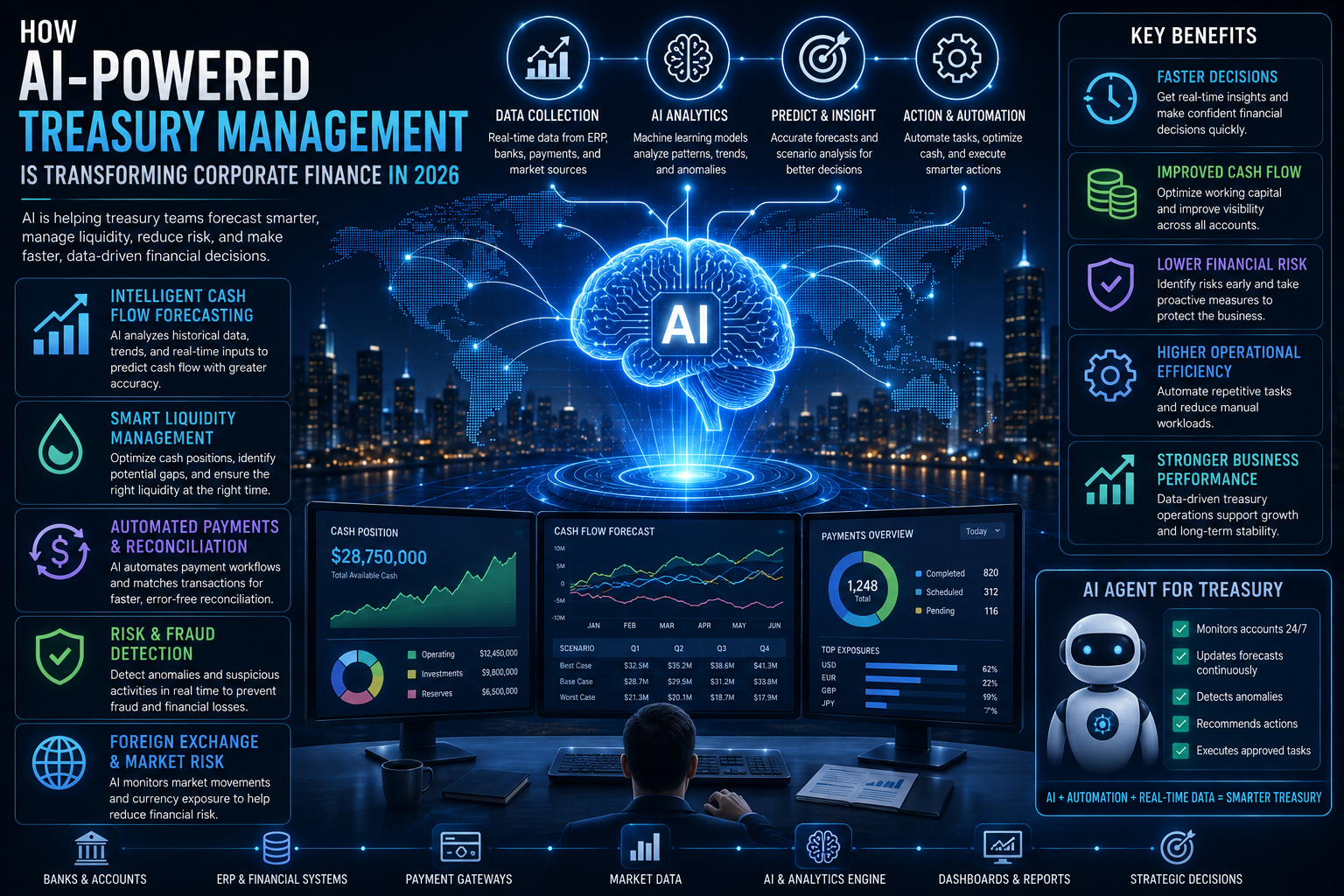
AI-powered treasury management combines artificial intelligence, predictive analytics, automation, real-time financial data, and intelligent risk monitoring to help businesses understand their financial position and respond to changing conditions more quickly.
This direction fits BullNext's current technology and financial coverage, which includes real-time payments, digital-asset infrastructure, and AI-focused business technology. BullNext's homepage currently features AI-powered business topics prominently while also maintaining dedicated Markets and Cryptocurrencies coverage.
What Is AI-Powered Treasury Management?
Treasury management is responsible for ensuring that a company has the right amount of cash available at the right time.
It involves activities such as:
Cash-flow forecasting
Liquidity management
Bank-account management
Payments
Foreign-exchange exposure
Short-term investments
Debt management
Financial risk management
AI adds an intelligent layer to these processes.
Instead of relying only on historical spreadsheets and manually prepared forecasts, treasury teams can use AI to analyze large quantities of financial information and identify changing patterns.
The result is a treasury function that can become more predictive and responsive.
Why Corporate Treasury Is Changing
Financial conditions can change rapidly.
Interest rates, foreign-exchange markets, customer payments, supplier obligations, business expansion, and unexpected expenses can all influence corporate liquidity.
A forecast created at the beginning of a month may become less accurate as new information arrives.
AI can continuously process updated information.
This allows treasury teams to move toward dynamic forecasting rather than relying exclusively on periodic financial reviews.
AI-Powered Cash-Flow Forecasting
Cash-flow forecasting is one of the most important treasury applications for AI.
Businesses need to understand how much money they expect to receive and how much they expect to spend.
AI can analyze historical transactions, invoices, customer payment behavior, supplier obligations, seasonal patterns, and other relevant financial data.
The system can then generate forecasts and identify potential changes.
For example, if customer payments are consistently arriving later than expected, AI may identify the trend before it becomes a major liquidity problem.
This gives finance teams more time to respond.
Moving From Static to Dynamic Forecasting
Traditional forecasting often creates a snapshot.
AI enables a more continuous approach.
As new payments, invoices, sales information, and expenses enter a company's systems, forecasts can be updated.
This creates a dynamic view of liquidity.
A CFO might ask:
“What will our cash position look like if customer payments decline by 10% next quarter?”
An AI-powered treasury platform could potentially model that scenario using available financial information.
Scenario planning allows executives to understand potential outcomes before making strategic decisions.
Improving Liquidity Management
Liquidity is critical for business stability.
A company may have valuable assets and strong revenue but still experience financial stress if it cannot access sufficient cash when obligations become due.
AI can help treasury teams identify upcoming liquidity requirements.
It can compare expected inflows and outflows and highlight potential gaps.
This can help organizations determine when they may need additional financing, whether excess cash can be invested, or whether spending plans should be adjusted.
AI and Accounts Receivable
Customer payments are an important source of corporate liquidity.
AI can analyze payment histories and identify patterns in customer behavior.
For example, the system could identify customers who frequently pay late or estimate the probability that particular invoices will be paid on schedule.
These insights can improve cash-flow forecasting.
They can also help finance teams prioritize collection activities.
Instead of treating every outstanding invoice equally, businesses can focus attention on the accounts that create the greatest potential liquidity risk.
AI and Accounts Payable
Treasury management also involves outgoing payments.
Businesses need to manage supplier invoices, payroll, taxes, debt obligations, and other expenses.
AI can help organize and prioritize upcoming payments based on timing, contractual requirements, cash availability, and business priorities.
This can reduce manual workload for finance teams.
However, payment automation should include strong authorization controls, particularly for high-value transactions.
Real-Time Financial Visibility
Real-time payments and modern financial APIs are making financial information available more quickly.
This creates an important opportunity for treasury teams.
Instead of waiting for end-of-day or periodic reports, finance professionals can increasingly work with more current transaction information.
AI can analyze this information continuously.
This creates a feedback loop:
Transaction → Data → AI Analysis → Forecast → Decision → Action.
The faster this cycle becomes, the more responsive corporate finance can be.
AI and Foreign-Exchange Risk
Companies operating internationally may be exposed to currency fluctuations.
Revenue may be generated in one currency while expenses are paid in another.
Exchange-rate movements can therefore influence profitability and cash requirements.
AI can analyze historical currency exposure, expected transactions, and market information to help treasury teams understand potential risks.
It can also support scenario analysis.
For example, a business could examine how a significant currency movement might affect its expected cash position.
AI does not eliminate foreign-exchange risk, but it can improve visibility and decision support.
Smarter Payment Management
Corporate payment operations can involve thousands of transactions.
AI can help classify payments, identify unusual transactions, detect potential errors, and support reconciliation.
When combined with real-time payment infrastructure, intelligent treasury systems can potentially make payment workflows faster.
For example, an approved invoice could automatically move through verification, authorization, and payment processing.
Human approval can remain necessary for transactions that exceed predefined risk or value thresholds.
Fraud Detection in Treasury
Corporate treasury departments are attractive targets for financial fraud.
Attackers may attempt to manipulate invoices, compromise email accounts, impersonate executives, or change supplier payment information.
AI can monitor payment behavior and identify unusual patterns.
For example, a payment request that differs significantly from a supplier's historical behavior could trigger additional verification.
AI-powered monitoring can therefore become an important layer within broader treasury security.
This is particularly important as payments become faster.
The faster money moves, the less time organizations have to identify and stop fraudulent transactions.
AI Agents in Corporate Finance
The development of AI agents could take treasury automation further.
An AI agent could continuously monitor cash positions, identify upcoming obligations, analyze forecasts, and prepare recommendations.
For example, an agent might recognize that a business has excess cash in one account while another account is approaching a liquidity requirement.
It could prepare a proposed transfer for approval.
Similarly, an agent could identify that an expected customer payment has been delayed and update a liquidity forecast.
The objective is not necessarily to remove finance professionals.
Instead, AI agents can handle repetitive analytical tasks while humans focus on strategic decisions.
Treasury and Digital Assets
The growing integration of digital assets into financial infrastructure may create another dimension for treasury management.
Some businesses may increasingly interact with stablecoins, tokenized assets, or blockchain-based payment systems.
Treasury platforms may eventually need to monitor both traditional bank accounts and digital financial assets.
This could create a more complex financial environment.
Organizations will need appropriate controls around custody, liquidity, accounting, compliance, and risk.
BullNext's current coverage reflects the broader convergence between traditional finance and digital-asset infrastructure.
AI and Stablecoin Treasury Operations
Stablecoins may also become relevant to corporate treasury in selected use cases.
Businesses operating internationally could potentially use stablecoin-based infrastructure for certain cross-border settlements.
AI could monitor these transactions, reconcile payment records, and identify unusual activity.
However, organizations must evaluate regulatory requirements, custody arrangements, liquidity, accounting treatment, and counterparty risk before incorporating digital assets into treasury operations.
Automated Reconciliation
Reconciliation is one of the most time-consuming financial processes.
Finance teams need to match transactions with invoices, bank records, accounting entries, and internal systems.
AI can help identify matching transactions and highlight discrepancies.
This can reduce manual effort.
More importantly, automated reconciliation can give treasury teams a more current picture of available cash.
Instead of spending hours preparing data, finance professionals can spend more time interpreting it.
Scenario Planning for CFOs
One of AI's most valuable capabilities may be helping CFOs explore possible futures.
A treasury system can potentially model different scenarios:
Scenario 1: Strong Growth
Revenue increases significantly, creating higher cash inflows but also requiring more working capital.
Scenario 2: Slower Customer Payments
Revenue remains stable, but customers take longer to pay.
Scenario 3: Higher Operating Costs
Supplier and operational expenses increase.
Scenario 4: Market Volatility
Currency or interest-rate changes affect financial exposure.
AI can help calculate how each scenario could influence liquidity.
This provides executives with a more structured basis for strategic planning.
Interest-Rate Management
Companies with debt or significant cash holdings need to consider interest-rate conditions.
AI can help analyze debt structures and model potential changes in financing costs.
It can also support comparisons between different funding strategies.
Human finance professionals remain responsible for decisions, but AI can make scenario analysis faster and more comprehensive.
Better Financial Decision-Making
The biggest benefit of AI-powered treasury management is not automation alone.
It is improved decision quality.
A treasury team with faster access to accurate information can make better decisions about:
Cash allocation
Financing
Investments
Payments
Currency exposure
Liquidity
Risk
AI becomes a decision-support layer that helps finance leaders understand the financial consequences of different choices.
Data Quality Is Essential
AI cannot create reliable financial intelligence from unreliable information.
If bank data is incomplete, invoices are inaccurate, or accounting systems are poorly integrated, AI forecasts may be misleading.
Companies therefore need strong financial data governance.
Important information should be accurate, consistent, secure, and updated regularly.
Integration between enterprise resource planning systems, accounting software, banking platforms, payment systems, and treasury applications can significantly improve the quality of AI-driven analysis.
Security and Governance
Treasury systems deal with highly sensitive financial information.
Organizations need strong controls around access, authentication, payment authorization, and data security.
AI systems should also be monitored.
Companies need to understand what an AI system is allowed to do and when human approval is required.
High-value payments and strategic financial decisions should generally have appropriate human oversight.
The Future of Corporate Treasury
Corporate treasury is likely to become increasingly intelligent and automated.
Instead of preparing reports manually, treasury professionals may increasingly supervise AI systems that continuously analyze financial conditions.
A future treasury platform could:
Monitor financial accounts.
Analyze incoming and outgoing payments.
Update cash-flow forecasts.
Detect anomalies.
Model potential scenarios.
Prepare recommendations.
Route important decisions to authorized employees.
This creates a more proactive financial operating model.
How Companies Can Start
Businesses do not need to automate treasury operations all at once.
A practical approach is to begin with one measurable use case.
Good starting points include:
Cash-flow forecasting
Payment reconciliation
Fraud monitoring
Liquidity forecasting
Accounts-receivable analysis
Payment scheduling
Foreign-exchange exposure monitoring
Companies should establish clear metrics before implementation.
For example, they can measure forecast accuracy, reconciliation time, fraud detection speed, manual workload, and cash visibility.
Conclusion
AI-powered treasury management is changing corporate finance by turning financial data into continuous intelligence.
Instead of relying primarily on static reports and spreadsheets, businesses can use AI to forecast cash flow, monitor liquidity, detect anomalies, automate reconciliation, analyze risk, and explore financial scenarios.
The technology is particularly powerful when combined with real-time payments, modern financial APIs, cloud infrastructure, and intelligent automation.
But successful adoption requires more than sophisticated AI.
Companies need accurate data, secure systems, clear governance, appropriate human oversight, and strong financial controls.
The future treasury department will likely not be defined by how many spreadsheets its employees manage.
It will be defined by how quickly and accurately the organization can understand its financial position and act on that information.
In 2026, AI is helping move treasury management from reactive financial administration toward predictive, intelligent, and increasingly automated corporate finance.
For businesses looking to improve liquidity, reduce financial risk, and make faster decisions, that shift could become a major competitive advantage.