
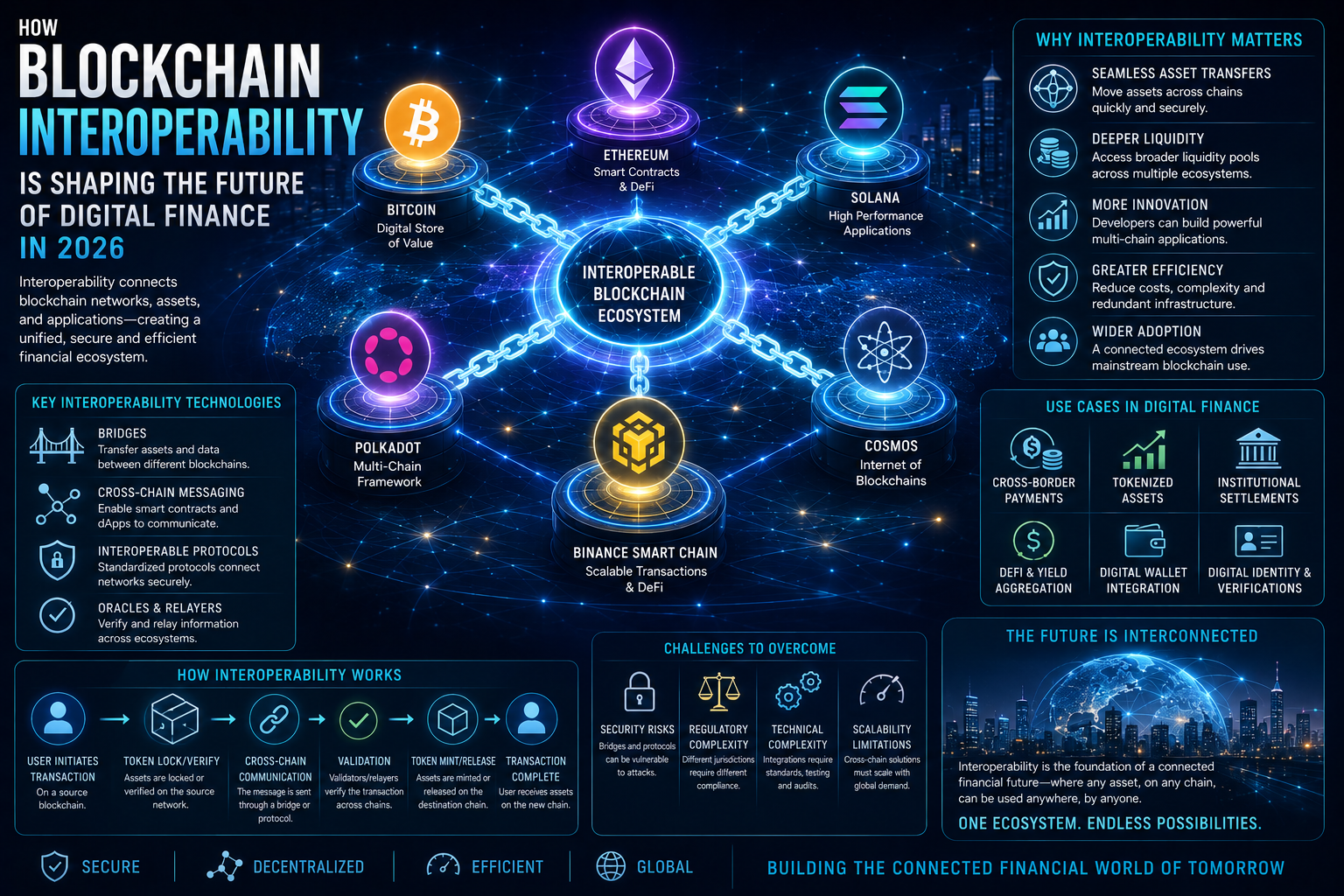
The blockchain industry is entering a more connected phase. In its early years, individual blockchain networks often operated as separate ecosystems, each with its own assets, applications, infrastructure, and users.
Today, that fragmentation is becoming a major challenge.
Businesses and financial institutions increasingly need digital assets to move across different networks. Stablecoins may exist on multiple blockchains. Tokenized financial assets may be issued on one network while investors use another. Decentralized applications may need access to liquidity from several ecosystems.
This is where blockchain interoperability becomes important.
Blockchain interoperability refers to technologies and protocols that allow different blockchain networks to communicate, exchange information, and transfer digital assets or messages.
In 2026, interoperability is increasingly becoming an infrastructure issue rather than simply a technical feature. As blockchain moves closer to institutional finance, the ability to connect different networks could determine how efficiently digital financial markets operate.
What Is Blockchain Interoperability?
A blockchain network is essentially its own digital environment.
Different networks can have different:
Consensus mechanisms
Smart-contract languages
Token standards
Security models
Transaction speeds
Governance structures
Without interoperability, moving information or assets between these environments can be difficult.
Interoperability technologies create communication layers between networks.
Depending on the design, they can allow users and applications to transfer assets, send messages, verify information, or coordinate transactions across multiple blockchains.
The long-term goal is a more connected blockchain ecosystem.
Why Interoperability Matters
The growth of blockchain has created a fragmented market.
One blockchain may have strong liquidity.
Another may offer lower transaction costs.
A third may be preferred by financial institutions.
Another may specialize in tokenized assets.
If these ecosystems remain isolated, users and businesses may have difficulty accessing the advantages of different networks.
Interoperability can reduce this fragmentation.
Instead of requiring businesses to choose a single blockchain for every activity, connected infrastructure can allow different networks to work together.
The Multi-Chain Financial Future
Financial markets are becoming increasingly digital.
Tokenized bonds, stablecoins, digital funds, and other blockchain-based financial products can potentially exist across different networks.
This creates a multi-chain environment.
For example, a tokenized asset could be issued on one blockchain while settlement or liquidity takes place through another.
Without interoperability, these processes can become complicated.
With interoperable infrastructure, applications can potentially communicate across networks.
This could make multi-chain finance more practical.
Stablecoins Need Interoperability
Stablecoins are one of the clearest examples.
A stablecoin may be available across multiple blockchain networks.
Businesses and users need reliable ways to move stablecoin value between these environments.
Interoperability can help connect liquidity across networks.
This is particularly important for cross-border payments.
A company may receive a stablecoin on one network while its payment provider operates on another.
Interoperability can potentially make the transfer process more efficient.
However, cross-chain transfers also introduce additional security and operational risks.
Tokenized Assets and Cross-Chain Markets
The growth of tokenized real-world assets makes interoperability even more important.
Financial institutions may tokenize:
Bonds
Funds
Real estate
Private credit
Commodities
Other securities
These assets may not all use the same blockchain.
Investors and financial institutions therefore need infrastructure that can connect different networks.
A fragmented tokenization market could limit liquidity.
Interoperability can potentially allow investors to interact with assets across multiple ecosystems while maintaining appropriate compliance and ownership controls.
Institutional Adoption
Large financial institutions are unlikely to build their entire digital-asset strategy around a single blockchain.
Different networks can provide different advantages.
An institution may use one network for token issuance, another for settlement, and another for specific applications.
Interoperability allows these systems to operate as part of a broader infrastructure.
This is particularly relevant as traditional financial institutions experiment with blockchain-based settlement and digital assets.
The industry is gradually moving from isolated blockchain projects toward interconnected financial infrastructure.
Cross-Chain Liquidity
Liquidity is critical to financial markets.
If digital assets remain locked within individual blockchain ecosystems, investors may have limited access to liquidity.
Cross-chain infrastructure can potentially connect liquidity pools and trading environments.
For example, a digital asset on one network could become accessible to users operating through another network.
This can increase the number of potential participants.
However, liquidity does not automatically move simply because two networks are technically connected.
Markets still require buyers, sellers, market makers, reliable pricing, and sufficient demand.
Blockchain Bridges
Blockchain bridges are one approach to interoperability.
A bridge can allow assets or information to move between blockchain networks.
For example, a user may deposit an asset on one blockchain and receive a corresponding representation on another.
Bridges can be useful, but they have also become a major security concern.
Some major blockchain exploits have involved vulnerabilities in bridge infrastructure.
This means interoperability cannot simply focus on convenience.
It must prioritize security.
The Security Challenge
Connecting two blockchain networks creates additional points of failure.
A poorly designed interoperability system could allow attackers to manipulate messages, compromise validators, exploit smart contracts, or create unauthorized transactions.
Security therefore needs to exist across the entire communication process.
Important considerations include:
Smart-contract security
Validator security
Message verification
Key management
Monitoring
Governance
Transaction limits
Emergency controls
The more valuable the assets being transferred, the more important these controls become.
Message-Based Interoperability
Not every cross-chain interaction requires an asset transfer.
Applications may simply need to send information between networks.
For example, a transaction on one blockchain could trigger an action on another.
This creates the concept of cross-chain messaging.
Message-based interoperability could support:
Cross-chain applications
Financial settlement
Identity verification
Governance
Data sharing
Automated workflows
This could become increasingly important as blockchain applications become more complex.
Interoperability and DeFi
Decentralized finance has historically been fragmented across multiple networks.
Each blockchain can have its own:
Lending protocols
Exchanges
Liquidity pools
Stablecoins
Derivatives platforms
Interoperability can connect these ecosystems.
Users could potentially access financial services across different networks without treating each blockchain as a completely separate financial system.
This could create a more unified digital financial market.
Cross-Chain AI Applications
Artificial intelligence could also benefit from blockchain interoperability.
AI applications may need to access data or financial assets across multiple blockchain networks.
An AI agent could potentially monitor several networks, compare liquidity, analyze transactions, or execute approved operations across ecosystems.
This could create a new combination:
AI agents + blockchain interoperability + programmable finance.
For example, an authorized financial AI agent could monitor multiple networks and identify the most efficient route for an approved transaction.
Human-defined limits would remain essential for high-risk financial actions.
Interoperability and Digital Identity
Digital identity is another area where interoperability matters.
A user may have verified credentials issued by one system while accessing services on another.
Interoperable identity infrastructure could allow credentials to be verified without requiring users to repeat the entire onboarding process.
This could improve digital financial services while reducing duplication.
However, privacy and permission management remain critical.
Identity information should not automatically become visible across every connected network.
Interoperability and CBDCs
Central bank digital currencies could also create interoperability requirements.
Different countries may develop different digital-currency systems.
If these systems cannot communicate, international transactions could remain fragmented.
Interoperability standards could potentially allow different digital currencies to interact while maintaining national regulatory requirements.
International payment infrastructure will likely need a combination of blockchain technology, banking systems, compliance processes, and standardized messaging.
The Role of Standards
Technical standards are essential for interoperability.
Without common standards, every blockchain may require a custom integration.
This would increase complexity and development costs.
Standardized protocols can make it easier for applications to communicate across networks.
The industry is therefore moving toward greater emphasis on interoperability standards and infrastructure layers.
The winning approach may not be one blockchain replacing all others.
It may be multiple networks connected through standardized communication systems.
Interoperability and Enterprise Adoption
Businesses generally prefer predictable infrastructure.
They need reliable transaction processing, security, compliance, support, and integration.
If blockchain networks remain isolated, enterprise adoption becomes more complicated.
Interoperability can simplify the environment.
A company could use different blockchain networks for different purposes while managing them through a unified enterprise interface.
Employees would not necessarily need to understand the technical details of every blockchain.
The complexity could remain behind the infrastructure layer.
Compliance Across Networks
Interoperability also creates regulatory challenges.
A transaction moving between networks may involve different jurisdictions, financial institutions, asset issuers, and service providers.
Compliance systems therefore need to understand the entire transaction path.
This may include:
Customer identity
Transaction monitoring
Sanctions screening
Asset restrictions
Jurisdictional requirements
Reporting obligations
Financial institutions will need interoperability systems that support compliance rather than bypass it.
The Business Opportunity
Interoperability creates opportunities for technology providers.
Businesses can build infrastructure around:
Cross-chain messaging
Asset transfers
Liquidity routing
Digital identity
Institutional settlement
Security
Compliance
Wallet management
Developer tools
As blockchain adoption grows, these infrastructure providers could become an important layer between individual blockchain networks and mainstream financial applications.
How Businesses Can Prepare
Companies exploring blockchain should avoid selecting networks based only on popularity.
They should evaluate:
Security
Transaction costs
Performance
Regulatory compatibility
Ecosystem maturity
Interoperability options
Custody support
Developer infrastructure
A multi-chain strategy may eventually provide greater flexibility.
However, businesses should also avoid unnecessary complexity.
A small pilot on one network may be more appropriate than immediately deploying across several chains.
The Future of Blockchain Infrastructure
The future blockchain ecosystem is unlikely to consist of one network handling every application.
Different blockchains may specialize in different functions.
One may focus on payments.
Another may support tokenized securities.
Another may provide high-performance applications.
Another may be optimized for privacy or enterprise use.
Interoperability can connect these specialized networks.
This could create a blockchain ecosystem that functions more like the internet: many independent networks and systems connected through common communication layers.
Conclusion
Blockchain interoperability is becoming a critical component of digital financial infrastructure in 2026.
As stablecoins, tokenized assets, decentralized finance, digital identity, and institutional blockchain applications expand, businesses increasingly need different blockchain networks to communicate.
Interoperability can help connect liquidity, transfer assets, exchange messages, and support multi-chain applications.
But connectivity creates new risks.
Security, compliance, privacy, governance, and technical reliability must be addressed before blockchain interoperability can become trusted financial infrastructure.
The most successful interoperability solutions will therefore focus on more than simply moving tokens between chains.
They will create secure, compliant, and reliable communication layers connecting different digital economies.
The future of blockchain may not be about determining which single network wins.
It may be about making many networks work together.
If that vision becomes reality, blockchain interoperability could become one of the most important foundations of the next generation of digital finance—connecting stablecoins, tokenized assets, financial institutions, decentralized applications, and global markets into a more integrated financial ecosystem.