
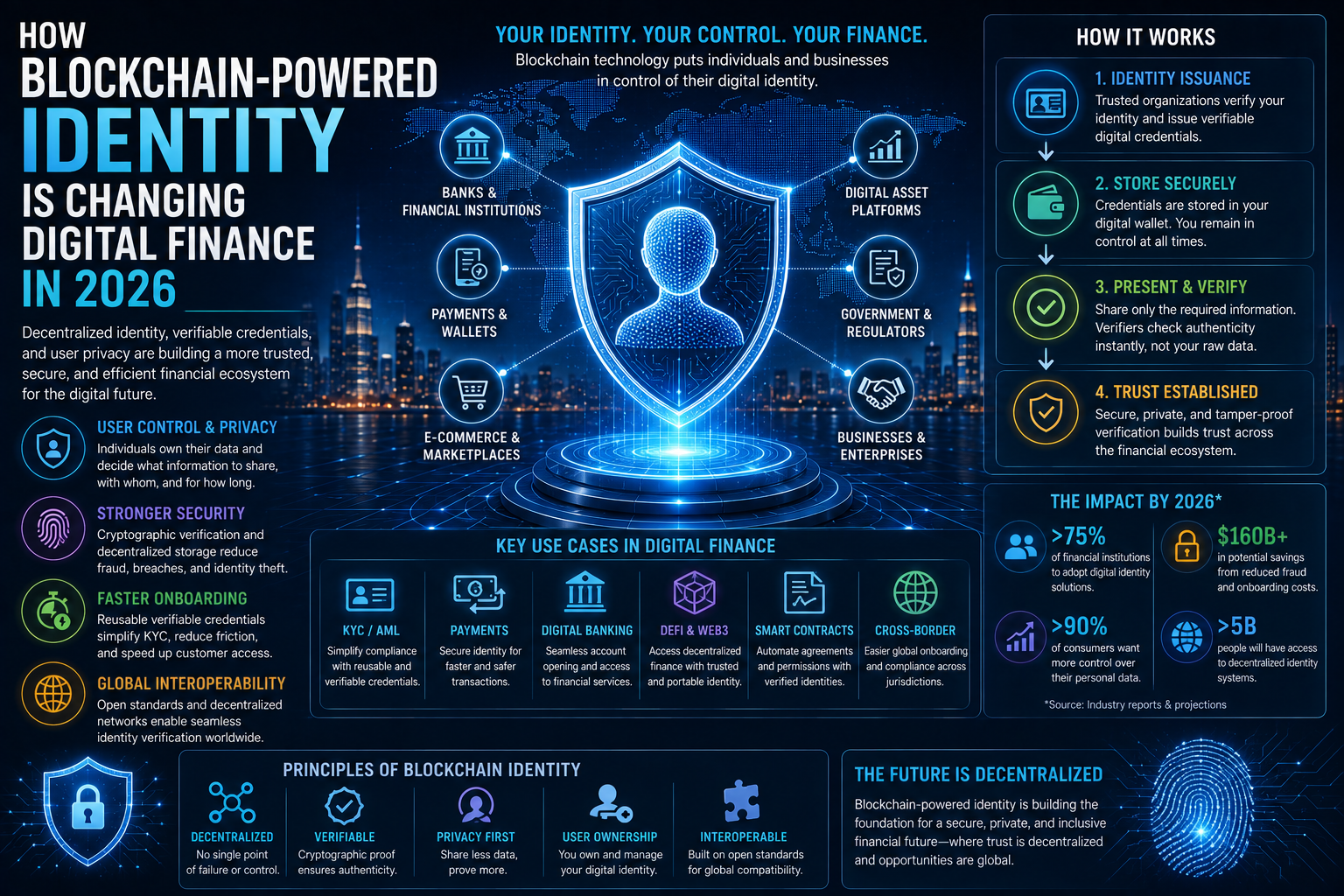
Digital finance is becoming more connected, faster, and increasingly dependent on online identity. Opening a bank account, accessing a financial platform, completing a payment, trading digital assets, or applying for a financial service can all require users to prove who they are.
Traditional identity systems often depend on centralized databases, repeated document submissions, passwords, and multiple verification processes. As financial services become increasingly digital and global, these systems can create friction for both businesses and customers.
Blockchain-powered identity offers another approach.
Instead of requiring organizations to repeatedly collect and store identity information, blockchain-based and decentralized identity systems can allow individuals and organizations to hold verifiable digital credentials and present specific information when required.
This technology is becoming particularly relevant to financial services, where trust, identity verification, privacy, and compliance are fundamental.
In May 2025, the World Wide Web Consortium (W3C) published Verifiable Credentials 2.0 as a Web Standard, establishing interoperable specifications for cryptographically secure, privacy-respecting, machine-verifiable credentials.
As these standards mature, blockchain-powered identity could become an important component of digital financial infrastructure.
What Is Blockchain-Powered Identity?
Blockchain-powered identity refers broadly to digital identity systems that use blockchain or related decentralized technologies to support identity verification, credentials, authentication, and trust.
Rather than relying on one organization to maintain every piece of identity information, decentralized approaches can allow users to control digital credentials while authorized organizations issue and verify them.
For example, a financial institution could issue a verified digital credential confirming that a customer has completed an identity check.
The customer could then present that credential to another participating service without necessarily repeating the entire verification process.
The exact architecture can vary. Not every decentralized identity system stores personal information directly on a blockchain. In privacy-focused designs, sensitive information can remain off-chain while cryptographic proofs establish that a credential is authentic.
Why Digital Identity Matters to Finance
Financial institutions need to know who their customers are.
Banks, fintech platforms, payment providers, exchanges, and other financial businesses must manage identity verification, fraud prevention, compliance, and access control.
Customers, meanwhile, want these processes to be fast and convenient.
The challenge is balancing both requirements.
Traditional systems can require customers to submit the same information repeatedly to different organizations.
A reusable, verifiable credential could potentially reduce this duplication.
The customer presents proof.
The financial institution verifies the proof.
The process can become more efficient without requiring every organization to independently rebuild the entire identity record.
Verifiable Credentials Create a New Trust Model
Verifiable credentials are particularly important because they provide a structured way to digitally represent claims made by an issuer.
For example, an issuer could confirm that a person has completed a particular verification process.
The credential can then be held by the individual and presented to a verifier.
W3C's Verifiable Credentials model defines an ecosystem involving issuers, holders, and verifiers, with cryptographic mechanisms helping verify that credentials are authentic and have not been improperly altered.
This creates a more flexible identity architecture than simply placing all information inside one centralized database.
Reducing Repeated KYC Processes
Know Your Customer, or KYC, is essential to financial services.
However, it can also create significant friction.
A customer may provide identification documents, address information, and other details to one financial institution and then repeat the same process when opening another account.
Blockchain-powered identity could support reusable credentials.
Once an authorized issuer has verified particular information, the customer could potentially present a corresponding credential to another participating financial service.
The receiving organization would still need to determine whether the credential satisfies its own legal and compliance requirements.
Therefore, blockchain identity does not eliminate KYC.
It could make parts of KYC more reusable and efficient.
Selective Disclosure
Privacy is one of the most important potential advantages of modern digital identity.
A customer does not always need to reveal every piece of information.
For example, a service may need to know whether a person is above a particular age without needing their complete date of birth.
Selective disclosure allows users to share only relevant information when supported by the credential system.
W3C's standards support privacy-oriented mechanisms, including selective disclosure and verifiable presentations.
This could help create financial systems where identity verification does not automatically mean exposing unnecessary personal information.
Identity and Digital Payments
Payments increasingly happen online.
A customer may use a mobile application, digital wallet, payment platform, or blockchain-based service to transfer money.
Identity infrastructure can help establish whether the parties involved are legitimate.
Blockchain-powered credentials could potentially support trusted identity information within payment ecosystems.
For businesses, this could help reduce repeated verification while maintaining compliance processes.
The challenge will be making these identity systems interoperable across payment providers and jurisdictions.
Blockchain Identity and Digital Assets
Digital-asset platforms have particularly strong reasons to improve identity infrastructure.
Cryptocurrency exchanges and other regulated digital-asset businesses may need to verify customers, manage compliance requirements, monitor transactions, and restrict certain activities.
A reusable digital identity credential could potentially simplify parts of this process.
For example, a verified customer could present a credential to an authorized platform rather than repeatedly submitting the same documentation.
The platform would still need to validate whether the credential meets its regulatory obligations.
Preventing Identity Fraud
Identity fraud is a major challenge for financial institutions.
Attackers may use stolen documents, fabricated information, compromised accounts, or synthetic identities.
Cryptographically verifiable credentials can make certain types of identity manipulation more difficult because the verifier can check whether a credential was genuinely issued and whether its cryptographic proof is valid.
However, blockchain identity does not eliminate identity fraud.
A legitimate credential could still be obtained fraudulently if the original verification process is weak.
The strength of the identity ecosystem therefore depends on both credential technology and trusted issuers.
Blockchain Does Not Mean Personal Data Goes on-Chain
A common misconception is that blockchain identity requires putting sensitive personal information directly onto a public blockchain.
That is not necessarily the case.
Privacy-focused architectures can keep personal information in wallets or other controlled systems while using cryptographic mechanisms to prove claims.
This distinction is important.
Blockchains are generally designed for durable records, while sensitive identity information may require correction, deletion, restricted access, or privacy protections.
Good identity architecture therefore needs to consider what information belongs on-chain and what should remain off-chain.
Identity for Businesses and Organizations
Blockchain-powered identity is not only about individuals.
Businesses also need digital identities.
Companies interact with banks, suppliers, payment platforms, regulators, investors, and other organizations.
A verifiable organizational credential could potentially confirm information such as company registration, licensing, or authorization.
This could help automate business-to-business verification.
For example, a financial platform could verify that a company is properly registered before providing a service.
Again, the quality of the system depends on trusted issuers and appropriate regulatory frameworks.
Cross-Border Financial Services
Global finance presents another major opportunity.
Identity verification systems often vary from country to country.
A business operating internationally may need to manage different documents, databases, and verification processes.
Interoperable digital credentials could potentially make cross-border identity verification more efficient.
This is especially relevant as digital commerce and financial services become increasingly international.
However, technology alone cannot eliminate differences between national laws.
Countries may have different requirements for identity verification, privacy, financial licensing, and data storage.
Global interoperability will therefore require cooperation between governments, financial institutions, technology providers, and standards organizations.
AI and Blockchain Identity
Artificial intelligence could make decentralized identity systems even more useful.
AI can help analyze credentials, identify suspicious activity, detect inconsistencies, and automate verification workflows.
At the same time, AI agents may increasingly interact with financial platforms on behalf of users.
This creates a new identity question:
How does a financial system know whether an AI agent is authorized to act for a person or business?
Digital credentials could potentially provide cryptographic proof of authorization.
An AI agent could present verifiable credentials showing which organization or user it represents and what permissions it has.
This could become increasingly important as autonomous software participates in digital commerce.
Digital Identity and AI Agents
Imagine a business using an AI agent to purchase software services.
The supplier needs to know that the agent is acting for a legitimate company.
The agent could potentially present organizational credentials, authorization information, and transaction permissions.
The supplier can verify those credentials before allowing the transaction.
This creates a foundation for machine-to-machine trust.
As AI agents become more capable, identity systems may need to authenticate not only humans but also software acting on their behalf.
Security and Key Management
Blockchain-powered identity introduces important security considerations.
Users may need to protect cryptographic keys, digital wallets, or other credentials.
If access credentials are lost or compromised, recovering identity can become complicated.
Identity platforms therefore need secure recovery mechanisms, authentication, backup procedures, and protection against account takeover.
The system must also consider what happens when a credential needs to be revoked.
W3C's Verifiable Credentials standards include mechanisms for publishing credential status information, including revocation and suspension-related processes.
Regulatory Compliance Remains Essential
Blockchain identity does not replace regulation.
Financial institutions still need to comply with applicable KYC, AML, privacy, consumer-protection, and financial-services requirements.
A credential may prove that a particular claim was issued by a trusted organization, but a financial institution must still determine whether that credential satisfies its legal obligations.
Regulators will therefore play an important role in determining how decentralized identity becomes integrated into financial systems.
Interoperability Is the Biggest Opportunity
One of the biggest challenges is fragmentation.
If every bank, fintech company, exchange, and government uses a different identity system, customers will still face repeated verification.
Interoperability is therefore critical.
W3C's Verifiable Credentials 2.0 standards are designed to provide common mechanisms for expressing and verifying digital credentials across different applications.
Standards do not guarantee universal adoption, but they provide an important foundation for systems that can communicate with each other.
The Business Benefits
If implemented effectively, blockchain-powered identity could provide several benefits:
Faster customer onboarding
Reduced repetitive verification
Stronger credential authenticity
Better privacy controls
Lower administrative costs
Improved fraud prevention
More efficient cross-border verification
Better digital compliance workflows
The biggest benefit may be creating a reusable layer of digital trust.
Instead of rebuilding identity verification for every interaction, businesses could verify trusted digital credentials.
Challenges Businesses Must Address
Despite the potential, organizations should not treat blockchain identity as a simple technology upgrade.
Important challenges include:
Privacy: Sensitive information must be protected.
Security: Digital credentials and cryptographic keys require strong protection.
Interoperability: Different systems need compatible standards.
Regulation: Identity solutions must satisfy applicable laws.
User experience: Digital identity must remain easy enough for ordinary customers to use.
Recovery: Organizations need processes for lost credentials and compromised accounts.
Trust: Issuers must be credible and their verification processes reliable.
Solving these challenges will be essential for mainstream adoption.
The Future of Digital Finance
Digital finance is moving toward a world where identity, payments, assets, and applications increasingly interact digitally.
Blockchain-powered identity could become the trust layer connecting these systems.
A customer could hold verified credentials in a digital wallet.
A financial institution could verify those credentials.
A payment platform could authorize transactions based on verified identity and permissions.
An AI agent could act on behalf of the customer within defined limits.
All of these interactions could occur without requiring users to repeatedly submit the same documents.
Conclusion
Blockchain-powered identity has the potential to become an important foundation for digital finance in 2026 and beyond.
By combining cryptographic verification, reusable credentials, privacy-preserving technologies, and decentralized architectures, identity systems can become more portable and efficient.
The technology does not eliminate the need for banks, regulators, KYC processes, or trusted institutions.
Instead, it can change how those institutions verify information.
The emergence of W3C's Verifiable Credentials 2.0 standard provides an important foundation for interoperable, machine-verifiable digital credentials.
The next stage will depend on adoption, interoperability, regulation, security, and user experience.
As financial services become increasingly digital—and as AI agents begin interacting with financial systems—the ability to establish trusted identity without unnecessary data sharing could become a major competitive advantage.
The future of finance may therefore depend not only on digital money and digital assets, but also on digital trust