
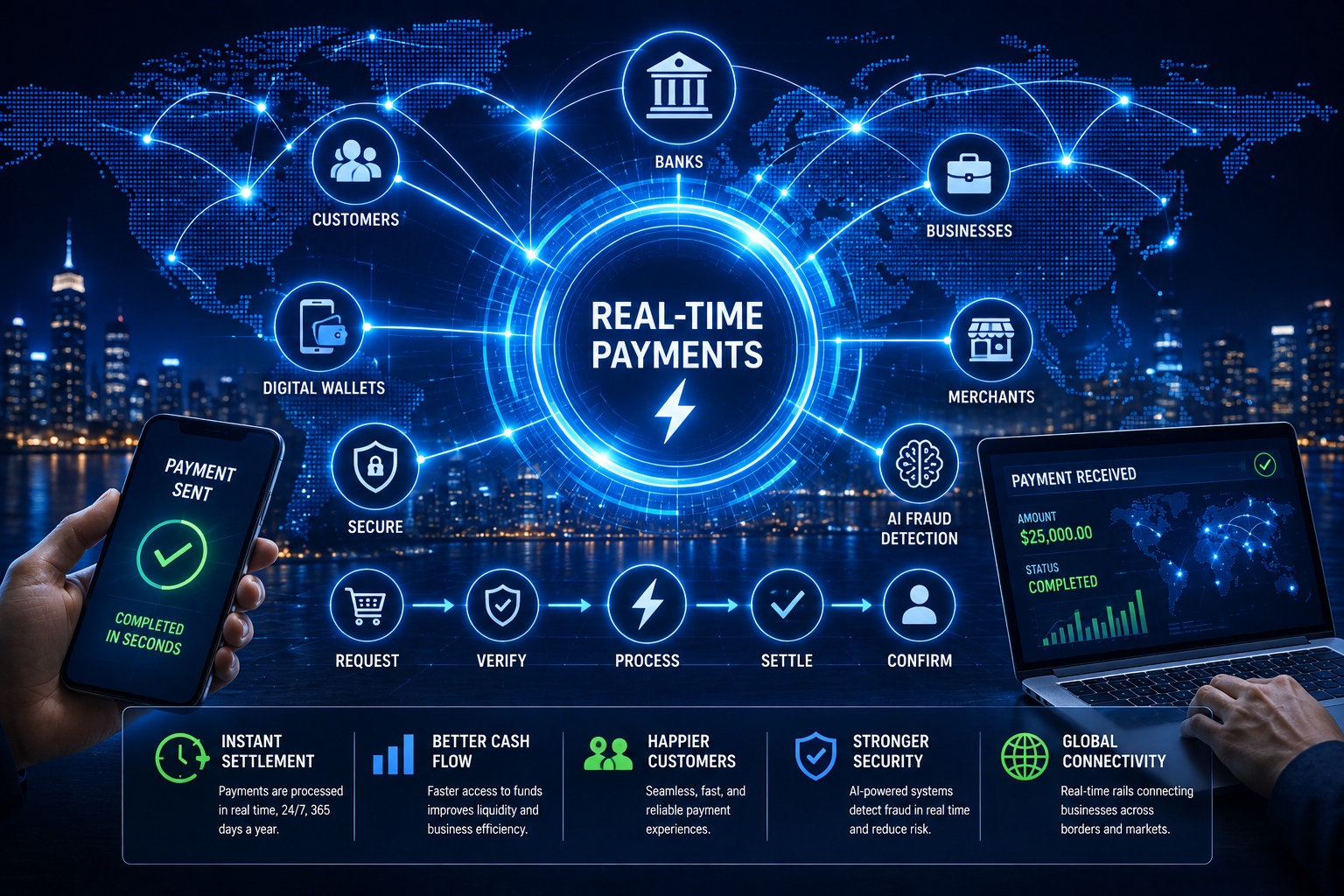
The global payments industry is undergoing a major transformation. Businesses increasingly expect payments to be fast, accessible, transparent, and available around the clock. At the same time, consumers have become accustomed to instant digital experiences in almost every part of their lives.
Traditional payment systems have supported global commerce for decades, but many transactions still depend on banking hours, intermediaries, batch processing, and settlement processes that can introduce delays.
Real-time payments are changing that model.
Real-time payment systems allow funds to move between accounts within seconds or near real time, depending on the network and participating institutions. As these systems expand across countries and become integrated with business software, banks, fintech platforms, marketplaces, and digital commerce, they are changing how companies manage cash flow and interact with customers.
In 2026, real-time payments are becoming more than a consumer convenience. They are increasingly becoming a strategic component of modern business infrastructure.
What Are Real-Time Payments?
Real-time payments are electronic transactions that are processed and made available to recipients rapidly, often within seconds.
Unlike traditional payment systems that may process transactions in batches, real-time infrastructure is designed to operate continuously.
This can allow businesses and consumers to send and receive money outside traditional banking schedules.
The exact speed, availability, transaction limits, and features depend on the payment network and country.
The broader trend, however, is clear: businesses are moving toward payment systems that operate closer to the speed of digital commerce itself.
Why Speed Matters for Businesses
Payment delays can affect business operations.
A company waiting for customer payments may have less cash available for suppliers, payroll, inventory, or investment.
Real-time payments can shorten the gap between a transaction being initiated and funds becoming available.
For businesses, this can improve cash-flow visibility.
A company can potentially receive payment from customers and use those funds more quickly instead of waiting for traditional settlement cycles.
The result is a financial environment where money moves more closely in line with the underlying commercial activity.
Real-Time Payments and E-Commerce
E-commerce is one of the industries most likely to benefit from faster payments.
Customers expect online purchases to be completed quickly.
When payment processing is slow or complicated, it can create friction during checkout.
Real-time payment options can provide customers with additional ways to pay while allowing merchants to confirm transactions quickly.
This can improve the connection between payment confirmation, order processing, and fulfillment.
For digital businesses operating across multiple markets, real-time payment infrastructure can also provide new opportunities to streamline payment operations.
Improving Business Cash Flow
Cash flow is one of the most important financial concerns for businesses.
A profitable company can still experience financial pressure if money arrives slowly while expenses must be paid immediately.
Real-time payments can potentially reduce settlement delays.
For example, a business receiving customer payments can have faster access to funds, allowing it to manage working capital more efficiently.
This can be especially valuable for smaller businesses that may not have large cash reserves.
Faster Supplier Payments
Real-time payments can also change business-to-business transactions.
Businesses often need to pay suppliers, contractors, service providers, and other partners.
Traditional payment methods may involve processing delays and reconciliation work.
With real-time infrastructure, approved payments can potentially reach suppliers much faster.
This could help businesses strengthen supplier relationships and reduce payment-related uncertainty.
However, organizations still need appropriate approval processes and financial controls before implementing instant payments at scale.
The Rise of 24/7 Commerce
Digital businesses do not operate only during traditional working hours.
Customers can purchase products at any time.
Online marketplaces can receive orders throughout the day and night.
Global companies may operate across several time zones simultaneously.
Real-time payments support this always-on business environment.
A transaction does not necessarily need to wait until the next business day to be processed.
This creates a closer connection between digital commerce and financial infrastructure.
Real-Time Payments and Global Business
International payments remain more complicated than domestic transactions.
Different countries use different currencies, banking systems, regulations, and payment networks.
Real-time payment infrastructure is developing across multiple markets, but global interoperability remains a challenge.
Businesses operating internationally may eventually benefit from payment systems that connect faster domestic networks with cross-border settlement infrastructure.
This could reduce some delays associated with international commerce.
However, currency conversion, compliance, sanctions screening, taxation, and regulatory requirements will continue to play important roles.
The Role of Fintech Companies
Fintech companies are helping accelerate payment innovation.
Unlike traditional financial institutions that may rely on legacy infrastructure, newer payment providers can build services around modern APIs, cloud systems, digital wallets, and real-time networks.
Fintech platforms can connect businesses to payment infrastructure while providing additional services such as reconciliation, analytics, fraud detection, and financial management.
This creates an ecosystem in which payment processing becomes integrated with broader business software.
Real-Time Payments and Digital Wallets
Digital wallets are another important part of the real-time payments ecosystem.
Consumers and businesses increasingly use wallets to store payment credentials and move money digitally.
When wallets connect with real-time payment networks, users can potentially transfer funds quickly without relying exclusively on traditional card infrastructure.
For businesses, wallet integration can create additional payment channels and improve customer convenience.
The challenge is fragmentation.
Different wallets and payment systems may use different technologies and standards.
Interoperability will therefore be important for long-term growth.
AI and Real-Time Payments
Artificial intelligence can make real-time payment systems more intelligent.
Fast payments also create a challenge: there is less time to identify suspicious activity before a transaction is completed.
AI can analyze transactions and behavioral patterns in real time to identify potentially fraudulent activity.
A payment system could evaluate factors such as transaction history, account behavior, device signals, location information, and unusual activity.
If risk appears high, the system could request additional authentication or route the transaction for further review.
This creates a combination of:
real-time payments + real-time risk intelligence.
Reducing Payment Fraud
Speed without security can create additional risks.
Fraudsters may attempt to exploit instant payment systems because funds can move rapidly.
Financial institutions and payment providers therefore need strong fraud controls.
AI-powered monitoring can help identify suspicious patterns before transactions are completed.
Organizations can also use authentication, transaction limits, risk scoring, device intelligence, and behavioral analysis.
The objective is to protect customers without creating unnecessary friction for legitimate payments.
Real-Time Payments and Business Automation
Payments are increasingly becoming part of automated business workflows.
A business application could generate an invoice, receive approval, verify payment details, and initiate a transaction.
Real-time payment infrastructure can make this process faster.
In the future, AI agents may also participate in certain payment workflows.
For example, an authorized business agent could identify an approved invoice and prepare a payment for human approval.
For lower-risk recurring transactions, businesses may eventually automate more of the process within carefully defined controls.
Programmable Payments
Real-time payments can become even more powerful when combined with programmable financial infrastructure.
Businesses can potentially connect payment execution with predefined business conditions.
For example, payment could be triggered after a delivery is confirmed or a contractual milestone is reached.
This does not necessarily require blockchain.
Traditional real-time payment networks can also support sophisticated payment automation when connected to modern business systems.
The result is a shift from payments being a separate administrative activity toward payments becoming an integrated part of digital workflows.
Improving Reconciliation
Payment reconciliation can be a time-consuming process.
Businesses need to match payments with invoices, orders, customers, and accounting records.
Real-time systems combined with APIs can provide transaction information more quickly.
Automation can then match payments to the correct records.
This can reduce manual administrative work and give finance teams a more current view of cash positions.
For companies processing large numbers of transactions, this can create meaningful operational benefits.
Real-Time Payments for Small Businesses
Small and medium-sized businesses can particularly benefit from faster payment access.
Large organizations may have significant credit facilities and cash reserves.
Smaller companies often have less financial flexibility.
Receiving money faster can help them pay suppliers, manage operating expenses, and invest in growth.
Real-time payments can therefore contribute to better financial flexibility for smaller businesses.
The impact will depend on transaction fees, access to payment infrastructure, and the availability of suitable business banking services.
Challenges to Adoption
Real-time payments are not without challenges.
Businesses and financial institutions need to address:
Fraud prevention
Cybersecurity
Regulatory compliance
Payment errors
Transaction limits
System availability
Interoperability
Customer authentication
Data privacy
Operational resilience
Because transactions can settle quickly, mistakes may also become harder to reverse.
Businesses need strong verification and approval procedures before sending funds.
The Importance of Interoperability
The full potential of real-time payments depends on connectivity.
A payment system that operates instantly but cannot communicate with other networks has limited usefulness for global commerce.
Interoperability between banks, payment providers, digital wallets, business software, and national payment systems can make real-time payments more powerful.
Cross-border interoperability will be particularly important.
Businesses operating internationally need payment infrastructure that can function across different currencies and regulatory environments.
Real-Time Payments and Financial Inclusion
Faster digital payments may also contribute to financial inclusion.
People and businesses with access to digital financial services can potentially receive and transfer money more efficiently.
For small businesses, faster access to customer payments can improve financial flexibility.
For individuals, real-time payments can simplify transfers and everyday financial activity.
However, inclusion requires more than payment speed.
Affordable access, digital literacy, consumer protection, reliable infrastructure, and appropriate regulation are also necessary.
The Future of Business Finance
Real-time payments could eventually become part of a broader financial operating system.
Business software may increasingly connect accounting, invoicing, treasury management, fraud detection, customer payments, and supplier payments.
AI can analyze financial activity.
Automation can initiate approved actions.
Real-time payment infrastructure can move funds.
Together, these technologies can create faster and more intelligent financial operations.
How Businesses Can Prepare
Businesses interested in real-time payments should begin by identifying payment processes where speed creates measurable value.
Potential use cases include:
Customer payments
Supplier payments
Payroll
Refunds
Insurance claims
Marketplace payouts
Cross-border transactions
Treasury transfers
Companies should evaluate fees, security, integration requirements, transaction limits, compliance obligations, and reconciliation processes.
They should also establish clear controls for payment authorization.
The goal should not simply be to make payments faster.
It should be to make the entire financial workflow faster, safer, and more efficient.
Conclusion
Real-time payments are transforming global business by bringing financial transactions closer to the speed of digital commerce.
Faster settlement can improve cash flow, accelerate supplier payments, simplify e-commerce, support 24/7 operations, and create new opportunities for automated financial workflows.
At the same time, instant payments require stronger fraud detection, cybersecurity, authentication, and operational controls.
The most successful businesses will not treat real-time payments as simply another payment option.
They will integrate them into broader financial systems that connect customers, suppliers, accounting platforms, treasury operations, and intelligent automation.
As AI, fintech, digital wallets, and real-time payment networks continue to develop, the boundaries between commerce and financial infrastructure will increasingly disappear.
In 2026, the competitive advantage may belong to businesses that can move money as quickly as they move information.