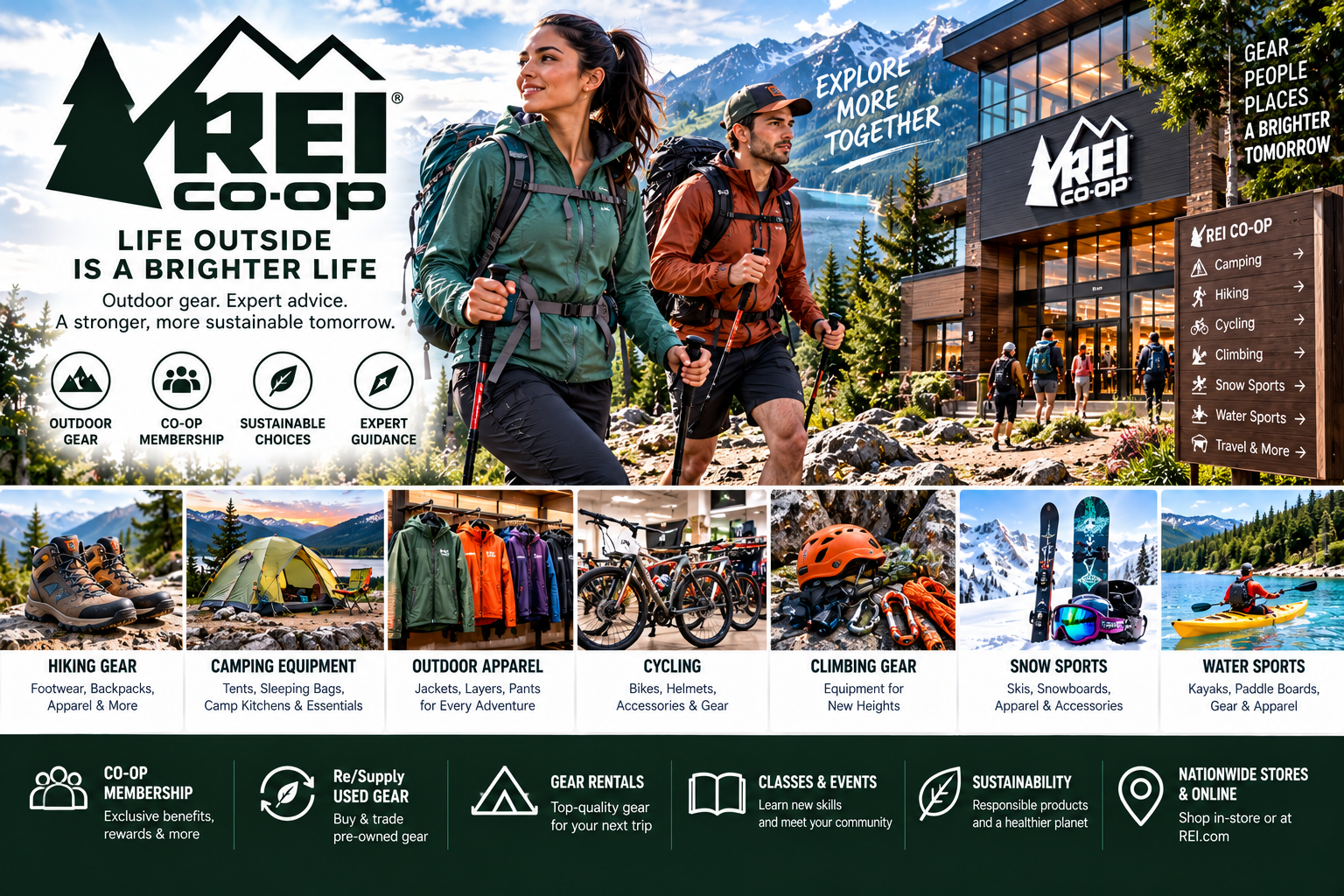
REI Co-op, formally known as Recreational Equipment, Inc., is one of the best-known specialty outdoor retailers in the United States. Founded in 1938, the company has built its business around outdoor equipment, apparel, footwear, recreation services, and a cooperative membership model.
Unlike a conventional publicly traded retailer, REI is structured as a consumer cooperative. Customers can become members and participate in the co-op, while the company reinvests in its employees, members, communities, outdoor access, and environmental initiatives.
REI reported $3.54 billion in 2025 co-op sales, more than 26 million members, and 12,478 employees. The company also opened six stores during 2025, including four new locations.
In 2026, REI's business continues to combine specialty outdoor retail with digital commerce, membership benefits, rentals, used gear, classes, events, sustainability initiatives, and its own Co-op-branded products.
What Is REI?
REI is a specialty outdoor retailer headquartered near Seattle, Washington.
The company sells products designed for activities including:
Hiking
Camping
Backpacking
Climbing
Cycling
Running
Snow sports
Water sports
Travel
Fitness
Outdoor recreation
REI operates physical stores and digital shopping channels through REI.com, REI Outlet, and its mobile app. The company says everyone is welcome to shop at REI, while members receive additional benefits.
History of REI
REI traces its origins to 1938, when a group of 23 climbing enthusiasts formed a cooperative to make quality outdoor equipment more accessible.
Over the decades, REI expanded from a small cooperative serving climbers into a national specialty outdoor retailer.
The company's original cooperative philosophy remains part of its identity.
REI says its purpose is centered on enabling people to experience life outside and supporting the outdoor community. Its current business combines retail with education, rentals, used gear, community programs, and environmental initiatives.
The REI Cooperative Business Model
One of REI's biggest differences from traditional retailers is its cooperative structure.
Customers can become REI Co-op members by paying a one-time membership fee.
Membership provides access to benefits such as:
Co-op Member Rewards
Special offers
Member pricing on selected services
Classes and events
Used gear opportunities
Rental benefits
Member experiences
REI's financial statements describe the company as a cooperative in which members have voting rights under the co-op's membership structure. As of January 3, 2026, REI reported 8.1 million voting-eligible members.
The broader customer membership base was more than 26 million at the end of 2025.
REI Membership
Membership is a central component of the REI business model.
REI currently promotes a lifetime co-op membership, meaning customers do not need to repeatedly pay an annual membership fee.
One of the best-known benefits is the Co-op Member Reward.
REI says members can earn an estimated 10% annual reward on eligible full-price co-op purchases, with the reward generally becoming available the following March.
The reward structure creates an additional connection between customers and the cooperative.
REI Products
REI offers a wide assortment of outdoor products.
Outdoor Apparel
The company sells clothing designed for different environments and activities, including:
Hiking jackets
Rain jackets
Fleece
Down jackets
Base layers
Hiking pants
Outdoor shirts
Shorts
Gloves
Hats
Outdoor apparel increasingly combines technical performance with everyday usability.
Hiking Footwear
REI carries hiking and outdoor footwear for different terrain and activities.
Products include:
Hiking boots
Hiking shoes
Trail shoes
Approach shoes
Sandals
Waterproof footwear
Features can include traction, waterproof membranes, cushioning, ankle support, and lightweight construction.
Camping Equipment
Camping is one of REI's core categories.
The retailer sells:
Tents
Sleeping bags
Sleeping pads
Camping chairs
Camp kitchens
Stoves
Coolers
Lanterns
Camp furniture
The category ranges from lightweight backpacking equipment to larger family camping products.
Backpacks
Backpacks are essential for hiking, travel, camping, and climbing.
REI offers products ranging from small daypacks to large multi-day backpacking packs.
Modern backpack design focuses on:
Weight
Fit
Ventilation
Organization
Load distribution
Durability
Cycling
REI also operates in the cycling category through bicycles, equipment, apparel, helmets, accessories, and maintenance-related services.
The company's Co-op Cycles brand is part of its own product portfolio.
Co-op Brands
REI sells products from numerous outdoor brands while also developing its own merchandise.
Its Co-op-branded products cover categories including:
Outdoor apparel
Camping
Cycling
Hiking
Travel
Accessories
Outdoor equipment
The company has increasingly emphasized product design, material innovation, durability, and inclusive sizing.
In 2025, REI said it redesigned its children's Co-op Cycles using data-driven sizing and input from parents and caregivers rather than simply scaling down adult bicycle designs.
REI and Outdoor Brands
REI carries products from hundreds of outdoor brands.
The retailer's assortment can include brands specializing in:
Hiking
Running
Camping
Climbing
Cycling
Skiing
Snowboarding
Water sports
Outdoor apparel
Technical equipment
REI's Product Impact Standards also apply to the brands it carries.
The company reported that more than 830 brands shared performance updates with REI in 2025 as part of its product-impact work.
REI Used Gear: Re/Supply
One of REI's notable initiatives is Re/Supply, its used-gear marketplace.
The program allows members to purchase and trade in eligible used outdoor equipment.
This creates an alternative to purchasing new products and can extend the useful life of outdoor gear.
REI describes Re/Supply as a way for members to shop and trade in used equipment that is ready for more time outdoors.
REI Gear Rentals
REI also offers outdoor equipment rentals.
Rental categories can include products needed for:
Camping
Hiking
Snow sports
Paddle sports
Other outdoor activities
The company's rental program is designed to make outdoor recreation more accessible while also providing an alternative to purchasing equipment that may only be used occasionally.
REI states that members can save up to 33% on rentals.
REI Classes and Events
REI is more than a product retailer.
The company offers classes and events that can help consumers learn outdoor skills.
Examples can include instruction related to:
Hiking
Camping
Backpacking
Climbing
Cycling
Navigation
Outdoor safety
Fitness
REI describes its classes as opportunities to receive hands-on guidance and meet other people interested in outdoor activities.
This educational component differentiates the company from retailers focused exclusively on product transactions.
REI Stores
Physical stores remain an important part of REI's business.
At the end of 2025, REI had opened six store locations during the year, including four net-new stores in:
Amherst, New York
Chico, California
Durango, Colorado
Elk Grove, California
The company also relocated stores in Carlsbad, California, and Lynnwood, Washington.
REI's stores serve multiple functions:
Product shopping
Gear testing
Customer service
Classes
Rentals
Product pickup
Outdoor community engagement
REI E-Commerce
Digital commerce has become an important part of the REI shopping experience.
Customers can browse and purchase products through:
REI Outlet
REI's mobile application
Digital shopping allows consumers to research product specifications, compare outdoor gear, read reviews, check availability, and manage orders.
The combination of digital and physical retail creates an omnichannel model.
REI and Sustainability
Sustainability is a major component of REI's corporate identity and product strategy.
The company works on issues including:
Product durability
Recycled materials
Waste reduction
Climate action
Clean energy
Outdoor access
Product repair
Used gear
Sustainable materials
REI says it achieved a 15% reduction in emissions compared with its 2019 baseline in 2025 and achieved its waste-diversion goal for the second consecutive year.
REI Product Impact Standards
REI has established Product Impact Standards for its own products and brands it carries.
These standards address areas such as:
Environmental impact
Materials
Social responsibility
Product durability
Inclusion
The company reviews progress across its product assortment as part of its broader impact strategy.
Circular Economy and Outdoor Gear
The outdoor industry is increasingly exploring circular business models.
Instead of the traditional:
Make → Sell → Use → Discard
companies can create systems based on:
Make → Sell → Use → Repair → Resell → Reuse
REI's Re/Supply marketplace and rental services fit into this broader circular-economy model.
These programs can help customers access equipment without necessarily purchasing new products every time.
REI and Outdoor Access
REI's business model is closely connected to outdoor participation.
The company supports organizations and initiatives focused on:
Outdoor access
Public lands
Environmental protection
Outdoor equity
Community recreation
REI's Cooperative Action Fund provides grants to nonprofit organizations working on outdoor access and related issues.
In 2025, the fund and related efforts supported more than 360 nonprofit partners, according to REI's impact reporting.
REI's 2025 Financial Performance
REI reported $3.54 billion in net sales for 2025, slightly above 2024.
Gross profit increased by 7% to approximately $1.52 billion, while the company's full-year net loss narrowed to $54.3 million.
REI also reported two profitable quarters during the final part of 2025.
The company said its performance reflected stronger operating discipline, healthier full-price selling, and improved inventory management.
REI Member Rewards in 2025
REI reported distributing more than $202 million in Co-op Member Rewards related to its 2025 results.
The company also invested approximately $121.9 million in employee incentives and profit sharing during the year.
These figures illustrate how REI's cooperative structure connects financial performance with members and employees.
REI and Inclusive Outdoor Products
Outdoor equipment historically has not always been designed around the full range of body types, ages, abilities, and experiences.
REI has increasingly incorporated inclusive design into its product development.
The redesigned children's Co-op Cycles are one example.
The company used sizing data and input from parents and caregivers to rethink bicycle designs for children.
This approach reflects a wider outdoor-industry trend toward designing products for a broader range of consumers.
Technology in Outdoor Retail
Technology is changing how consumers discover, purchase, and use outdoor equipment.
Retailers increasingly use technology for:
Online product recommendations
Inventory management
Digital shopping
Mobile commerce
Customer service
Product research
Personalized marketing
Data-driven product development
Outdoor equipment itself is also becoming more technologically advanced.
Examples include:
GPS watches
Smart fitness trackers
Technical fabrics
Lightweight materials
Advanced insulation
Water filtration systems
Solar-powered equipment
Digital navigation devices
Artificial Intelligence and REI
Artificial intelligence is becoming increasingly relevant to retail.
Potential applications include:
Product recommendations
Search optimization
Customer support
Inventory forecasting
Demand planning
Marketing personalization
Product discovery
For outdoor retailers, AI can potentially help customers find products based on activity, weather conditions, experience level, budget, and destination.
The challenge is ensuring that automated recommendations remain accurate for specialized outdoor equipment where product suitability can have safety implications.
Outdoor Retail Trends in 2026
Several trends are shaping REI and the wider outdoor industry in 2026.
1. Experiential Retail
Consumers increasingly expect physical stores to provide more than shelves of merchandise.
Classes, events, demonstrations, rentals, and expert advice can make stores destinations rather than simple transaction points.
2. Used Gear and Resale
Secondhand outdoor equipment continues to gain importance.
Re/Supply gives REI a direct role in the growing circular economy.
3. Outdoor Wellness
Hiking, walking, camping, running, and other outdoor activities increasingly overlap with broader wellness trends.
4. Technical Apparel
Consumers continue to seek lightweight, breathable, waterproof, durable, and versatile clothing.
5. Inclusive Product Design
Brands and retailers are increasingly considering more body types, ages, abilities, and experience levels during product development.
6. Sustainable Materials
Recycled materials and lower-impact production remain important areas of innovation.
7. Digital Commerce
Consumers increasingly combine online research with physical-store experiences.
8. Outdoor Community
Running clubs, hiking groups, classes, events, and local outdoor communities can help retailers build stronger relationships with customers.
9. Rental Models
Renting can make expensive outdoor activities more accessible and reduce the need for occasional users to purchase specialized equipment.
10. Product Durability
Consumers increasingly consider how long outdoor equipment will last rather than simply focusing on its initial price.
Challenges Facing REI
REI operates in a competitive retail environment.
The company faces challenges including:
Consumer Spending
Outdoor gear can be discretionary, meaning demand can change when consumers become more cautious about spending.
Competition
REI competes with specialty outdoor retailers, sporting-goods chains, brand-owned stores, online marketplaces, and direct-to-consumer companies.
Inventory Management
Outdoor demand can vary based on weather, seasons, economic conditions, and consumer trends.
Sustainability Costs
Developing lower-impact products and supply chains can involve additional investment.
Digital Competition
Online retailers compete heavily on convenience, pricing, selection, and delivery.
Cooperative Economics
REI must balance investments in members, employees, communities, environmental programs, and the financial sustainability of the co-op.
The Future of REI
REI's future is likely to remain centered on the combination of outdoor retail + membership + services + community + sustainability.
Its business extends beyond selling products.
The company provides:
Gear + Apparel + Footwear + Rentals + Classes + Used Gear + Digital Commerce + Membership + Outdoor Community
This broader ecosystem can create multiple ways for customers to interact with the brand.
REI's 2025 results showed modest sales growth alongside improved gross profit and a narrower annual loss, while the company continued investing in stores, members, employees, products, and outdoor initiatives.
Frequently Asked Questions
What does REI stand for?
REI stands for Recreational Equipment, Inc. The company operates as a consumer cooperative.
When was REI founded?
REI was founded in 1938 by a group of 23 climbing enthusiasts.
Is REI a cooperative?
Yes. REI is structured as a consumer cooperative, and customers can become members.
How much does REI membership cost?
REI currently promotes a lifetime co-op membership. The membership fee and benefits should be checked on REI's current membership page because terms can change.
What does REI sell?
REI sells outdoor apparel, footwear, camping equipment, hiking gear, backpacks, bicycles, climbing equipment, snow-sports products, accessories, and other outdoor products.
Does REI sell used gear?
Yes. REI operates Re/Supply, where members can purchase and trade in eligible used outdoor equipment.
Does REI rent outdoor equipment?
Yes. REI offers gear rentals, and members can receive discounts on eligible rentals.
Does REI offer outdoor classes?
Yes. REI offers classes and events covering different outdoor activities and skills.
How much did REI make in 2025?
REI reported approximately $3.54 billion in 2025 co-op sales.
How many REI members are there?
REI reported more than 26 million members in 2025.
Conclusion
REI has developed a distinctive position in the outdoor retail industry by combining specialty merchandise with a cooperative membership model, outdoor education, rentals, used gear, community programs, and sustainability initiatives.
The company reported $3.54 billion in 2025 sales and more than 26 million members, while continuing to expand its store network and invest in products and outdoor access.
Its Re/Supply marketplace, rental services, classes, Co-op products, and digital channels demonstrate how outdoor retail is evolving beyond traditional product sales.
As consumers increasingly connect outdoor recreation with wellness, travel, sustainability, technology, and community, REI's combination of retail and outdoor experiences positions it within several major trends shaping the industry in 2026.