Singapore is one of Asia’s most important centers for finance, technology, trade, property, and international business. Despite its small geographic size, the city-state has developed a large concentration of entrepreneurs, investors, property developers, bankers, technology founders, and wealthy families.
The latest Forbes Singapore 50 Richest 2026 list provides a snapshot of this wealth landscape. Forbes estimates that the combined fortune of the 50 richest people and families in Singapore was approximately $239 billion. Eduardo Saverin remained at the top of the list with an estimated $32.9 billion, while major fortunes were also connected to real estate, banking, manufacturing, healthcare, technology, and consumer businesses.
An important feature of the Singapore list is that it includes both individual fortunes and family wealth. It can also include foreign citizens who have significant residential or business connections to Singapore. Forbes calculated the 2026 figures using stock prices and exchange rates as of August 14, 2026, while private companies were valued using comparable publicly traded businesses.
Singapore’s Wealthiest People and Families
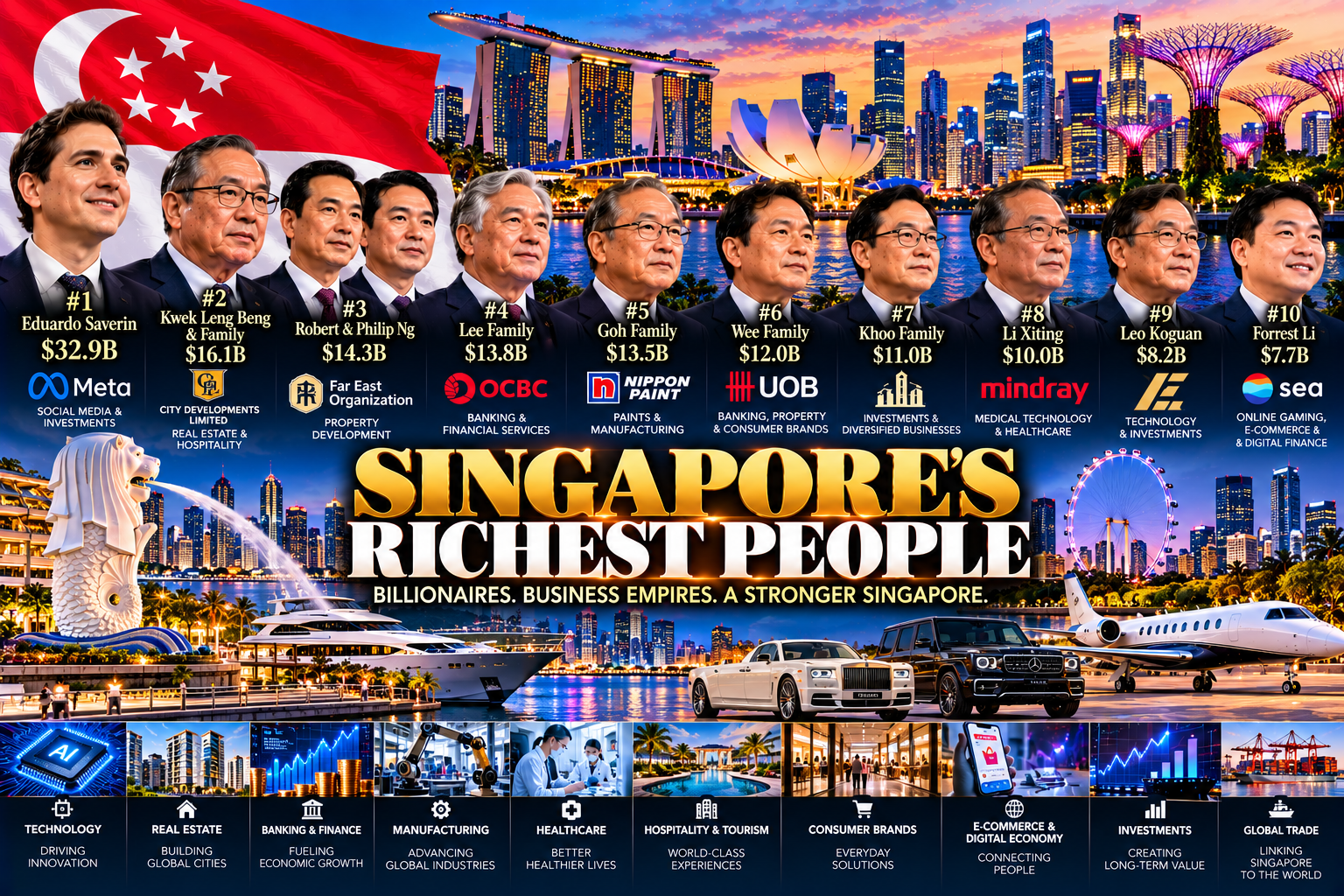
The leading names on the 2026 Forbes list include:
Eduardo Saverin — $32.9 billion
Kwek Leng Beng & family — $16.1 billion
Robert & Philip Ng — $14.3 billion
Lee family — $13.8 billion
Goh family — $13.5 billion
Wee family — $12 billion
Khoo family — $11 billion
Li Xiting — $10 billion
Leo Koguan — $8.2 billion
Forrest Li — $7.7 billion
These figures are Forbes' 2026 list valuations and can differ from real-time billionaire estimates because stock prices and exchange rates change after the list's valuation date.
Eduardo Saverin: Technology and Venture Capital
Eduardo Saverin remains one of Singapore's most prominent technology billionaires.
He is best known as a cofounder of Facebook, now Meta Platforms. After his involvement with Facebook, Saverin moved further into venture capital and founded B Capital with Raj Ganguly.
Forbes identifies Facebook and investments as the main sources of his fortune. Saverin is a Singapore resident and Brazilian citizen. His Forbes real-time profile has also shown substantial changes in his estimated wealth as Meta's share price moves.
His career illustrates an important pathway to wealth in the modern economy: building or owning an interest in a major technology company and then using that capital to invest in other businesses.
Kwek Leng Beng and Family: Property and Hospitality
Kwek Leng Beng and his family hold the second position on Forbes' 2026 Singapore list, with approximately $16.1 billion.
Their wealth is closely associated with City Developments Limited, one of Singapore's major property groups.
The group's activities extend across residential property, commercial real estate, and hospitality. Forbes reported that CDL has been divesting some non-core assets while focusing more closely on residential and hospitality opportunities. The group also acquired a London Holiday Inn property in December.
The Kwek family's wealth demonstrates the continuing importance of property development in Singapore and other international markets.
Robert and Philip Ng: Far East Organization
Brothers Robert and Philip Ng rank third with a combined fortune of approximately $14.3 billion.
Their family controls Far East Organization, a major private property developer and landlord in Singapore.
Forbes describes Far East Organization as Singapore's largest private landlord and property developer. The group's activities include real estate and hospitality, while its wider family interests extend across Singapore and Hong Kong.
The Ng family's story is closely connected with Singapore's transformation into a major global city.
The Lee Family: Banking and Wealth Management
The Lee family ranks fourth with approximately $13.8 billion.
A major component of the family's wealth is its stake in Oversea-Chinese Banking Corporation (OCBC).
According to Forbes, the family's fortune increased substantially as OCBC shares nearly doubled over the year, helped by the bank's growing wealth-management business.
The Lee family's position highlights the importance of financial services to Singapore's wealth ecosystem.
Singapore has developed into a major Asian financial hub, supporting banking, asset management, private wealth, insurance, and investment businesses.
Goh Family: Manufacturing and Paints
The Goh family is another major Singaporean business family, with wealth connected to Nippon Paint Holdings.
The family's business interests demonstrate that Singapore's wealthiest individuals are not limited to technology, finance, and real estate.
Industrial manufacturing can also produce substantial fortunes when companies operate at international scale.
Paints, coatings, chemicals, and industrial products support construction, automotive manufacturing, infrastructure, and consumer markets around the world.
Wee Family: Banking and Property
The Wee family has a long history in Singapore's banking and property sectors.
Forbes values the family's 2026 fortune at approximately $12 billion. Its wealth comes from stakes in United Overseas Bank (UOB), property companies including UOL Group and Kheng Leong, and consumer brand Haw Par.
The family's businesses show how banking, property, and consumer products can form a diversified multigenerational business portfolio.
Khoo Family: Diversified Family Wealth
The Khoo family is another long-established Singapore business family.
Its wealth has historically been associated with banking and investments, while family interests have extended across multiple sectors.
Family fortunes can be particularly complex because assets may be held through companies, trusts, investment structures, and different generations.
This is one reason Forbes' Singapore list explicitly includes family fortunes rather than treating every billionaire as an entirely separate individual fortune.
Li Xiting: Medical Technology
Li Xiting represents the growing importance of healthcare technology in Singapore's billionaire economy.
He is chairman and cofounder of Shenzhen Mindray Bio-Medical Electronics, a major medical-device company.
Forbes identifies medical technology as the primary source of his fortune. Although Mindray is based in China, Li is a Singapore citizen and resident, demonstrating the international character of Singapore's wealthy population.
His story also shows how Singapore can serve as a home for entrepreneurs whose businesses operate across Asia.
Leo Koguan: Technology Investments
Leo Koguan's fortune is associated with technology investments.
Technology-related billionaire wealth can fluctuate considerably because much of it may be tied to publicly traded companies.
A change in share prices can significantly alter the estimated value of an individual's holdings without requiring the person to buy or sell those shares.
This is why billionaire rankings should be viewed as estimates of ownership value rather than cash sitting in a bank account.
Forrest Li: E-Commerce, Gaming and Digital Finance
Forrest Li is the founder and CEO of Sea Limited, a Singapore-based technology company.
Sea operates businesses spanning online gaming, e-commerce, and digital financial services.
Forbes estimates his 2026 Singapore 50 Richest fortune at approximately $7.7 billion. Its profile identifies online gaming and e-commerce as important sources of his wealth.
Sea's performance also illustrates the volatility of technology fortunes. Forbes reported that Sea shares declined significantly during the year as competition affected its e-commerce business, reducing the combined wealth of its cofounders.
Real Estate Remains a Major Source of Wealth
Property is one of the most visible pillars of Singapore's wealth economy.
Major property-related fortunes are connected to:
Residential developments
Commercial buildings
Shopping centers
Hotels
Office properties
Luxury developments
International real estate
Property investment funds
Kwek Leng Beng, Robert and Philip Ng, and other wealthy Singapore families demonstrate how property ownership and development can create multigenerational wealth.
Singapore's highly developed infrastructure and position as an international business center also support demand for commercial and residential property.
Banking and Financial Services
Singapore is widely recognized as an important financial center in Asia.
Its financial ecosystem includes:
Commercial banking
Private banking
Wealth management
Asset management
Insurance
Venture capital
Private equity
Family offices
Investment management
The Lee and Wee families are examples of fortunes with significant banking connections.
As wealth management expands across Asia, Singapore continues to attract international investors and wealthy families.
Technology and the Digital Economy
Technology represents a newer source of billionaire wealth.
Singapore's digital economy includes:
E-commerce
Online gaming
Fintech
Digital payments
Artificial intelligence
Venture capital
Software
Data infrastructure
Cybersecurity
Eduardo Saverin and Forrest Li illustrate different forms of technology wealth: one built primarily through an early stake in a global social-media company and subsequent venture investing, and the other through building a Southeast Asian technology platform.
Manufacturing and Healthcare
Singapore's billionaire economy also includes advanced manufacturing and healthcare.
The Goh family's connection to Nippon Paint and Li Xiting's medical-device business demonstrate the international reach of these sectors.
Singapore's infrastructure, logistics network, skilled workforce, and access to Asian markets make it a strategic base for international businesses.
Consumer and Retail Businesses
Consumer businesses also contribute to Singapore's wealth landscape.
The country's wealthy entrepreneurs and families have interests in:
Supermarkets
Food and beverages
Consumer products
Retail
Hospitality
Restaurants
Lifestyle brands
Forbes reported that supermarket entrepreneur Lim Hock Chee benefited from the expansion of Sheng Siong Group, with his family's wealth reaching approximately $2.7 billion on the 2026 list.
The Wong brothers, who own footwear and accessories company Charles & Keith, also returned to the list in 2026.
Singapore's International Business Environment
Singapore's wealth economy cannot be separated from its international role.
The country is strategically positioned between major Asian markets and has developed strong connections to global trade, finance, technology, shipping, aviation, and investment.
Many wealthy Singapore residents also operate businesses outside the city-state.
This international character is reflected in Forbes' methodology, which allows foreign citizens with substantial business, residential, or other ties to Singapore to appear on the list.
Why Billionaire Rankings Change
Billionaire rankings can change rapidly because estimated wealth depends heavily on asset values.
Forbes' 2026 Singapore list was calculated using:
Public-company share prices
Exchange rates
Ownership stakes
Financial information
Private-company valuations
Family holdings
The valuation date for the 2026 list was August 14, 2026. Private businesses were valued using comparable publicly traded companies.
Therefore, the figures should not be interpreted as fixed amounts of cash.
For example, Forbes reported that Eduardo Saverin remained No. 1 despite his estimated fortune declining by $10.1 billion over the year, while the Lee family's fortune increased by 78% as OCBC shares rose.
Singapore's Wealthiest Families
Family wealth is particularly important in Singapore.
Several major fortunes have been built over decades and passed between generations.
Family businesses can combine:
Business ownership
Property
Banking shares
Investment portfolios
Hospitality assets
Manufacturing
Consumer brands
The result is a wealth structure that can remain influential across multiple generations.
New Sources of Singaporean Wealth
While traditional industries remain important, newer sectors may continue to reshape Singapore's billionaire landscape.
Potential sources of future wealth include:
Artificial Intelligence
AI-related demand is influencing semiconductor manufacturing, data centers, software, cloud infrastructure, and financial technology.
Forbes reported that Singapore's economy expanded 6.1% in the first half of 2026, with electronics and precision engineering benefiting from strong AI-related demand.
Data Centers
Singapore's position as a digital hub creates demand for data infrastructure and supporting services.
Fintech
Digital banking, payments, financial platforms, and wealth-management technology remain important areas of development.
Venture Capital
Technology founders who accumulate significant capital may increasingly become investors themselves, supporting the next generation of startups.
The Future of Singapore's Wealth Economy
Singapore's billionaire landscape is likely to remain diversified.
Real estate and banking will continue to support established family fortunes, while technology, healthcare, AI, digital finance, and e-commerce can create new sources of wealth.
The city's role as a regional headquarters and financial center also means that Singapore's richest residents may continue to build businesses across Southeast Asia and global markets.
At the same time, public-market volatility, interest rates, property values, currency movements, and global economic conditions can cause substantial changes in estimated billionaire wealth.
Final Thoughts
Singapore's richest people represent several generations of business development.
Eduardo Saverin reflects the global technology economy. Kwek Leng Beng and Robert and Philip Ng represent the importance of property and hospitality. The Lee and Wee families demonstrate the influence of banking and financial services, while Li Xiting highlights medical technology and Forrest Li represents Southeast Asia's digital economy.
According to Forbes, Singapore's 50 richest people and families collectively held approximately $239 billion in 2026. Although 35 listees were wealthier than a year earlier, declines among some technology fortunes kept the group's combined wealth broadly unchanged.
The country's wealth story therefore extends far beyond individual fortunes. It reflects Singapore's evolution as a global center for finance, property, technology, manufacturing, healthcare, trade, and international investment.
FAQs
Who is the richest person in Singapore in 2026?
Eduardo Saverin ranked first on Forbes' 2026 Singapore 50 Richest list with an estimated fortune of $32.9 billion.
How much are Singapore's 50 richest worth?
Forbes estimated the combined wealth of Singapore's 50 richest people and families at approximately $239 billion in 2026.
Is Eduardo Saverin Singaporean?
Saverin is a Brazilian citizen and Singapore resident. Forbes includes him on its Singapore wealth list because of his substantial residential ties to the country.
What industries create the most billionaire wealth in Singapore?
Major sources include technology, real estate, banking, manufacturing, healthcare, hospitality, consumer businesses, and investments.
Why does Singapore have so many wealthy families?
Singapore's role as a financial and business center has supported the development of major companies and family enterprises across banking, property, manufacturing, hospitality, and investment.
Can billionaire wealth change quickly?
Yes. Much billionaire wealth is tied to shares and other assets whose market values fluctuate. Forbes' Singapore list uses a specific valuation date, so later market movements can change real-time estimates.