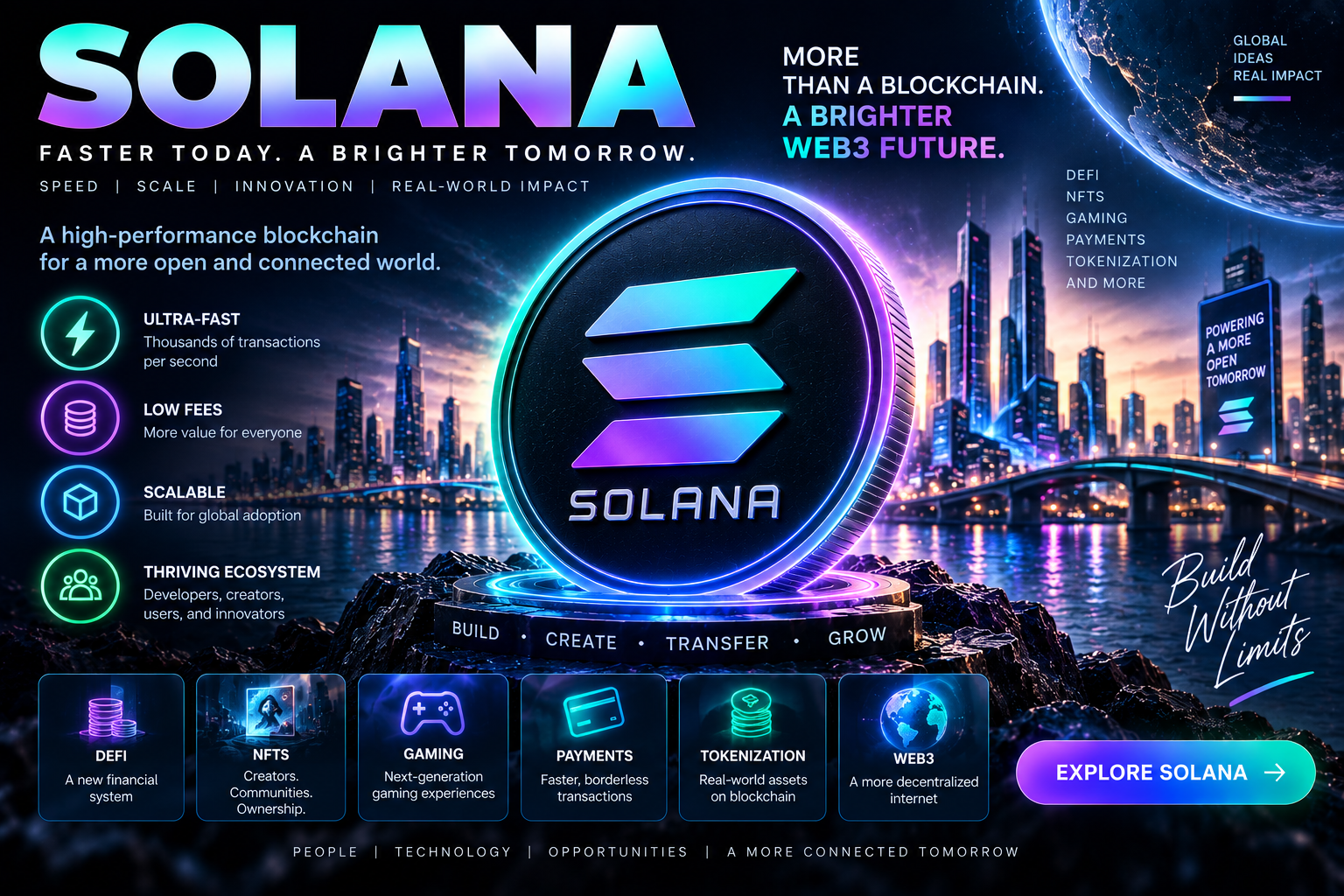
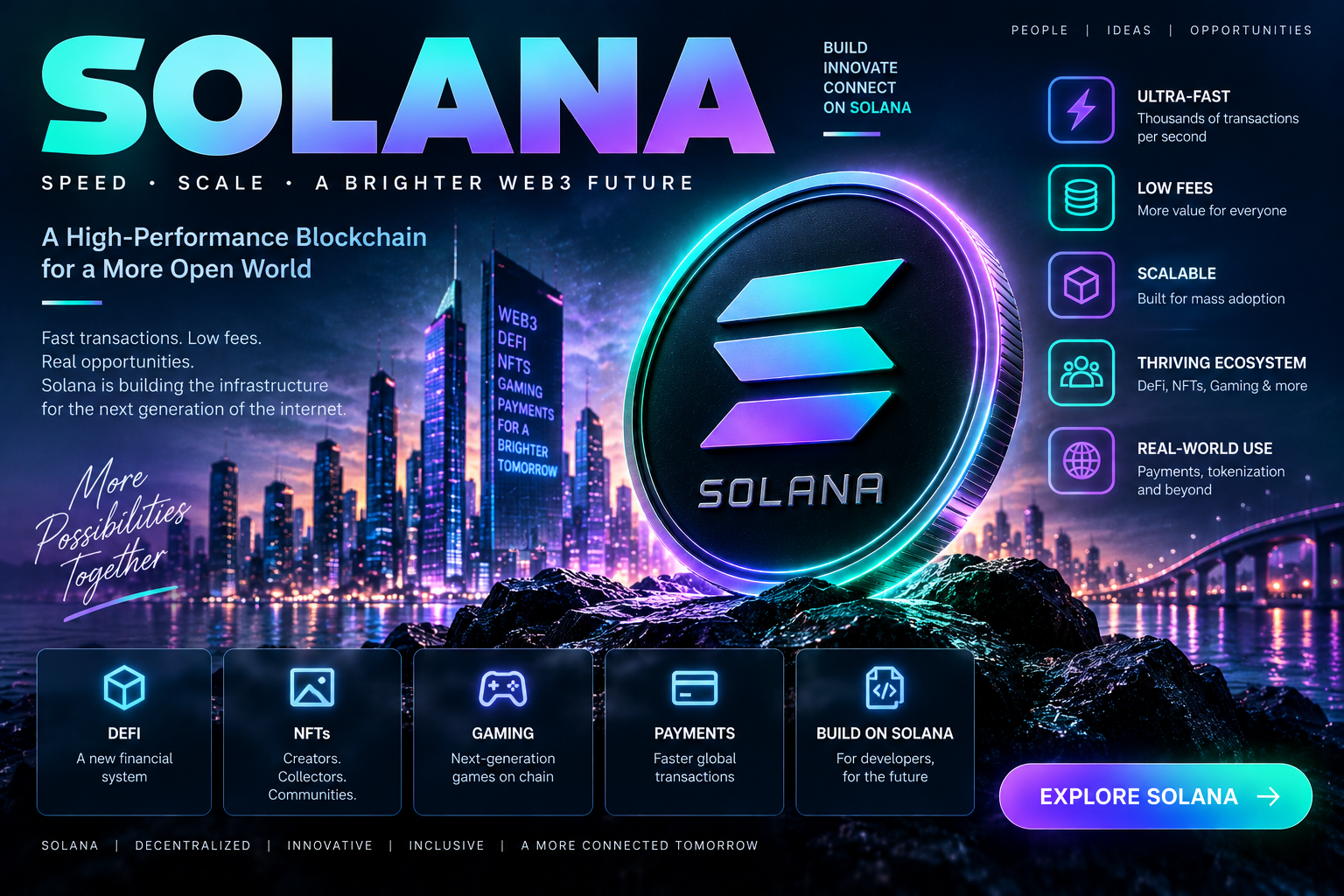
Solana has become one of the most recognized blockchain networks in the cryptocurrency industry. Designed to support fast and efficient transactions, Solana aims to provide infrastructure for decentralized applications, digital assets, financial services, gaming, payments, and other blockchain-based technologies.
The native cryptocurrency of the Solana network is SOL. It is used to pay transaction fees, participate in network security through staking, and interact with applications built on the Solana blockchain.
Solana has attracted developers and users because of its focus on transaction speed, relatively low fees, scalability, and a growing ecosystem of decentralized applications.
This article explores what Solana is, how it works, the role of SOL, its technology, staking, DeFi, NFTs, ecosystem, advantages, risks, and potential future development.
What Is Solana?
Solana is a decentralized blockchain platform designed to process transactions quickly while supporting applications and digital assets.
The project was founded by Anatoly Yakovenko and launched its network in 2020. Solana was developed with a focus on scalability and high transaction throughput.
Unlike some older blockchain networks that can become expensive or slower when activity increases, Solana was designed from the beginning to process a large volume of transactions efficiently.
The network supports smart contracts and decentralized applications, making it more than simply a cryptocurrency payment system.
What Is SOL?
SOL is the native cryptocurrency of the Solana blockchain.
It performs several important functions within the network.
Users can use SOL to:
Pay transaction fees
Transfer value
Participate in staking
Interact with decentralized applications
Trade digital assets
Participate in blockchain-based ecosystems
SOL can be stored in compatible cryptocurrency wallets and traded through digital-asset exchanges.
Because SOL is required for many activities on the Solana network, its utility is closely connected to the growth and usage of the blockchain ecosystem.
How Does Solana Work?
Solana uses a combination of technologies to process transactions and coordinate its decentralized network.
One of its best-known innovations is Proof of History (PoH).
Proof of History provides a cryptographic method for establishing a sequence of events and timestamps within the network.
Solana combines this mechanism with proof-of-stake-based consensus and other technical components.
The result is a blockchain architecture designed to process transactions at high speed.
Rather than relying on a single centralized server, Solana operates through a distributed network of validators.
Proof of History
Proof of History is one of Solana's most distinctive technological concepts.
It provides a way for network participants to establish the order and passage of time between events.
In traditional distributed systems, determining the order of events can require communication between participants.
Proof of History is designed to reduce some of this coordination burden by providing a verifiable sequence of events.
This technology contributes to Solana's overall architecture and helps the network coordinate activity efficiently.
Proof of History should not be confused with a standalone consensus mechanism. It works alongside other components of Solana's network architecture.
Solana Validators
Validators play an important role in maintaining the Solana blockchain.
They process transactions, participate in consensus, and help maintain the network.
Validators require specialized hardware and reliable infrastructure because Solana is designed to process a high volume of blockchain activity.
The number and geographic distribution of validators are important factors when evaluating the decentralization and resilience of a blockchain network.
Solana's validator ecosystem has continued to develop as the network has grown.
Solana Staking
SOL holders can participate in network security through staking.
Staking involves delegating SOL to validators or operating validator infrastructure directly.
Validators that successfully participate in network operations can receive rewards, while delegators may receive a portion of those rewards according to the staking arrangement.
Staking can provide an additional utility for SOL beyond simply holding or trading the asset.
However, staking involves risks. These can include validator performance, lockup or withdrawal conditions, market volatility, and risks associated with third-party staking platforms.
Users should understand the specific staking mechanism before committing their SOL.
Solana Transaction Speed
Transaction speed is one of Solana's most prominent characteristics.
The network was designed to support high transaction throughput and rapid processing.
Fast blockchain transactions can be particularly useful for applications that require frequent interactions, such as decentralized exchanges, gaming, payments, and high-volume digital applications.
However, advertised network capacity and real-world application performance can differ depending on transaction types, network conditions, infrastructure, and implementation.
Speed is therefore only one factor when evaluating a blockchain network.
Solana Transaction Fees
Solana is also known for relatively low transaction costs.
Low fees can make it easier for users to interact with decentralized applications without paying large amounts for every transaction.
This can be especially important for applications involving frequent transactions.
For example, blockchain games, decentralized exchanges, NFT applications, and payment systems may require users to perform many transactions.
Lower fees can reduce the cost of participating in these ecosystems.
Nevertheless, network conditions can change, and users should always check the current transaction cost before performing an important transaction.
Solana Smart Contracts
Solana supports programmable applications through smart contracts, commonly called programs within the Solana ecosystem.
Developers can create programs that define how applications operate on the blockchain.
These programs can support:
Decentralized exchanges
Lending applications
NFT marketplaces
Games
Payment systems
Token platforms
Social applications
Financial protocols
Solana's programming environment differs from Ethereum's EVM-based ecosystem, giving developers a different technical framework for building decentralized applications.
Solana and DeFi
Decentralized finance, or DeFi, is one of the major areas of blockchain development.
Solana has developed a significant DeFi ecosystem involving trading, lending, borrowing, liquidity provision, derivatives, and other financial applications.
Users can connect compatible wallets to decentralized applications and interact with blockchain-based protocols.
The low transaction costs and high throughput of Solana can be useful for DeFi applications that require frequent transactions.
However, DeFi carries significant risks, including smart-contract vulnerabilities, liquidity problems, market volatility, oracle failures, and fraudulent projects.
Solana Decentralized Exchanges
Decentralized exchanges allow users to trade digital assets through blockchain-based systems.
Solana's high-throughput architecture makes it suitable for decentralized trading applications.
Users can connect their wallets and exchange tokens without necessarily depositing funds into a centralized exchange.
Decentralized trading can provide greater control over assets, but users are responsible for understanding the smart contracts and applications they interact with.
Liquidity can also vary between different trading pairs.
Solana and Stablecoins
Stablecoins are digital assets designed to maintain a relatively stable value, often by tracking a currency such as the U.S. dollar.
Solana supports stablecoin activity across its ecosystem.
Stablecoins can be used for:
Trading
Payments
DeFi
Transfers
Liquidity management
Digital settlements
The combination of stablecoins and a high-throughput blockchain can create opportunities for fast digital payments and financial applications.
Solana and NFTs
Solana has also developed an ecosystem for non-fungible tokens, commonly known as NFTs.
NFTs are unique blockchain-based assets that can represent digital or physical items.
They can be used for:
Digital artwork
Collectibles
Gaming assets
Memberships
Tickets
Virtual goods
Digital experiences
Solana's relatively low transaction costs have made it attractive for NFT applications where users may need to perform many transactions.
NFT activity can change significantly depending on market conditions, but the technology remains part of the Solana ecosystem.
Solana Token Standards
Developers can create tokens that operate within the Solana ecosystem.
These tokens can represent cryptocurrencies, stablecoins, governance assets, utility tokens, and other digital assets.
Solana's token infrastructure allows applications and wallets to interact with assets using standardized blockchain functionality.
This helps developers build ecosystems in which different digital assets can be used across multiple applications.
Solana and Web3
Solana is an important platform within the broader Web3 ecosystem.
Web3 applications aim to use decentralized networks to provide users with greater control over digital assets and online interactions.
Solana can provide infrastructure for:
Decentralized applications
Digital wallets
Blockchain games
Social platforms
Financial applications
Digital collectibles
Payments
Tokenized assets
The ecosystem continues to develop as developers experiment with new applications.
Solana Mobile and Consumer Applications
Solana's ecosystem has also expanded into consumer-oriented blockchain products.
The broader Solana community has explored mobile devices, payments, decentralized applications, and user-friendly blockchain experiences.
Bringing blockchain technology to ordinary consumers is an important challenge for the industry.
For blockchain applications to achieve widespread adoption, users need simple wallets, easy interfaces, reliable infrastructure, and clear security practices.
Solana and Blockchain Payments
Blockchain payments are another potential use case for Solana.
Fast processing and relatively low fees can make the network suitable for certain payment applications.
Stablecoins operating on Solana can also allow users to transfer digital representations of fiat currencies.
Potential payment applications include:
Online commerce
Peer-to-peer transfers
International payments
Digital subscriptions
Creator payments
Business settlements
However, widespread payment adoption requires more than technical performance. Businesses also need regulatory clarity, reliable infrastructure, user demand, and convenient conversion between digital assets and traditional currencies.
Solana and Tokenization
Tokenization involves representing real-world assets or rights through blockchain-based tokens.
Solana can support tokenized assets through its token infrastructure and smart-contract capabilities.
Potential applications include:
Real-world assets
Financial instruments
Stablecoins
Digital certificates
Collectibles
Loyalty assets
Investment products
Tokenization could connect traditional financial assets with blockchain-based applications.
However, legal ownership and regulatory compliance remain essential components of any real-world tokenization system.
Advantages of Solana
Solana has several characteristics that have contributed to its growth.
High Throughput
The network is designed to process a large number of transactions.
Low Fees
Transaction costs have historically been relatively low compared with some other major blockchain networks.
Fast Processing
Solana is designed for rapid transaction confirmation and execution.
Smart Contracts
Developers can build programmable applications on the network.
Growing Ecosystem
Solana supports DeFi, NFTs, gaming, payments, tokenization, and other applications.
Staking
SOL holders can participate in network security through staking.
Risks of Solana
Solana also carries several important risks.
Market Volatility
SOL can experience significant price fluctuations.
Network Reliability
High-performance blockchain networks can face technical challenges, congestion, or outages.
Smart-Contract Risk
Applications built on Solana may contain vulnerabilities.
Centralization Concerns
The hardware and infrastructure requirements associated with high-performance blockchain networks can contribute to discussions about validator accessibility and decentralization.
Regulatory Risk
Changing cryptocurrency regulations can affect businesses and users.
Ecosystem Risk
Individual applications, tokens, bridges, and protocols may fail or be exploited even when the underlying blockchain continues operating.
Solana Security
The security of the Solana blockchain and the security of individual applications are separate issues.
The network uses validators and cryptographic mechanisms to protect blockchain activity.
However, users can still lose funds through:
Phishing
Fake websites
Malicious tokens
Compromised wallets
Private-key theft
Fraudulent applications
Social engineering
Users should verify applications and wallet addresses carefully before approving transactions.
Recovery phrases and private keys should never be shared with other people.
Solana Network Challenges
Solana's rapid growth has also created technical challenges.
A blockchain designed for high throughput requires significant infrastructure.
Validator hardware, network bandwidth, software optimization, and network coordination can all influence performance.
Maintaining reliability while increasing transaction capacity is one of the central technical challenges facing high-performance blockchain networks.
Solana developers and ecosystem participants continue to work on improvements to network performance and resilience.
Solana Compared With Ethereum
Solana and Ethereum are both programmable blockchain platforms, but they use different technical architectures.
Ethereum has a large ecosystem centered around smart contracts, decentralized applications, DeFi, NFTs, and Layer-2 networks.
Solana emphasizes high throughput, rapid processing, and low transaction costs on its base network.
Ethereum uses proof of stake and has a broad multi-layer scaling ecosystem.
Solana uses proof-of-stake-based consensus combined with Proof of History and other specialized technologies.
Developers may choose between these ecosystems based on programming requirements, transaction costs, performance needs, user communities, liquidity, and infrastructure.
Solana Compared With Bitcoin
Bitcoin and Solana serve different primary purposes.
Bitcoin was created primarily as a decentralized monetary network and digital asset.
Solana was designed as a high-performance programmable blockchain capable of supporting decentralized applications.
Bitcoin uses proof of work, while Solana uses a proof-of-stake-based architecture with additional technologies such as Proof of History.
Bitcoin's ecosystem focuses heavily on decentralized money and settlement, while Solana supports a broader range of programmable applications.
Solana and Institutional Interest
Institutional interest in blockchain technology has expanded across areas such as digital assets, payments, tokenization, and financial infrastructure.
Solana's high-throughput architecture has made it relevant to discussions around scalable blockchain applications.
Institutional participation can involve custody, financial products, tokenization projects, infrastructure, or other forms of blockchain integration.
However, interest in the Solana network does not necessarily mean that every institution directly holds SOL.
The specific form of adoption matters when evaluating institutional activity.
The Future of Solana
The future of Solana will depend on several factors.
Technology development will remain important as the network seeks to improve performance, reliability, scalability, and decentralization.
Developer adoption is another major factor.
A blockchain's long-term value depends not only on its technical specifications but also on whether developers continue building useful applications and whether users continue interacting with those applications.
The growth of stablecoins, DeFi, gaming, payments, tokenization, and consumer applications could create additional use cases for Solana.
At the same time, competition from Ethereum and other high-performance blockchain networks will remain significant.
Solana and the Future of Digital Finance
Blockchain technology is increasingly being explored for financial applications.
These include digital payments, stablecoins, tokenized securities, decentralized trading, settlement, and financial infrastructure.
Solana's combination of transaction speed and relatively low fees could make it suitable for applications requiring frequent blockchain interactions.
If blockchain adoption continues expanding, high-performance networks may become important infrastructure for digital financial services.
However, technology alone cannot determine adoption. Regulation, business models, user experience, security, liquidity, and economic incentives will also play major roles.
Solana and Real-World Applications
The long-term development of Solana will depend partly on real-world utility.
Potential applications include:
Digital payments
Financial services
Gaming
Social platforms
Tokenization
Digital identity
Creator economies
Consumer applications
Decentralized marketplaces
The more useful applications that can be built and sustainably operated, the greater the potential utility of the underlying blockchain infrastructure.
What Makes Solana Different?
Solana's main distinction is its focus on combining high throughput with a programmable blockchain environment.
Many blockchain networks make different trade-offs between decentralization, security, scalability, speed, and transaction costs.
Solana represents one approach to these trade-offs.
Its architecture is designed to process large amounts of activity while supporting smart contracts and decentralized applications.
This has helped create a distinct position for Solana within the competitive blockchain industry.
Conclusion
Solana is a major blockchain platform designed to support fast and scalable decentralized applications.
Its native cryptocurrency, SOL, is used for transaction fees, staking, transfers, and interaction with the broader Solana ecosystem.
The network's technology includes Proof of History alongside proof-of-stake-based consensus and other specialized components designed to support high transaction throughput.
Solana has developed an ecosystem covering decentralized finance, decentralized exchanges, NFTs, stablecoins, gaming, payments, tokenization, and Web3 applications.
At the same time, the network faces challenges involving reliability, decentralization, cybersecurity, market volatility, regulation, and competition.
The future of Solana will depend on continued technological development, network resilience, developer activity, real-world adoption, and the growth of applications built on its infrastructure.
As blockchain technology continues to evolve, Solana remains an important network to follow in the development of scalable digital finance and decentralized applications.