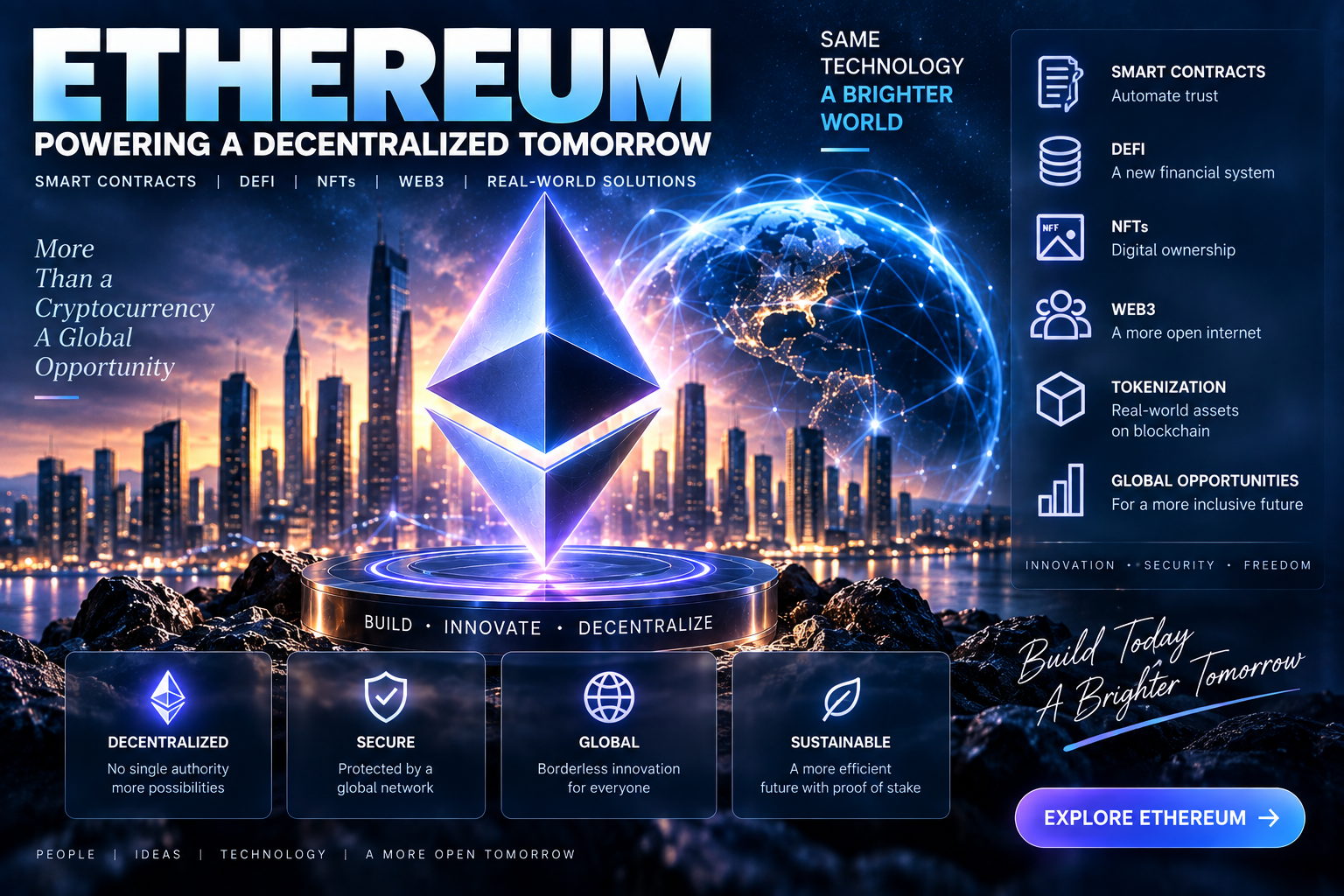
Ethereum has become one of the most influential blockchain networks in the world. While Bitcoin introduced a decentralized digital currency, Ethereum expanded the possibilities of blockchain technology by creating a programmable platform where developers can build applications, financial services, digital assets, and automated systems.
The native cryptocurrency of Ethereum is Ether, commonly known by its ticker symbol ETH. ETH is used throughout the Ethereum ecosystem to pay transaction fees, participate in network security through staking, and interact with decentralized applications.
Today, Ethereum is closely associated with smart contracts, decentralized finance (DeFi), non-fungible tokens (NFTs), stablecoins, Web3, tokenization, and blockchain-based applications.
What Is Ethereum?
Ethereum is a decentralized blockchain platform designed to run programmable applications.
The network was proposed by Vitalik Buterin and launched in 2015. Its core concept was to create a blockchain that could do more than simply transfer digital currency.
Ethereum introduced a programmable environment in which developers could create smart contracts. These contracts are computer programs that operate according to rules written in code.
This approach opened the door to a wide range of decentralized applications.
Instead of requiring every transaction or agreement to be handled by a centralized company, smart contracts can automate certain processes directly on a blockchain.
What Is ETH?
ETH, or Ether, is the native cryptocurrency of the Ethereum network.
ETH has several important functions within the ecosystem. It is used to pay transaction fees, interact with smart contracts, transfer value, and support Ethereum's proof-of-stake consensus system.
When users interact with an Ethereum application, they may need ETH to pay the network's required transaction fees.
ETH can also be held in cryptocurrency wallets or traded through digital-asset platforms.
Because Ethereum supports a large application ecosystem, ETH plays a central role in the network's economy.
How Does Ethereum Work?
Ethereum operates through a distributed network of computers called nodes.
These computers maintain and verify the blockchain according to Ethereum's protocol rules.
When a user submits a transaction, it is broadcast to the network. Validators process and verify transactions before they become part of the blockchain.
Ethereum's blockchain maintains a shared record of activity. This allows different participants to interact with the same decentralized system without depending on one central database.
The network can process simple ETH transfers as well as complicated smart-contract interactions.
Smart Contracts: The Foundation of Ethereum
Smart contracts are one of Ethereum's most important innovations.
A smart contract is software stored on a blockchain that can execute predefined instructions.
For example, a smart contract could be programmed to transfer a digital asset when certain conditions are met.
Smart contracts can support:
Decentralized exchanges
Lending platforms
Digital marketplaces
Token creation
Payment systems
Gaming applications
NFTs
Financial protocols
Decentralized organizations
Tokenized assets
Because smart contracts operate according to programmed rules, they can automate processes that traditionally require intermediaries.
However, smart contracts are software and can contain bugs or vulnerabilities. Users therefore need to consider technical risks when interacting with decentralized applications.
Ethereum Virtual Machine
The Ethereum Virtual Machine, or EVM, is the computational environment responsible for executing Ethereum smart contracts.
Developers write smart-contract code that can be executed through the EVM.
The EVM is an important reason Ethereum has developed such a large developer ecosystem. Applications can be built using established Ethereum programming tools, standards, and development frameworks.
Other blockchain networks have also adopted EVM compatibility, allowing developers to deploy or adapt applications across multiple networks.
Ethereum Gas Fees
Ethereum transactions require computational resources.
The system used to measure and pay for this computational work is commonly known as gas.
Every Ethereum transaction has an associated computational cost. A simple ETH transfer generally requires fewer resources than a complex smart-contract transaction.
Gas prices can change depending on network activity.
When Ethereum experiences high demand, users may encounter higher transaction costs. During quieter periods, fees can be lower.
Gas fees are therefore an important consideration for Ethereum users, especially when interacting with decentralized applications.
Ethereum's Move to Proof of Stake
Ethereum underwent one of the most significant changes in its history when it transitioned from proof of work to proof of stake in 2022.
The event was known as The Merge.
Before The Merge, Ethereum used mining to secure the network. After the transition, Ethereum began using validators and staking as part of its consensus mechanism.
Under proof of stake, participants can deposit ETH to help secure the network and participate in consensus.
The transition fundamentally changed Ethereum's network architecture and greatly reduced the electricity requirements associated with Ethereum's own consensus mechanism.
Ethereum Staking
Staking allows ETH holders to participate in Ethereum's proof-of-stake system.
A validator helps process and confirm network activity according to Ethereum's rules. In return, validators can receive rewards for performing their responsibilities correctly.
There are different ways to participate in staking.
Some users operate their own validator infrastructure, while others use staking pools or third-party services.
Each method has different technical requirements and risks.
Users should understand the terms, fees, withdrawal conditions, counterparty risks, and technical requirements associated with a staking service before depositing ETH.
Ethereum and Decentralized Finance
Ethereum has played a major role in the development of decentralized finance, commonly called DeFi.
DeFi refers to financial applications that operate using blockchain-based smart contracts.
Ethereum-based DeFi applications can provide services such as:
Lending
Borrowing
Trading
Liquidity provision
Derivatives
Asset management
Payments
Stablecoin transfers
Instead of relying entirely on traditional banks or financial institutions, DeFi applications allow users to interact with blockchain protocols through compatible wallets.
However, DeFi is not risk-free. Smart-contract vulnerabilities, market volatility, liquidity problems, scams, and platform failures can result in losses.
Ethereum and Decentralized Exchanges
Decentralized exchanges, or DEXs, allow users to trade digital assets through blockchain-based protocols.
Unlike centralized exchanges, DEXs can allow users to interact directly with smart contracts while maintaining control of their wallets.
Ethereum has been a major platform for the development of decentralized exchange technology.
DEXs have contributed to Ethereum's role as a major settlement and application layer for digital assets.
Ethereum and Stablecoins
Stablecoins are digital assets designed to maintain a relatively stable value, often by tracking an external asset such as the U.S. dollar.
Ethereum supports a large stablecoin ecosystem.
Stablecoins are used for:
Cryptocurrency trading
Digital payments
DeFi
Cross-border transfers
Blockchain settlements
Liquidity management
The growth of stablecoins has increased the number of financial activities that can be performed directly on blockchain networks.
Ethereum and NFTs
Ethereum also played a central role in the development of the NFT market.
Non-fungible tokens are unique blockchain-based assets that can represent ownership or access to digital or physical items.
NFTs have been used for:
Digital artwork
Collectibles
Gaming assets
Event tickets
Memberships
Digital experiences
Virtual goods
Ethereum's token standards made it possible for developers to create common frameworks for managing different types of digital assets.
Although market interest in NFTs has changed over time, NFTs remain an important example of Ethereum's programmable capabilities.
Ethereum Token Standards
Ethereum has developed standards that make it easier for applications to interact with digital assets.
One of the best-known standards is ERC-20, which is widely used for fungible tokens.
Other Ethereum standards support NFTs and other forms of digital assets.
Token standards provide common technical rules that can improve compatibility between wallets, applications, exchanges, and blockchain services.
This standardized approach has contributed significantly to the growth of Ethereum's ecosystem.
Ethereum Layer-2 Scaling
One of the major challenges for Ethereum has been scaling.
Layer-2 networks have emerged as an important part of the Ethereum ecosystem.
These networks are designed to process transactions or computation outside Ethereum's primary execution layer while using Ethereum as part of their settlement or security infrastructure.
Layer-2 technologies can help increase transaction capacity and reduce costs for certain types of activity.
The growth of Layer-2 networks has expanded the Ethereum ecosystem and created additional environments for decentralized applications.
Ethereum and Web3
Ethereum is closely connected to the concept of Web3.
Web3 generally refers to internet applications that incorporate decentralized technologies and blockchain-based ownership.
Ethereum can provide infrastructure for:
Decentralized applications
Digital wallets
Smart contracts
Digital assets
Decentralized communities
Tokenized ownership
Blockchain-based identity systems
The goal of many Web3 applications is to give users greater control over assets and interactions rather than relying exclusively on centralized platforms.
Ethereum and Tokenization
Tokenization is another area where Ethereum technology has attracted attention.
Tokenization involves representing an asset, ownership right, or financial instrument using blockchain-based tokens.
Potential applications include:
Real estate
Financial securities
Collectibles
Investment products
Intellectual property
Digital certificates
Loyalty programs
Real-world assets
Blockchain-based tokenization can make certain assets programmable and potentially easier to transfer or integrate with digital applications.
The development of tokenized assets will also depend heavily on regulation, legal frameworks, custody systems, and market infrastructure.
Ethereum for Developers
Ethereum has created a large global ecosystem for blockchain developers.
Developers can use Ethereum-compatible tools to create smart contracts and decentralized applications.
Programming languages, development frameworks, wallets, testing environments, blockchain explorers, and infrastructure providers all contribute to this ecosystem.
Ethereum's open development model has encouraged experimentation across areas including finance, gaming, social applications, digital ownership, and decentralized organizations.
Advantages of Ethereum
Ethereum offers several characteristics that have contributed to its popularity.
Programmable Blockchain
Ethereum allows developers to create applications using smart contracts.
Large Developer Ecosystem
A broad community of developers and companies builds infrastructure and applications around Ethereum.
Decentralized Architecture
Ethereum operates through a distributed network rather than one centralized server.
Diverse Applications
The network supports DeFi, NFTs, stablecoins, tokenization, gaming, and many other applications.
Staking
Ethereum's proof-of-stake system allows participants to contribute to network security through staking.
Open Infrastructure
Developers can build applications on Ethereum without needing permission from a single centralized platform.
Risks of Ethereum
Ethereum also carries several risks.
ETH Price Volatility
The market value of ETH can fluctuate significantly.
Smart-Contract Vulnerabilities
Poorly written or exploited smart contracts can result in financial losses.
Network Fees
Gas costs can increase during periods of high demand.
Regulatory Uncertainty
Changes in cryptocurrency regulations can affect users and businesses.
Security Threats
Phishing, wallet theft, malicious applications, and scams remain significant concerns.
Third-Party Risks
Centralized exchanges, staking services, bridges, and other intermediaries may introduce risks beyond the Ethereum protocol itself.
Ethereum Security
Ethereum's network uses cryptography and proof-of-stake consensus to help protect blockchain activity.
However, users remain responsible for protecting their own accounts and assets.
A wallet recovery phrase should be kept private and stored securely. Users should also carefully verify websites and decentralized applications before connecting a wallet or approving a transaction.
A fraudulent transaction or malicious smart-contract approval can potentially result in the loss of digital assets.
Security awareness is therefore an essential part of participating in the Ethereum ecosystem.
Ethereum Regulation
Ethereum and ETH are subject to different regulatory approaches around the world.
Governments and regulators continue to examine digital assets, cryptocurrency exchanges, decentralized finance, staking, stablecoins, tokenized securities, taxation, and consumer protection.
Regulatory treatment can influence how businesses develop Ethereum-based products and how users access cryptocurrency services.
Because laws vary between jurisdictions, individuals and businesses should check the rules that apply to their particular location.
Ethereum's Role in Digital Finance
Ethereum has helped demonstrate that blockchain networks can function as programmable financial infrastructure.
Traditional financial services typically depend on centralized institutions and databases.
Ethereum allows developers to create financial applications that operate through smart contracts.
This does not mean that decentralized applications eliminate all intermediaries or risks. Instead, they introduce another technical model for providing financial and digital services.
This distinction is important when evaluating the role of Ethereum in the broader financial system.
Ethereum and Institutional Interest
Ethereum has attracted interest from technology companies, financial institutions, developers, and digital-asset businesses.
Institutions can interact with Ethereum through custody services, blockchain infrastructure, tokenization projects, financial products, and other applications.
Institutional participation can contribute to broader infrastructure and accessibility.
At the same time, increased institutional activity can connect Ethereum more closely to traditional financial markets and macroeconomic conditions.
The Future of Ethereum
The future of Ethereum will depend on technology, adoption, developer activity, regulation, competition, and market conditions.
Scalability remains an important area of development. Layer-2 networks and improvements to Ethereum's infrastructure can help support larger numbers of users and applications.
The growth of tokenization could also create new use cases for Ethereum.
Stablecoins, decentralized finance, digital identity, gaming, and other blockchain applications may continue evolving as the technology matures.
Ethereum also faces competition from other blockchain platforms. Different networks offer different approaches to transaction costs, scalability, speed, decentralization, and application development.
Ethereum's Long-Term Significance
Ethereum's significance goes beyond the price of ETH.
Its most important contribution may be the concept of a blockchain that can act as a programmable settlement and application platform.
Smart contracts have created a new environment where software can control digital assets and execute predefined rules.
This concept has influenced an entire generation of blockchain projects and decentralized applications.
Whether individual applications succeed or fail, the underlying idea of programmable blockchain infrastructure has become an important part of modern technology discussions.
Conclusion
Ethereum is one of the most important blockchain platforms in the cryptocurrency industry.
Its native cryptocurrency, ETH, supports transaction fees, network participation, and the broader Ethereum economy. More importantly, Ethereum's smart-contract functionality allows developers to build decentralized applications and financial systems directly on blockchain infrastructure.
The Ethereum ecosystem now includes decentralized finance, stablecoins, NFTs, tokenized assets, Layer-2 networks, Web3 applications, and numerous developer tools.
Ethereum also faces challenges, including market volatility, smart-contract risks, regulatory uncertainty, network complexity, and competition from other blockchain platforms.
As blockchain technology continues to evolve, Ethereum's ability to support programmable applications and decentralized digital assets makes it an important platform to follow.
Its future will depend on continued technical development, ecosystem growth, real-world adoption, regulatory clarity, and the ability of developers to build useful applications for users around the world.