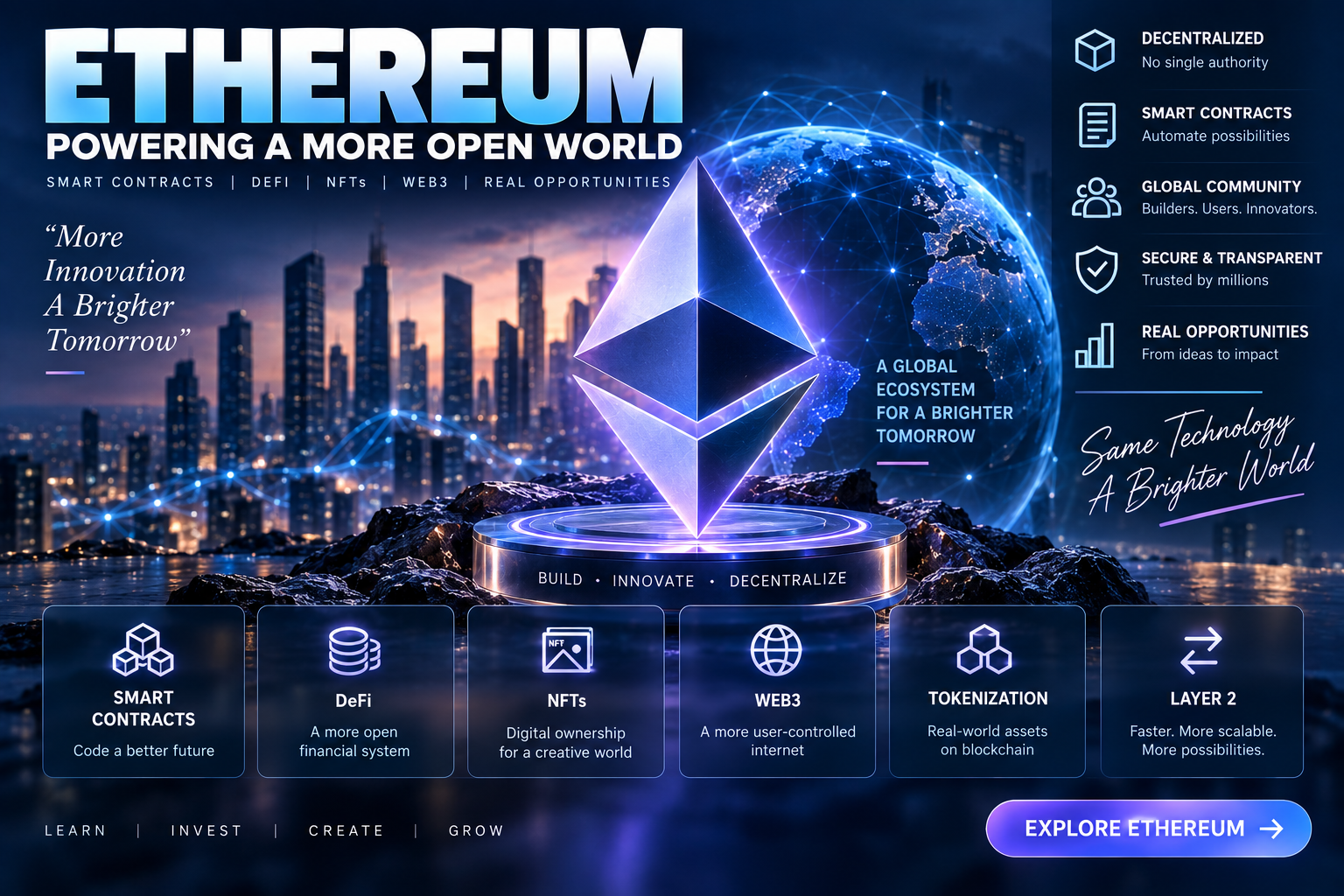
Ethereum has become one of the most important blockchain platforms in the digital economy. While Bitcoin introduced a decentralized approach to digital money, Ethereum expanded the concept by creating a programmable blockchain capable of supporting smart contracts, decentralized applications, digital assets, and a wide range of blockchain-based services.
The Ethereum ecosystem has developed into a major part of the cryptocurrency industry. Its native cryptocurrency, Ether (ETH), is used to pay transaction fees, interact with applications, and participate in the network's economic system.
From decentralized finance and non-fungible tokens to tokenization and blockchain applications, Ethereum has played a significant role in the development of Web3.
What Is Ethereum?
Ethereum is a decentralized blockchain platform designed to allow developers to create and operate applications without relying entirely on centralized intermediaries.
The network was proposed by Vitalik Buterin and launched in 2015. Unlike blockchains designed primarily for transferring digital currency, Ethereum was built as a programmable platform.
Its key feature is the ability to execute smart contracts.
Smart contracts are programs stored and executed on a blockchain. They can automatically perform actions when predefined conditions are satisfied.
This functionality allows developers to build applications that operate according to transparent rules encoded in software.
What Is ETH?
ETH, or Ether, is the native cryptocurrency of the Ethereum network.
ETH serves several important purposes within the ecosystem. Users can use ETH to pay transaction fees, commonly called gas fees. Developers and applications also rely on ETH as part of the network's economic infrastructure.
ETH can be transferred between wallets, held as a digital asset, and used within Ethereum-based applications.
Because Ethereum supports a large ecosystem of decentralized applications, ETH has become more than simply a digital payment asset.
How Ethereum Works
Ethereum operates using a distributed network of computers known as nodes.
These nodes maintain and verify the blockchain according to Ethereum's protocol rules.
When a user submits a transaction or interacts with a smart contract, the transaction is processed by the network. Valid activity is recorded on the blockchain, creating a shared history that participants can independently verify.
Ethereum's architecture allows the network to support both simple transfers of ETH and complex interactions with decentralized applications.
Ethereum and Smart Contracts
Smart contracts are at the heart of Ethereum's functionality.
A smart contract is software that runs according to programmed rules. Once deployed to the blockchain, its behavior can be executed by the network without requiring a traditional intermediary for every operation.
Smart contracts can be used for applications such as:
Decentralized exchanges
Lending platforms
Token issuance
Digital collectibles
Payment systems
Decentralized organizations
Gaming applications
Tokenized assets
Financial applications
Smart contracts have helped make Ethereum one of the most widely used platforms for blockchain application development.
Ethereum Virtual Machine
The Ethereum Virtual Machine, commonly known as the EVM, is an important component of Ethereum's architecture.
It provides an environment in which Ethereum smart contracts can be executed according to the network's rules.
Developers can write smart-contract code and deploy it to the Ethereum blockchain. The EVM processes this code across the network.
The EVM concept has also influenced other blockchain networks that aim to provide compatibility with Ethereum-based applications and development tools.
Ethereum Gas Fees
Transactions and smart-contract operations on Ethereum require computational resources.
The fee mechanism used to pay for these resources is commonly referred to as gas.
Different transactions can require different amounts of computational work. A simple ETH transfer generally requires less computation than a complex smart-contract interaction.
Network demand can also influence the cost of using Ethereum.
During periods of high activity, users may experience higher fees, while lower network demand can result in lower transaction costs.
Gas fees are therefore an important consideration for anyone interacting with Ethereum applications.
Ethereum's Transition to Proof of Stake
One of the most significant changes in Ethereum's history was its transition from proof of work to proof of stake.
The transition, known as The Merge, took place in September 2022.
Under proof of stake, Ethereum relies on validators rather than proof-of-work miners to help secure and validate the network.
Validators commit ETH to participate in the network's consensus process. The proof-of-stake system changed the technical structure of Ethereum's network and significantly reduced its direct electricity requirements compared with its former proof-of-work design.
Ethereum Validators
Validators play an important role in Ethereum's proof-of-stake system.
Validators participate in proposing and attesting to blocks according to the network's consensus rules.
To become a validator through Ethereum's native staking system, participants traditionally need to deposit a specified amount of ETH. Other staking services and pooled solutions can provide different ways for users to participate.
Staking can generate rewards, but it also involves technical, market, and protocol-related risks.
Users should understand how a particular staking service works before committing assets.
Ethereum Staking
Ethereum staking allows ETH holders to participate in network security and potentially receive rewards.
There are several ways to participate, including running a validator independently, joining a staking pool, or using services offered by centralized or decentralized platforms.
Each approach has different requirements and risks.
Independent validators require technical infrastructure and responsibility for maintaining reliable operations. Staking services can simplify the process but introduce additional counterparty or platform risks.
ETH deposited into staking arrangements may also have different withdrawal and liquidity considerations depending on the specific service being used.
Ethereum and Decentralized Finance
Ethereum played a major role in the growth of decentralized finance, commonly known as DeFi.
DeFi applications aim to provide financial services through blockchain-based protocols rather than relying entirely on traditional financial institutions.
Ethereum-based DeFi applications can provide functions such as:
Lending
Borrowing
Trading
Liquidity provision
Asset management
Payments
Derivatives
Stablecoin transfers
Users can interact with these protocols directly through compatible wallets.
However, DeFi applications can involve smart-contract vulnerabilities, market volatility, liquidity risks, and other technical and financial risks.
Ethereum and Decentralized Exchanges
Decentralized exchanges, or DEXs, are blockchain-based platforms that allow users to trade digital assets through smart contracts.
Unlike traditional centralized exchanges, decentralized exchanges can allow users to maintain control of their assets through their own wallets while interacting with smart contracts.
Ethereum has been a major environment for the development of decentralized exchange technology.
DEX activity has contributed to Ethereum's importance within the broader digital-asset ecosystem.
Ethereum and Stablecoins
Stablecoins are digital assets designed to maintain a relatively stable value, often by referencing an underlying currency such as the U.S. dollar.
Ethereum supports a large ecosystem of stablecoins.
Stablecoins can be used for:
Digital payments
Cryptocurrency trading
DeFi applications
Cross-border transfers
On-chain settlements
Liquidity management
The availability of stablecoins has helped expand the number of financial applications that can operate on blockchain networks.
Ethereum and NFTs
Ethereum was also central to the rise of non-fungible tokens, commonly known as NFTs.
NFTs are blockchain-based tokens that can represent unique digital or physical assets.
They have been used for:
Digital artwork
Collectibles
Gaming items
Memberships
Event tickets
Digital identities
Virtual assets
Ethereum-based NFT standards helped establish common frameworks through which developers could create and manage unique tokens.
Although NFT market activity has changed significantly over time, the technology remains part of the broader blockchain ecosystem.
Ethereum Token Standards
Ethereum provides standards that developers can use when creating digital tokens.
One of the most recognized standards is ERC-20, which is widely used for fungible tokens.
Other standards support different types of assets and functionality, including non-fungible tokens.
These standards make it easier for wallets, exchanges, applications, and other blockchain services to interact with compatible tokens.
Ethereum Layer-2 Networks
Ethereum has developed an ecosystem of Layer-2 networks designed to help scale blockchain activity.
Layer-2 systems process certain transactions or computations outside Ethereum's main execution environment while using Ethereum as part of their security or settlement framework.
These technologies can help improve transaction capacity and potentially reduce costs for certain users.
The broader Ethereum ecosystem now includes different scaling approaches and networks serving various applications.
Ethereum and Tokenization
Tokenization is another major area of Ethereum development.
Tokenization involves representing rights to assets or value through blockchain-based tokens.
Potential applications include:
Real-world assets
Financial instruments
Real estate
Securities
Collectibles
Loyalty programs
Digital credentials
Blockchain-based tokenization can provide programmable ownership records and automated transaction functionality.
The development of tokenized financial products could become an important area for blockchain technology as regulatory and institutional frameworks continue to evolve.
Ethereum and Web3
Ethereum is closely associated with the development of Web3.
Web3 broadly refers to applications and services that use decentralized technologies to give users greater control over digital assets, identity, and interactions.
Ethereum can provide infrastructure for decentralized applications, wallets, tokens, smart contracts, and blockchain-based communities.
The Web3 ecosystem remains under development, and different projects use different technical and economic models.
Benefits of Ethereum
Ethereum offers several important characteristics.
Programmability
Developers can create applications using smart contracts.
Decentralization
Ethereum operates through a distributed network rather than a single centralized server.
Open Development
Developers around the world can build applications and protocols on the Ethereum network.
Large Ecosystem
Ethereum supports a broad range of applications, tokens, wallets, infrastructure providers, and developer tools.
Digital Asset Support
The network can support many forms of blockchain-based assets.
Financial Innovation
Ethereum has enabled new approaches to lending, trading, payments, tokenization, and other financial services.
Risks of Ethereum
Ethereum also involves considerable risks.
Market Volatility
ETH can experience substantial price movements.
Smart-Contract Risk
Applications built on Ethereum can contain software vulnerabilities.
Regulatory Risk
Government policies can affect cryptocurrency businesses, applications, and users.
Network Complexity
Ethereum's technology can be difficult for new users to understand.
User Security
Wallets, private keys, and recovery phrases must be protected carefully.
Platform Risk
Centralized exchanges and third-party services can introduce additional risks that are separate from the Ethereum protocol itself.
Understanding these risks is essential before using ETH or interacting with Ethereum applications.
Ethereum Security
The Ethereum protocol uses cryptographic technology and decentralized consensus to protect the network.
However, users can still lose assets because of scams, phishing, malicious smart contracts, compromised wallets, or incorrect transactions.
A blockchain transaction generally cannot simply be reversed because a user made a mistake.
Users should carefully verify wallet addresses, applications, transaction details, and websites before approving transactions.
Private keys and recovery phrases should never be shared with strangers or entered into suspicious websites.
Ethereum Regulation
The regulatory treatment of Ethereum and ETH varies between jurisdictions.
Governments and regulators continue to develop rules covering digital assets, exchanges, taxation, securities, custody, decentralized finance, and financial services.
Regulatory changes can influence how Ethereum-based businesses operate and how users access cryptocurrency services.
Anyone using ETH for business or investment purposes should understand the laws and regulations applicable in their jurisdiction.
Ethereum's Role in the Global Digital Economy
Ethereum has expanded the concept of blockchain technology beyond digital currency.
Its programmable infrastructure allows developers to create systems in which financial transactions, digital assets, ownership records, and other functions can be managed through blockchain-based software.
This has attracted developers, entrepreneurs, financial institutions, technology companies, and individual users.
Ethereum therefore occupies an important position at the intersection of cryptocurrency, software development, financial technology, and decentralized applications.
The Future of Ethereum
Ethereum's future development will depend on several factors.
Technology upgrades will continue to focus on scalability, efficiency, security, and user experience.
Layer-2 networks and other scaling technologies may expand the number of transactions and applications that can operate around Ethereum's ecosystem.
Institutional adoption and tokenization could also influence Ethereum's role in financial infrastructure.
At the same time, Ethereum faces competition from other blockchain platforms that offer alternative approaches to scalability, fees, applications, and developer ecosystems.
The long-term development of Ethereum will therefore depend on technological progress, developer activity, user adoption, regulatory conditions, and market demand.
Ethereum and the Future of Digital Finance
Ethereum has demonstrated how blockchain technology can become a programmable financial infrastructure.
Instead of simply transferring a digital currency from one address to another, users can interact with software that automatically executes predefined rules.
This creates possibilities for decentralized exchanges, lending markets, tokenized assets, stablecoins, digital collectibles, and many other applications.
As financial institutions and technology companies continue exploring blockchain technology, Ethereum may remain an important platform for experimentation and development.
Conclusion
Ethereum has evolved from a blockchain project into a broad digital ecosystem supporting smart contracts, decentralized applications, financial protocols, tokens, NFTs, stablecoins, and Web3 infrastructure.
Its native cryptocurrency, ETH, plays a central role in the network by supporting transaction fees and the proof-of-stake consensus system.
Ethereum's programmable architecture has helped drive some of the most important developments in blockchain technology. At the same time, users face risks involving market volatility, smart contracts, regulation, cybersecurity, and third-party services.
The future of Ethereum will depend on its ability to continue improving scalability, security, efficiency, and usability while maintaining a strong developer and user ecosystem.
As blockchain technology continues to develop, Ethereum remains an important platform to watch in the evolving world of digital finance and decentralized technology.