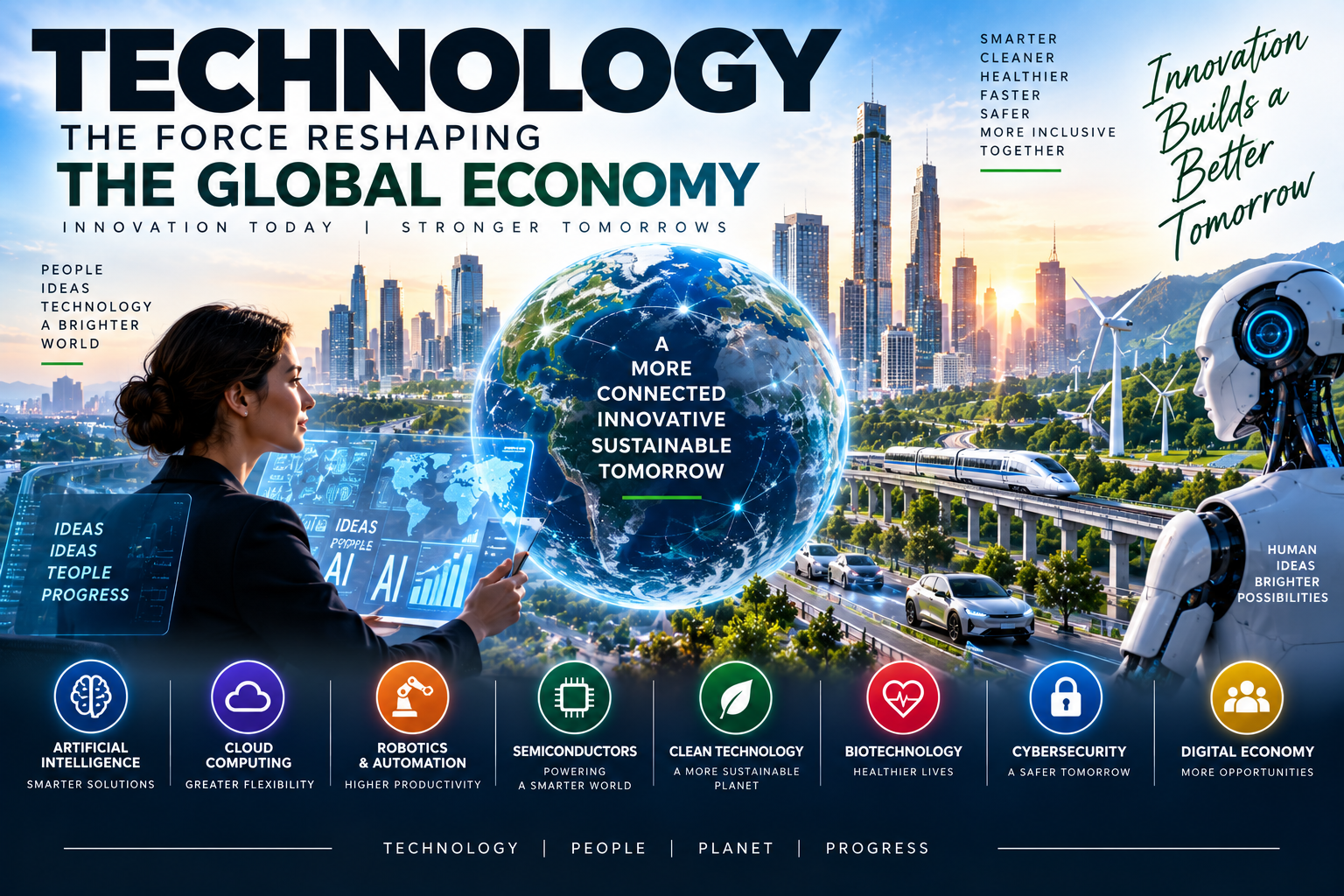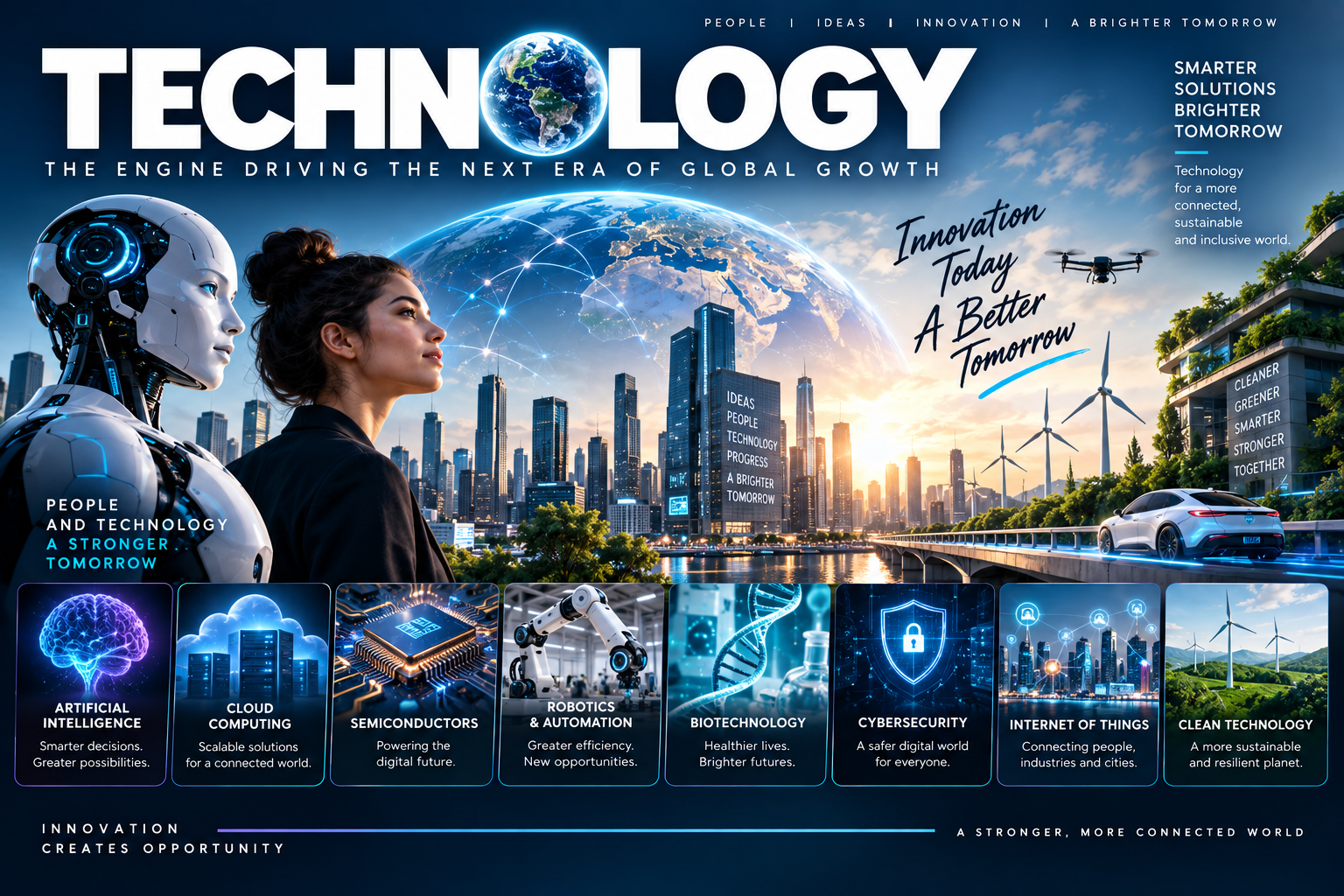
Technology has become one of the most powerful forces shaping the modern world. From artificial intelligence and cloud computing to robotics, biotechnology, semiconductors, and advanced connectivity, technological innovation is changing how people live, how companies operate, and how economies compete.
What once seemed like futuristic concepts are increasingly becoming part of everyday life. Businesses use artificial intelligence to analyze information, automate tasks, and improve customer experiences. Financial institutions rely on digital infrastructure to process transactions at extraordinary speed. Manufacturers are integrating robotics into production lines, while healthcare organizations are using advanced technologies to support diagnosis, research, and personalized care.
Technology is no longer simply an industry. It is an essential foundation of almost every major industry.
As investment in innovation accelerates, the global economy is entering a period in which technological capabilities can determine competitiveness, productivity, resilience, and long-term growth.
Technology as a Global Economic Force
The economic importance of technology extends far beyond technology companies themselves. Digital tools now influence manufacturing, agriculture, transportation, finance, healthcare, education, retail, energy, entertainment, and government services.
For businesses, technology can improve productivity by reducing repetitive work, accelerating decision-making, and enabling employees to collaborate across borders. Cloud platforms allow companies to access computing resources without building extensive physical infrastructure, while digital communication makes international cooperation easier.
Technology can also create entirely new markets.
The growth of the smartphone economy, for example, created opportunities for mobile applications, digital payments, online marketplaces, location-based services, streaming platforms, and creator businesses. Similarly, artificial intelligence is generating new opportunities in software, data services, automation, cybersecurity, healthcare, education, and professional services.
The result is a global economy in which innovation increasingly determines which businesses grow, which industries transform, and which regions attract investment.
Artificial Intelligence Takes Center Stage
Artificial intelligence has emerged as one of the defining technologies of the current decade.
AI systems can process large amounts of information, recognize patterns, generate content, support decision-making, and automate increasingly complex tasks. Businesses are exploring AI applications across customer service, marketing, software development, finance, research, logistics, and operations.
Generative AI has expanded this transformation by allowing users to create text, images, audio, software code, and other forms of content using natural-language instructions.
For companies, the attraction is clear. AI can potentially help employees work faster while allowing organizations to analyze information at a scale that would be difficult to achieve manually.
However, AI also introduces important questions about accuracy, privacy, employment, intellectual property, cybersecurity, and responsible use.
The long-term economic impact of AI will therefore depend not only on how powerful the technology becomes, but also on how effectively businesses, governments, and societies adapt to it.
Cloud Computing and the Digital Infrastructure Economy
Modern technology depends heavily on digital infrastructure.
Cloud computing has transformed the way organizations store information, run applications, manage data, and scale their operations. Instead of maintaining all computing resources internally, businesses can access infrastructure and software through cloud platforms.
This model can provide flexibility for companies of different sizes. A startup can use sophisticated computing resources without making the same infrastructure investments historically required by large corporations. Established businesses can scale digital operations more quickly and support employees working across multiple locations.
Cloud infrastructure is also becoming increasingly important for artificial intelligence because advanced AI applications require significant computing power and data-processing capabilities.
As digital services expand, demand for data centers, networking equipment, storage, cybersecurity, and specialized computing hardware is also increasing.
Semiconductors: The Foundation of Modern Technology
Behind many of the world's most important technologies are semiconductors.
These tiny components power smartphones, computers, vehicles, industrial equipment, medical devices, telecommunications systems, and artificial intelligence infrastructure.
The semiconductor industry has therefore become strategically important to governments and businesses around the world.
Advanced chips are particularly valuable because they support high-performance computing, AI systems, telecommunications, and sophisticated electronics. This has encouraged countries to strengthen domestic semiconductor capabilities and diversify supply chains.
The competition surrounding semiconductor manufacturing demonstrates an important reality: technological leadership depends not only on software and ideas, but also on physical infrastructure, engineering expertise, specialized equipment, and reliable supply chains.
Robotics and the Future of Automation
Robotics is another major area of technological development.
Factories have used industrial robots for decades, but modern robotics is becoming increasingly sophisticated. Robots can now perform tasks involving greater levels of precision, movement, inspection, and coordination.
Automation is expanding beyond manufacturing. Warehouses use robotic systems to organize inventory and move goods. Hospitals are exploring robotic technologies for certain procedures and logistics. Agriculture is adopting automated equipment for monitoring, harvesting, and field operations.
The rise of robotics does not necessarily mean that human workers will disappear. Instead, many workplaces may experience a shift in the types of tasks people perform.
Jobs that depend heavily on repetitive physical or administrative activities may become more automated, while demand could increase for workers who can manage technology, solve problems, interpret information, and perform tasks requiring creativity and human judgment.
Biotechnology and Digital Healthcare
Technology is also changing medicine and healthcare.
Advances in biotechnology, medical imaging, data analysis, digital health platforms, and laboratory technology are expanding the ability to understand diseases and develop treatments.
Artificial intelligence can help researchers analyze large biological datasets, while digital systems can make healthcare information more accessible and easier to manage.
Wearable devices are also changing how people interact with personal health and fitness information. Sensors can collect data related to activity, sleep, heart rate, and other measurements, creating opportunities for more continuous monitoring.
At the same time, healthcare technology raises important questions about data security, privacy, access, and the responsible interpretation of digital information.
The opportunity is significant, but technological progress in healthcare must be matched by strong standards and human oversight.
Technology and the Transformation of Business
Technology has changed the competitive landscape for businesses of almost every size.
A small company can now reach international customers through digital platforms, online advertising, social media, e-commerce, and cloud-based tools. Entrepreneurs can build businesses with relatively limited physical infrastructure compared with previous generations.
Large companies, meanwhile, are investing heavily in automation, data analytics, AI, cybersecurity, digital supply chains, and personalized customer experiences.
Technology is also changing management itself.
Executives increasingly depend on real-time information to understand customers, operations, financial performance, and market trends. Data-driven decision-making can allow organizations to respond more quickly to changing conditions.
But having more data does not automatically produce better decisions. Businesses must develop the skills and systems needed to distinguish useful information from noise.
Cybersecurity Becomes a Strategic Priority
As businesses become more digital, cybersecurity becomes increasingly important.
Companies now depend on networks, cloud platforms, software applications, connected devices, and digital databases. A serious cyber incident can disrupt operations, expose sensitive information, damage reputation, and create significant financial consequences.
Cybersecurity is therefore moving from being primarily an IT concern to becoming a strategic business issue.
Organizations are investing in identity protection, encryption, monitoring systems, employee education, threat detection, and security infrastructure. Artificial intelligence is also being used on both sides of the cybersecurity equation: defenders can use automated systems to identify suspicious activity, while attackers can potentially use advanced tools to develop more sophisticated threats.
The future of digital business will depend partly on the ability to make technology secure as well as useful.
The Internet of Things and Connected Industries
The Internet of Things, commonly known as IoT, connects physical devices to digital networks.
Sensors and connected systems can collect information from factories, vehicles, buildings, farms, warehouses, and homes. This information can then be analyzed to improve efficiency and performance.
In manufacturing, connected machines can help companies monitor production and identify potential maintenance requirements. In transportation, connected systems can support fleet management and traffic optimization. In agriculture, sensors can provide information about environmental conditions.
Smart cities represent another major application. Connected infrastructure could help cities manage transportation, energy consumption, public services, and urban planning more efficiently.
As more physical objects become digitally connected, the boundary between the physical and digital economies will continue to disappear.
Technology and Sustainability
Technological innovation is also playing a central role in the transition toward a more sustainable economy.
Renewable energy systems, electric vehicles, smart grids, energy-storage technologies, advanced materials, and energy-efficient buildings are examples of technologies that can support lower-emission economic activity.
Digital systems can also improve resource efficiency. Businesses can use data to reduce waste, optimize logistics, monitor energy consumption, and improve production processes.
However, technology itself has an environmental footprint. Data centers consume energy, electronic devices require raw materials, and discarded electronics create waste.
The challenge is therefore not simply to develop more technology, but to develop technology that uses resources more efficiently and supports long-term environmental resilience.
The Future of Work
One of the most significant consequences of technological progress will be its impact on employment.
Automation and AI are likely to change many occupations. Some tasks may disappear, while new responsibilities and professions emerge.
The most important skill in the future may not be the ability to perform one specific task, but the ability to learn continuously.
Digital literacy, critical thinking, communication, creativity, problem-solving, and technological adaptability are becoming increasingly valuable. Organizations will also need to invest in training as employees transition into new roles.
The workplace of the future is unlikely to be defined solely by humans or machines. Instead, successful organizations may increasingly combine human judgment and creativity with machine speed and analytical capabilities.
Technology and the Global Competition for Innovation
Technology has become an important part of international economic competition.
Countries that develop strong research institutions, skilled workforces, digital infrastructure, manufacturing capabilities, and innovation ecosystems can gain advantages in emerging industries.
Governments are therefore increasing attention toward areas such as artificial intelligence, semiconductors, quantum computing, biotechnology, cybersecurity, telecommunications, and clean technology.
This competition could accelerate innovation, but it may also create tensions around trade, intellectual property, data governance, technology standards, and supply-chain security.
The countries that succeed may not necessarily be those that invent every technology themselves. Strong ecosystems can emerge through cooperation between universities, startups, corporations, investors, and governments.
The Importance of Responsible Innovation
Technological progress creates enormous opportunities, but innovation without responsibility can create serious problems.
Privacy protection, ethical AI, digital safety, cybersecurity, misinformation, algorithmic bias, intellectual property, and unequal access are increasingly important issues.
Governments and businesses face the challenge of creating rules that protect people without preventing useful innovation.
This balance will become particularly important as technologies become more powerful. Regulation that is too weak can allow harmful practices to spread, while regulation that is too rigid could discourage investment and experimentation.
Responsible innovation requires transparency, accountability, security, and a clear understanding of how technologies affect society.
Technology and the Next Decade
The next decade could bring major advances across several technological fields.
Artificial intelligence may become deeply integrated into everyday software and professional workflows. Robotics could become more capable and accessible. Biotechnology may unlock new approaches to healthcare. Semiconductor development could support increasingly powerful computing systems. Clean technologies could reshape energy and transportation.
Meanwhile, technologies that are currently developing may converge.
AI could work alongside robotics. Connected devices could communicate with intelligent systems. Biotechnology could combine with advanced computing. Renewable energy could be integrated with smart digital infrastructure.
This convergence could produce innovations that are difficult to predict today.
Conclusion
Technology is no longer simply a tool used by the modern economy. It is one of the forces defining the economy itself.
Artificial intelligence, cloud computing, semiconductors, robotics, biotechnology, cybersecurity, connected devices, and clean technologies are transforming industries and changing how value is created.
The greatest opportunities will likely belong to businesses and societies that can adopt new technologies while investing in people, security, education, and responsible innovation.
The future of technology will not be determined solely by machines becoming more powerful. It will also depend on how humans choose to use that power.
As innovation continues to accelerate, technology will remain one of the central engines of global economic growth—and one of the most important forces shaping the future of modern life.