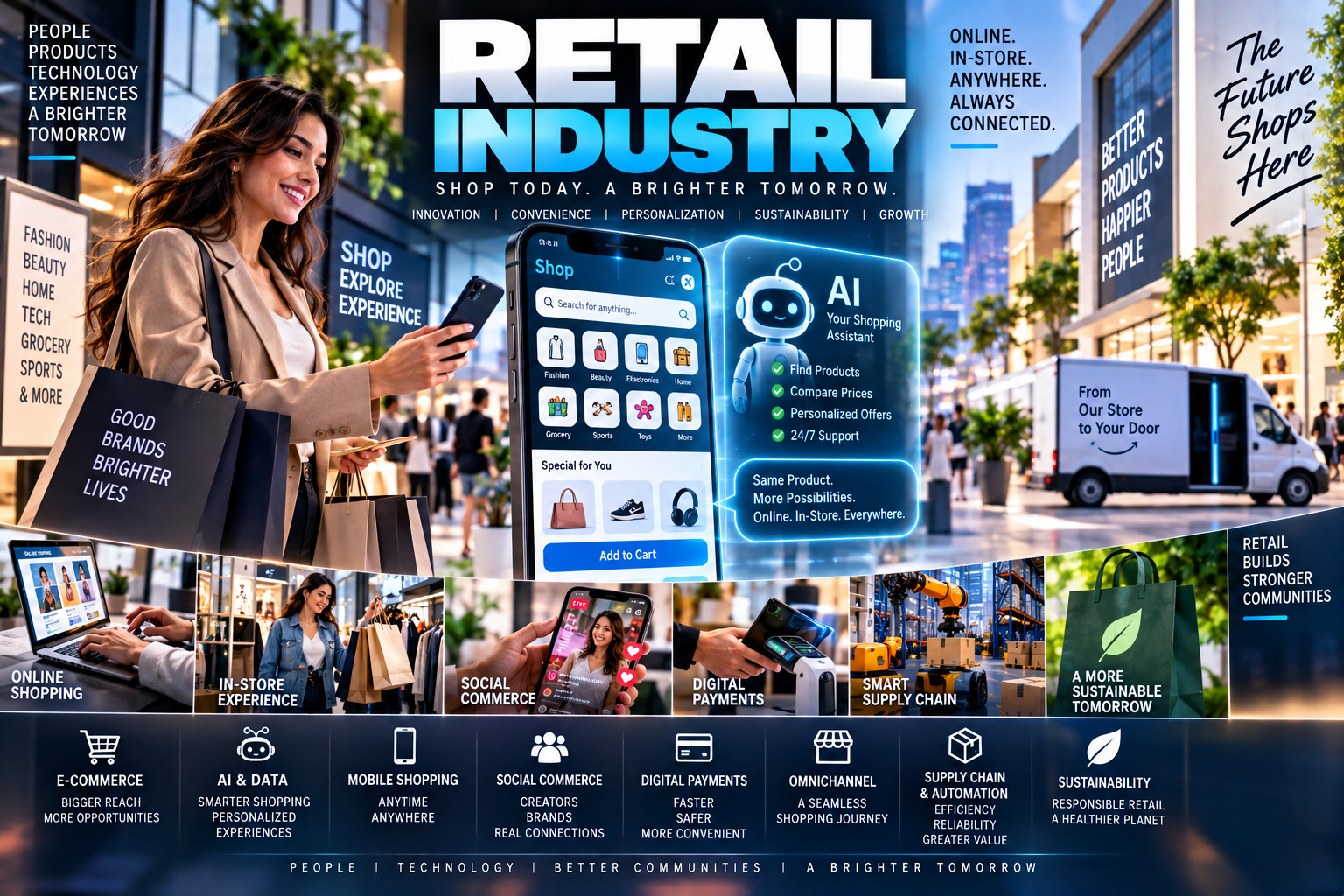
The retail industry is one of the most dynamic parts of the global economy. From neighborhood stores and shopping centers to e-commerce platforms and global brands, retail connects businesses directly with consumers. It influences how people discover products, compare prices, make purchases, receive services, and interact with brands.
Over the past decade, technology has transformed retail at an extraordinary pace. Smartphones, online shopping, digital payments, artificial intelligence, automation, data analytics, and social commerce have changed traditional shopping habits. Consumers can now discover a product on social media, compare prices online, purchase it through a mobile device, and receive it at their home without visiting a physical store.
However, physical retail has not disappeared. Instead, the industry is moving toward a more integrated model in which physical stores and digital channels work together.
The future of retail will be shaped by technology, convenience, personalization, customer experience, supply-chain efficiency, and the ability of businesses to respond to changing consumer expectations.
What Is the Retail Industry?
The retail industry includes businesses that sell products and services directly to consumers. It covers a wide range of categories, including grocery, fashion, electronics, furniture, beauty, luxury goods, home products, convenience stores, department stores, specialty retailers, and online marketplaces.
Retail businesses can operate through physical stores, websites, mobile applications, social platforms, or a combination of these channels.
The industry plays an important role in the economy because it connects manufacturers and suppliers with consumers. Retailers also create employment across sales, logistics, marketing, technology, customer service, management, and other areas.
The Rise of E-Commerce
E-commerce has fundamentally changed retail.
Consumers can now shop from almost anywhere and at any time. Online stores provide access to large product selections, customer reviews, price comparisons, personalized recommendations, and home delivery.
For retailers, e-commerce creates opportunities to reach customers beyond their local geographic markets.
A small business can potentially sell products to customers in other cities or countries without opening physical stores in each location.
However, online retail is highly competitive. Customers can quickly compare products and prices across multiple websites. Retailers therefore need strong branding, reliable fulfillment, competitive pricing, convenient delivery, and excellent customer service.
The Omnichannel Retail Experience
The distinction between online and offline shopping is becoming less important.
Modern consumers often move between different channels during the same purchasing journey. A customer might discover a product on social media, research it on a website, visit a physical store to see it, and eventually purchase it through a mobile application.
This has created the concept of omnichannel retail.
An omnichannel strategy connects different customer touchpoints so that shoppers can experience a consistent relationship with a brand.
Examples include buying online and collecting an order in a store, checking store inventory through an app, or returning an online purchase at a physical location.
The goal is to make shopping more flexible rather than forcing customers to choose between online and offline channels.
Artificial Intelligence in Retail
Artificial intelligence is becoming increasingly important to retailers.
AI can analyze customer behavior, forecast demand, personalize recommendations, optimize pricing, improve customer service, and support inventory management.
Retailers can use predictive analytics to estimate which products customers are likely to purchase and when demand may increase.
AI-powered customer service tools can also answer routine questions and help shoppers find products.
Generative AI may further influence retail by assisting with product descriptions, marketing content, customer communication, and internal operations.
However, retailers need to use customer data responsibly. Personalization can improve the shopping experience, but excessive or poorly managed data collection can create privacy concerns.
Personalization and Customer Experience
Consumers increasingly expect personalized experiences.
Retailers can use information about customer preferences, previous purchases, browsing behavior, and other interactions to provide more relevant recommendations and communications.
Personalization can make it easier for customers to discover products they are genuinely interested in.
However, personalization needs to provide value.
Customers may become uncomfortable if businesses appear to know too much about them or use their data without clear transparency.
Successful retailers will need to balance personalization with privacy and customer trust.
The Growth of Social Commerce
Social media is becoming an increasingly important retail channel.
Platforms allow brands to showcase products through videos, images, livestreams, influencers, and direct shopping features.
Consumers can discover products while watching content and move from discovery to purchase with fewer steps.
This has created opportunities for both established retailers and smaller businesses.
Creators and influencers can also become powerful distribution partners because they have direct relationships with specific communities.
Social commerce therefore connects retail with the broader creator economy.
Mobile Shopping
Smartphones have become central to modern retail.
Mobile applications and mobile websites allow consumers to browse products, compare prices, make payments, track deliveries, and communicate with retailers.
Mobile devices can also connect online and physical shopping experiences.
Retailers may use mobile applications for loyalty programs, digital receipts, personalized offers, product information, and store navigation.
As mobile technology continues to evolve, the smartphone is likely to remain one of the most important tools in the retail customer journey.
Digital Payments
Digital payments have changed the checkout experience.
Consumers can increasingly pay using mobile wallets, contactless payments, online banking, cards, and other digital methods.
For retailers, digital payments can make transactions faster and more convenient.
Payment technology can also support online commerce by allowing customers to complete purchases without physical cash.
Security is critical, however. Retailers need to protect payment information and customer accounts from fraud and cyber threats.
Supply Chain and Inventory Management
Behind every retail experience is a complex supply chain.
Retailers need to source products, manage warehouses, forecast demand, transport inventory, and ensure that products reach customers at the right time.
Technology can improve these processes.
Data analytics and AI can help forecast demand and reduce the risk of excess inventory or stock shortages.
Automation and robotics can support warehouse operations, while real-time tracking can improve visibility across logistics networks.
Efficient supply-chain management can reduce costs while improving customer satisfaction.
The Changing Physical Store
Physical stores continue to play an important role, but their purpose is changing.
Instead of simply functioning as places where customers purchase products, stores can become spaces for discovery, service, experience, and community.
Some retailers use technology to create interactive displays, self-checkout systems, digital product information, personalized offers, and other experiences.
Physical stores also provide something online shopping cannot fully reproduce: the ability to see, touch, test, or experience products in person.
The strongest retailers may therefore combine the convenience of e-commerce with the experience of physical stores.
Retail Automation
Automation is increasingly being used across retail operations.
Self-checkout systems can reduce waiting times. Automated warehouses can improve order fulfillment. Software can automate pricing, inventory updates, customer notifications, and administrative tasks.
Automation can increase productivity and allow employees to focus on activities requiring human interaction.
However, retailers need to consider the customer experience when implementing automation.
Technology should make shopping easier rather than simply shifting responsibilities from employees to customers.
Sustainability in Retail
Sustainability has become an increasingly important consideration for retailers.
Consumers and investors are paying greater attention to packaging, supply chains, product materials, energy use, waste, and business practices.
Retailers are exploring ways to reduce packaging, improve logistics efficiency, offer more sustainable products, and reduce waste.
Technology can help businesses monitor supply chains and identify opportunities to use resources more efficiently.
The challenge is balancing sustainability goals with affordability and customer expectations.
The Role of Customer Loyalty
Customer loyalty remains a major competitive advantage in retail.
Loyalty programs can encourage repeat purchases by providing rewards, personalized offers, early access, or other benefits.
Digital loyalty programs allow retailers to connect customer activity across different channels.
However, loyalty cannot be created through discounts alone.
Customers are more likely to remain loyal when a retailer consistently provides good products, reliable service, fair pricing, convenience, and a positive experience.
Trust and brand reputation are therefore important components of long-term retail success.
Retail Data and Analytics
Retailers generate enormous amounts of data.
Sales transactions, website activity, customer interactions, inventory records, marketing campaigns, and supply-chain information can all provide insights.
Analytics can help retailers understand which products are performing well, which marketing strategies are effective, and where operational improvements are possible.
Real-time information can also help businesses respond more quickly to changing demand.
However, data must be accurate and responsibly managed. Poor-quality data can result in incorrect decisions, while careless handling of customer information can create privacy and security risks.
Challenges Facing the Retail Industry
The retail industry faces several major challenges.
Competition is intense, particularly in e-commerce. Consumers can compare prices easily, while businesses face pressure to provide fast and affordable delivery.
Supply-chain disruptions can also affect product availability and costs.
Retailers must manage changing consumer preferences, inflationary pressures, labor challenges, technology investments, cybersecurity risks, and sustainability expectations.
Customer expectations are also rising. People increasingly want convenience, speed, transparency, personalization, and reliable service.
Retailers that fail to adapt can quickly lose market share.
Retail and the Creator Economy
Creators are becoming increasingly influential in retail.
A product recommendation from a trusted creator can introduce a brand to a highly engaged audience.
Influencer marketing, affiliate commerce, livestream shopping, and creator-led product launches are creating new pathways from content to commerce.
This trend is particularly powerful because consumers often view creators as more relatable than traditional advertisements.
Retailers can benefit from these relationships when partnerships are authentic and aligned with the creator's audience.
The Future of Retail
The future of retail will likely be more connected, personalized, automated, and experience-driven.
Artificial intelligence will continue to influence product recommendations, customer service, forecasting, and operations.
Mobile commerce and social commerce are likely to expand, while physical stores will increasingly focus on experience and service.
Retailers will also invest in supply-chain technology, cybersecurity, digital payments, automation, and sustainability.
The most successful companies may not be those that are purely online or purely physical. Instead, they may be businesses that seamlessly connect digital and physical experiences.
Conclusion
The retail industry is undergoing a fundamental transformation.
E-commerce, mobile technology, artificial intelligence, social commerce, digital payments, automation, and data analytics are changing how products are discovered, purchased, delivered, and experienced.
At the same time, physical stores remain valuable because they provide human interaction and experiences that digital channels cannot fully replicate.
The future of retail will therefore depend on integration.
Retailers that understand their customers, use technology responsibly, manage their supply chains efficiently, protect data, and create convenient experiences will be better positioned to compete.
Ultimately, retail is no longer simply about selling products. It is about creating connected experiences, building customer trust, and delivering value wherever and whenever consumers choose to shop.
Frequently Asked Questions About the Retail Industry
1. What is the retail industry?
The retail industry consists of businesses that sell products and services directly to consumers through physical stores, websites, mobile applications, marketplaces, and other channels.
2. How is technology changing retail?
Technology is transforming retail through AI, e-commerce, mobile shopping, digital payments, automation, data analytics, social commerce, and connected customer experiences.
3. What is e-commerce?
E-commerce is the buying and selling of products or services through digital channels, particularly websites and mobile applications.
4. What is omnichannel retail?
Omnichannel retail connects online and physical shopping channels to create a more seamless customer experience.
5. How is AI used in retail?
AI can support personalized recommendations, demand forecasting, inventory management, customer service, pricing analysis, marketing, and other retail operations.
6. Why is personalization important in retail?
Personalization can help customers discover products and offers that are more relevant to their interests while helping retailers improve engagement and customer relationships.
7. What is social commerce?
Social commerce involves discovering, promoting, and purchasing products through social media platforms and creator-driven digital content.
8. Are physical retail stores still important?
Yes. Physical stores provide opportunities for customers to see, touch, test, and experience products while also offering personal service and immediate access.
9. How can retailers improve customer loyalty?
Retailers can build loyalty through quality products, reliable service, convenience, competitive value, personalized experiences, rewards programs, and strong customer relationships.
10. Why is supply-chain technology important for retailers?
Supply-chain technology helps retailers forecast demand, manage inventory, track shipments, improve warehouse operations, and reduce delays and unnecessary costs.
11. What are the biggest challenges facing retailers?
Major challenges include intense competition, changing consumer expectations, supply-chain disruptions, cybersecurity, rising costs, labor challenges, and the need to continuously adopt new technology.
12. What is the future of retail?
The future of retail is likely to involve more AI, automation, mobile commerce, social commerce, digital payments, personalized experiences, advanced logistics, and integration between online and physical stores.
13. How are creators influencing retail?
Creators can influence purchasing decisions through product recommendations, reviews, livestreams, affiliate links, sponsorships, and creator-led product launches, connecting audiences directly with brands and products.