
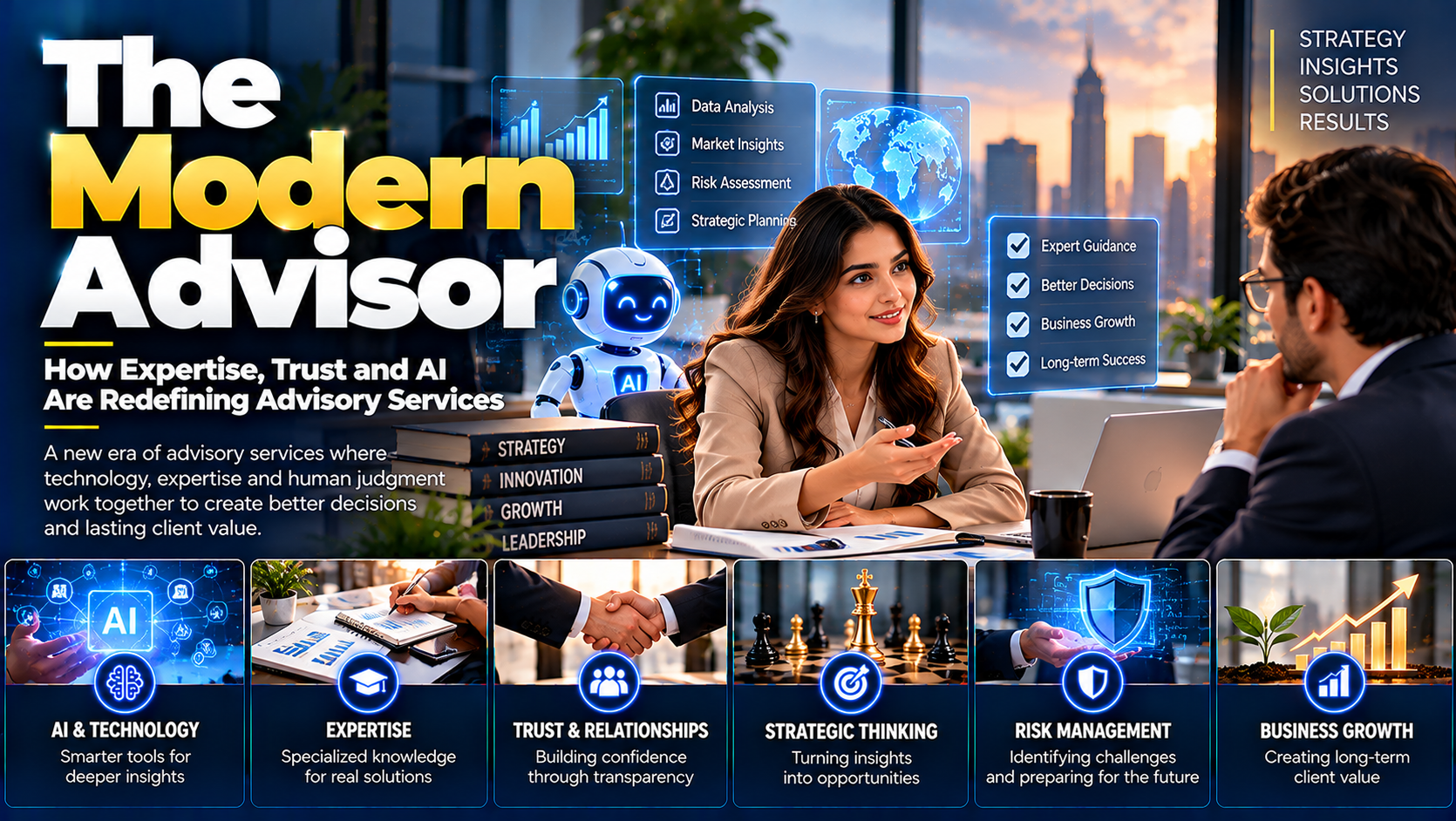
The role of an advisor is changing rapidly.
Across business, finance, technology and management, clients are seeking more than information. They want clear direction, informed judgment, practical solutions and someone who can help them make confident decisions in an increasingly complex world.
At the same time, artificial intelligence is transforming how advisors research problems, analyze information, prepare recommendations and communicate with clients. Tasks that once required hours of manual work can increasingly be supported by automated tools, creating opportunities for advisors to concentrate on higher-value activities.
The result is a fundamental shift in the advisory profession.
The modern advisor is no longer simply a source of expertise. They are becoming a strategic partner who combines specialized knowledge, analytical thinking, technology and human understanding to help clients achieve meaningful outcomes.
Research published by Morningstar in October 2026 found that 80% of surveyed US financial advisors were using AI, up from 67% in 2025. The research also highlighted the importance of client relationships, transparent fees and demonstrating the value of professional advice. Although the survey focused on financial advisors in the United States, it illustrates a broader transformation in knowledge-based services. (Morningstar)
For advisors across industries, the challenge is becoming clear: technology can improve the delivery of advice, but expertise, accountability and trust remain essential.
1. The Advisor's Role Is Expanding
Traditionally, an advisor was often hired to solve a particular problem.
A financial advisor helped manage investments. A business advisor recommended operational improvements. A technology advisor evaluated systems. A career advisor guided professional development.
These specialized roles remain important, but clients increasingly expect advisors to understand how individual decisions affect the wider organization or personal situation.
A technology recommendation, for example, may influence operating costs, employee productivity, cybersecurity and customer experience. A business expansion strategy may affect financing, hiring, supply chains and regulatory obligations.
Modern advisors therefore need to understand not only their specialist subject but also the broader context in which their recommendations will be used.
This requires three capabilities:
Technical expertise: Understanding the subject deeply enough to identify realistic solutions.
Strategic thinking: Recognizing how decisions affect long-term objectives.
Practical execution: Helping clients turn recommendations into measurable results.
An advisor who understands all three can provide more value than someone who delivers a report without considering implementation.
2. AI Is Changing How Advisors Work
Artificial intelligence is becoming an important tool across advisory services.
Depending on the profession and the tools available, AI can assist with research, data analysis, document preparation, meeting summaries, scenario modeling and routine communications.
This can reduce administrative workloads and allow advisors to spend more time understanding client needs.
Morningstar's 2026 research identified internal productivity, idea generation, research and client communication among the areas where financial advisors were using AI. (Morningstar)
Consider a business advisor preparing for a meeting with a manufacturing company.
Instead of beginning with a blank document, the advisor might use AI to organize operational data, summarize background material, generate questions and compare possible improvement strategies.
The advisor must then verify the information, test assumptions, understand the company's circumstances and decide which recommendations are appropriate.
AI can accelerate preparation, but it does not automatically establish whether a recommendation is commercially sensible.
The strongest approach is to combine machine-assisted analysis with professional judgment.
3. Expertise Matters More When Information Is Easy to Access
Clients can already find enormous amounts of information online.
They can compare products, read industry reports, watch tutorials and use AI assistants to explain unfamiliar subjects.
As access to information improves, the value of an advisor increasingly depends on the ability to interpret it.
Two clients may receive the same information but need completely different recommendations because their objectives, resources, risks and constraints differ.
A skilled advisor understands those differences.
They know which questions to ask, which assumptions deserve scrutiny and which details could change the final decision.
This makes experience, specialist knowledge and contextual understanding valuable differentiators.
The future advisor will not necessarily be the person who provides the most information. It may be the person who helps clients understand what the information means for them.
4. Trust Is a Competitive Advantage
Advisory relationships depend on trust.
Clients often share confidential information, discuss uncertain plans and rely on advisors when decisions carry significant consequences.
Without trust, even technically strong recommendations can struggle to gain acceptance.
Trust develops through consistent behavior rather than persuasive language alone.
Modern advisors can strengthen it by:
Explaining recommendations clearly.
Disclosing limitations and uncertainties.
Separating evidence from personal opinion.
Protecting confidential information.
Acknowledging mistakes.
Communicating potential conflicts of interest.
Following through on commitments.
Explaining fees and expected value.
Financial-advisory research from Edward Jones and Morning Consult in 2026 found that 68% of surveyed financial advisors believed maintaining long-term client trust required a human touch. The finding reinforces the importance of relationships even as technology becomes more capable. (Edward Jones)
Trust is particularly important when AI is involved. Clients should understand when automated tools contribute to analysis, what information is being used and who remains responsible for the advice.
5. Communication Separates Good Advisors From Great Ones
An advisor may understand a complicated issue perfectly and still fail to help a client if the explanation is unclear.
Effective communication means translating complex information into language that supports decision-making.
A strong advisor explains not only what they recommend but also why the recommendation matters, what alternatives exist and what could go wrong.
For example, a technology advisor recommending a new software platform should not focus exclusively on technical features.
They should explain how the system could affect costs, productivity, security, training and long-term flexibility.
Similarly, a business advisor should connect strategic recommendations to revenue, customer satisfaction, operational performance or risk reduction.
The goal is not to demonstrate how much the advisor knows.
It is to help the client understand what to do next.
6. Specialization Creates Differentiation
The advisory market is competitive. General knowledge can be useful, but a clearly defined specialty helps advisors communicate their value.
A business advisor might specialize in small-business growth, operational efficiency or international expansion.
A technology advisor might focus on cloud migration, cybersecurity, data infrastructure or AI implementation.
A financial advisor might concentrate on retirement planning, business-owner wealth or complex family financial needs.
Specialization offers several advantages.
First, it makes marketing more precise. Second, it helps advisors build deeper expertise. Third, it allows them to develop repeatable processes for recurring client problems.
However, specialization should not create tunnel vision. Advisors still need to recognize when a problem extends beyond their competence and requires another professional.
The strongest specialists understand both their capabilities and their limitations.
7. Data-Driven Advice Must Be Balanced With Judgment
Modern advisory work increasingly depends on data.
Businesses collect information about customers, revenue, operations, employee performance, marketing and financial results. AI tools can help identify patterns and generate potential explanations.
But data is not automatically meaningful.
A metric may be incomplete, outdated or misleading. A correlation may not demonstrate causation. A forecast may depend on assumptions that fail to hold in practice.
Advisors need to understand how evidence was collected and what it can reasonably support.
A reliable analytical process involves:
Defining the problem.
Checking data quality.
Identifying relevant variables.
Comparing plausible explanations.
Testing assumptions.
Evaluating uncertainty.
Explaining the implications.
Recommending an appropriate next step.
This process reduces the risk of confident recommendations built on weak evidence.
AI-generated analysis should also be reviewed before it is used to make consequential decisions.
8. Advisors Must Learn to Manage Risk
Good advice is not simply about maximizing potential benefits.
It also involves identifying risks and preparing for unexpected outcomes.
A business expansion might increase revenue potential but require additional capital. A new technology might improve productivity while introducing cybersecurity vulnerabilities. An investment strategy might offer higher expected returns while exposing a client to greater losses.
The advisor's responsibility is to make these trade-offs understandable.
Risk management may involve scenario planning, contingency strategies, independent reviews, compliance checks and clear decision thresholds.
Advisors should also communicate uncertainty honestly.
No analysis can eliminate every risk, and no professional can guarantee every outcome.
Clients benefit when they understand both the opportunity and the downside before committing resources.
9. The Modern Advisor Is a Long-Term Partner
Some advisory relationships remain focused on a single project. Others develop into long-term partnerships.
The difference often depends on whether the advisor helps clients build lasting capabilities rather than simply delivering a recommendation.
A business advisor might help establish performance indicators and review them regularly.
A technology advisor might develop a roadmap for future upgrades.
A financial advisor might revisit a client's goals as circumstances change.
This ongoing relationship can improve continuity and help clients respond to new challenges.
However, regular engagement should provide real value. Advisors should not manufacture unnecessary work merely to extend a contract.
The objective is to remain useful as client needs evolve.
10. Human Skills Will Remain Essential
AI can help generate analysis, organize information and support communication, but advisory work also involves human concerns.
Clients may be anxious about financial losses, uncertain about business strategy or worried about organizational change.
They may struggle to reconcile competing priorities or make decisions under pressure.
Listening, empathy, negotiation and emotional awareness help advisors understand these situations.
These skills also make it easier to challenge a client's assumptions without damaging the relationship.
The future advisor will need to combine analytical capability with the ability to understand people.
That combination becomes especially important when a technically correct recommendation is difficult to implement because of organizational culture, personal concerns or conflicting interests.
11. Building a Modern Advisory Practice
Advisors who want to remain competitive should evaluate their own business models.
A modern practice needs more than expertise. It also requires clear positioning, efficient operations, appropriate technology and a consistent client experience.
Several practical steps can help.
Define the ideal client
Identify the types of clients whose problems match your experience and capabilities.
Clarify the value proposition
Explain which problems you solve, how you work and what outcomes clients can reasonably expect.
Standardize repeatable work
Create templates, checklists and processes for recurring activities while preserving room for customized advice.
Adopt technology thoughtfully
Use tools that improve research, productivity or communication, but evaluate privacy, accuracy, security and cost.
Measure outcomes
Track relevant indicators such as project completion, client satisfaction, decision quality, cost savings or operational improvement.
Keep developing expertise
Follow industry changes, update professional knowledge and learn from previous engagements.
Protect independence
Disclose conflicts of interest and distinguish evidence-based recommendations from commercial incentives.
These practices can help an advisory business become more reliable without losing the personal attention that clients value.
12. Choosing the Right Advisor Is Becoming More Important
Clients also need to become more careful when selecting advisors.
A polished website, impressive title or confident presentation does not guarantee competence.
Before hiring an advisor, clients should consider several questions:
Does the advisor have relevant experience?
Can they explain their methodology?
Are their recommendations supported by evidence?
Do they disclose fees and potential conflicts?
Can they provide appropriate references or examples?
Do they understand the client's objectives?
Are they clear about what they cannot guarantee?
How will success be measured?
For regulated services such as financial, legal or medical advice, clients should also verify the professional's qualifications and relevant licensing or registration.
A good advisor should welcome reasonable questions about competence, accountability and process.
13. Ethics and Accountability Cannot Be Automated Away
AI creates new ethical responsibilities for advisors.
Sensitive client information may be exposed if it is entered into unsuitable tools. Automated analysis may reproduce bias or produce inaccurate results. Clients may not realize that generated content contains errors.
Professional responsibility therefore includes more than using advanced technology.
Advisors should understand their organization's policies, protect client data, verify important outputs and comply with applicable professional and legal requirements.
They should also be transparent about the role of technology when that information is relevant to the client.
Most importantly, the use of AI should not become an excuse for avoiding responsibility.
If an advisor presents a recommendation to a client, they must understand its basis and be prepared to explain its limitations.
14. The Future of Advisory Services
The advisory industry is likely to become more differentiated.
Some services will become increasingly automated, making basic information and standardized analysis faster and less expensive.
Other services will continue to depend on specialized expertise, complex judgment, confidentiality and long-term relationships.
This may create two broad opportunities.
The first is scalable advisory services supported by digital tools and standardized processes.
The second is highly personalized advisory work for clients facing complicated or consequential decisions.
Many successful practices may combine both approaches: automation for routine tasks and human attention where context, judgment and trust matter most.
Advisors who adapt effectively will not necessarily be those who adopt every new tool. They will be those who understand which tools improve outcomes and where professional expertise remains indispensable.
Conclusion
The modern advisor is evolving from an information provider into a strategic partner.
AI is changing research, analysis and communication, while clients increasingly expect personalized recommendations, clear explanations and measurable value.
These changes raise the standard for advisory services.
Expertise remains essential, but it must be supported by critical thinking, communication, ethical conduct, technology awareness and a genuine understanding of client needs.
The strongest advisors will use AI to improve their work without surrendering their judgment. They will specialize where they can create meaningful value, communicate uncertainty honestly and build relationships grounded in trust.
Ultimately, the future of advisory services will not be determined by technology alone.
It will be shaped by professionals who can combine knowledge, judgment, accountability and human understanding to help clients make better decisions.
Frequently Asked Questions
What does an advisor do?
An advisor helps individuals or organizations understand challenges, evaluate options and make informed decisions within a particular area of expertise.
What makes a good advisor?
A good advisor combines relevant expertise, analytical thinking, clear communication, ethical conduct, practical recommendations and an understanding of client objectives.
How is AI changing advisory services?
AI can assist with research, data analysis, document preparation and routine communication. Advisors must still verify important outputs and apply professional judgment.
Will AI replace advisors?
AI may automate some routine advisory tasks, but complex decisions often require context, accountability, trust and human understanding. The impact will vary by profession and service.
How can advisors build client trust?
They can communicate clearly, protect confidential information, disclose conflicts, acknowledge uncertainty, explain fees and follow through on commitments.
How can an advisor stand out in a competitive market?
Specialization, demonstrable expertise, a clear value proposition, strong communication and evidence of client outcomes can help an advisor differentiate their services.
What should clients check before hiring an advisor?
Clients should review relevant qualifications, experience, methodology, fees, conflicts of interest, references and the advisor's approach to measuring success.
What is the future of advisory services?
The future is likely to combine AI-assisted research and automation with more personalized guidance, specialized expertise, stronger data governance and continued emphasis on human judgment.
Final Thought
Information is becoming easier to access, but sound judgment remains difficult to replace.
The advisors who thrive will be those who turn information into understanding, understanding into practical recommendations and recommendations into meaningful results.