
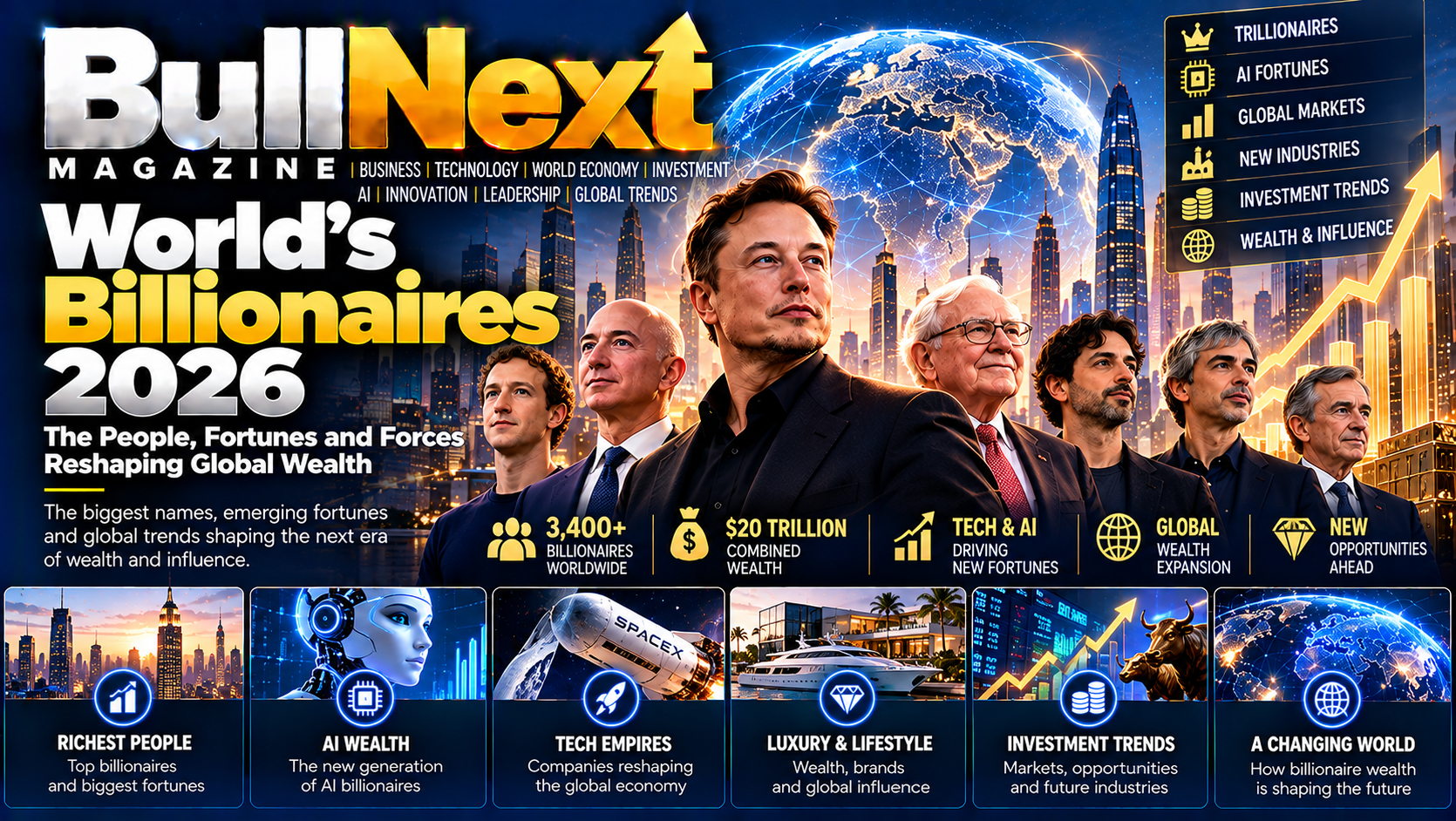
The world’s billionaire landscape has entered a remarkable new era.
Fortunes once measured in tens of billions are now approaching or exceeding the trillion-dollar mark. Technology, artificial intelligence, space, digital platforms, semiconductors, luxury brands, finance and global consumer businesses are creating extraordinary concentrations of wealth.
At the center of this transformation is a simple but powerful force: ownership of assets that can scale dramatically.
Forbes' 2026 billionaire data shows that the global billionaire population has reached more than 3,400 people, with combined wealth around $20 trillion. The number of billionaires has increased substantially over the past decade, while the fortunes of the richest individuals have expanded at an even faster pace.
The most dramatic example is Elon Musk.
Forbes declared Musk the world's first trillionaire in June 2026 after SpaceX began trading publicly at a valuation approaching $2 trillion. By October, Musk had again crossed the $1 trillion threshold as Tesla and SpaceX valuations strengthened.
But the billionaire story is much bigger than one individual.
It reflects how technology is changing the global economy, how capital is moving toward scalable businesses and how ownership can transform successful companies into enormous personal fortunes.
A New Era of Global Wealth
The number of billionaires has grown dramatically.
Forbes' 2026 research identified more than 3,400 billionaires worldwide, representing approximately $20 trillion in combined wealth. Forbes also reported that the billionaire population has grown by roughly 50% over the past decade.
This growth reflects several forces working simultaneously.
Global markets have expanded.
Technology has made businesses easier to scale internationally.
Financial markets have increased the value of successful companies.
Entrepreneurs can reach millions of customers through digital platforms.
And investors are allocating enormous amounts of capital toward technologies they believe could reshape entire industries.
The result is an economy capable of creating extremely large fortunes at unprecedented speed.
Elon Musk and the Trillion-Dollar Milestone
Perhaps the biggest story in the billionaire world during 2026 has been Elon Musk's rise to trillionaire status.
Musk's fortune is closely connected to his ownership stakes in companies including Tesla and SpaceX, alongside his involvement in artificial intelligence through xAI.
Forbes reported in June that SpaceX's public debut pushed Musk's estimated fortune to approximately $1.1 trillion, making him the world's first trillionaire.
The milestone was historically significant because it demonstrated how quickly ownership in high-growth technology companies can translate into enormous personal wealth.
Musk had first appeared on Forbes' annual billionaire list in 2012 with an estimated fortune of about $2 billion.
His rise illustrates the extraordinary compounding effect that can occur when an entrepreneur retains significant ownership in companies whose valuations grow dramatically.
By October 2026, his fortune had again crossed the $1 trillion mark, according to Forbes estimates reported by VnExpress.
Who Are the World's Richest People?
The exact ranking of the world's richest people changes frequently because billionaire wealth is closely connected to public-market valuations.
Forbes' real-time billionaire tracker updates fortunes as share prices move, meaning rankings can change from one trading day to another.
Recent rankings have placed names such as:
Elon Musk
Jeff Bezos
Larry Page
Michael Dell
Sergey Brin
Larry Ellison
Mark Zuckerberg
Bernard Arnault
Warren Buffett
among the world's wealthiest individuals.
Their businesses span different industries, from technology and e-commerce to luxury goods, finance and enterprise computing.
What connects many of them is substantial ownership of businesses that have achieved enormous scale.
The Technology Billionaire Has Become the Dominant Archetype
The modern billionaire is increasingly associated with technology.
That does not mean traditional industries have disappeared.
Energy, manufacturing, retail, real estate and finance continue to produce enormous fortunes.
But technology has a special characteristic:
It can scale extremely quickly.
A software platform can serve another million customers without building another million physical stores.
A digital service can reach new countries without constructing an entirely new physical distribution network.
An AI company can potentially distribute software globally almost instantly.
This scalability can produce enormous increases in company valuations.
As a result, founders and early investors can see their ownership stakes become worth billions or even hundreds of billions.
AI Is Reshaping the Billionaire Landscape
Artificial intelligence is becoming one of the most important forces behind the newest generation of wealth.
The AI economy includes far more than chatbot companies.
It encompasses:
Semiconductor manufacturers
AI model developers
Cloud computing
Data centers
Robotics
Enterprise software
Cybersecurity
AI infrastructure
Autonomous systems
AI-powered applications
The investment surrounding AI is enormous.
Reuters reported in October 2026 that global spending on data centers could eventually exceed $30 trillion by 2050, according to a PwC projection cited by the news agency.
That scale of investment creates opportunities throughout the technology ecosystem.
The companies building AI models need enormous computing infrastructure.
Computing infrastructure requires advanced chips.
Chips require specialized manufacturing and equipment.
Data centers require energy, cooling and networking.
This creates an interconnected wealth ecosystem.
AI Wealth Is Not Limited to AI Founders
One of the most important features of the AI economy is that wealth can be created across the supply chain.
A company does not necessarily need to build the most popular AI chatbot to benefit from AI.
It might manufacture processors.
It might provide cloud infrastructure.
It might build networking technology.
It might operate data centers.
It might develop specialized enterprise software.
It might provide cybersecurity.
This means the AI wealth story is broader than the names most consumers recognize.
The next generation of billionaire fortunes could emerge from companies that provide the infrastructure underneath AI rather than from consumer-facing AI products.
The AI Investment Boom Comes With Questions
The amount of capital flowing into artificial intelligence is extraordinary.
Reuters reported in October that global AI investment has reached a scale that exceeds many previous technology investment booms, while economists and investors continue debating whether future productivity gains will justify the enormous spending.
This creates an important tension.
Investors believe AI could transform productivity, business models and entire industries.
But the financial returns from such massive infrastructure investments still need to materialize.
If AI generates enormous new markets, today's valuations could eventually appear justified.
If adoption and productivity improvements take longer than expected, some companies could face significant pressure.
The billionaire landscape could therefore change dramatically depending on how successfully the AI economy converts investment into real economic value.
Asia's Billionaire Power Is Growing
The billionaire economy is not exclusively American.
Asia has become an increasingly important source of enormous fortunes.
China and India have produced major technology, manufacturing, retail and infrastructure fortunes.
In September 2026, Reuters reported that ByteDance founder Zhang Yiming had become Asia's richest individual, with wealth exceeding $105 billion, according to Bloomberg data.
Zhang's rise demonstrates the growing importance of technology companies outside the United States.
ByteDance's AI capabilities, including its Doubao chatbot and Seedance text-to-video model, have become important parts of the company's growth strategy. Reuters reported that ByteDance was projected to invest heavily in AI during 2026.
This highlights a broader trend.
The future billionaire map is becoming increasingly global.
India Is Becoming a Major Wealth Center
India also has a significant billionaire ecosystem.
The country has produced major fortunes in:
Infrastructure
Energy
Technology
Retail
Telecommunications
Manufacturing
Pharmaceuticals
Finance
India's expanding economy and large consumer market provide opportunities for entrepreneurs to build companies at enormous scale.
The growth of digital payments, online commerce, technology services and telecommunications has also created new pathways for wealth creation.
As India's economy continues to expand, its role in the global billionaire landscape is likely to remain significant.
Billionaire Wealth Is Mostly Ownership
One of the most misunderstood aspects of billionaire wealth is the difference between net worth and cash.
A billionaire with a $100 billion fortune does not necessarily have $100 billion sitting in a bank account.
Most of the wealth may be represented by:
Public-company shares
Private-company ownership
Investment holdings
Real estate
Other assets
If the value of those assets increases, net worth rises.
If their value falls, net worth can decline rapidly.
This is why billionaire rankings can change dramatically in a short period.
Forbes' real-time system updates public holdings frequently while private-company values are adjusted according to different methodologies.
Why Billionaire Rankings Change So Quickly
Imagine an entrepreneur owns 20% of a company.
If the company is worth $100 billion, that stake is worth approximately $20 billion.
If the company becomes worth $500 billion, the stake becomes worth approximately $100 billion.
The entrepreneur's personal wealth could therefore increase by $80 billion without receiving an $80 billion salary.
This is the power of equity ownership.
It also explains why technological breakthroughs can create enormous fortunes.
When markets believe a company can dominate a major future industry, its valuation can increase dramatically.
Warren Buffett Shows a Different Path
Not every billionaire fortune is built through technology.
Warren Buffett represents a different model.
His wealth has been built through decades of investing, business ownership and capital allocation.
In October 2026, Buffett moved into the world's top 10 wealthiest individuals, overtaking Zara founder Amancio Ortega, according to Forbes' real-time ranking as reported by VnExpress. His estimated wealth was around $142 billion at the time.
Buffett's career demonstrates that enormous wealth can also be built through patience, disciplined investing and long-term ownership.
His approach differs dramatically from the technology-driven fortunes of Musk, Bezos, Page and other technology entrepreneurs.
Yet both models share one important characteristic:
long-term ownership.
The Billionaire Wealth Formula
Although there is no guaranteed formula for becoming extremely wealthy, major fortunes often contain several common ingredients.
1. Ownership
Founders and investors retain valuable equity.
2. Scalability
The business can serve a huge market.
3. Innovation
The company offers something that changes consumer or business behavior.
4. Capital
The company can attract investment to expand.
5. Timing
The business enters a market when demand is accelerating.
6. Global Reach
The company can expand beyond its original market.
7. Compounding
Profits, ownership and asset values grow over long periods.
These factors can reinforce one another.
Billionaires and the New Global Economy
The world's billionaires wealthiest individuals increasingly influence industries that affect everyday life.
Technology billionaires influence:
Artificial intelligence
Social media
Digital commerce
Space exploration
Electric vehicles
Cloud computing
Semiconductors
Financial technology
Their companies can shape how people communicate, travel, work, shop and access information.
That gives billionaire wealth a dimension that goes beyond personal finance.
It becomes a question of economic influence.
Extreme Wealth and Economic Power
The concentration of wealth creates ongoing debate.
Supporters of entrepreneurship argue that large fortunes can reward innovation and provide incentives for investors to fund ambitious companies.
Critics argue that extreme wealth can translate into disproportionate political, social and economic influence.
The debate involves questions about:
Wealth taxes
Capital gains
Inheritance
Corporate taxation
Market competition
Political influence
Philanthropy
Economic inequality
The issue becomes particularly important when billionaires control companies operating in strategically important technologies.
Artificial intelligence is a clear example.
A small number of companies are developing systems that could influence productivity, employment, education, cybersecurity and national competitiveness.
Billionaires and Philanthropy
Extreme wealth also creates opportunities for philanthropy.
Some of the world's wealthiest individuals have committed large amounts of money to:
Healthcare
Education
Scientific research
Climate initiatives
Poverty reduction
Global development
Public health
Technology access
Bill Gates is one prominent example.
Reuters reported in September 2026 that the Gates Foundation planned to spend at least $1 billion over two years on AI applications in education, healthcare and agriculture, alongside efforts to make AI more accessible across languages.
Philanthropy can therefore become another way billionaire wealth influences global development.
The Debate Over Wealth Concentration
The growth of billionaire fortunes has also intensified debates about inequality.
Forbes reported that the combined wealth of the world's billionaires has grown dramatically over the past decade.
Supporters of wealth creation argue that rising billionaire wealth can reflect the growth of valuable businesses.
Critics argue that the distribution of those gains matters as much as the size of the economy itself.
The key question is therefore not simply:
How much wealth exists?
It is:
Who owns it, how was it created and how widely are its benefits distributed?
That debate will remain central to global economic policy.
Young Billionaires and the Next Generation
The billionaire class is also becoming younger in certain technology sectors.
Digital businesses allow entrepreneurs to reach global audiences without decades of physical expansion.
A software company can potentially grow rapidly.
A social-media platform can acquire hundreds of millions of users.
An AI startup can attract billions of dollars in investment before becoming a mature company.
This creates the possibility of extremely rapid wealth creation.
However, rapid wealth also creates risks.
Young founders may suddenly have enormous financial and social influence before they have extensive experience managing it.
The responsibilities of extreme wealth therefore become as important as the wealth itself.
The Future Billionaire May Come From an Unexpected Industry
Technology dominates today's wealth headlines, but the next billionaire boom could emerge from other sectors.
Potential areas include:
Artificial Intelligence
AI infrastructure, applications, robotics and autonomous systems could create enormous companies.
Biotechnology
New therapies, genetic technologies and computational biology could transform healthcare.
Energy
Advanced nuclear power, batteries, grid technology and renewable energy could create major new markets.
Space
Satellites, launch systems, communications and space infrastructure remain long-term opportunities.
Robotics
AI-powered machines could transform manufacturing, logistics, healthcare and services.
Climate Technology
Companies solving energy, water and environmental challenges could become increasingly valuable.
Advanced Manufacturing
Semiconductors, automation and smart factories could reshape global supply chains.
The Risk of Billionaire Fortunes
Large fortunes can also decline.
Technology companies can lose market share.
Stock prices can collapse.
Regulation can change.
Consumer behavior can shift.
A competitor can introduce a superior product.
An industry can become obsolete.
This means billionaire wealth should not be viewed as permanent.
Even some of the world's most powerful fortunes have experienced enormous fluctuations.
The modern billionaire economy is therefore characterized by both extraordinary creation and extraordinary volatility.
What Entrepreneurs Can Learn From the World's Billionaires
The objective for most entrepreneurs should not be becoming a billionaire.
The probability is extraordinarily small.
But studying billionaire businesses can reveal useful principles.
Solve a Large Problem
Businesses become more valuable when they solve meaningful problems for large markets.
Build Something Scalable
Digital products and strong systems can expand more efficiently than purely manual businesses.
Retain Meaningful Ownership
Ownership can become more valuable than salary when a company grows dramatically.
Think Long Term
Some of the world's largest fortunes took decades to build.
Reinvest
Capital invested into technology, people and expansion can accelerate growth.
Build Strong Teams
No billion-dollar company is built by one person alone.
Adapt
Markets change, technologies evolve and competitors appear.
Long-term winners continually adjust.
What the World's Billionaires Tell Us About Business
The billionaire rankings are more than a list of wealthy individuals.
They are a snapshot of where economic power is accumulating.
When technology companies dominate the list, it tells us technology is creating enormous economic value.
When luxury companies rise, it reveals the strength of global consumer demand.
When investment fortunes grow, it highlights the power of capital markets.
When new Asian billionaires emerge, it demonstrates the changing geography of global wealth.
The billionaire list is therefore also a map of economic transformation.
The Next Billion-Dollar and Trillion-Dollar Fortunes
The trillionaire era has already begun.
The next question is how many more trillion-dollar personal fortunes could emerge.
That will depend on the size of future industries.
If AI creates entirely new markets worth trillions of dollars, founders and investors with significant ownership could capture extraordinary wealth.
The same could happen with robotics, biotechnology, energy, space or other technologies.
But the path will not be guaranteed.
Markets can overestimate new technologies.
Investors can fund companies too aggressively.
Competition can destroy expected returns.
Regulation can change business models.
History shows that technological revolutions create enormous fortunes—but they can also destroy enormous fortunes.
Conclusion
The world's billionaires in 2026 represent one of the most dramatic transformations in modern economic history.
More than 3,400 billionaires now control approximately $20 trillion in combined wealth, according to Forbes' 2026 data.
Technology remains one of the most powerful forces behind new fortunes.
Artificial intelligence is creating an entirely new investment ecosystem.
Space technology is opening new markets.
Digital platforms continue to scale globally.
And investors are increasingly looking for the technologies that could define the next generation of economic growth.
Elon Musk's rise to and beyond the trillion-dollar threshold has become the clearest symbol of this new era.
But the future of global wealth will not be determined by one person.
It will be shaped by thousands of entrepreneurs, investors, companies, technologies and markets.
The biggest fortunes of tomorrow may belong to people whose names are barely known today.
What is certain is that the global billionaire landscape will continue to evolve as technology, capital and entrepreneurship reshape the world economy.
The world's richest people are not simply beneficiaries of economic change.
In many cases, they are also among the people driving it.
Frequently Asked Questions
Who is the world's richest person in 2026?
Elon Musk has held the position of the world's richest person during 2026. Forbes reported that he became the world's first trillionaire in June after SpaceX began trading publicly.
How many billionaires are there in the world?
Forbes' 2026 research identified more than 3,400 billionaires worldwide with combined wealth of around $20 trillion.
Who are some of the world's richest billionaires?
Names frequently appearing near the top of 2026 rankings include Elon Musk, Jeff Bezos, Larry Page, Michael Dell and Sergey Brin, although rankings change with market valuations.
Why does billionaire net worth change so quickly?
Most billionaire wealth is tied to assets such as company shares. When those assets rise or fall in value, estimated net worth can change dramatically.
Is AI creating new billionaires?
AI is becoming a major source of new wealth and investment. The broader AI ecosystem includes software, chips, data centers, cloud computing, robotics and infrastructure.
Who is Asia's richest billionaire?
Recent 2026 reporting identified ByteDance founder Zhang Yiming as Asia's richest individual, with wealth exceeding $105 billion in September.
Can billionaire wealth disappear?
Yes. Because large fortunes are often concentrated in companies and investments, major changes in valuations can cause enormous declines in net worth.
What industries create billionaires?
Technology, finance, retail, manufacturing, real estate, energy, luxury goods and telecommunications have all produced major billionaire fortunes.
Why are billionaire fortunes controversial?
Extreme wealth raises debates about economic inequality, taxation, market concentration, philanthropy and the influence of wealthy individuals over public life.
Will there be more trillionaires?
It is possible. If emerging industries such as AI, robotics, biotechnology, energy or space technology create companies worth trillions of dollars, significant ownership stakes could generate additional trillion-dollar fortunes.