
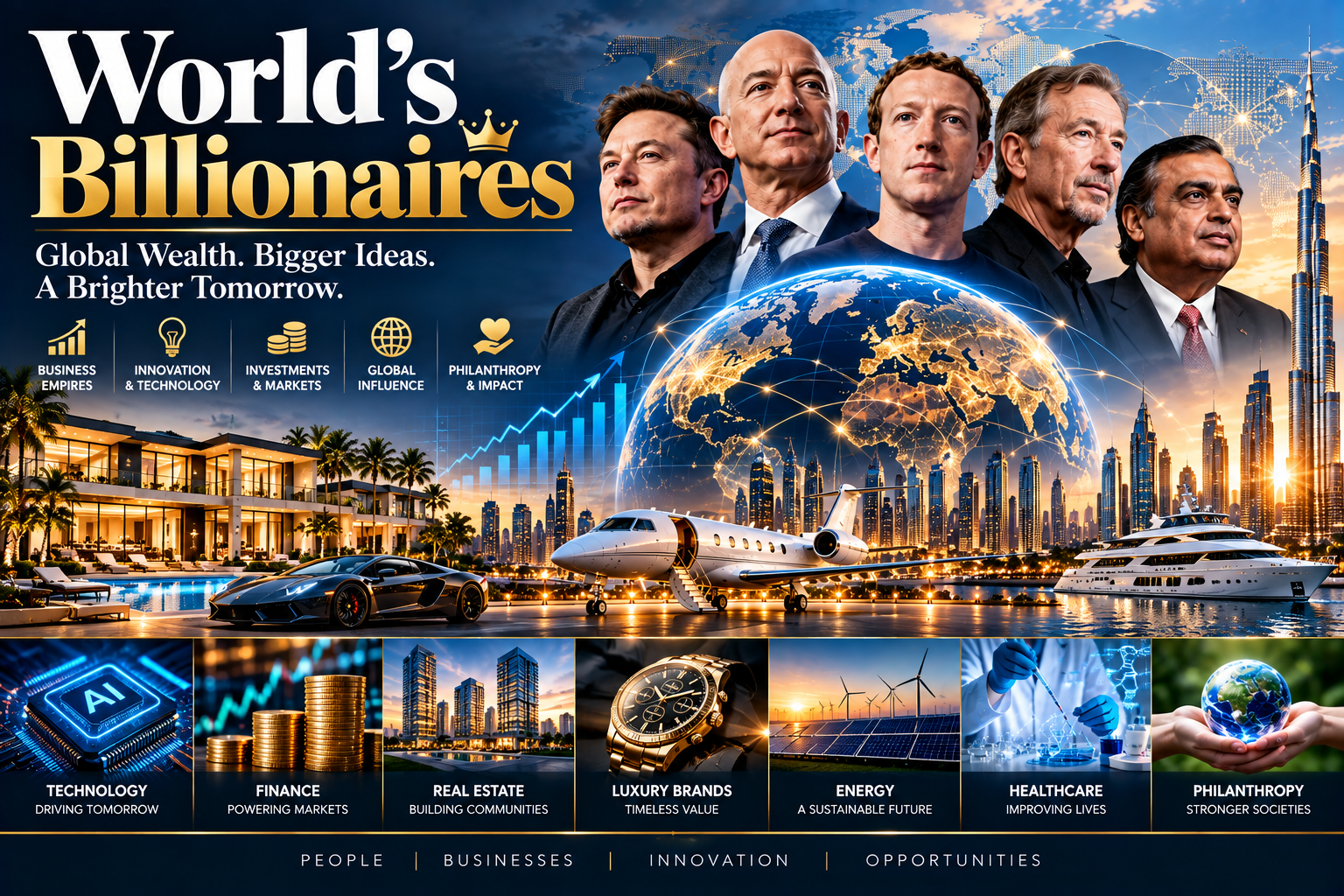
The world's billionaires represent one of the most visible groups in the global economy. Their fortunes are connected to some of the largest technology companies, investment firms, retail businesses, manufacturing groups, luxury brands, energy companies, and real estate portfolios.
But billionaire wealth is about more than large numbers. Behind every fortune is a combination of business ownership, investments, assets, market valuations, entrepreneurship, inheritance, and economic opportunity.
In 2026, the global billionaire population reached record levels. Forbes' 2026 World's Billionaires list identified 3,428 billionaires with combined wealth of approximately $20.1 trillion, an increase of 400 people from the previous year. The United States had 989 billionaires, followed by China and Hong Kong with 610, while India ranked third with 229.
At the same time, billionaire rankings can change quickly because much of this wealth is connected to publicly traded companies and other assets whose values fluctuate.
What Does It Mean to Be a Billionaire?
A billionaire is generally someone whose estimated net worth is at least $1 billion.
Net worth is calculated by considering the estimated value of assets and subtracting liabilities.
Assets may include:
Public company shares
Private businesses
Real estate
Investment portfolios
Cash and financial holdings
Luxury assets
Other valuable property
This means billionaire wealth should not be confused with cash.
Someone may have billions of dollars in estimated wealth because they own a substantial percentage of a company. If the company's stock price increases, their estimated fortune can increase even though they have not received that amount of money as income.
The same principle works in reverse when asset values decline.
The World's Billionaires in 2026
The billionaire population has expanded significantly over recent years.
Forbes' 2026 annual list recorded 3,428 billionaires globally with combined wealth of $20.1 trillion. Forbes attributed the record partly to the continuing expansion of artificial intelligence, strong markets, and favorable economic conditions.
The distribution of billionaire wealth is highly concentrated in certain countries.
The United States remains the largest home of billionaires, with 989 people on the 2026 list. China and Hong Kong followed with 610, while India had 229.
These figures reflect the importance of large financial markets, technology industries, entrepreneurship, manufacturing, consumer businesses, and established family enterprises.
Who Are the World's Richest People?
Billionaire rankings are constantly changing because public-company valuations move every day.
According to Forbes' September 1, 2026 ranking, the top 10 richest people were:
Elon Musk
Larry Page
Jeff Bezos
Sergey Brin
Michael Dell
Mark Zuckerberg
Larry Ellison
Jensen Huang
Steve Ballmer
Amancio Ortega
Forbes reported that nine of the ten richest people on that date were Americans, with Spain's Amancio Ortega the only non-U.S. citizen in the group.
These positions should be viewed as a snapshot rather than permanent rankings because fortunes can change rapidly with stock prices and private-company valuations.
Elon Musk and the Rise of Technology Wealth
Elon Musk's fortune demonstrates how ownership in high-growth technology companies can create extraordinary wealth.
Forbes reported that Musk became the world's first trillionaire in June 2026 after SpaceX went public. His estimated fortune briefly reached approximately $1.45 trillion later that month before a decline in SpaceX's share price reduced his wealth below the trillion-dollar threshold.
As of September 2026, Forbes continued to rank Musk as the world's richest person. His wealth is primarily connected to SpaceX and Tesla, alongside interests in other technology companies.
Musk's changing net worth illustrates an important characteristic of billionaire wealth: large fortunes can move by tens or even hundreds of billions of dollars without the individual receiving equivalent amounts of cash.
Jeff Bezos and Global E-Commerce
Jeff Bezos is another example of technology-driven wealth creation.
Bezos founded Amazon in 1994 and built it from an online bookstore into one of the world's largest technology and commerce companies.
According to Forbes, Bezos owns approximately 8% of Amazon and also owns Blue Origin and The Washington Post.
His wealth demonstrates how ownership in a company with a global customer base can become a significant source of long-term personal wealth.
Amazon's expansion across e-commerce, cloud computing, logistics, advertising, entertainment, and other areas has also helped make it one of the most influential companies in the modern economy.
Larry Page and Sergey Brin
Google cofounders Larry Page and Sergey Brin remain among the world's wealthiest individuals.
Their fortunes are closely connected to Alphabet, Google's parent company.
The company's businesses span:
Internet search
Digital advertising
Cloud computing
Artificial intelligence
Consumer technology
YouTube
Autonomous transportation
Other technology ventures
Their continued position among the world's richest people demonstrates the long-term wealth creation potential of digital platforms.
Mark Zuckerberg and Social Media
Mark Zuckerberg built much of his fortune through Meta Platforms, the parent company of Facebook, Instagram, WhatsApp, and other businesses.
Social media has become a major global advertising and communications industry.
Meta's business demonstrates how digital platforms can generate enormous economic value by connecting billions of users with advertisers and services.
The company has also invested heavily in artificial intelligence, data infrastructure, and virtual and augmented reality technologies.
Jensen Huang and the AI Economy
Artificial intelligence has become one of the defining business trends behind billionaire wealth in 2026.
Jensen Huang, cofounder and CEO of Nvidia, has become one of the most prominent beneficiaries of the growth in AI infrastructure.
Nvidia's technology is widely used in AI computing, data centers, gaming, and advanced computing.
The growth of AI has created demand for:
Advanced processors
Data centers
Cloud infrastructure
Networking technology
AI software
Energy infrastructure
Semiconductor manufacturing
This demonstrates how a technological shift can create opportunities across an entire industrial ecosystem.
Billionaires Beyond Technology
Although technology has become an important source of modern billionaire wealth, it is not the only one.
Major fortunes have also been built through:
Finance
Investment management, private equity, banking, hedge funds, and financial services have created some of the world's largest fortunes.
Retail
Large retail businesses can generate enormous wealth through scale, distribution, logistics, and consumer demand.
Manufacturing
Industrial companies remain important sources of wealth, particularly in economies with strong manufacturing sectors.
Energy
Oil, gas, electricity, renewable energy, and related infrastructure continue to support major business fortunes.
Luxury Goods
Luxury fashion, cosmetics, jewelry, and other premium consumer products have produced billionaire founders and family owners.
Real Estate
Property developers, landlords, investors, and family real estate businesses can accumulate substantial wealth through long-term ownership and development.
How Billionaire Wealth Is Calculated
Billionaire wealth estimates are based on available information about assets and liabilities.
For public companies, ownership stakes can be valued using current or recent market prices.
Private businesses are more complicated because they do not have a continuously traded market price.
Researchers may therefore use:
Recent funding rounds
Comparable companies
Company financial information
Ownership percentages
Industry valuations
Publicly available records
Other assets such as real estate, aircraft, yachts, and art may also be included depending on the methodology.
Forbes explains that its billionaire methodology considers stakes in public and private companies along with other assets and subtracts debt.
Why Billionaire Rankings Change
The world's richest people can move up or down the rankings quickly.
Several factors can influence their estimated fortunes:
Stock market movements
Company earnings
Private-company valuations
Business acquisitions
New investments
Currency movements
Debt
Asset sales
Charitable giving
Changes in ownership
For example, Musk's fortune experienced enormous changes during 2026 because of movements in SpaceX and Tesla valuations. Forbes reported that his fortune rose by more than $200 billion during August after falling by $363 billion in July.
This is why billionaire rankings should always be associated with a date.
The Geography of Billionaire Wealth
Billionaire wealth is distributed across many regions, but some countries have significantly larger billionaire populations.
United States
The U.S. has the world's largest billionaire population according to the 2026 Forbes list.
Its technology, finance, consumer, healthcare, entertainment, and industrial sectors have produced many major fortunes.
China and Hong Kong
China and Hong Kong together ranked second in the 2026 Forbes billionaire count.
Their billionaire population reflects the importance of technology, manufacturing, real estate, consumer businesses, and other industries.
India
India ranked third with 229 billionaires in Forbes' 2026 global list.
Major fortunes in India are associated with sectors including infrastructure, energy, telecommunications, technology, retail, pharmaceuticals, and consumer businesses.
Europe
European billionaire fortunes are strongly represented in luxury goods, retail, manufacturing, finance, technology, and family-owned businesses.
Amancio Ortega, founder of the fashion company Zara, was ranked tenth globally in Forbes' September 2026 list.
Billionaires and Family Businesses
Not every billionaire built a fortune from scratch.
Some inherited ownership of family businesses or substantial assets.
Family wealth can come from:
Manufacturing companies
Retail chains
Real estate
Agriculture
Financial businesses
Energy companies
Consumer brands
However, inherited businesses may continue to change under new leadership.
Later generations can expand into new countries, industries, technologies, and markets.
Self-Made and Inherited Wealth
Billionaire wealth is often described using categories such as "self-made" and "inherited."
A self-made billionaire generally built most of their fortune through entrepreneurship, investments, or ownership created during their career.
An inherited billionaire received substantial wealth from family members or family-controlled assets.
The distinction can become complicated when someone inherits a business but later expands its value significantly.
The global billionaire population therefore includes a mixture of entrepreneurs, investors, heirs, business families, and people whose fortunes combine several sources.
Billionaires and Artificial Intelligence
Artificial intelligence is one of the most important developments affecting billionaire wealth today.
AI is influencing multiple industries at the same time.
These include:
Software
Semiconductors
Robotics
Healthcare
Finance
Manufacturing
Advertising
Transportation
Cybersecurity
Data centers
The technology requires significant investment in computing power and infrastructure.
This has created opportunities not only for AI software companies but also for semiconductor manufacturers, cloud providers, energy companies, and data-center operators.
The AI boom was one of the major themes highlighted in Forbes' 2026 billionaire research.
Billionaires and Philanthropy
Many billionaires participate in philanthropy through foundations, charitable donations, research funding, and social initiatives.
Common areas of billionaire philanthropy include:
Education
Healthcare
Scientific research
Climate initiatives
Poverty reduction
Disaster relief
Arts and culture
Community development
Jeff Bezos, for example, established the Bezos Earth Fund and pledged billions toward climate-related initiatives.
The scale, structure, and priorities of philanthropic giving differ significantly from one billionaire to another.
The Economic Influence of Billionaires
Billionaires can influence economies through their ownership of businesses and allocation of capital.
Large companies can employ thousands or millions of people directly and indirectly.
Entrepreneurs can also fund new technologies and businesses.
Investors provide capital to companies that may later create jobs, products, and services.
At the same time, the concentration of wealth among a small number of individuals has generated significant economic and policy discussion around taxation, inequality, corporate ownership, philanthropy, and economic opportunity.
These debates involve economists, governments, researchers, businesses, and the public.
Billionaires and Global Business
The modern billionaire economy is increasingly global.
A company founded in one country can serve customers across dozens of countries.
Technology platforms can reach international users almost instantly.
Manufacturers can operate global supply chains.
Luxury brands can sell products across continents.
Investment firms can allocate capital to businesses around the world.
This global connectivity has made it possible for successful companies to reach enormous markets and, in some cases, generate extraordinary shareholder wealth.
Billionaire Wealth and Market Volatility
One of the most important points to understand is that billionaire wealth is often volatile.
If someone owns a large percentage of a public company, their net worth can change significantly as the share price moves.
This means a billionaire can become considerably richer or poorer on paper without selling any shares.
For example, Forbes' reporting on Musk's 2026 fortune showed how quickly changes in SpaceX's valuation could affect his estimated wealth.
Therefore, billionaire rankings should be viewed as estimates at particular points in time rather than permanent measures of wealth.
The Future of the World's Billionaires
The next generation of billionaires may emerge from industries that are still developing.
Potential wealth-creating sectors include:
Artificial intelligence
Robotics
Biotechnology
Space technology
Renewable energy
Energy storage
Cybersecurity
Advanced manufacturing
Digital finance
Healthcare technology
Established industries will also continue producing significant fortunes as businesses expand into new markets and technologies.
The growing importance of AI suggests that technological infrastructure could remain a major source of wealth creation, while traditional sectors such as retail, real estate, finance, energy, and manufacturing will continue to evolve.
Final Thoughts
The world's billionaires provide a fascinating view into the forces shaping the global economy.
Their fortunes are connected to technology companies, financial markets, real estate, manufacturing, retail, luxury goods, energy, investments, and family businesses.
Forbes' 2026 global billionaire list counted a record 3,428 billionaires with combined wealth of approximately $20.1 trillion, demonstrating the extraordinary scale of wealth accumulated by the world's richest individuals.
Yet billionaire rankings are constantly changing.
Company valuations, stock prices, investments, economic conditions, and ownership structures can cause enormous changes in estimated net worth.
Ultimately, studying the world's billionaires is not simply about identifying the richest people. It is also about understanding how businesses grow, how capital moves, how technology creates new industries, and how global markets influence personal wealth.
Frequently Asked Questions
Who are the world's billionaires?
The world's billionaires are individuals with estimated net worths of at least $1 billion. Their fortunes come from businesses, investments, real estate, family wealth, and other assets.
How many billionaires are there in the world?
Forbes' 2026 World's Billionaires list identified 3,428 billionaires worldwide with combined wealth of approximately $20.1 trillion.
Who was the world's richest person in September 2026?
Forbes' September 1, 2026 ranking listed Elon Musk as the world's richest person. Rankings can change as asset values change.
Which country has the most billionaires?
The United States had the largest billionaire population in Forbes' 2026 global list, with 989 billionaires.
How do billionaires make their money?
Major sources include entrepreneurship, technology, investments, finance, manufacturing, retail, real estate, energy, luxury goods, and inherited businesses.
Is billionaire wealth mostly cash?
No. Much billionaire wealth is held in company shares, private businesses, real estate, and other assets.
Why does billionaire net worth change?
Changes in stock prices, private-company valuations, investments, debt, currency values, and other assets can significantly affect estimated net worth.
Is artificial intelligence creating new billionaires?
AI has become a major driver of business investment and company valuations. Forbes identified the AI boom as one factor behind the record wealth represented in its 2026 billionaire list.
Are all billionaires self-made?
No. The global billionaire population includes entrepreneurs, investors, heirs, family-business owners, and individuals whose fortunes come from multiple sources.
Will the world's billionaire rankings stay the same?
No. Rankings can change frequently because many billionaire fortunes are connected to assets whose market values fluctuate. Forbes publishes periodic and real-time estimates to reflect those changes.