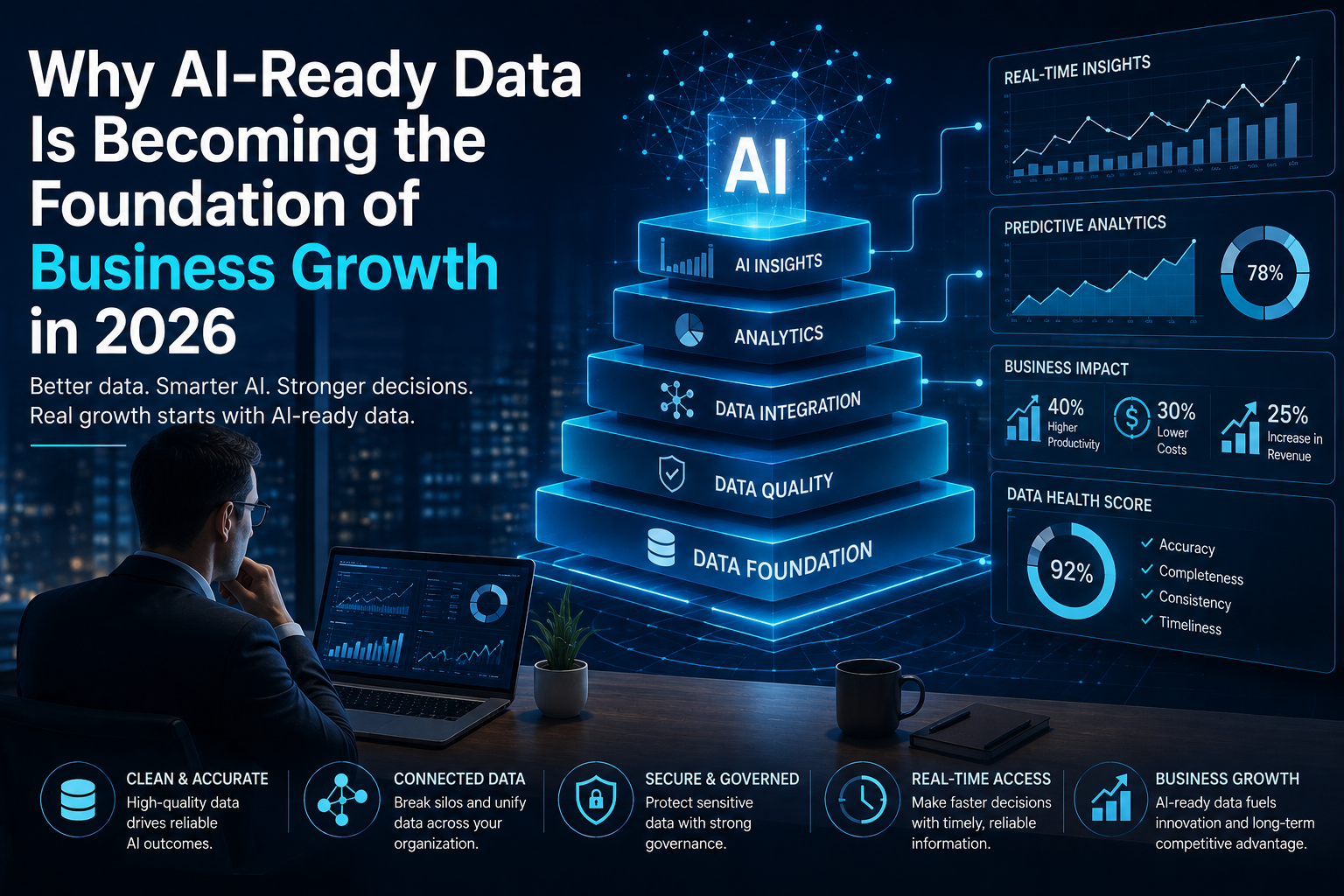
Artificial intelligence has become one of the most important technologies shaping modern business, but successful AI adoption depends on something more fundamental: data. In 2026, companies are discovering that having access to advanced AI models is not enough. The quality, structure, accessibility, and security of their data increasingly determine how much value they can generate from artificial intelligence.
Businesses across industries are investing in AI-powered analytics, automation, customer experiences, forecasting, and decision-making. Yet organizations with fragmented, outdated, or poorly managed information can struggle to achieve meaningful results.
This is creating a new strategic priority: becoming AI-ready.
AI-ready data is not simply a large collection of information. It is data that is accurate, accessible, well-structured, properly governed, and available to intelligent systems in a way that supports useful business decisions.
What Does AI-Ready Data Mean?
AI-ready data refers to information that can be effectively processed and understood by artificial intelligence systems.
Traditional business data is often stored across different departments and platforms. Customer information may exist in a CRM, financial records in accounting software, employee information in HR systems, and operational information in separate databases.
When these systems do not communicate effectively, businesses create data silos.
AI systems perform much better when relevant information can be accessed consistently. Clean and connected data allows AI tools to identify patterns, compare information, generate insights, and support automated workflows more effectively.
Therefore, preparing data for AI is becoming an important part of digital transformation.
Data Quality Is Becoming a Competitive Advantage
Businesses have spent years collecting data, but quantity does not automatically create value.
Poor-quality information can lead to inaccurate analysis and unreliable AI outputs. Duplicate records, missing information, outdated customer profiles, inconsistent formats, and incorrect classifications can all affect AI performance.
For example, an AI forecasting system that receives inaccurate sales information may produce unreliable predictions. A customer-service AI that cannot access updated customer records may provide incomplete answers.
As companies rely more heavily on AI, data quality becomes increasingly important.
Organizations that establish strong processes for validating, updating, and organizing information can create a stronger foundation for intelligent technologies.
Breaking Down Data Silos
One of the biggest challenges facing businesses is fragmented information.
Large organizations often operate dozens or even hundreds of software systems. Each platform may generate valuable information, but the data can remain isolated.
AI creates an opportunity to connect these sources.
Instead of analyzing sales, marketing, customer support, and operational information independently, businesses can create more unified data environments.
This can provide decision-makers with a broader understanding of what is happening across the organization.
For example, declining sales may appear to be a marketing problem when viewed from one dataset. When combined with customer-support information and product feedback, the business may discover that customer dissatisfaction is actually contributing to lower demand.
Connected data can therefore improve the quality of business decisions.
AI and Real-Time Business Intelligence
Traditional business reporting often relies on periodic analysis. Managers may receive weekly or monthly reports describing what happened in the past.
AI is helping move businesses toward more dynamic intelligence.
AI systems can process information continuously and identify important changes as they occur. Companies can monitor sales, customer behavior, supply chains, financial performance, and operational metrics in near real time.
This creates a more responsive business environment.
Instead of waiting for the end of a reporting cycle, leaders can identify emerging problems earlier and take action before they become larger challenges.
Real-time intelligence can be especially valuable in highly competitive industries where market conditions change rapidly.
Better Customer Experiences
AI-ready data is also changing how companies interact with customers.
Businesses can combine purchase history, customer-service interactions, preferences, website behavior, and other relevant information to create more personalized experiences.
AI can then analyze these datasets to recommend products, identify customer needs, predict potential issues, and support personalized communication.
For customers, the benefit is a more relevant experience.
For businesses, better personalization can support customer retention, engagement, and long-term relationships.
However, organizations must balance personalization with responsible data management. Customers increasingly expect businesses to protect their information and use it transparently.
AI-Ready Data and Automation
Data is also the foundation of intelligent automation.
AI agents and automated systems need access to reliable information to perform tasks effectively.
Consider an AI system responsible for processing customer requests. It may need information from a CRM, order management platform, payment system, and knowledge base.
If those systems contain inconsistent or incomplete information, automation can become unreliable.
When data is properly organized and connected, AI can perform more complex workflows.
This could include processing invoices, updating records, preparing reports, responding to customer questions, monitoring inventory, or identifying unusual transactions.
The better the data infrastructure, the more useful intelligent automation becomes.
Data Security Becomes More Important
As businesses connect more data to AI systems, security becomes a major priority.
AI applications may interact with sensitive customer, financial, employee, or operational information. Organizations need to control who can access data and what AI systems are permitted to do with it.
Strong authentication, access controls, encryption, monitoring, and data classification can help reduce security risks.
Companies should also understand where their data is being processed and establish clear policies around third-party AI services.
The objective is not to prevent employees from using AI. Instead, businesses need secure frameworks that allow AI adoption without unnecessarily exposing sensitive information.
The Role of Data Governance
Data governance is becoming increasingly important as organizations expand their use of artificial intelligence.
A strong governance framework establishes rules for how information is collected, stored, accessed, updated, and used.
It can also define responsibilities for data quality and security.
For AI applications, governance becomes even more important because poor data practices can directly influence automated decisions and recommendations.
Businesses should know where important datasets originate, who owns them, how accurate they are, and what limitations they have.
This creates greater accountability and helps organizations build more reliable AI systems.
Preparing Employees for a Data-Driven Business
Technology alone cannot create an AI-ready organization.
Employees also need to understand how data is generated, interpreted, and used.
Data literacy is becoming an increasingly valuable business skill. Employees do not necessarily need to become data scientists, but they should understand how to evaluate information, recognize inconsistencies, and interpret AI-generated insights.
Managers also need to know when AI recommendations require additional human review.
This combination of technology and human judgment can create stronger decision-making processes.
Building an AI-Ready Data Strategy
Businesses looking to improve their AI readiness can begin with several practical steps.
First, organizations should identify their most valuable data sources. Not every dataset needs the same level of investment.
Second, businesses should evaluate data quality and identify duplicates, gaps, outdated records, and inconsistent formats.
Third, organizations can prioritize integration between important systems.
Fourth, businesses should establish clear governance and security policies.
Finally, companies should connect data improvements to measurable business outcomes.
The goal should not be to modernize data infrastructure simply because AI is popular. The objective is to create a data environment that produces measurable improvements in productivity, customer experience, operational efficiency, or revenue.
Small Businesses Can Benefit Too
AI-ready data is not limited to large enterprises.
Small and medium-sized businesses can also benefit from better data practices.
A company does not need a massive data warehouse to begin. Even basic improvements to customer records, financial information, inventory data, and sales reporting can create a stronger foundation for AI tools.
Cloud platforms and increasingly accessible AI services are also making advanced capabilities available to smaller organizations.
For smaller companies, the key is to focus on a few high-value use cases rather than attempting to transform every business process simultaneously.
The Future of AI-Driven Business
The next stage of AI adoption will likely involve increasingly intelligent systems that can work across multiple business functions.
AI agents may analyze information from different departments, identify opportunities, recommend actions, and execute approved workflows.
But the effectiveness of these systems will depend heavily on the information available to them.
This means data infrastructure may become just as strategically important as AI models themselves.
Companies that invest in clean, connected, secure, and accessible information will be better positioned to adopt new AI capabilities as they emerge.
Conclusion
In 2026, AI-ready data is becoming a strategic foundation for business growth.
Artificial intelligence can automate processes, generate insights, personalize customer experiences, and support better decisions, but these capabilities depend on reliable information.
Businesses that continue to treat data as an isolated technical resource may struggle to capture the full potential of AI. Organizations that treat data as a strategic asset can build stronger foundations for innovation and long-term competitiveness.
The future of AI-driven business will therefore not be determined only by which companies adopt the most advanced AI technologies. It will also depend on which organizations build the data infrastructure, governance, security, and workforce capabilities necessary to use those technologies effectively.
As AI becomes increasingly embedded in everyday business operations, being AI-ready will increasingly mean being data-ready.