
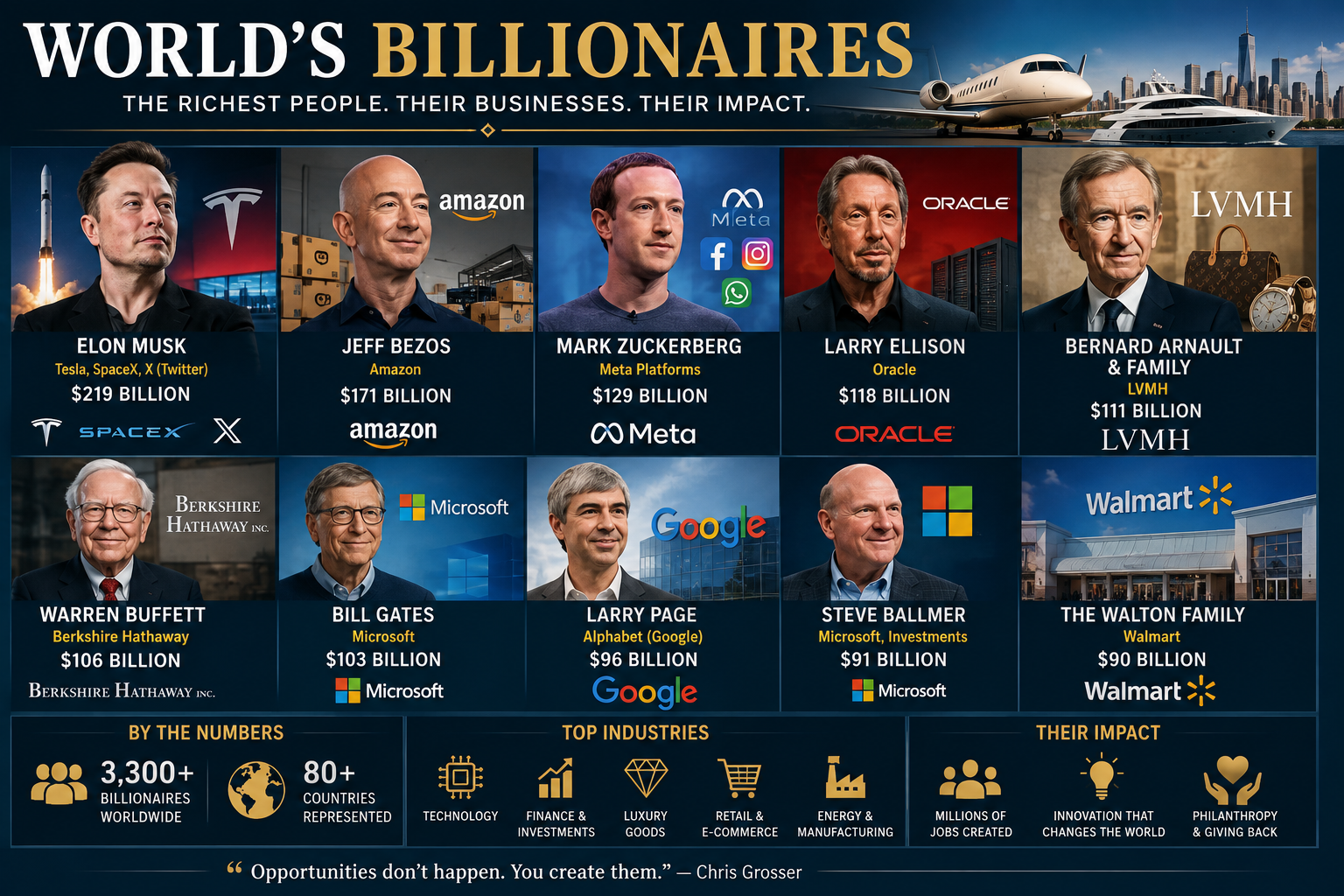
The world's billionaires represent some of the most influential figures in business, technology, finance, luxury, retail, manufacturing, and investment. Their fortunes have been built through companies, investments, ownership stakes, inherited wealth, and long-term business growth.
The billionaire list changes regularly because the value of publicly traded companies and private businesses changes. Therefore, instead of focusing only on today's exact ranking, it is more useful to understand who the world's richest people are, where their wealth comes from, and how their business empires developed.
From technology founders to luxury-industry leaders and legendary investors, the world's wealthiest individuals have followed very different paths.
Who Are the World's Billionaires?
A billionaire is generally a person whose net worth is at least $1 billion.
Billionaires can build their fortunes in many different industries, including:
Technology
E-commerce
Finance
Investments
Luxury goods
Manufacturing
Real estate
Energy
Media
Telecommunications
Consumer products
Some created companies from the ground up, while others inherited businesses or accumulated wealth through investments and ownership.
Because billionaire wealth is often tied to company shares, rankings can change significantly from one period to another.
1. Elon Musk
Elon Musk is one of the world's best-known billionaire entrepreneurs, with his wealth primarily connected to his ownership interests in companies such as Tesla and SpaceX.
His career demonstrates the potential impact of combining technology, engineering, entrepreneurship, and ambitious long-term projects.
Musk has been involved in several major technology ventures, including electric vehicles, space technology, artificial intelligence, and digital platforms.
His business journey is particularly notable because he has repeatedly entered industries that require substantial capital and technological development.
Key lesson
Musk's career demonstrates the importance of ambitious goals, technological innovation, and willingness to enter difficult markets.
2. Jeff Bezos
Jeff Bezos founded Amazon, which began as an online bookstore and developed into one of the world's largest technology and commerce companies.
Amazon eventually expanded into areas including cloud computing, digital services, logistics, entertainment, and consumer products.
Bezos has also invested in other ventures and founded Blue Origin, a private aerospace company.
His story is often associated with long-term thinking and customer-focused business development.
Key lesson
Bezos demonstrates how a relatively focused business idea can evolve into a much larger ecosystem when a company continually invests in infrastructure and customer experience.
3. Mark Zuckerberg
Mark Zuckerberg co-founded Facebook, which later became part of Meta Platforms.
The company expanded from a social networking platform into a broader technology business involving services such as Instagram, WhatsApp, advertising platforms, artificial intelligence, and virtual and augmented reality initiatives.
Zuckerberg's wealth is closely connected to his ownership of Meta.
Key lesson
Zuckerberg's journey demonstrates the power of technology platforms that can scale to billions of users.
4. Larry Ellison
Larry Ellison co-founded Oracle, a major enterprise technology company.
Oracle became an important provider of database technology, enterprise software, cloud services, and business technology solutions.
Ellison's career demonstrates how specialized technology can become the foundation of a massive global business.
Key lesson
A company does not always need to target ordinary consumers to become enormous. Enterprise technology can create significant value when it solves critical business problems.
5. Bernard Arnault
Bernard Arnault built much of his wealth through the luxury industry and his leadership of LVMH, the group behind numerous major luxury brands.
The luxury sector demonstrates a different path to enormous wealth compared with technology.
Luxury companies often rely on:
Strong brands
Global distribution
Product quality
Customer loyalty
Pricing power
Heritage
Exclusivity
Key lesson
A powerful brand can become one of a company's most valuable long-term assets.
6. Warren Buffett
Warren Buffett is one of the world's most famous investors and the longtime leader of Berkshire Hathaway.
Unlike technology founders whose fortunes are closely associated with one company, Buffett became famous for disciplined investing and capital allocation.
His investment philosophy has emphasized:
Long-term ownership
Understanding businesses
Financial discipline
Patience
Avoiding unnecessary speculation
Buffett's career is particularly important because it shows that enormous wealth can also be created through long-term investment and ownership rather than founding a technology startup.
Key lesson
Patience and disciplined capital allocation can be powerful advantages.
7. Bill Gates
Bill Gates co-founded Microsoft and became one of the most influential figures in the technology industry.
Microsoft's software products helped transform personal computing and later expanded into enterprise software, cloud computing, artificial intelligence, gaming, and other technology markets.
Gates later became increasingly involved in philanthropy through the Gates Foundation.
Key lesson
Technology businesses can achieve extraordinary scale when their products become essential to other businesses and consumers.
8. Larry Page and Sergey Brin
Larry Page and Sergey Brin co-founded Google, which later became part of Alphabet.
Google transformed online search and developed a huge ecosystem of digital products and services.
Its business expanded into advertising, cloud computing, mobile software, artificial intelligence, hardware, and other technologies.
Key lesson
A simple technology concept can become extremely valuable when it becomes a fundamental part of everyday life.
9. Steve Ballmer
Steve Ballmer became one of the world's wealthiest people through his long career at Microsoft and his ownership stake in the company.
He served as Microsoft's CEO after Bill Gates and later became the owner of the Los Angeles Clippers.
His career demonstrates that substantial wealth can also come from executive leadership and long-term ownership rather than founding a company.
Key lesson
Ownership can be an important component of long-term wealth creation.
10. The Walton Family
The Walton family built much of its wealth through ownership of Walmart, one of the world's largest retailers.
Walmart's growth demonstrates the enormous scale that can be achieved through retail, logistics, supply-chain management, and operational efficiency.
Rather than depending on luxury pricing or advanced technology alone, Walmart built its business around affordability and convenience.
Key lesson
Operational efficiency and scale can create enormous economic value.
How Do Billionaires Build Their Wealth?
Although billionaire stories are very different, several common patterns appear.
Business Ownership
One of the most important factors is ownership.
Entrepreneurs who own significant shares of successful companies can see their wealth increase as those companies grow.
This is different from simply earning a salary.
Long-Term Investment
Some wealthy individuals build fortunes by investing capital over many years.
Compounding can become increasingly powerful when investments are held for long periods.
Innovation
Technology and innovation have created enormous fortunes in recent decades.
Companies that develop products used by millions or billions of people can potentially reach extraordinary valuations.
Brand Building
Luxury businesses demonstrate how powerful brands can generate substantial value.
A trusted and recognizable brand can create customer loyalty and pricing power.
Scale
A business that can serve millions of customers efficiently has a much greater opportunity to generate substantial revenue than a business limited to a very small market.
Technology has made global scale easier in many industries.
Why Billionaire Rankings Change
Billionaire rankings are not permanent.
A person's net worth can change because of:
Stock market movements
Company valuations
Private-company valuations
Asset sales
Investments
Currency movements
Changes in ownership
For this reason, rankings published months apart can look different.
A person can move several positions without receiving or losing billions of dollars in cash because much of their wealth may be connected to the changing value of assets they own.
Billionaires and Company Ownership
A common misunderstanding is that a billionaire necessarily has billions of dollars sitting in a bank account.
Usually, much of their wealth is tied to assets.
These may include:
Company shares
Private businesses
Real estate
Investment holdings
Other financial assets
This means net worth is an estimate of the value of what someone owns minus relevant liabilities, rather than simply the amount of cash available to spend.
Technology's Role in Modern Billionaire Wealth
Technology has played an especially important role in the growth of billionaire fortunes.
Companies can now reach global audiences much faster than many traditional businesses.
Software can be distributed internationally with relatively low marginal costs, while digital platforms can connect millions or billions of users.
Major technology areas contributing to modern wealth creation include:
Artificial intelligence
Cloud computing
E-commerce
Social media
Semiconductors
Software
Digital advertising
Electric vehicles
Space technology
However, technology is not the only path to extreme wealth.
Retail, luxury goods, finance, manufacturing, and investments remain important.
What Can Entrepreneurs Learn From the World's Billionaires?
Studying billionaire stories can be useful, but entrepreneurs should avoid assuming that copying one person's strategy will produce the same result.
Instead, look for broader principles.
Solve Important Problems
Successful companies often solve problems that affect large numbers of people.
Build Ownership
Entrepreneurship can create wealth partly because founders may retain ownership in the businesses they build.
Think Long Term
Large companies often require years of investment before reaching their full potential.
Adapt to Change
Markets evolve. Companies that cannot adapt may lose their competitive advantage.
Focus on Customers
Businesses ultimately depend on customers choosing their products or services.
Build Strong Teams
Large organizations require talented people across technology, finance, operations, marketing, sales, and leadership.
Frequently Asked Questions
Who is the richest person in the world?
The identity of the world's richest person can change frequently because billionaire wealth is heavily influenced by company valuations and stock prices. For the latest ranking, check a current billionaire ranking from a reputable financial source.
How many billionaires are there in the world?
The number changes over time as asset values rise and fall and new people cross the billion-dollar threshold. Annual billionaire rankings from major financial publications provide updated estimates.
How do billionaires make their money?
Billionaires build wealth through business ownership, entrepreneurship, investments, inherited assets, executive compensation, real estate, and combinations of these sources.
Are billionaires actually billionaires in cash?
Usually not. Much of a billionaire's net worth may consist of company shares, private businesses, investments, and other assets rather than cash.
Why does billionaire wealth change so quickly?
Many billionaires own large amounts of publicly traded company stock. When share prices move, the estimated value of their holdings can change significantly.
Which industries create the most billionaires?
Technology, finance, investments, manufacturing, retail, real estate, luxury goods, and energy have all produced large numbers of billionaires.
Are all billionaires self-made?
No. Billionaires have different backgrounds. Some built companies themselves, some inherited significant wealth, and others accumulated wealth through investments or business ownership.
Can studying billionaires help entrepreneurs?
Yes. Their careers can provide useful examples of business strategy, leadership, innovation, investing, scaling, and long-term decision-making. However, their circumstances are not identical to those of ordinary entrepreneurs.
What is the biggest lesson from billionaire success stories?
There is no universal formula. However, creating valuable products or services, maintaining ownership, thinking long term, adapting to change, and understanding customers are recurring themes.
Does becoming a billionaire require starting a technology company?
No. Billionaire wealth has been created through many industries, including retail, finance, luxury goods, manufacturing, real estate, and investments.
Conclusion
The world's billionaires come from very different backgrounds and industries. Some built technology companies, some developed retail empires, some became successful investors, and others grew luxury or manufacturing businesses.
Their stories show that extreme wealth can come from many different forms of ownership and value creation.
At the same time, billionaire rankings should be viewed as changing snapshots rather than permanent positions. Stock prices, company valuations, investments, and other assets can cause fortunes to rise or fall rapidly.
For entrepreneurs and business readers, the most valuable reason to study billionaires is not simply to know who is richest. Their journeys provide examples of how businesses are built, how markets evolve, how ownership creates wealth, and how long-term decisions can influence extraordinary outcomes.