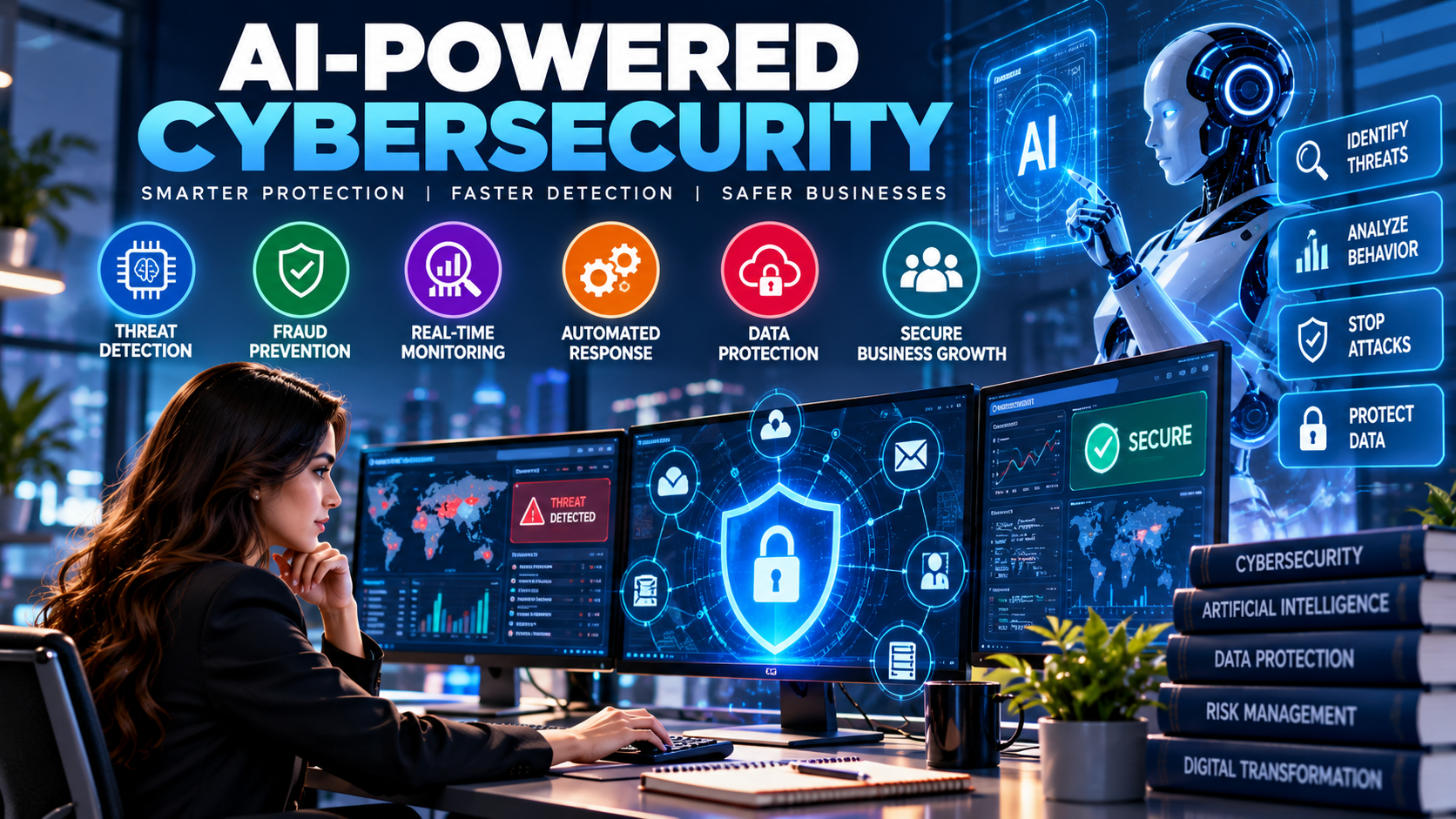
Cybersecurity has become a critical priority for businesses, governments, and individuals as digital technologies continue to expand. Organizations increasingly depend on cloud platforms, online transactions, connected devices, and digital communication systems. While these technologies improve efficiency, they also create opportunities for cybercriminals to exploit vulnerabilities, steal sensitive information, and disrupt business operations.
Traditional security systems remain important, but they may struggle to keep pace with sophisticated attacks, large volumes of security alerts, and rapidly changing threat patterns. AI-powered cybersecurity offers a new approach by using artificial intelligence and machine learning to analyze data, identify suspicious activity, detect potential threats, and support faster security responses.
From identifying unusual login behavior to detecting malicious software and prioritizing security alerts, AI can help organizations strengthen their defenses. However, artificial intelligence is not a complete replacement for security professionals, reliable security practices, or human decision-making.
Understanding how AI-powered cybersecurity works, its benefits, limitations, and practical applications can help businesses develop stronger strategies to protect their digital assets.
What Is AI-Powered Cybersecurity?
AI-powered cybersecurity refers to the use of artificial intelligence technologies to help prevent, detect, investigate, and respond to cyber threats.
These technologies can analyze large volumes of data from networks, computers, applications, user accounts, and cloud environments. By identifying patterns and unusual behavior, AI systems can help security teams discover potential threats that might otherwise remain unnoticed.
Machine learning is one of the main technologies used in AI-powered security. It allows systems to identify patterns in data and use those patterns to classify activity, detect anomalies, or estimate the likelihood of certain security events.
Other AI capabilities, including natural language processing and generative AI, can help security teams analyze reports, summarize alerts, investigate suspicious messages, and interpret technical information.
For example, an AI-powered security system might identify a login attempt from an unusual location followed by unexpected data access. Rather than treating each event separately, the system can analyze their relationship and flag the combined activity for investigation.
AI-powered cybersecurity works best as part of a broader security strategy that includes access controls, software updates, encryption, employee training, monitoring, and incident response planning.
Why AI-Powered Cybersecurity Matters
Cyber threats continue to evolve as businesses adopt new technologies and expand their digital operations. Attackers may use stolen credentials, phishing messages, malicious software, or vulnerabilities in applications to gain unauthorized access.
At the same time, security teams often manage more alerts and data than they can investigate manually.
AI can help address these challenges by processing information quickly, identifying relationships between events, and prioritizing activity that requires attention.
1. Increasing Cyber Threat Complexity
Modern attacks may involve multiple stages, including initial access, credential theft, movement between systems, and unauthorized data transfers.
AI can help identify suspicious patterns across these stages, allowing security teams to investigate activity that appears connected.
2. Growing Volumes of Security Data
Businesses generate security information through network logs, cloud applications, endpoint devices, identity systems, and email platforms.
AI can analyze this information at scale and help security professionals focus on the most important findings.
3. Faster Threat Detection
Some security incidents can cause significant damage if they remain undetected. AI-assisted monitoring can identify certain threats quickly and trigger alerts or predefined responses.
The speed and accuracy of detection depend on the quality of the data, system configuration, and type of threat.
4. Shortage of Cybersecurity Expertise
Many organizations face difficulties recruiting and retaining experienced security professionals. AI tools can help automate repetitive tasks and make investigations more efficient, allowing existing teams to focus on complex problems.
However, AI does not eliminate the need for skilled personnel who can validate findings and make informed security decisions.
How AI-Powered Cybersecurity Works
AI-powered cybersecurity systems typically combine data collection, analysis, threat identification, and response capabilities.
Step 1: Collect Security Data
The system gathers information from relevant sources, such as network traffic, endpoint devices, application logs, email systems, cloud services, and user authentication records.
The usefulness of the analysis depends on whether the collected data is accurate, relevant, and sufficiently comprehensive.
Step 2: Analyze Patterns and Behavior
AI models examine the collected information to identify relationships, recognize known threat indicators, or detect behavior that differs from expected patterns.
For example, a system may flag an account that suddenly downloads an unusually large amount of confidential information.
Step 3: Identify and Prioritize Threats
The system assigns alerts or risk scores based on available evidence and configured rules.
Security teams can use these results to prioritize incidents that appear more urgent or potentially damaging.
A high-risk alert is not automatically proof of a successful attack. It still requires appropriate validation.
Step 4: Support Investigation
AI tools can correlate events, summarize relevant logs, identify affected systems, and suggest possible explanations.
These capabilities may reduce the time required to understand an incident, especially when information is distributed across multiple security platforms.
Step 5: Respond to Threats
Depending on the system and its permissions, AI-assisted security tools may recommend or execute predefined actions, such as isolating an endpoint, blocking a suspicious connection, or requesting additional authentication.
High-impact actions should use appropriate safeguards, approval requirements, and rollback procedures to reduce the risk of disrupting legitimate business activity.
Key Applications of AI in Cybersecurity
AI can support several areas of digital security. Its value depends on the organization's threat environment, technical infrastructure, and implementation approach.
1. AI-Powered Threat Detection
Threat detection involves identifying malicious activity before it causes significant harm.
AI systems can analyze network traffic, system events, and other security signals to identify suspicious behavior. They may also help detect previously unseen variations of known threats.
For example, a system might recognize unusual communication between internal devices that does not match normal business activity.
AI-based detection is particularly useful when combined with threat intelligence, established security rules, and human investigation.
2. Phishing and Email Security
Phishing remains a common method for stealing credentials and distributing malicious links or attachments.
AI-powered email security tools can analyze message content, sender behavior, links, attachments, and communication patterns to identify suspicious messages.
Some systems can recognize unusual language or impersonation attempts even when a message does not contain an obvious malicious link.
However, AI can also make mistakes. Employees should continue to verify unexpected requests, especially those involving payments, password resets, confidential information, or urgent instructions.
3. Malware Detection
Malware includes malicious software designed to steal information, damage systems, or provide unauthorized access.
Traditional security tools often use known signatures to identify threats. AI-based systems can complement these methods by examining suspicious behavior, file characteristics, and system activity.
For instance, an endpoint security platform may flag a process that attempts to modify large numbers of files or access sensitive system resources unexpectedly.
AI-assisted detection should be combined with endpoint protection, patch management, application controls, and reliable backup systems.
4. Network Security Monitoring
Networks connect employees, applications, servers, cloud resources, and business systems. Monitoring this activity is essential for identifying unauthorized access and suspicious communication.
AI can analyze network patterns and highlight deviations that may indicate compromised devices, unauthorized data transfers, or unusual connections.
Security teams can use these insights to investigate potential incidents and improve network segmentation or access controls.
5. Identity and Access Protection
Compromised accounts are a major security concern because attackers may use legitimate credentials to avoid basic detection mechanisms.
AI-powered identity security tools can examine login patterns, device characteristics, authentication events, and access behavior.
If an account behaves unusually, the system may request additional verification, restrict access, or alert a security team.
These capabilities are most effective when combined with multifactor authentication, least-privilege access, and strong identity management policies.
6. Fraud Detection
AI is widely used to analyze transactions and identify activity that may indicate fraud.
Financial institutions, online marketplaces, and payment providers can use machine learning to identify unusual transaction patterns, suspicious account behavior, and potential misuse.
For example, a payment system may flag a series of transactions that differ significantly from a customer's normal activity.
Fraud detection models must be monitored carefully to reduce false positives, protect customer privacy, and avoid unfairly affecting legitimate users.
7. Vulnerability Management
A vulnerability is a weakness in software, hardware, configuration, or operational practice that may be exploited.
AI-assisted vulnerability management can help organizations analyze asset inventories, security findings, threat intelligence, and system exposure to prioritize remediation.
This can help teams focus on weaknesses that present greater practical risk rather than treating every finding as equally urgent.
AI does not replace vulnerability scanning, software updates, secure configuration, or expert verification.
8. Security Operations and Incident Response
Security operations centers monitor systems, investigate alerts, and coordinate responses to potential incidents.
AI can help summarize events, group related alerts, identify likely causes, and recommend investigative steps.
Some security platforms can also automate carefully defined response procedures.
For example, an organization might automatically disable a clearly compromised temporary account after specific detection conditions are met. More disruptive actions may require human approval.
9. Cloud Security
Cloud environments can involve numerous services, permissions, identities, and data stores. Misconfigurations or excessive permissions can expose important business information.
AI-assisted cloud security tools can help identify unusual access patterns, risky configurations, and potentially suspicious activity across cloud workloads.
Organizations should combine these tools with secure configuration standards, access reviews, encryption, logging, and clear responsibility for cloud security.
Benefits of AI-Powered Cybersecurity for Businesses
Adopting AI-assisted security can provide several operational advantages when the technology is selected and managed appropriately.
Faster Security Analysis
AI can analyze large amounts of information more quickly than manual review alone. This can help teams identify relevant alerts and investigate potential incidents sooner.
Improved Threat Visibility
By correlating events from multiple systems, AI tools may reveal patterns that are difficult to recognize when each alert is examined separately.
Reduced Repetitive Work
Automating routine tasks such as alert categorization, log summarization, and basic enrichment can free security professionals to focus on more complex investigations.
More Consistent Monitoring
Automated monitoring can operate continuously, helping organizations identify suspicious events outside normal working hours.
Better Risk Prioritization
AI-assisted systems can help prioritize security issues based on contextual signals, potential impact, and known threat information.
Support for Business Continuity
Earlier detection and more efficient incident handling can help reduce disruption. However, effective business continuity also requires tested backups, recovery procedures, and incident response plans.
Scalability
As organizations grow, the volume of security information often increases. AI can help process additional data, although infrastructure costs, model performance, and monitoring requirements must still be managed.
AI-Powered Cybersecurity vs. Traditional Cybersecurity
AI-powered and traditional cybersecurity are not competing approaches that require businesses to choose only one. They are often most effective when combined.
Area | Traditional security methods | AI-assisted security |
|---|---|---|
Threat detection | Rules, signatures, and known indicators | Pattern analysis, anomaly detection, and learned relationships |
Data processing | Often depends on predefined rules and manual investigation | Can analyze large datasets and correlate events |
Unknown threats | May struggle when indicators are not recognized | May identify unusual behavior, but can still miss new attacks |
Alert handling | Can require significant manual review | Can assist with grouping, prioritization, and summaries |
Response | Uses configured rules and human-led procedures | Can recommend or automate selected responses |
Accuracy | Depends on rule quality and available threat information | Depends on data quality, model performance, and configuration |
Traditional security remains essential for enforcing policies, blocking known threats, controlling access, and maintaining secure systems. AI can add another layer of analysis and automation, but it should not be treated as a complete replacement.
Risks and Limitations of AI in Cybersecurity
AI-powered security tools can improve detection and response, but they also introduce limitations that organizations must understand.
False Positives
AI may identify legitimate behavior as suspicious. Excessive false alarms can waste investigation time and cause employees to lose confidence in security systems.
Organizations should measure alert quality and tune detection systems to their operating environment.
False Negatives
AI may fail to detect malicious activity, particularly when the attack differs from the patterns the system recognizes.
Businesses should maintain multiple layers of defense rather than depending on a single AI tool.
Data Privacy Concerns
Security systems may process employee records, customer information, communication logs, and other sensitive data.
Organizations should restrict data collection to legitimate needs, control access, establish retention policies, and assess applicable privacy obligations.
Adversarial Manipulation
Attackers may attempt to evade detection or manipulate AI systems by changing their behavior, exploiting model weaknesses, or introducing misleading information.
Security teams should test systems, monitor performance, and use multiple detection methods.
Overreliance on Automation
An automated response can cause operational problems if it blocks a legitimate user, disables a critical service, or isolates an essential device.
Businesses should define approval requirements, response limits, emergency procedures, and recovery mechanisms.
AI-Supported Cyberattacks
Cybercriminals can also use AI to improve phishing messages, automate reconnaissance, or create more convincing social engineering attempts.
Organizations should therefore consider both defensive AI capabilities and the possibility that attackers may use similar technologies.
Cost and Complexity
AI security solutions may require specialized expertise, infrastructure, integration, and ongoing monitoring.
Before investing, businesses should identify a clear security problem and evaluate whether the proposed system offers sufficient value.
How Businesses Can Implement AI-Powered Cybersecurity
A successful implementation begins with a clear understanding of existing security risks and business requirements.
1. Assess Current Security Risks
Identify important assets, sensitive data, critical systems, common threats, and existing security weaknesses.
A risk assessment helps determine where AI could provide meaningful support.
2. Define Clear Objectives
Establish specific goals, such as reducing investigation time, improving phishing detection, prioritizing vulnerabilities, or identifying unusual account behavior.
Clear objectives make it easier to evaluate the results of an implementation.
3. Choose Suitable Security Tools
Compare solutions according to their detection capabilities, integration options, data requirements, privacy protections, support services, and total cost.
Consider whether the tool complements existing security systems rather than creating unnecessary duplication.
4. Begin With a Limited Pilot
Test the solution in a controlled environment or with a specific use case before expanding deployment.
A pilot allows the organization to evaluate detection quality, operational impact, false positives, and integration challenges.
5. Establish Human Oversight
Define which activities can be automated and which require human approval.
Actions that may interrupt critical services, affect large numbers of users, or expose sensitive information should receive appropriate safeguards.
6. Train Security Staff
Employees need to understand how the system works, how to investigate its alerts, and how to recognize incorrect or incomplete recommendations.
Training should also cover data privacy, incident escalation, and safe use of generative AI tools.
7. Measure Performance
Track results using indicators such as detection time, investigation time, false-positive rates, incident response time, and the number of successfully resolved security issues.
Use the findings to refine system settings and improve procedures.
8. Review and Improve Continuously
Threats, technologies, and business systems change over time. Regularly review model performance, permissions, integrations, and response procedures to ensure the system remains appropriate.
Best Practices for AI-Powered Cybersecurity
Organizations can strengthen AI-assisted security by following established cybersecurity principles.
Use multifactor authentication: Require additional verification for important accounts and systems.
Apply least-privilege access: Give users and automated systems only the permissions they need.
Keep software updated: Apply security patches and maintain supported software versions.
Encrypt sensitive information: Protect data during transmission and storage where appropriate.
Maintain secure backups: Keep backups protected from unauthorized modification and test recovery procedures.
Train employees: Teach staff to recognize phishing, suspicious requests, and social engineering attempts.
Protect AI systems: Secure model access, training data, integrations, and the tools used to automate security tasks.
Maintain incident response plans: Define responsibilities, communication channels, and recovery procedures before an incident occurs.
Test security controls: Conduct authorized security assessments and review whether controls work as intended.
Monitor AI performance: Evaluate detection quality, false alarms, and operational impact regularly.
AI should be part of a comprehensive cybersecurity program, not the only line of defense.
The Role of AI in Protecting Small and Medium-Sized Businesses
Small and medium-sized businesses increasingly depend on digital services but may have limited security budgets or small IT teams.
AI-assisted security tools can help these organizations monitor devices, filter suspicious emails, identify unusual login behavior, and prioritize security alerts.
Managed security service providers can also offer access to monitoring and incident response capabilities that would be difficult for a small business to maintain independently.
However, smaller organizations should avoid purchasing complex solutions without understanding their requirements. Basic protections such as multifactor authentication, secure backups, patch management, endpoint security, and employee awareness remain essential.
A practical starting point is to identify the business's most important systems, strengthen existing controls, and then evaluate whether AI can improve a specific security task.
The Future of AI-Powered Cybersecurity
The future of cybersecurity will likely involve greater integration between artificial intelligence, threat intelligence, cloud security, identity management, and automated response systems.
AI agents may increasingly assist with multi-step investigations, gather relevant evidence, summarize incidents, and coordinate selected defensive actions. These capabilities could help security teams handle complex workloads more efficiently.
At the same time, organizations will need stronger controls to prevent unauthorized actions, protect sensitive data, and ensure that AI-generated conclusions are reliable.
Attackers may also use increasingly sophisticated automation, creating a continuing need for improved detection methods, resilient systems, and skilled security professionals.
Future cybersecurity strategies will likely combine AI with established controls, human expertise, threat intelligence, and regular security testing.
The goal is not to automate every security decision. It is to use technology where it improves protection, efficiency, and decision-making while maintaining appropriate human responsibility.
Conclusion
AI-powered cybersecurity is transforming how organizations identify threats, analyze security data, investigate incidents, and respond to suspicious activity. Through machine learning, behavioral analysis, and intelligent automation, businesses can improve visibility, prioritize risks, and support faster security operations.
However, AI is not a complete solution to cyber risk. False alarms, missed threats, privacy concerns, implementation costs, and automated errors remain important considerations.
Organizations should combine AI-assisted tools with established security practices, trained professionals, clear policies, and tested recovery procedures. A measured implementation approach helps businesses evaluate benefits while managing risks.
As cyber threats continue to evolve, organizations that adopt AI responsibly and maintain strong cybersecurity fundamentals can improve their readiness to protect digital assets, maintain customer trust, and support long-term business resilience.
Frequently Asked Questions About AI-Powered Cybersecurity
What is AI-powered cybersecurity?
AI-powered cybersecurity uses artificial intelligence and machine learning to help detect threats, analyze security data, identify unusual behavior, investigate incidents, and support defensive responses.
How does AI improve cybersecurity?
AI can analyze large volumes of data, identify patterns, correlate security events, prioritize alerts, and automate selected tasks. These capabilities can help security teams investigate threats more efficiently.
Can AI prevent all cyberattacks?
No. AI can miss threats or incorrectly flag legitimate activity. Effective protection requires multiple security controls, continuous monitoring, employee training, and reliable incident response procedures.
What are the main applications of AI in cybersecurity?
Common applications include phishing detection, malware analysis, network monitoring, identity protection, fraud detection, vulnerability prioritization, cloud security, and incident response.
Is AI-powered cybersecurity suitable for small businesses?
Yes. Small businesses can use AI-assisted email security, endpoint protection, identity monitoring, and managed security services. They should select tools that match their risks, resources, and technical capabilities.
What are the risks of AI in cybersecurity?
Key risks include false positives, missed threats, data privacy concerns, adversarial manipulation, excessive automation, and implementation complexity.
Will AI replace cybersecurity professionals?
AI is more likely to change many cybersecurity tasks than eliminate the need for professionals. Human expertise remains important for risk assessment, complex investigations, strategic decisions, governance, and incident management.
How can a business get started with AI cybersecurity?
Begin with a security risk assessment, identify a specific problem, evaluate suitable tools, run a controlled pilot, establish human oversight, and measure the results before expanding implementation.AI-Powered Cybersecurity: How Artificial Intelligence Is Transforming Digital Security
Introduction
Cybersecurity has become a critical priority for businesses, governments, and individuals as digital technologies continue to expand. Organizations increasingly depend on cloud platforms, online transactions, connected devices, and digital communication systems. While these technologies improve efficiency, they also create opportunities for cybercriminals to exploit vulnerabilities, steal sensitive information, and disrupt business operations.
Traditional security systems remain important, but they may struggle to keep pace with sophisticated attacks, large volumes of security alerts, and rapidly changing threat patterns. AI-powered cybersecurity offers a new approach by using artificial intelligence and machine learning to analyze data, identify suspicious activity, detect potential threats, and support faster security responses.
From identifying unusual login behavior to detecting malicious software and prioritizing security alerts, AI can help organizations strengthen their defenses. However, artificial intelligence is not a complete replacement for security professionals, reliable security practices, or human decision-making.
Understanding how AI-powered cybersecurity works, its benefits, limitations, and practical applications can help businesses develop stronger strategies to protect their digital assets.
What Is AI-Powered Cybersecurity?
AI-powered cybersecurity refers to the use of artificial intelligence technologies to help prevent, detect, investigate, and respond to cyber threats.
These technologies can analyze large volumes of data from networks, computers, applications, user accounts, and cloud environments. By identifying patterns and unusual behavior, AI systems can help security teams discover potential threats that might otherwise remain unnoticed.
Machine learning is one of the main technologies used in AI-powered security. It allows systems to identify patterns in data and use those patterns to classify activity, detect anomalies, or estimate the likelihood of certain security events.
Other AI capabilities, including natural language processing and generative AI, can help security teams analyze reports, summarize alerts, investigate suspicious messages, and interpret technical information.
For example, an AI-powered security system might identify a login attempt from an unusual location followed by unexpected data access. Rather than treating each event separately, the system can analyze their relationship and flag the combined activity for investigation.
AI-powered cybersecurity works best as part of a broader security strategy that includes access controls, software updates, encryption, employee training, monitoring, and incident response planning.
Why AI-Powered Cybersecurity Matters
Cyber threats continue to evolve as businesses adopt new technologies and expand their digital operations. Attackers may use stolen credentials, phishing messages, malicious software, or vulnerabilities in applications to gain unauthorized access.
At the same time, security teams often manage more alerts and data than they can investigate manually.
AI can help address these challenges by processing information quickly, identifying relationships between events, and prioritizing activity that requires attention.
1. Increasing Cyber Threat Complexity
Modern attacks may involve multiple stages, including initial access, credential theft, movement between systems, and unauthorized data transfers.
AI can help identify suspicious patterns across these stages, allowing security teams to investigate activity that appears connected.
2. Growing Volumes of Security Data
Businesses generate security information through network logs, cloud applications, endpoint devices, identity systems, and email platforms.
AI can analyze this information at scale and help security professionals focus on the most important findings.
3. Faster Threat Detection
Some security incidents can cause significant damage if they remain undetected. AI-assisted monitoring can identify certain threats quickly and trigger alerts or predefined responses.
The speed and accuracy of detection depend on the quality of the data, system configuration, and type of threat.
4. Shortage of Cybersecurity Expertise
Many organizations face difficulties recruiting and retaining experienced security professionals. AI tools can help automate repetitive tasks and make investigations more efficient, allowing existing teams to focus on complex problems.
However, AI does not eliminate the need for skilled personnel who can validate findings and make informed security decisions.
How AI-Powered Cybersecurity Works
AI-powered cybersecurity systems typically combine data collection, analysis, threat identification, and response capabilities.
Step 1: Collect Security Data
The system gathers information from relevant sources, such as network traffic, endpoint devices, application logs, email systems, cloud services, and user authentication records.
The usefulness of the analysis depends on whether the collected data is accurate, relevant, and sufficiently comprehensive.
Step 2: Analyze Patterns and Behavior
AI models examine the collected information to identify relationships, recognize known threat indicators, or detect behavior that differs from expected patterns.
For example, a system may flag an account that suddenly downloads an unusually large amount of confidential information.
Step 3: Identify and Prioritize Threats
The system assigns alerts or risk scores based on available evidence and configured rules.
Security teams can use these results to prioritize incidents that appear more urgent or potentially damaging.
A high-risk alert is not automatically proof of a successful attack. It still requires appropriate validation.
Step 4: Support Investigation
AI tools can correlate events, summarize relevant logs, identify affected systems, and suggest possible explanations.
These capabilities may reduce the time required to understand an incident, especially when information is distributed across multiple security platforms.
Step 5: Respond to Threats
Depending on the system and its permissions, AI-assisted security tools may recommend or execute predefined actions, such as isolating an endpoint, blocking a suspicious connection, or requesting additional authentication.
High-impact actions should use appropriate safeguards, approval requirements, and rollback procedures to reduce the risk of disrupting legitimate business activity.
Key Applications of AI in Cybersecurity
AI can support several areas of digital security. Its value depends on the organization's threat environment, technical infrastructure, and implementation approach.
1. AI-Powered Threat Detection
Threat detection involves identifying malicious activity before it causes significant harm.
AI systems can analyze network traffic, system events, and other security signals to identify suspicious behavior. They may also help detect previously unseen variations of known threats.
For example, a system might recognize unusual communication between internal devices that does not match normal business activity.
AI-based detection is particularly useful when combined with threat intelligence, established security rules, and human investigation.
2. Phishing and Email Security
Phishing remains a common method for stealing credentials and distributing malicious links or attachments.
AI-powered email security tools can analyze message content, sender behavior, links, attachments, and communication patterns to identify suspicious messages.
Some systems can recognize unusual language or impersonation attempts even when a message does not contain an obvious malicious link.
However, AI can also make mistakes. Employees should continue to verify unexpected requests, especially those involving payments, password resets, confidential information, or urgent instructions.
3. Malware Detection
Malware includes malicious software designed to steal information, damage systems, or provide unauthorized access.
Traditional security tools often use known signatures to identify threats. AI-based systems can complement these methods by examining suspicious behavior, file characteristics, and system activity.
For instance, an endpoint security platform may flag a process that attempts to modify large numbers of files or access sensitive system resources unexpectedly.
AI-assisted detection should be combined with endpoint protection, patch management, application controls, and reliable backup systems.
4. Network Security Monitoring
Networks connect employees, applications, servers, cloud resources, and business systems. Monitoring this activity is essential for identifying unauthorized access and suspicious communication.
AI can analyze network patterns and highlight deviations that may indicate compromised devices, unauthorized data transfers, or unusual connections.
Security teams can use these insights to investigate potential incidents and improve network segmentation or access controls.
5. Identity and Access Protection
Compromised accounts are a major security concern because attackers may use legitimate credentials to avoid basic detection mechanisms.
AI-powered identity security tools can examine login patterns, device characteristics, authentication events, and access behavior.
If an account behaves unusually, the system may request additional verification, restrict access, or alert a security team.
These capabilities are most effective when combined with multifactor authentication, least-privilege access, and strong identity management policies.
6. Fraud Detection
AI is widely used to analyze transactions and identify activity that may indicate fraud.
Financial institutions, online marketplaces, and payment providers can use machine learning to identify unusual transaction patterns, suspicious account behavior, and potential misuse.
For example, a payment system may flag a series of transactions that differ significantly from a customer's normal activity.
Fraud detection models must be monitored carefully to reduce false positives, protect customer privacy, and avoid unfairly affecting legitimate users.
7. Vulnerability Management
A vulnerability is a weakness in software, hardware, configuration, or operational practice that may be exploited.
AI-assisted vulnerability management can help organizations analyze asset inventories, security findings, threat intelligence, and system exposure to prioritize remediation.
This can help teams focus on weaknesses that present greater practical risk rather than treating every finding as equally urgent.
AI does not replace vulnerability scanning, software updates, secure configuration, or expert verification.
8. Security Operations and Incident Response
Security operations centers monitor systems, investigate alerts, and coordinate responses to potential incidents.
AI can help summarize events, group related alerts, identify likely causes, and recommend investigative steps.
Some security platforms can also automate carefully defined response procedures.
For example, an organization might automatically disable a clearly compromised temporary account after specific detection conditions are met. More disruptive actions may require human approval.
9. Cloud Security
Cloud environments can involve numerous services, permissions, identities, and data stores. Misconfigurations or excessive permissions can expose important business information.
AI-assisted cloud security tools can help identify unusual access patterns, risky configurations, and potentially suspicious activity across cloud workloads.
Organizations should combine these tools with secure configuration standards, access reviews, encryption, logging, and clear responsibility for cloud security.
Benefits of AI-Powered Cybersecurity for Businesses
Adopting AI-assisted security can provide several operational advantages when the technology is selected and managed appropriately.
Faster Security Analysis
AI can analyze large amounts of information more quickly than manual review alone. This can help teams identify relevant alerts and investigate potential incidents sooner.
Improved Threat Visibility
By correlating events from multiple systems, AI tools may reveal patterns that are difficult to recognize when each alert is examined separately.
Reduced Repetitive Work
Automating routine tasks such as alert categorization, log summarization, and basic enrichment can free security professionals to focus on more complex investigations.
More Consistent Monitoring
Automated monitoring can operate continuously, helping organizations identify suspicious events outside normal working hours.
Better Risk Prioritization
AI-assisted systems can help prioritize security issues based on contextual signals, potential impact, and known threat information.
Support for Business Continuity
Earlier detection and more efficient incident handling can help reduce disruption. However, effective business continuity also requires tested backups, recovery procedures, and incident response plans.
Scalability
As organizations grow, the volume of security information often increases. AI can help process additional data, although infrastructure costs, model performance, and monitoring requirements must still be managed.
AI-Powered Cybersecurity vs. Traditional Cybersecurity
AI-powered and traditional cybersecurity are not competing approaches that require businesses to choose only one. They are often most effective when combined.
Area | Traditional security methods | AI-assisted security |
|---|---|---|
Threat detection | Rules, signatures, and known indicators | Pattern analysis, anomaly detection, and learned relationships |
Data processing | Often depends on predefined rules and manual investigation | Can analyze large datasets and correlate events |
Unknown threats | May struggle when indicators are not recognized | May identify unusual behavior, but can still miss new attacks |
Alert handling | Can require significant manual review | Can assist with grouping, prioritization, and summaries |
Response | Uses configured rules and human-led procedures | Can recommend or automate selected responses |
Accuracy | Depends on rule quality and available threat information | Depends on data quality, model performance, and configuration |
Traditional security remains essential for enforcing policies, blocking known threats, controlling access, and maintaining secure systems. AI can add another layer of analysis and automation, but it should not be treated as a complete replacement.
Risks and Limitations of AI in Cybersecurity
AI-powered security tools can improve detection and response, but they also introduce limitations that organizations must understand.
False Positives
AI may identify legitimate behavior as suspicious. Excessive false alarms can waste investigation time and cause employees to lose confidence in security systems.
Organizations should measure alert quality and tune detection systems to their operating environment.
False Negatives
AI may fail to detect malicious activity, particularly when the attack differs from the patterns the system recognizes.
Businesses should maintain multiple layers of defense rather than depending on a single AI tool.
Data Privacy Concerns
Security systems may process employee records, customer information, communication logs, and other sensitive data.
Organizations should restrict data collection to legitimate needs, control access, establish retention policies, and assess applicable privacy obligations.
Adversarial Manipulation
Attackers may attempt to evade detection or manipulate AI systems by changing their behavior, exploiting model weaknesses, or introducing misleading information.
Security teams should test systems, monitor performance, and use multiple detection methods.
Overreliance on Automation
An automated response can cause operational problems if it blocks a legitimate user, disables a critical service, or isolates an essential device.
Businesses should define approval requirements, response limits, emergency procedures, and recovery mechanisms.
AI-Supported Cyberattacks
Cybercriminals can also use AI to improve phishing messages, automate reconnaissance, or create more convincing social engineering attempts.
Organizations should therefore consider both defensive AI capabilities and the possibility that attackers may use similar technologies.
Cost and Complexity
AI security solutions may require specialized expertise, infrastructure, integration, and ongoing monitoring.
Before investing, businesses should identify a clear security problem and evaluate whether the proposed system offers sufficient value.
How Businesses Can Implement AI-Powered Cybersecurity
A successful implementation begins with a clear understanding of existing security risks and business requirements.
1. Assess Current Security Risks
Identify important assets, sensitive data, critical systems, common threats, and existing security weaknesses.
A risk assessment helps determine where AI could provide meaningful support.
2. Define Clear Objectives
Establish specific goals, such as reducing investigation time, improving phishing detection, prioritizing vulnerabilities, or identifying unusual account behavior.
Clear objectives make it easier to evaluate the results of an implementation.
3. Choose Suitable Security Tools
Compare solutions according to their detection capabilities, integration options, data requirements, privacy protections, support services, and total cost.
Consider whether the tool complements existing security systems rather than creating unnecessary duplication.
4. Begin With a Limited Pilot
Test the solution in a controlled environment or with a specific use case before expanding deployment.
A pilot allows the organization to evaluate detection quality, operational impact, false positives, and integration challenges.
5. Establish Human Oversight
Define which activities can be automated and which require human approval.
Actions that may interrupt critical services, affect large numbers of users, or expose sensitive information should receive appropriate safeguards.
6. Train Security Staff
Employees need to understand how the system works, how to investigate its alerts, and how to recognize incorrect or incomplete recommendations.
Training should also cover data privacy, incident escalation, and safe use of generative AI tools.
7. Measure Performance
Track results using indicators such as detection time, investigation time, false-positive rates, incident response time, and the number of successfully resolved security issues.
Use the findings to refine system settings and improve procedures.
8. Review and Improve Continuously
Threats, technologies, and business systems change over time. Regularly review model performance, permissions, integrations, and response procedures to ensure the system remains appropriate.
Best Practices for AI-Powered Cybersecurity
Organizations can strengthen AI-assisted security by following established cybersecurity principles.
Use multifactor authentication: Require additional verification for important accounts and systems.
Apply least-privilege access: Give users and automated systems only the permissions they need.
Keep software updated: Apply security patches and maintain supported software versions.
Encrypt sensitive information: Protect data during transmission and storage where appropriate.
Maintain secure backups: Keep backups protected from unauthorized modification and test recovery procedures.
Train employees: Teach staff to recognize phishing, suspicious requests, and social engineering attempts.
Protect AI systems: Secure model access, training data, integrations, and the tools used to automate security tasks.
Maintain incident response plans: Define responsibilities, communication channels, and recovery procedures before an incident occurs.
Test security controls: Conduct authorized security assessments and review whether controls work as intended.
Monitor AI performance: Evaluate detection quality, false alarms, and operational impact regularly.
AI should be part of a comprehensive cybersecurity program, not the only line of defense.
The Role of AI in Protecting Small and Medium-Sized Businesses
Small and medium-sized businesses increasingly depend on digital services but may have limited security budgets or small IT teams.
AI-assisted security tools can help these organizations monitor devices, filter suspicious emails, identify unusual login behavior, and prioritize security alerts.
Managed security service providers can also offer access to monitoring and incident response capabilities that would be difficult for a small business to maintain independently.
However, smaller organizations should avoid purchasing complex solutions without understanding their requirements. Basic protections such as multifactor authentication, secure backups, patch management, endpoint security, and employee awareness remain essential.
A practical starting point is to identify the business's most important systems, strengthen existing controls, and then evaluate whether AI can improve a specific security task.
The Future of AI-Powered Cybersecurity
The future of cybersecurity will likely involve greater integration between artificial intelligence, threat intelligence, cloud security, identity management, and automated response systems.
AI agents may increasingly assist with multi-step investigations, gather relevant evidence, summarize incidents, and coordinate selected defensive actions. These capabilities could help security teams handle complex workloads more efficiently.
At the same time, organizations will need stronger controls to prevent unauthorized actions, protect sensitive data, and ensure that AI-generated conclusions are reliable.
Attackers may also use increasingly sophisticated automation, creating a continuing need for improved detection methods, resilient systems, and skilled security professionals.
Future cybersecurity strategies will likely combine AI with established controls, human expertise, threat intelligence, and regular security testing.
The goal is not to automate every security decision. It is to use technology where it improves protection, efficiency, and decision-making while maintaining appropriate human responsibility.
Conclusion
AI-powered cybersecurity is transforming how organizations identify threats, analyze security data, investigate incidents, and respond to suspicious activity. Through machine learning, behavioral analysis, and intelligent automation, businesses can improve visibility, prioritize risks, and support faster security operations.
However, AI is not a complete solution to cyber risk. False alarms, missed threats, privacy concerns, implementation costs, and automated errors remain important considerations.
Organizations should combine AI-assisted tools with established security practices, trained professionals, clear policies, and tested recovery procedures. A measured implementation approach helps businesses evaluate benefits while managing risks.
As cyber threats continue to evolve, organizations that adopt AI responsibly and maintain strong cybersecurity fundamentals can improve their readiness to protect digital assets, maintain customer trust, and support long-term business resilience.
Frequently Asked Questions About AI-Powered Cybersecurity
What is AI-powered cybersecurity?
AI-powered cybersecurity uses artificial intelligence and machine learning to help detect threats, analyze security data, identify unusual behavior, investigate incidents, and support defensive responses.
How does AI improve cybersecurity?
AI can analyze large volumes of data, identify patterns, correlate security events, prioritize alerts, and automate selected tasks. These capabilities can help security teams investigate threats more efficiently.
Can AI prevent all cyberattacks?
No. AI can miss threats or incorrectly flag legitimate activity. Effective protection requires multiple security controls, continuous monitoring, employee training, and reliable incident response procedures.
What are the main applications of AI in cybersecurity?
Common applications include phishing detection, malware analysis, network monitoring, identity protection, fraud detection, vulnerability prioritization, cloud security, and incident response.
Is AI-powered cybersecurity suitable for small businesses?
Yes. Small businesses can use AI-assisted email security, endpoint protection, identity monitoring, and managed security services. They should select tools that match their risks, resources, and technical capabilities.
What are the risks of AI in cybersecurity?
Key risks include false positives, missed threats, data privacy concerns, adversarial manipulation, excessive automation, and implementation complexity.
Will AI replace cybersecurity professionals?
AI is more likely to change many cybersecurity tasks than eliminate the need for professionals. Human expertise remains important for risk assessment, complex investigations, strategic decisions, governance, and incident management.
How can a business get started with AI cybersecurity?
Begin with a security risk assessment, identify a specific problem, evaluate suitable tools, run a controlled pilot, establish human oversight, and measure the results before expanding implementation.