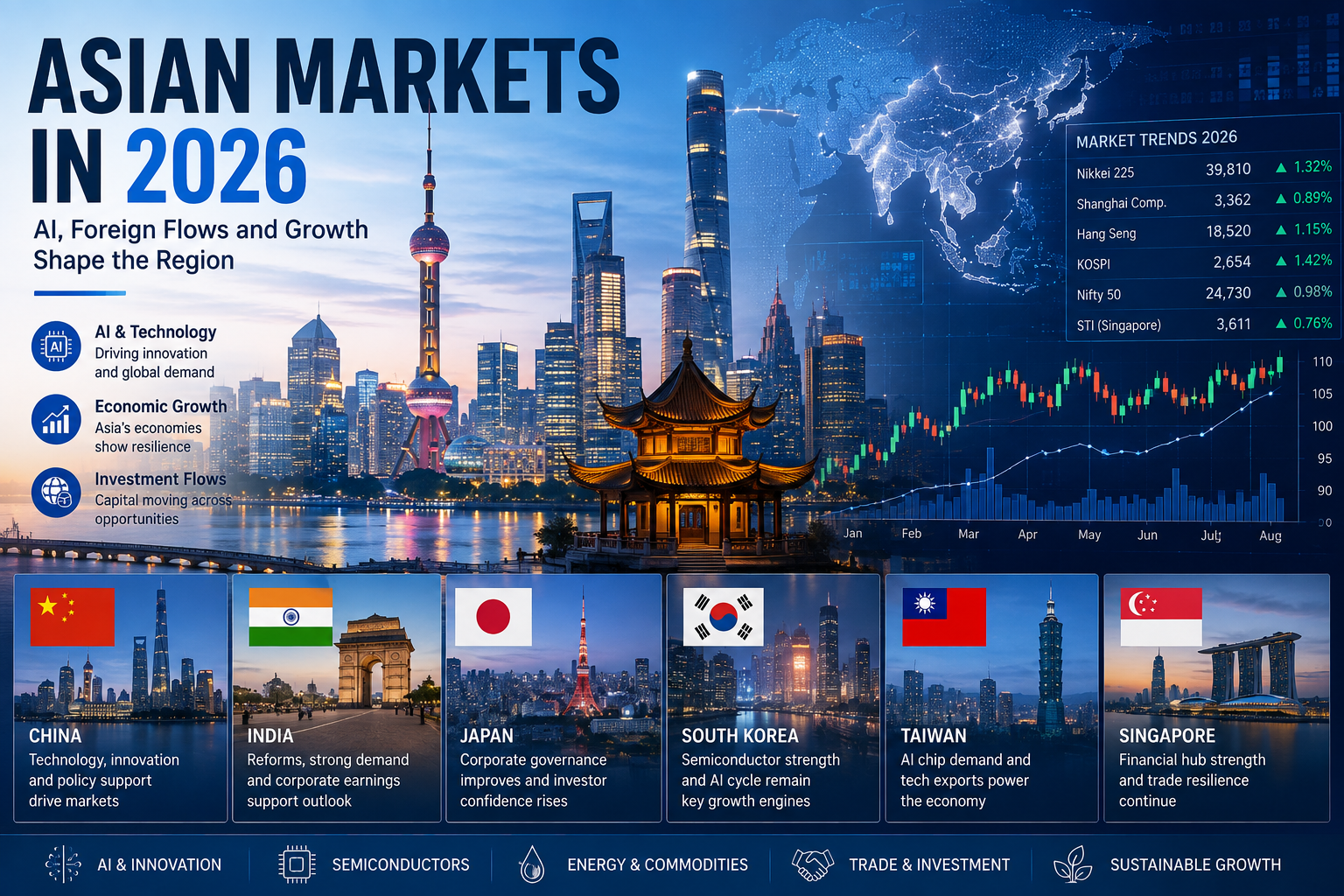
Asian markets are entering the second half of 2026 with a mix of strong economic fundamentals and growing uncertainty. Technology and artificial intelligence have supported major stock markets, while higher energy costs, foreign-investor flows and changing expectations for global interest rates are creating new challenges.
The Asian Development Bank forecasts growth of 4.9% for developing Asia and the Pacific in 2026, down from 5.5% in 2025. It expects growth to improve to 5.1% in 2027. Higher energy costs and geopolitical risks remain important concerns for the region.
At the same time, Asian equities have shown significant differences from one market to another. Technology-heavy markets such as Taiwan and South Korea have been affected by concerns about AI spending, while India and several Southeast Asian markets have attracted some foreign investment.
AI Remains a Major Driver of Asian Markets
Artificial intelligence has become one of the biggest themes affecting Asian equities.
South Korea and Taiwan are particularly important because of their semiconductor and technology industries. Companies involved in chips, memory, networking equipment and other AI infrastructure have benefited from strong global demand.
J.P. Morgan's mid-year Asia outlook noted that Asia ex-Japan remains in an AI infrastructure earnings cycle because the region controls important parts of the supply chain, including logic, memory, networking and power.
However, investors have also started questioning whether the enormous spending on AI infrastructure can continue at the same pace.
That has created greater volatility in technology-heavy markets.
Taiwan and South Korea Face Foreign Selling
Foreign investors sold Asian equities for a ninth consecutive month in July 2026, with Taiwan and South Korea experiencing particularly large outflows.
According to Reuters, foreign investors sold approximately $22.95 billion of Taiwanese equities and $6.26 billion of South Korean equities in July. Concerns about AI spending and future chip demand contributed to the selling.
The selling does not necessarily mean investors have abandoned Asian technology companies.
Instead, it shows that investors are becoming more selective after the enormous gains generated by AI-related stocks.
India Offers a Different Market Story
India has followed a somewhat different path.
Reuters reported that India's benchmark stock indexes had declined during 2026 amid foreign outflows, higher crude prices and global uncertainty. However, strong corporate earnings and domestic demand have provided support to the market.
India has also been trying to make its stock market more attractive to international investors.
The Securities and Exchange Board of India is preparing reforms involving trading, stock lending, short selling and market infrastructure. Foreign ownership of Indian equities has fallen to a 17-year low, while more than $50 billion flowed out of Indian equities between October 2024 and June 2026.
If these reforms improve market accessibility, India could potentially attract more international capital over the longer term.
China’s Technology Market Gains Attention
China's technology markets have also become increasingly important.
The Shanghai STAR Market, designed to support high-growth technology companies, has significantly outperformed several other Chinese technology indexes in 2026.
The STAR 50 Index was up approximately 23% in 2026 according to recent Financial Times reporting, compared with a smaller gain for Shenzhen's technology benchmark.
Semiconductors, robotics and other strategic technologies have attracted investor interest.
The development also reflects China's broader effort to strengthen domestic technology capabilities and reduce reliance on foreign technology.
Hong Kong Sees Strong Market Activity
Hong Kong remains an important bridge between international investors and Chinese companies.
Hong Kong Exchanges and Clearing reported record second-quarter results in 2026, with net profit rising 21% year over year to HK$5.38 billion. Average daily trading turnover also reached a record HK$289.5 billion.
The exchange also benefited from strong IPO activity.
This could be significant for Asian markets because successful IPOs can attract international capital and provide growing companies with access to financing.
However, technology stocks remain volatile, showing that strong trading activity does not necessarily mean every market segment will rise.
Malaysia Benefits From the AI Investment Boom
Malaysia is emerging as an important beneficiary of the global semiconductor and data-center investment cycle.
The country's economy grew 6% year over year in the second quarter of 2026, with manufacturing and construction providing significant support.
Malaysia is particularly important in semiconductor back-end manufacturing, including packaging and testing.
Its proximity to Singapore and its role in the global supply chain have also helped attract foreign investment.
Johor has become a major data-center hub, benefiting from investment associated with the global AI boom.
However, rapid data-center development also creates challenges involving electricity, water consumption and environmental sustainability.
Singapore Shows Economic Resilience
Singapore's economy has also benefited from the technology investment cycle.
The country's economy expanded 5.9% year over year in the second quarter of 2026, according to recent reporting, prompting the government to raise its full-year growth forecast to 4.5%–5.5%.
Singapore's position as a major financial, trading and technology hub gives it exposure to several major Asian trends.
The country is also benefiting from semiconductor demand and data-center investment.
However, its role as a major energy-trading center means higher energy prices can create challenges.
Asian Bond Markets Are Growing
The Asian market story is not limited to stocks.
Foreign borrowers are increasingly using Asia-Pacific bond markets to raise money.
Reuters reported that issuance of Australian-dollar "kangaroo" bonds reached approximately A$60 billion in 2026, up 40% from 2025. Chinese yuan-denominated bond issuance has also increased significantly.
This suggests that international borrowers are becoming more comfortable accessing Asian currencies and capital markets.
The trend could strengthen Asia's position in global finance while giving investors more opportunities beyond traditional U.S. dollar markets.
Energy Costs Remain a Major Risk
One of the biggest challenges facing Asian economies is energy.
The Asian Development Bank expects inflation in developing Asia and the Pacific to reach 4.3% in 2026, compared with 3% in 2025. Higher oil and gas prices are a major reason for the increase.
Higher energy prices can affect companies and consumers simultaneously.
Businesses may face higher production and transportation costs, while households may have less disposable income.
Energy-importing economies can be particularly vulnerable when global oil prices rise sharply.
Interest Rates Could Influence Asian Markets
Global interest rates remain another important factor.
Asian currencies, bonds and stocks can respond to changes in expectations for U.S. monetary policy.
If global interest rates remain high, investors may prefer safer or higher-yielding assets. If rates decline, emerging-market assets can potentially become more attractive.
Central-bank decisions in Japan, China, India, South Korea, Indonesia and other Asian economies will therefore remain important market events.
What Investors Are Watching
Several themes could shape Asian markets during the remainder of 2026.
AI and Semiconductors
Investors will continue watching whether AI demand translates into sustainable corporate earnings.
Foreign Capital
The direction of international investment flows could significantly affect Asian equity markets.
Energy Prices
Higher oil and gas prices could increase inflation and pressure corporate margins.
China's Economy
China remains one of the world's largest economies and a major driver of regional trade.
Interest Rates
Changes in global and Asian monetary policy can influence currencies, bonds and stocks.
IPO Activity
Strong IPO markets can attract capital and create opportunities for companies and investors.
Asian Markets Are Becoming More Diverse
One of the most important features of Asian markets in 2026 is the increasing diversity of investment opportunities.
Investors can find exposure to:
Semiconductors
Artificial intelligence
Robotics
Banking
Consumer businesses
Manufacturing
Energy
Infrastructure
Data centers
Financial services
Technology
This means Asia is no longer simply a single investment story.
Different countries and sectors can perform very differently depending on economic conditions and investor sentiment.
What Could Happen Next?
The outlook for Asian markets is mixed but remains important for global investors.
The region has strong long-term growth drivers, including technology, manufacturing, urbanization, rising consumer demand and digitalization.
However, risks remain.
The Asian Development Bank has highlighted energy disruptions, tighter financial conditions, trade uncertainty, potential equity-market corrections and a possible repricing of AI-related stocks as major risks.
The result could be a market environment where investors increasingly focus on individual companies and sectors rather than simply buying the entire region.
Final Thoughts
Asian markets remain among the most important parts of the global financial system in 2026.
Technology and AI continue to support semiconductor and data-center industries, while China, India, Japan, South Korea, Taiwan, Malaysia and Singapore are developing different investment stories.
At the same time, foreign capital flows, energy prices, inflation and interest rates are creating volatility.
For investors, the key theme may be selectivity.
The strongest opportunities may come from companies with sustainable earnings, strong balance sheets and exposure to long-term trends rather than from simply following the hottest market.
Asia's economic importance is unlikely to disappear. But as 2026 progresses, investors will need to distinguish between temporary market enthusiasm and businesses capable of delivering sustainable long-term growth.
FAQs
What is driving Asian markets in 2026?
Artificial intelligence, semiconductor demand, technology investment, economic growth and changing global interest-rate expectations are among the major drivers.
Which Asian markets are strongly connected to AI?
Taiwan and South Korea are particularly exposed to AI through semiconductors and related technology supply chains. Malaysia and Singapore are also benefiting from data-center and semiconductor investment.
Why are foreign investors selling Asian stocks?
Recent selling has been concentrated in technology-heavy markets, particularly Taiwan and South Korea, amid concerns about AI spending and future chip demand.
Is India still attractive to investors?
India faces foreign-outflow and valuation challenges, but strong domestic demand, corporate earnings and market reforms could support its longer-term outlook.
Why is Malaysia attracting investment?
Malaysia is benefiting from semiconductor manufacturing and the rapid expansion of data centers connected to the global AI investment boom.
What are the biggest risks for Asian markets?
Major risks include higher energy prices, inflation, tighter financial conditions, trade uncertainty, geopolitical tensions and a potential correction in AI-related stocks.
Are Asian bond markets growing?
Yes. International borrowers are increasingly using Asian currencies and bond markets, including Australian-dollar and Chinese yuan markets, to diversify their financing.
What is the Asian economic growth forecast for 2026?
The Asian Development Bank forecasts 4.9% growth for developing Asia and the Pacific in 2026, down from 5.5% in 2025.