
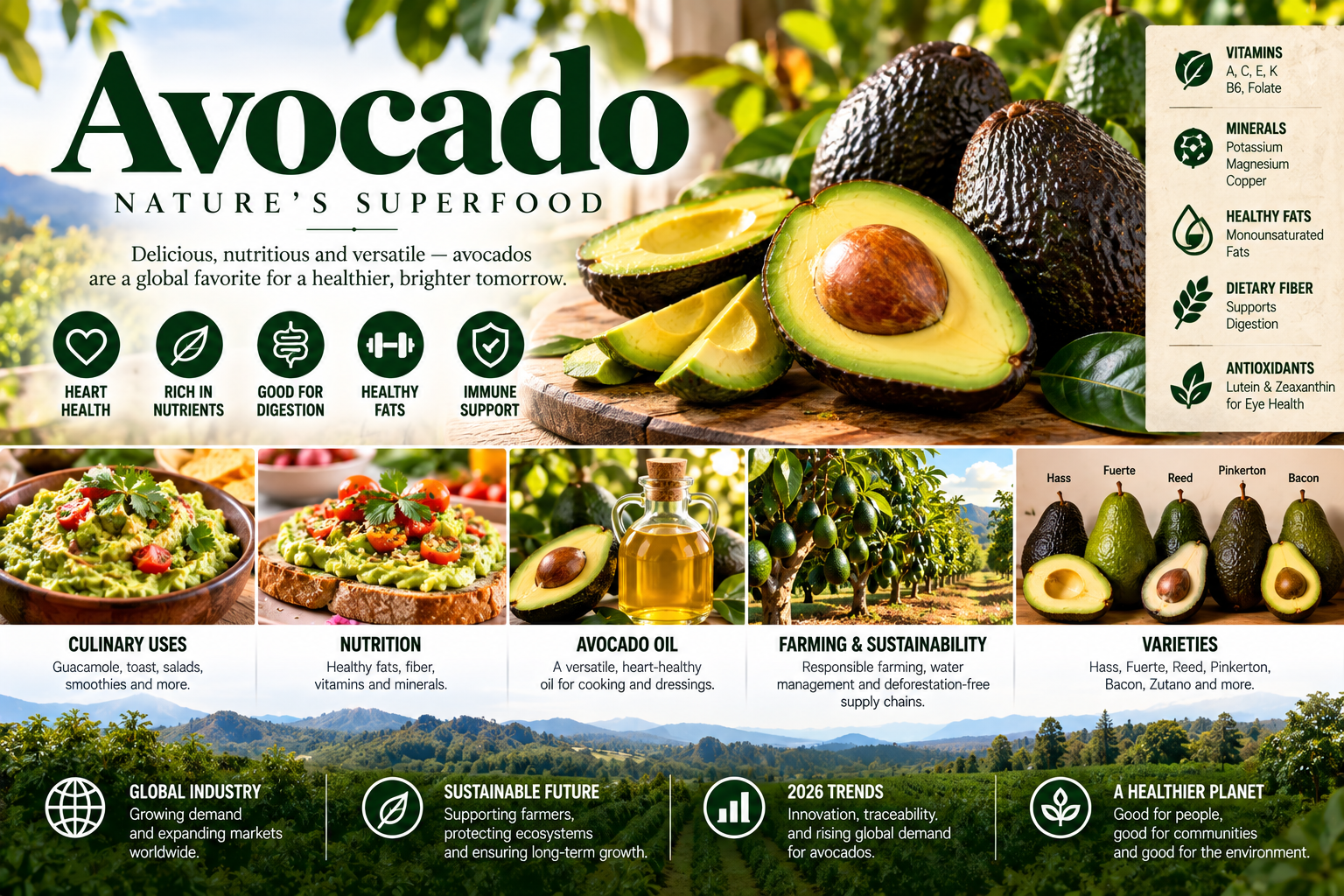
Avocado has evolved from a regional agricultural crop into one of the world's most recognizable fruits. Known for its creamy texture, distinctive flavor and high concentration of unsaturated fats, avocado is now used across breakfast foods, salads, sandwiches, dips, smoothies, restaurants and packaged food products.
Botanically, avocado is a fruit and specifically a large berry with a single seed. The fruit comes from the Persea americana tree and is believed to have originated in Mexico and Central America. Mexico remains the world's leading avocado-producing country.
The avocado industry is also becoming an increasingly important part of international agriculture and food trade. Mexico is forecasting 2.8 million metric tons of avocado production in 2026, approximately 3% above its 2025 production, according to the USDA Foreign Agricultural Service.
At the same time, growing consumer demand is encouraging producers and exporters to focus more heavily on water management, traceability, biodiversity and deforestation-free production.
What Is an Avocado?
Avocado is a nutrient-dense fruit grown on evergreen trees in the Persea genus.
Unlike many fruits, avocado contains relatively little sugar and is naturally rich in fat, particularly monounsaturated fat. It also provides dietary fiber and a range of vitamins, minerals and plant compounds.
Its creamy consistency makes it unusually versatile.
Avocado can be:
Sliced
Mashed
Diced
Blended
Baked
Used in sauces
Added to salads
Served on toast
Used in guacamole
Added to smoothies
Used in sushi
Incorporated into desserts
This versatility has helped avocado become both a household food and a major commercial ingredient.
Where Do Avocados Come From?
Avocados are native to Mexico and Central America.
Today, commercial production has expanded to many regions with suitable climates, including Mexico, Peru, Colombia, Kenya, Chile, the Dominican Republic, California and other producing regions.
Mexico is particularly important to global supply.
The USDA Foreign Agricultural Service forecasts Mexican avocado production at approximately 2.8 million metric tons in 2026, representing about 28% of global production.
The Mexican industry is concentrated particularly in Michoacán and Jalisco.
Hass Avocado
The Hass avocado is the dominant commercial variety in many international markets.
Hass avocados are recognizable by their textured skin, creamy flesh and relatively small seed.
One reason Hass has become commercially successful is its combination of flavor, texture, transportability and consumer familiarity.
Harvard's Nutrition Source notes that Hass is the most common avocado variety and is available throughout the year in many markets.
Other Avocado Varieties
Although Hass dominates international trade, many other avocado varieties exist.
Fuerte
Fuerte was historically an important commercial variety and remains cultivated in some regions.
It generally has smoother green skin and a different flavor and texture profile from Hass.
Reed
Reed avocados are relatively large and round, with creamy flesh and a distinctive flavor.
Pinkerton
Pinkerton avocados are elongated and known for a relatively small seed.
Bacon
Bacon avocados generally have smoother green skin and are often cultivated in regions where conditions are suitable for the variety.
Zutano
Zutano has green skin and is another variety found in commercial and specialty markets.
Different varieties can vary considerably in:
Size
Shape
Skin texture
Ripening behavior
Oil content
Flavor
Harvest season
Climate requirements
Avocado Nutrition
Avocado's nutritional profile is one of the major reasons for its popularity.
According to Harvard T.H. Chan School of Public Health, a medium avocado contains approximately:
240 calories
22 grams of fat
15 grams of monounsaturated fat
10 grams of fiber
13 grams of carbohydrate
3 grams of protein
It also provides vitamins and minerals including folate, vitamin C, vitamin E, vitamin K, potassium and magnesium.
The exact nutritional content varies according to fruit size and variety.
Healthy Fats in Avocado
One of avocado's defining characteristics is its high concentration of monounsaturated fat.
Monounsaturated fats are unsaturated fats commonly found in plant foods such as avocados, nuts and certain vegetable oils.
Replacing some saturated fats with unsaturated fats can be part of an overall heart-conscious eating pattern.
However, avocado should be considered as one component of a balanced diet rather than a standalone solution for health.
Fiber
Avocado is also a good source of dietary fiber.
Fiber contributes to digestive health and can help increase satiety.
Harvard notes that avocado contains both insoluble and soluble fiber and that its fibers can act as prebiotics for beneficial intestinal bacteria.
This makes avocado relevant to the growing consumer interest in gut health and fiber-rich foods.
Potassium
Avocado provides potassium, an essential mineral involved in fluid balance, muscle function and nerve signaling.
Harvard's Nutrition Source lists avocados among important dietary sources of potassium.
A diet containing a variety of fruits, vegetables, legumes and other nutrient-rich foods can help consumers meet potassium requirements.
Vitamins and Plant Compounds
Avocado contains several micronutrients and plant compounds, including:
Vitamin C
Vitamin E
Vitamin K
Folate
B vitamins
Lutein
Zeaxanthin
Magnesium
Potassium
Lutein and zeaxanthin are carotenoids found in the human eye and are among the plant compounds present in avocado.
Avocado and Heart Health
Avocado has attracted significant nutritional research because of its monounsaturated fats, fiber and potassium.
Harvard reports that a large observational study involving more than 110,000 adults found that people consuming two or more servings of avocado per week had a lower observed risk of cardiovascular disease and heart disease. However, observational research cannot prove that avocado itself caused the lower risk, because other dietary and lifestyle factors may contribute.
This distinction is important when discussing nutrition.
Avocado can contribute valuable nutrients to a healthy dietary pattern, but no single food determines overall health.
Avocado and Weight Management
Avocado is relatively calorie-dense because it contains substantial amounts of fat.
At the same time, its fiber and fat content can contribute to satiety.
For people managing calorie intake, portion size remains important.
The role of avocado in weight management therefore depends on the overall diet, serving sizes and individual nutritional needs.
Avocado in Vegetarian and Vegan Diets
Avocado is particularly popular among vegetarian and vegan consumers because it provides plant-based fat and can add richness to meals without animal products.
It can be used in:
Vegan sandwiches
Plant-based tacos
Grain bowls
Salads
Smoothies
Toast
Sushi
Dips
Vegan sauces
Its creamy texture can also be used as a substitute for certain dairy-based ingredients in recipes.
Guacamole
Guacamole is perhaps the most internationally recognized avocado-based food.
Traditional guacamole generally combines mashed avocado with ingredients such as:
Lime
Onion
Chili
Tomato
Garlic
Cilantro
Salt
The dish has roots in Mexican cuisine and has become a major global food product.
In the United States, avocado demand receives a particularly large seasonal boost around major sporting events and holidays.
Avocado Toast
Avocado toast became a major food trend during the 2010s and remains popular.
The basic concept combines mashed or sliced avocado with toasted bread, often supplemented with:
Eggs
Seeds
Tomatoes
Chili flakes
Herbs
Lemon or lime
Olive oil
Cheese
Its popularity helped position avocado as a breakfast and brunch staple in many markets.
Avocado Oil
Avocado oil is produced by extracting oil from avocado flesh.
It contains a high proportion of monounsaturated fat and has become popular in cooking, salad dressings and food manufacturing.
Harvard notes that avocado oil has a high smoke point and a relatively neutral flavor compared with some other oils.
The commercial avocado-oil market is expanding alongside consumer interest in plant-based cooking oils.
Avocado in the Food Industry
Avocado is no longer limited to fresh produce departments.
Commercial applications include:
Guacamole
Dips
Frozen avocado
Avocado oil
Ready-to-eat meals
Salads
Sandwiches
Wraps
Smoothies
Sauces
Restaurant dishes
Baby and family foods
Snack products
Food manufacturers increasingly use avocado as an ingredient associated with natural foods, plant-based diets and premium nutrition.
The Global Avocado Industry
Avocado has become an important global agricultural commodity.
Production is concentrated in countries with climates suitable for avocado cultivation, while consumer markets extend far beyond producing regions.
Mexico remains the leading producer.
The USDA's 2026 forecast puts Mexican production at approximately 2.8 million metric tons. The agency says favorable agricultural conditions, improved practices and sustained export demand are supporting the increase.
Kenya is also becoming an increasingly important producer and exporter.
The USDA Foreign Agricultural Service forecasts Kenya's 2026 avocado production at approximately 727,000 metric tons, an increase of 4.8% from 2025.
Mexico and the U.S. Avocado Market
Mexico plays an especially important role in supplying the United States.
The Mexican avocado industry reported that U.S. imports of Mexican avocados were projected to exceed 2.5 billion pounds during the 2025–2026 season.
The scale of this trade illustrates how deeply integrated the North American avocado supply chain has become.
Demand is no longer limited to traditional avocado consumers. Restaurants, grocery retailers, foodservice operators and packaged-food companies have all helped broaden the market.
Seasonal Demand
Avocado consumption can increase sharply around major events.
The 2026 Big Game created an especially notable demand period. The Mexican avocado industry reported more than 300 million pounds of Mexican avocados entering the United States during the four weeks before the event.
Seasonal marketing is important because avocado is frequently associated with:
Sports events
Parties
Cinco de Mayo
Summer cookouts
Restaurant promotions
Breakfast and brunch
Family gatherings
These occasions create recurring opportunities for retailers and foodservice businesses.
Avocado Farming
Avocado cultivation requires suitable temperatures, soil conditions, water availability and careful orchard management.
Farmers must manage:
Irrigation
Soil health
Pollination
Pest control
Tree nutrition
Harvest timing
Fruit quality
Post-harvest handling
Climate conditions can have a significant impact on production.
The USDA's 2026 Mexico forecast notes that potential El Niño conditions later in the year could bring drier conditions and heat spikes that may affect fruit size.
Water Management
Water is one of the most important sustainability issues associated with avocado cultivation.
The Mexican industry has increasingly emphasized irrigation efficiency and water stewardship.
The industry's sustainability strategy includes goals around water management, biodiversity, climate and deforestation.
The USDA's 2026 Mexico report also notes that producers are increasing adoption of pressurized irrigation systems to improve water management.
Because avocado production occurs in diverse environments, water requirements and environmental impacts can vary substantially by region, farming system and climate.
Avocado and Deforestation
Deforestation has become another major issue in discussions about avocado production, particularly in regions where agricultural expansion can place pressure on forests.
Mexico introduced a federal framework in 2026 aimed at deforestation-free agricultural exports by 2030.
The Mexican avocado industry was among the first agricultural sectors to enter the conservation agreement, according to the Avocado Institute of Mexico.
The industry has stated goals around achieving net-zero deforestation and improving forest and biodiversity protection.
These commitments are important, but long-term progress depends on implementation, monitoring, enforcement and transparent measurement.
Technology in Avocado Farming
Agricultural technology is becoming increasingly important.
Modern avocado farms can use:
Weather stations
Soil-moisture sensors
Irrigation monitoring
Satellite imagery
Digital farm-management platforms
Crop forecasting
Supply-chain tracking
Automated packing systems
These technologies can help producers improve resource efficiency and monitor crop conditions.
The Mexican industry's sustainability programs have included weather stations and soil-moisture monitoring as part of water-management efforts.
Avocado Harvesting and Supply Chains
Avocado is a climacteric fruit, meaning it continues to ripen after harvest.
This characteristic allows producers to harvest fruit before it reaches full eating softness and manage ripening during transportation and distribution.
The modern avocado supply chain involves:
Orchard → Harvest → Packing → Quality Control → Transportation → Importer → Retailer → Consumer
Temperature management and careful handling are important because bruising and over-ripening can reduce product quality.
Avocado Food Safety
Food safety is an important part of international avocado trade.
In the United States, imported avocado shipments above certain thresholds are subject to USDA Agricultural Marketing Service inspection and certification requirements. USDA states that imported avocados must meet specified grade and maturity requirements before entering the U.S. market, subject to applicable exemptions.
Food safety controls can include:
Inspection
Traceability
Packing-house standards
Transportation controls
Agricultural regulations
Import requirements
These systems help protect consumers while maintaining international trade.
How to Choose a Ripe Avocado
A ripe avocado generally yields slightly when gently pressed.
Harvard's Nutrition Source notes that firm, light-green avocados generally need additional time to ripen, while ripe fruit typically feels slightly soft. Dark, shriveled skin and extensive mushy areas can indicate over-ripening.
The exact appearance varies by variety.
For Hass avocados, skin color often becomes darker as the fruit ripens.
How to Store Avocado
Unripe avocados can generally be kept at room temperature until they soften.
Once ripe, refrigeration can slow further ripening.
After cutting an avocado, exposure to oxygen causes enzymatic browning.
Lemon or lime juice, airtight storage and refrigeration can help slow this process.
Popular Avocado Recipes
Avocado can be incorporated into countless meals.
Popular options include:
Avocado Toast
Mash avocado over whole-grain toast and add seasonings, vegetables or eggs.
Guacamole
Combine mashed avocado with lime, onion, tomato, chili and herbs.
Avocado Salad
Combine sliced avocado with greens, tomatoes, cucumber and a simple dressing.
Smoothies
Blend avocado with fruit, milk or plant-based alternatives for a creamy texture.
Grain Bowls
Add avocado to rice, quinoa or other whole grains with vegetables and protein.
Tacos
Sliced or mashed avocado can add richness to tacos and other Mexican-inspired dishes.
Avocado and the Wellness Economy
Avocado fits naturally into several major consumer trends.
These include:
Whole-food eating
Plant-based diets
High-fiber diets
Healthy-fat consumption
Mediterranean-style eating
Convenient meal preparation
Premium fresh produce
Functional food interest
Harvard notes that avocado's combination of fiber, monounsaturated fats, potassium and micronutrients makes it compatible with several healthy dietary patterns.
2026 Avocado Industry Trends
Several trends are shaping the avocado market in 2026.
1. Growing Global Demand
Avocado consumption continues to expand across major markets.
The U.S. has become a particularly important consumer market, with imports from Mexico reaching record levels around major seasonal events.
2. Production Growth
Mexico forecasts 2.8 million metric tons of avocado production in 2026, while Kenya expects approximately 727,000 metric tons.
3. Sustainable Irrigation
Water-efficient irrigation systems are receiving increasing attention as producers respond to resource constraints.
4. Deforestation-Free Supply Chains
Traceability and deforestation monitoring are becoming more important for international agricultural commodities.
5. Premium Fresh Produce
Consumers increasingly associate avocado with premium, nutrient-dense and versatile foods.
6. Convenience Foods
Ready-to-eat guacamole, pre-cut avocado and frozen avocado products can make the fruit easier to incorporate into everyday meals.
7. Avocado Oil
Demand for plant-based cooking oils continues to create opportunities beyond fresh fruit.
8. Agricultural Technology
Sensors, irrigation systems, data analytics and digital farm management are becoming increasingly relevant to avocado production.
Challenges Facing the Avocado Industry
Despite strong demand, avocado production faces several challenges.
Climate Change
Changes in temperature and rainfall can influence flowering, fruit development and harvest yields.
Water Availability
Water management is particularly important in regions where agricultural demand competes with other uses.
Deforestation Concerns
Expansion into sensitive ecosystems can create environmental concerns and increase pressure for traceability.
Supply-Chain Costs
Avocados are perishable, making transportation, storage and distribution important to profitability.
Price Volatility
Weather conditions, crop size, transportation costs and international demand can all influence avocado prices.
Labor
Avocado farming and packing require substantial agricultural labor, making workforce availability another important industry consideration.
The Future of Avocado
The future of the avocado industry will likely depend on balancing consumer demand with environmental and agricultural resilience.
Producers are increasingly focused on improving yields without proportionally increasing resource consumption.
Potential areas of development include:
Precision irrigation
Climate-resilient farming
Deforestation monitoring
Digital traceability
Improved packaging
Cold-chain technology
New avocado varieties
Sustainable orchard management
Automated sorting
Agricultural AI
Alternative processing technologies
The Mexican industry has set long-term sustainability objectives around water, biodiversity, climate and deforestation, including a goal of net-zero deforestation by 2035.
Whether these goals are achieved will depend on implementation, verification and collaboration across growers, packers, exporters, governments and retailers.
Frequently Asked Questions About Avocado
Is avocado a fruit or a vegetable?
Avocado is botanically a fruit and is classified as a large berry with a single seed.
What is the most common avocado variety?
Hass is the most common avocado variety in many markets and is widely available year-round.
Is avocado high in fat?
Yes. Avocado contains a relatively high amount of fat compared with most fruits, with much of that fat being monounsaturated.
Does avocado contain fiber?
Yes. Avocado is a good source of dietary fiber.
Is avocado a source of potassium?
Yes. Avocado provides potassium, an essential mineral involved in fluid balance, nerve signaling and muscle function.
Which country produces the most avocados?
Mexico is the world's leading avocado producer. USDA forecasts approximately 2.8 million metric tons of Mexican avocado production for 2026.
Can avocado be used for cooking?
Yes. Fresh avocado can be incorporated into many recipes, while avocado oil can be used for cooking and dressings.
How do you know when an avocado is ripe?
A ripe avocado typically gives slightly when gently pressed. Firm fruit usually needs more time to ripen.
Conclusion
Avocado has become much more than a popular fruit.
Its combination of creamy texture, culinary versatility, fiber, monounsaturated fats, potassium and other nutrients has helped transform it into a major global food commodity.
Mexico remains at the center of the global avocado economy, with 2026 production forecast at approximately 2.8 million metric tons. Kenya and other producing countries are also expanding their roles in international markets.
At the same time, the industry's future increasingly depends on responsible water use, climate resilience, biodiversity protection, traceability and deforestation-free supply chains.
In 2026, avocado represents the intersection of agriculture, nutrition, international trade, foodservice, technology and sustainability. As global demand continues to develop, innovation throughout the farm-to-table supply chain will play an increasingly important role in determining how the industry grows.