Finding a competitive savings account can make a meaningful difference when building long-term financial security. For people who want predictable returns without direct exposure to stock market fluctuations, certificates of deposit (CDs) can be an attractive savings option.
CDs allow customers to deposit money with a bank or credit union for a specific period in exchange for an agreed interest rate. In many cases, withdrawing funds before the maturity date results in an early withdrawal penalty.
In October 2026, several U.S. financial institutions are advertising CD rates around or above 4% APY, with some five-year offers reaching 5.00% APY. However, the best rate depends on the term, minimum deposit, account requirements, and availability.
This guide compares competitive CD offers, explains how CD interest works, and provides practical tips for choosing an account that matches your savings goals.
What Is a Certificate of Deposit (CD)?
A certificate of deposit is a savings product offered by banks and credit unions. Customers deposit money for a predetermined period, known as the CD term, and generally earn interest at an agreed rate.
Common CD terms include:
3 months
6 months
9 months
1 year
18 months
2 years
3 years
4 years
5 years
Some financial institutions offer even longer terms.
Unlike a traditional savings account, a standard CD generally restricts access to the deposited funds until maturity. If you withdraw money early, the institution may charge a penalty based on its account agreement.
CDs may be useful for people who have savings they do not expect to need immediately and want a predictable return.
Best CD Rates in October 2026
Several banks and credit unions currently offer competitive CD yields across different terms.
The following examples reflect published market information available around October 28–30, 2026. Rates can change at any time, and the highest advertised APY may have additional eligibility or deposit requirements.
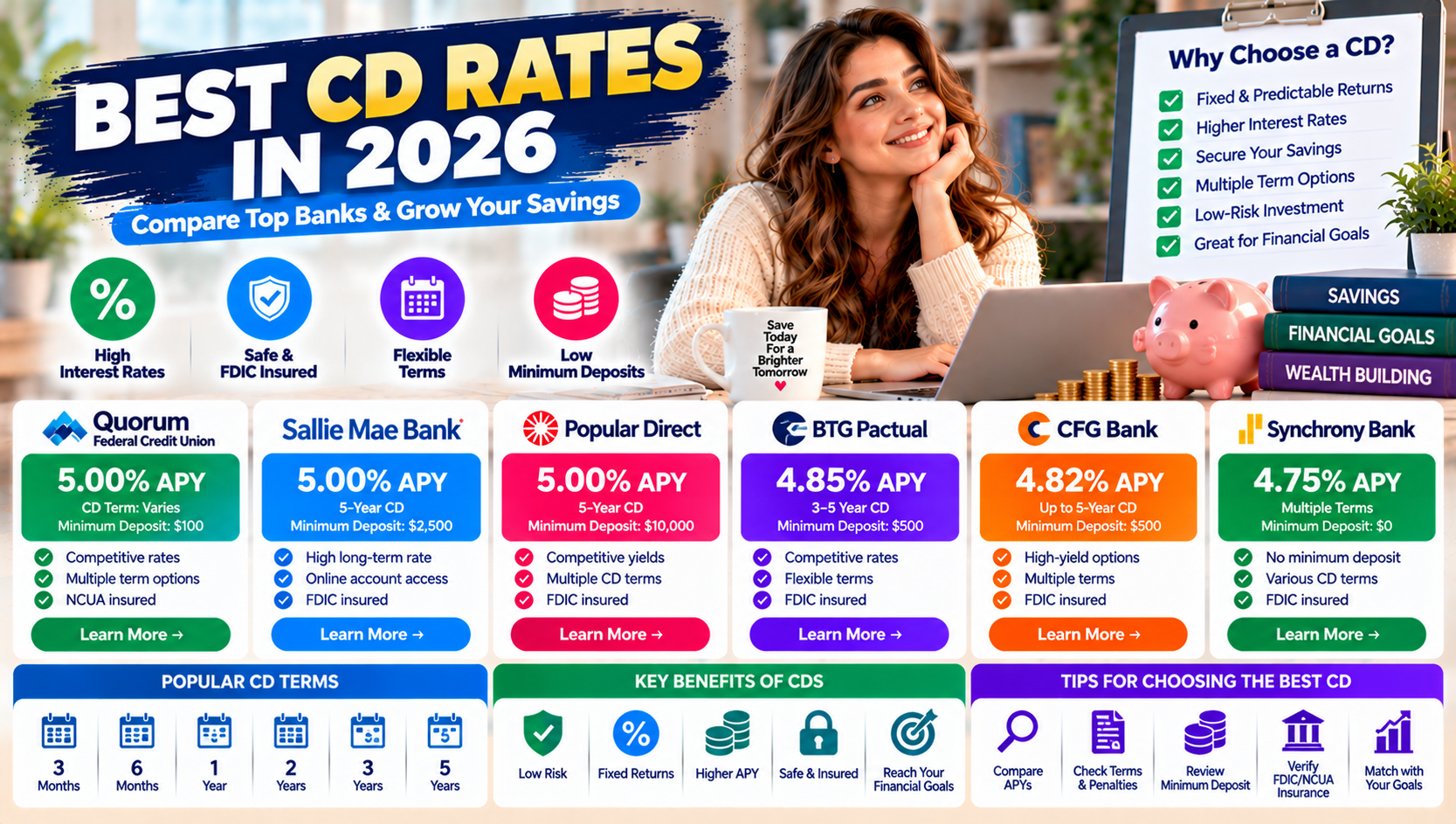
Financial institution | Example CD rate | Term | Minimum deposit |
|---|---|---|---|
Quorum Federal Credit Union | Up to 5.00% APY | Varies by offer | $100 |
Sallie Mae Bank | Up to 5.00% APY | 5 years | $2,500 |
Popular Direct | Up to 5.00% APY | 5 years | $10,000 |
BTG Pactual Bank | Up to 4.85% APY | 3–5 years, depending on offer | $500 |
CFG Bank | Up to 4.82% APY | Up to 5 years | $500 |
E*TRADE | Up to 4.80% APY | Multiple terms | $0 |
Synchrony Bank | Up to 4.75% APY | Multiple terms | $0 |
Barclays | Up to 4.75% APY | Up to 5 years | $0 |
Bread Savings | Up to 4.85% APY | Multiple terms | $1,500 |
Happen Bank | Up to 4.76% APY | Multiple terms | $500 |
Important: These are selected advertised offers, not a guaranteed or exhaustive ranking. The highest APY may apply only to a particular term. Verify the exact rate, minimum deposit, and early withdrawal penalty directly with the institution before opening an account.
Market comparisons from Bankrate and NerdWallet reported several 5.00% APY offers in late October 2026. <Cite refs={["turn487458search0","turn487458search3","turn487458search5"]}/>
Best CD Accounts to Consider
1. Quorum Federal Credit Union
Quorum Federal Credit Union is worth researching for savers looking for competitive CD yields and relatively low opening deposits.
Its published October 2026 comparison listings included offers reaching 5.00% APY, with a minimum deposit of $100.
Potential advantages:
Competitive advertised yields
Relatively low minimum opening deposit
Multiple term options
Credit union deposit protection through the NCUA, subject to applicable limits and requirements
Review membership eligibility, the exact CD term, and early withdrawal conditions before applying.
2. Sallie Mae Bank
Sallie Mae Bank offers savings products and certificates of deposit for eligible customers.
Its five-year CD was listed at 5.00% APY in late October 2026, with a $2,500 minimum deposit.
Potential advantages:
Competitive long-term CD offer
Fixed-rate savings structure
Suitable for customers comfortable locking money away for several years
Compare the five-year term with shorter alternatives to determine whether the additional commitment fits your financial plans.
3. Popular Direct
Popular Direct offers online CDs with several available maturity periods.
Its five-year CD was advertised at 5.00% APY in October 2026, while selected shorter-term products also appeared among competitive market offers.
Potential advantages:
Competitive advertised yields
Multiple CD terms
Online account management
One important consideration is its higher minimum opening deposit, which may not suit customers with smaller savings balances.
4. BTG Pactual Bank
BTG Pactual Bank is another institution to consider when comparing high-yield CDs.
October 2026 market listings showed selected offers reaching approximately 4.85% APY.
Potential advantages:
Competitive rates across selected terms
A relatively accessible minimum deposit on listed offers
Options for different savings periods
Confirm the specific CD's rate, maturity period, and account requirements before opening an account.
5. CFG Bank
CFG Bank offers online CD products with competitive yields.
Its October 2026 listings included selected CD offers above 4.60% APY, with a minimum opening deposit of $500.
Potential advantages:
Competitive rates across several terms
Accessible opening deposit
Options for medium- and long-term savings
Check the account agreement for early withdrawal penalties and other conditions.
6. E*TRADE
E*TRADE offers certificates of deposit with several maturity options.
Its October 2026 market listings included selected offers reaching approximately 4.80% APY.
Potential advantages:
No minimum deposit on some listed CDs
Multiple term options
Digital account management
Compare the available CD terms and confirm whether the advertised rate is available to you.
7. Synchrony Bank
Synchrony Bank provides online savings products and certificates of deposit.
Selected CD offers were listed at up to 4.75% APY in late October 2026.
Potential advantages:
No minimum deposit on some CD products
Different maturity options
Online account access
Review the withdrawal policy and current APY before depositing funds.
8. Barclays
Barclays offers online CD products for customers who want to compare fixed-rate savings options.
Its two-year CD was listed at approximately 4.75% APY in late October 2026.
Potential advantages:
No minimum deposit on some products
Competitive selected term offers
Online account management
Check the current CD rates and penalties because account conditions may change.
Best CD Rates by Term
The best CD rate depends on how long you can leave your savings untouched.
The following examples show selected competitive offers reported in late October 2026.
CD term | Example institution | Advertised APY |
|---|---|---|
3 months | Bank5 Connect | 4.30% |
6 months | Happen Bank | 4.40% |
1 year | CFG Bank | 4.65% |
2 years | Barclays | 4.75% |
3 years | Popular Direct | 4.85% |
5 years | Sallie Mae / Popular Direct | 5.00% |
These rates are examples from market comparisons and may change. The available offers, minimum deposits, and terms should be checked before opening an account. <Cite refs={["turn487458search2","turn487458search3","turn487458search4","turn487458search6"]}/>
How Does CD Interest Work?
CD interest is generally calculated using the account's interest rate, deposit amount, and time period. The annual percentage yield (APY) reflects the interest earned over one year, including the effect of compounding.
For example, suppose you deposit $10,000 into a one-year CD with a 4.50% APY.
Item | Amount |
|---|---|
Initial deposit | $10,000 |
Annual percentage yield | 4.50% |
Estimated interest after one year | $450 |
Estimated maturity balance | $10,450 |
This is a simplified illustration assuming the stated APY remains applicable for the full term and no withdrawals or other adjustments occur. Actual earnings depend on the bank's interest calculation and payment rules.
When comparing CDs, use APY rather than the nominal interest rate because APY provides a more consistent basis for comparing interest earnings.
Fixed-Rate CDs vs. Variable-Rate CDs
Most standard CDs offer a fixed interest rate, but some specialized products may have variable rates or other adjustment features.
Feature | Fixed-rate CD | Variable-rate CD |
|---|---|---|
Interest rate | Usually stays unchanged | May change according to the agreement |
Earnings predictability | Higher | Lower |
Rate changes | Generally none during the term | Possible |
Main advantage | Predictable return | May benefit if rates rise |
Main risk | May miss higher future rates | Earnings may decrease |
A fixed-rate CD may suit customers who want predictable returns. A variable-rate product requires careful review of how and when the rate can change.
Benefits of Opening a CD Account
1. Predictable Returns
A standard fixed-rate CD provides a known interest rate for the agreed term, making it easier to estimate potential earnings.
2. Deposit Protection
Eligible deposits at FDIC-insured banks are generally protected up to $250,000 per depositor, per insured bank, for each ownership category.
Federally insured credit union deposits may receive comparable protection through the National Credit Union Administration (NCUA).
Coverage rules apply, and customers should confirm that their institution and account are eligible. <Cite refs={["turn197199search2","turn197199search8"]}/>
3. Encourages Consistent Saving
Because standard CDs restrict access to funds before maturity, they may help savers avoid unnecessary spending.
4. Competitive Interest Rates
Some CDs offer higher APYs than standard savings accounts, although rates vary according to market conditions and the selected term.
5. Different Maturity Options
Customers can choose from short- and long-term CDs depending on when they expect to need their money.
Disadvantages of CDs
CDs can be useful, but they also have limitations.
Early Withdrawal Penalties
Withdrawing money before maturity may result in a penalty. Depending on the agreement, the penalty may reduce earned interest and could affect principal in certain circumstances.
Limited Access to Funds
Money deposited in a standard CD is generally less accessible than funds in a regular savings account.
Inflation Risk
If inflation rises above the CD's APY, the purchasing power of the savings may decline even though the account continues earning interest.
Opportunity Cost
If market interest rates increase after opening a fixed-rate CD, you may be unable to benefit from better offers without paying an early withdrawal penalty.
Tax Considerations
Interest earned on CDs is generally taxable income for U.S. federal income tax purposes, subject to applicable rules. Consult a tax professional if you need guidance about your circumstances.
What Is a CD Ladder Strategy?
A CD ladder is a savings strategy that divides money among several CDs with different maturity dates.
Instead of depositing all your money into one long-term CD, you distribute it across multiple terms.
For example, a saver with $10,000 could divide the amount into five CDs:
CD | Deposit | Term |
|---|---|---|
CD 1 | $2,000 | 1 year |
CD 2 | $2,000 | 2 years |
CD 3 | $2,000 | 3 years |
CD 4 | $2,000 | 4 years |
CD 5 | $2,000 | 5 years |
As each CD matures, the saver can use the funds or reinvest them in a new longer-term CD.
Potential benefits of CD laddering:
Multiple maturity dates
More regular access to portions of savings
Reduced dependence on one interest rate
Flexibility to reinvest as market rates change
A CD ladder does not guarantee higher returns, and the actual outcome depends on available rates when each CD matures.
How to Choose the Best CD Rate
Choosing a CD involves more than finding the highest advertised APY.
1. Compare APYs
Look at offers from multiple FDIC-insured banks and NCUA-insured credit unions.
2. Choose the Right Term
Select a maturity date that matches when you expect to need the money.
3. Review Minimum Deposits
Some CDs require no minimum deposit, while others require hundreds or thousands of dollars.
4. Understand Early Withdrawal Penalties
Read the agreement to understand how much interest you could lose if you withdraw early.
5. Check Automatic Renewal Rules
Many CDs automatically renew at maturity unless the customer takes action during a specified grace period.
Review the renewal policy and the rate that may apply to the new term.
6. Verify Deposit Insurance
Confirm the institution's FDIC or NCUA insurance status and calculate whether your total deposits remain within applicable coverage limits.
7. Compare Alternative Savings Products
If you may need access to your money at any time, a high-yield savings account or money market deposit account may be more suitable.
CDs vs. High-Yield Savings Accounts
Both CDs and high-yield savings accounts can help customers earn interest on deposits, but they work differently.
Feature | Certificate of deposit | High-yield savings account |
|---|---|---|
Interest rate | Often fixed for the term | Usually variable |
Access to money | Restricted until maturity or subject to penalties | Generally more flexible |
Minimum deposit | Depends on provider | Depends on provider |
Best for | Money not needed immediately | Emergency funds and accessible savings |
Rate changes | Usually remain fixed | Can change over time |
A CD may be appropriate when you can leave money untouched for a set period. A high-yield savings account may be better if flexibility and quick access are priorities.
Frequently Asked Questions
What is the best CD rate in 2026?
In late October 2026, selected U.S. CD offers reached approximately 5.00% APY. Quorum Federal Credit Union, Sallie Mae Bank, and Popular Direct appeared among institutions advertising rates at that level for selected terms. Rates and requirements can change, so verify the current offer before applying.
Can I get 6% APY on a CD in 2026?
Some financial institutions may advertise promotional or limited-time products, but broad market comparisons in late October 2026 did not show widely available standard CDs paying 6%. Always verify whether an advertised rate is legitimate, current, and subject to special requirements.
Are CDs safer than stocks?
Eligible bank and credit union CD deposits generally have federal deposit insurance within applicable limits. Stocks are investments and are not protected against market losses by FDIC or NCUA deposit insurance.
Can I withdraw money from a CD early?
Generally, yes, but standard CDs may charge an early withdrawal penalty. The amount depends on the institution and the account agreement. Some banks offer no-penalty CDs with different terms.
Are CD earnings taxable?
Interest earned on a CD is generally taxable income for U.S. federal income tax purposes. The bank may issue a tax form reporting interest earned, depending on applicable reporting requirements.
What happens when a CD matures?
At maturity, the bank generally returns the principal and any unpaid interest according to the account agreement. Some CDs automatically renew unless you withdraw or transfer the funds during the grace period.
What is a good CD term?
The right term depends on your financial goals. Shorter CDs may be appropriate when you expect to need your money sooner, while longer CDs may suit savings that can remain untouched for several years.
Is a CD better than a savings account?
A CD may offer a competitive fixed return, while a savings account generally provides more flexibility. Compare APYs, fees, withdrawal conditions, and your need for access to the money.
Final Thoughts
Certificates of deposit can be a useful option for people who want predictable interest earnings and a structured savings period. In October 2026, several U.S. banks and credit unions are advertising competitive CD rates, with selected offers reaching 5.00% APY.
Before opening an account, compare rates, minimum deposits, maturity periods, early withdrawal penalties, and deposit insurance coverage. Consider a CD ladder if you want multiple maturity dates, or choose a high-yield savings account if you need easier access to your money.
The best CD is not necessarily the one with the highest advertised APY. It is the account that offers a competitive return while matching your savings timeline and financial needs.
Disclaimer: This article is for educational and informational purposes only and does not constitute financial, legal, or tax advice. CD rates, APYs, account requirements, and penalties may change. Verify all terms directly with the financial institution before depositing money.