Managing overwhelming debt can be stressful, especially when high interest rates, late fees, and multiple monthly payments make it difficult to keep up. For consumers struggling with credit card balances, personal loans, and other unsecured debts, debt relief companies may offer a way to explore repayment or settlement options.
Debt relief companies generally help consumers negotiate with creditors, organize repayment plans, or evaluate other approaches to managing outstanding balances. However, these services differ significantly in cost, eligibility, and potential effects on credit scores.
The best debt relief company depends on your financial circumstances, the amount and type of debt you owe, and whether you can afford your current payments. Before enrolling in a program, it is important to understand how debt settlement works, compare fees, and review alternatives.
This guide explores notable debt relief companies in 2026, explains the advantages and disadvantages of debt relief programs, and provides practical tips for choosing a service responsibly.
What Are Debt Relief Companies?
Debt relief companies are businesses that help consumers address outstanding debts through negotiation, settlement, repayment assistance, or related services.
Some companies negotiate with creditors in an attempt to settle debts for less than the full amount owed. Others connect consumers with debt consolidation loans or structured repayment programs.
The term “debt relief” can describe several different services, so consumers should understand exactly what a company offers before signing an agreement.
Common debt relief services include:
Debt settlement: Negotiating with creditors to accept a reduced amount as payment toward a debt.
Debt management plans: Arranging a structured repayment plan, often through a nonprofit credit counseling agency.
Debt consolidation: Combining multiple balances into one loan or repayment arrangement.
Credit counseling: Reviewing a consumer’s budget and developing a plan to manage debt.
Specialized debt assistance: Helping eligible consumers explore options for specific obligations, such as tax debt.
These approaches have different costs, risks, and eligibility requirements. Debt consolidation and debt settlement are not interchangeable, and neither guarantees that a consumer will save money.
Best Debt Relief Companies in 2026
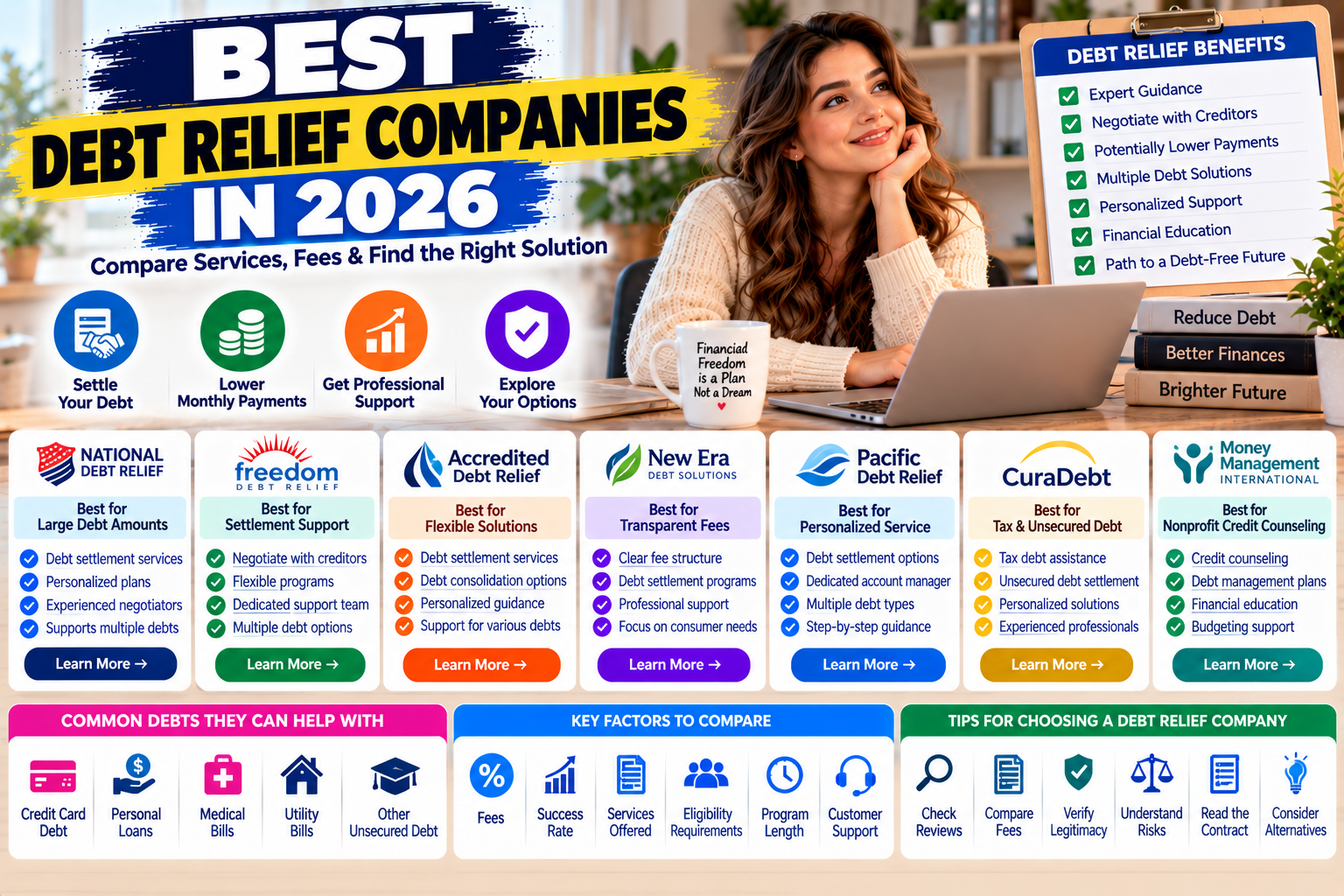
Several established companies offer debt settlement or related debt assistance services in the United States. The following providers are worth researching, depending on your financial needs.
Company offerings, fees, minimum debt requirements, and state availability can change. Confirm the current terms directly with each provider before enrolling.
Company | Potential fit | What to evaluate |
|---|---|---|
National Debt Relief | Consumers with substantial unsecured debt | Program fees, eligibility, settlement estimates |
Freedom Debt Relief | Consumers seeking settlement support | Costs, creditor coverage, customer support |
Accredited Debt Relief | Consumers comparing settlement and consolidation options | Service structure, fees, program eligibility |
New Era Debt Solutions | Consumers prioritizing fee transparency | Contract terms, fee calculation, available services |
Pacific Debt Relief | Consumers seeking personalized settlement assistance | Eligibility, fees, expected timeline |
CuraDebt | Consumers exploring tax or other specialized debt assistance | Relevant expertise, service costs, qualifications |
Money Management International | Consumers interested in nonprofit credit counseling | Counseling services, debt management plan fees |
The companies above offer different services, so they should not be treated as identical alternatives. For example, a debt settlement provider may negotiate with creditors, while a nonprofit counseling organization may help consumers repay their balances through a debt management plan.
Independent reviews from sources such as CNBC Select, NerdWallet, and Money can provide additional comparison points.
1. National Debt Relief
National Debt Relief is a debt settlement company that helps eligible consumers explore negotiations with creditors.
It may be worth researching if you have significant unsecured debt and are struggling to maintain your current payments.
What to review before enrolling:
Minimum debt requirements
Settlement fee structure
Types of eligible accounts
Estimated program duration
Potential credit and collection consequences
Ask the company to explain its fees in writing and provide realistic estimates rather than relying on advertised savings claims.
2. Freedom Debt Relief
Freedom Debt Relief offers debt settlement services for eligible consumers who want assistance negotiating certain outstanding debts.
Before choosing this provider, review the settlement process, account eligibility, customer support arrangements, and all charges associated with the program.
Consumers should also understand that creditors are not required to accept settlement offers, and successful negotiations are not guaranteed.
3. Accredited Debt Relief
Accredited Debt Relief is another provider consumers may consider when researching debt settlement services and related financial options.
Its suitability depends on the consumer’s financial situation, eligible debts, and the terms offered at enrollment.
Compare its settlement program with other providers, paying particular attention to the total cost, payment schedule, and whether any affiliated loan offers involve a separate agreement.
4. New Era Debt Solutions
New Era Debt Solutions is a debt settlement provider that consumers may want to compare when evaluating program costs and repayment expectations.
Ask for a detailed explanation of how fees are calculated, when they become payable, and how the company handles accounts that cannot be settled.
A transparent agreement should explain the services provided, the expected process, and the circumstances under which the program may be discontinued.
5. Pacific Debt Relief
Pacific Debt Relief helps eligible consumers explore debt settlement options.
Before enrolling, determine whether the company accepts your particular debt types and whether its program is available in your state.
Request information about settlement timelines, fees, creditor negotiations, and the possible consequences of missed payments.
6. CuraDebt
CuraDebt provides debt assistance services that may include tax debt and certain other financial obligations.
Consumers dealing with tax liabilities should distinguish between ordinary unsecured debt settlement and tax resolution. These services involve different rules, qualifications, and potential consequences.
If you owe federal or state taxes, compare the company’s proposal with the options available directly through the relevant tax authority.
7. Money Management International
Money Management International is a nonprofit credit counseling organization that provides financial education and debt-related assistance.
Consumers who want to repay their debts rather than negotiate a reduced settlement may find nonprofit credit counseling useful.
Ask whether a debt management plan is appropriate for your circumstances, which creditors participate, what fees apply, and how the arrangement may affect your accounts.
How Do Debt Relief Companies Work?
The process depends on the type of service you select.
Step 1: Review Your Financial Situation
The provider typically reviews your debts, income, expenses, and ability to make payments.
You should prepare a list of outstanding balances, interest rates, minimum payments, and account statuses before requesting a consultation.
Step 2: Identify Eligible Debts
Many debt settlement programs focus on unsecured obligations, such as credit card balances and certain personal loans.
Mortgages and auto loans are secured by property, so they generally require different solutions. Student loans, tax debts, and other specialized obligations may also follow separate rules.
Step 3: Compare Available Solutions
Depending on your circumstances, possible options may include:
Negotiating directly with creditors
Working with a nonprofit credit counselor
Enrolling in a debt management plan
Applying for a debt consolidation loan
Considering a settlement program
Seeking qualified legal advice if bankruptcy is a possibility
Do not assume that settlement is the most affordable option simply because it advertises reduced balances.
Step 4: Understand the Payment Arrangement
Some settlement programs ask consumers to deposit money into a dedicated account while negotiations are pursued.
A settlement company may recommend stopping payments to enrolled creditors. This can lead to late fees, additional interest, collection activity, credit damage, and possible lawsuits.
Understand these consequences before agreeing to such an arrangement.
Step 5: Review Each Settlement
If a creditor accepts an offer, carefully review the settlement terms, required payment dates, fees, and any remaining balance.
Keep copies of agreements, statements, and payment confirmations. Also determine whether canceled debt may create tax obligations.
How Much Do Debt Relief Companies Charge?
Debt relief fees vary by provider, state, program, and the amount of debt enrolled.
Some debt settlement companies charge fees based on the debt included in a program or the amount settled. Many U.S. companies operating under the Federal Trade Commission’s Telemarketing Sales Rule cannot collect settlement fees until they have achieved a qualifying settlement, the consumer agrees to it, and the consumer has made the required payment under the settlement. The exact rules depend on the service and how it is marketed.
For illustration, consider a hypothetical consumer enrolling $20,000 in eligible debt.
Illustrative fee rate | Potential fee |
|---|---|
15% | $3,000 |
20% | $4,000 |
25% | $5,000 |
These figures are examples, not quotes from any specific company. Actual charges and the basis used to calculate them may differ.
Fees are not the only expense to consider. Interest, late charges, taxes, legal expenses, and payments made to creditors can affect the total financial outcome.
Request a written cost breakdown before enrolling.
Benefits of Debt Relief Companies
A reputable provider may help consumers understand their options and organize a plan for addressing debt.
Potential benefits include:
Professional negotiation assistance: A settlement company may communicate with creditors and present settlement offers on behalf of eligible consumers.
A structured process: Some programs provide a defined process for reviewing accounts, preparing offers, and tracking progress.
Support with complex situations: Consumers dealing with multiple creditors may appreciate assistance organizing account information and understanding settlement terms.
Alternative repayment strategies: Credit counseling organizations may help consumers evaluate structured repayment plans and budgeting changes.
These benefits depend on the service provided and the consumer’s circumstances. No company can guarantee that every creditor will agree to a settlement or that a program will improve a consumer’s financial position.
Risks of Debt Relief Programs
Debt relief can be useful in some situations, but debt settlement carries meaningful risks.
Credit Score Damage
Missed or late payments can harm credit scores. If a settlement program recommends stopping payments, the resulting delinquencies and account statuses may remain on credit reports for years under applicable reporting rules.
Additional Interest and Fees
Creditors may continue adding interest, late fees, and other permitted charges while accounts remain unpaid.
Collection Activity and Lawsuits
Creditors may continue collection efforts or pursue legal action. Depending on applicable law and the circumstances, a judgment may lead to additional consequences.
No Guaranteed Settlement
Creditors are not generally required to accept a settlement offer. You could pay program-related costs without obtaining the expected outcome if the agreement and applicable law permit those costs.
Possible Tax Consequences
Canceled debt may be taxable income under U.S. federal tax rules, although exceptions and exclusions can apply. Consult a qualified tax professional about your circumstances.
Scams and Misleading Claims
Be cautious of companies that guarantee a specific reduction, promise to erase accurate negative credit information, impersonate government agencies, or pressure you into paying immediately.
The Federal Trade Commission’s debt relief guidance and the Consumer Financial Protection Bureau’s debt relief information provide useful information about warning signs and consumer protections.
Debt Settlement vs. Debt Consolidation vs. Credit Counseling
Understanding the differences can help you choose a suitable approach.
Feature | Debt settlement | Debt consolidation | Credit counseling |
|---|---|---|---|
Main purpose | Negotiate a reduced payoff | Combine multiple balances | Review debts and develop a repayment strategy |
Potential to reduce principal | Possible, not guaranteed | Usually no | Usually no |
Credit impact | May be substantial | Depends on payment history and new borrowing | Depends on the arrangement and account treatment |
Typical cost | Settlement fees and possible additional costs | Interest and possible loan fees | May be free or involve modest plan fees |
Main risk | Credit damage and unsuccessful negotiations | Higher total cost or new borrowing | Plan may not fit every creditor or budget |
A debt consolidation loan may simplify payments, but it can cost more over time if the repayment period is extended or the interest rate is high.
Credit counseling may be worth considering before entering a settlement program, particularly if you can afford regular payments but need help managing them.
How to Choose the Best Debt Relief Company
Use the following checklist when comparing providers.
1. Verify the Company
Research the company’s legal identity, business history, consumer complaints, and any relevant regulatory or legal actions.
Review independent consumer feedback, but do not rely on star ratings alone.
2. Understand All Fees
Request a written explanation of every fee, when it is charged, and how it is calculated.
Avoid providers that demand prohibited upfront settlement fees or refuse to explain their pricing.
3. Confirm Which Debts Qualify
Ask whether the company accepts your particular accounts and whether your state is covered.
Make sure the company can address your actual financial problem rather than offering an unrelated service.
4. Request Realistic Estimates
Ask about expected program duration, possible settlement outcomes, and what happens if creditors refuse offers.
Treat savings figures as estimates, not promises.
5. Compare Alternatives
Before enrolling, compare the proposed service with direct creditor negotiation, nonprofit credit counseling, a debt management plan, or a consolidation loan.
6. Read the Contract
Review cancellation provisions, account requirements, fees, refund terms, and responsibilities in case a settlement fails.
Do not sign an agreement you do not understand.
Alternatives to Debt Relief Companies
You may be able to manage your debts without hiring a settlement company.
Negotiate with creditors directly. Contact your creditor and ask whether a hardship program, reduced interest rate, modified payment plan, or temporary payment arrangement is available.
Contact a nonprofit credit counselor. A qualified counselor can help you review your budget and determine whether a debt management plan may be appropriate.
Consider debt consolidation. If you qualify for a loan with a lower total cost, consolidation may simplify payments. Compare APRs, fees, repayment terms, and the total amount payable.
Use a structured repayment method. The debt avalanche method prioritizes the highest-interest balance first, while the debt snowball method focuses on the smallest balance first. Both require consistent payments and a realistic budget.
Seek legal advice when necessary. If you face a lawsuit, wage garnishment, or debts you cannot reasonably repay, consult a qualified attorney about your rights and available options.
Frequently Asked Questions
What are the best debt relief companies in 2026?
National Debt Relief, Freedom Debt Relief, Accredited Debt Relief, New Era Debt Solutions, Pacific Debt Relief, CuraDebt, and Money Management International are providers consumers may wish to research. The right choice depends on whether you need debt settlement, nonprofit counseling, or specialized assistance.
Are debt relief companies legitimate?
Some are legitimate, but the industry also includes misleading offers and scams. Verify a provider’s identity, review its contract and fees, and check official consumer protection resources before enrolling.
How much debt do I need to qualify?
Requirements vary by company and program. Some settlement providers require several thousand dollars in eligible unsecured debt, while credit counseling services may assist consumers with smaller balances. Confirm the current eligibility criteria directly with the provider.
Can debt relief companies eliminate all my debt?
No. Debt settlement companies cannot guarantee that creditors will accept offers, and not all debts qualify. Any remaining obligations must be handled according to the applicable agreements and laws.
Will debt relief hurt my credit score?
It can. Missed payments, delinquent accounts, and settled debts may affect credit reports and scores. The extent and duration of the impact depend on your credit history and the reporting of each account.
Do debt relief companies charge upfront fees?
Fee rules depend on the service and applicable law. Under the FTC’s Telemarketing Sales Rule, covered debt relief providers generally cannot charge settlement fees before meeting the rule’s settlement and payment requirements. Check the relevant rules and contract before paying.
Is debt settlement better than debt consolidation?
Neither option is best for everyone. Settlement may be considered when someone is experiencing serious financial hardship and cannot afford regular payments. Consolidation may be more suitable for a borrower who qualifies for affordable financing and can maintain payments.
Can forgiven debt be taxed?
Canceled debt may be taxable under U.S. federal tax rules, but exceptions can apply. Speak with a qualified tax professional to understand the consequences for your situation.
How long does debt relief take?
Timelines depend on the provider, creditor response, debt amount, and program structure. Some settlement programs run for several years, but no specific completion date or result should be assumed without reviewing the agreement.
Final Thoughts
Debt relief companies may help some consumers explore ways to manage overwhelming unsecured debt, but choosing a provider requires careful research. Fees, eligibility, creditor participation, credit consequences, and possible tax obligations can substantially affect the final outcome.
Before committing to a settlement program, compare several providers and consider alternatives such as direct creditor negotiation, nonprofit credit counseling, and debt consolidation. Review every agreement carefully and avoid companies that promise guaranteed results or pressure you to act immediately.
The best debt relief solution is one that fits your financial circumstances, explains its costs clearly, and gives you a realistic path toward managing your obligations.
Disclaimer: This article is for general educational purposes and is not financial, legal, or tax advice. Debt relief outcomes vary, and readers should verify provider terms and seek qualified professional guidance when appropriate