
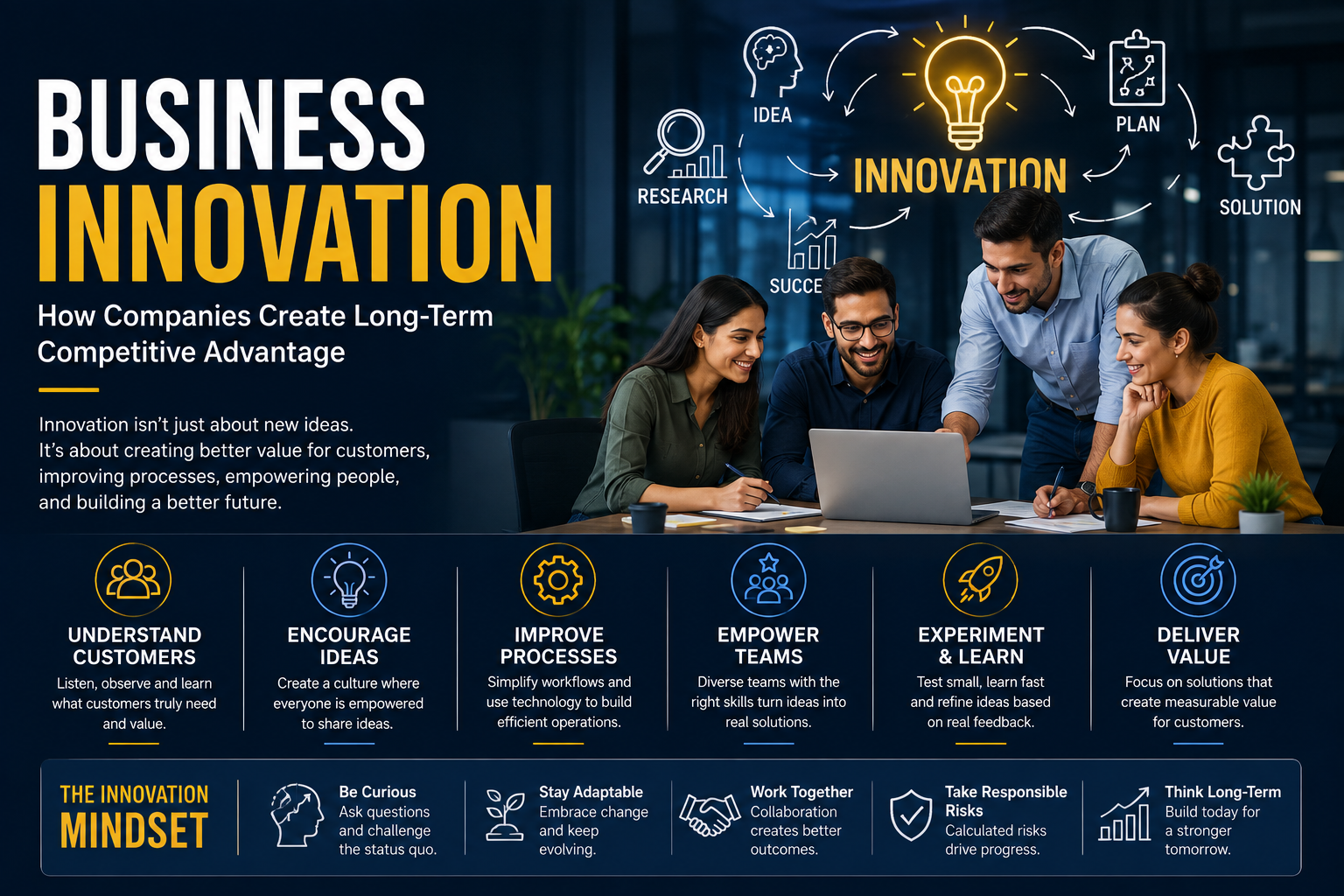
Innovation has always been an important part of business success. Companies that find better ways to serve customers, improve operations, develop products, and respond to changing markets can create advantages that last for years.
Innovation is often associated with advanced technology, but it is much broader than that. A company can innovate by creating a new product, improving an existing service, simplifying a process, changing the customer experience, or developing a completely different business model.
In a competitive marketplace, innovation helps organizations avoid becoming dependent on the methods that worked in the past.
What Is Business Innovation?
Business innovation is the process of introducing new or improved ideas that create meaningful value.
Innovation can happen in almost every part of an organization, including:
Products
Services
Operations
Marketing
Customer experience
Technology
Business models
Workplace practices
The purpose isn't simply to be different.
Successful innovation solves a problem, improves an experience, reduces unnecessary costs, creates new opportunities, or makes an organization more effective.
Why Innovation Matters
Customer expectations are constantly changing.
People expect products to become easier to use, services to become faster, and businesses to provide more convenient experiences.
At the same time, competitors are constantly looking for new ways to attract customers.
A company that stops improving may eventually lose relevance.
Innovation helps organizations respond to changing circumstances while creating opportunities for future growth.
Innovation Starts With a Problem
One of the most effective approaches to innovation is starting with a real problem.
Instead of asking:
“What new technology can we use?”
business leaders can ask:
“What problem are our customers or employees experiencing?”
This simple change in perspective can lead to better ideas.
Customers may struggle with complicated processes.
Employees may spend hours completing repetitive tasks.
A product may solve one problem but create another.
These situations can become opportunities for innovation.
Understanding the Customer
Customer knowledge is at the center of successful innovation.
Businesses can learn from:
Customer feedback
Reviews
Surveys
Support conversations
Usage data
Market research
Sales teams
Social media discussions
The objective is to understand what customers actually need rather than relying entirely on assumptions.
Sometimes customers don't know how to describe the solution they want.
They may simply describe a problem.
Innovative businesses learn how to identify the opportunity hidden inside that problem.
Product Innovation
Product innovation involves creating a new product or significantly improving an existing one.
Improvements might include:
Better performance
Easier usability
New features
Improved design
Greater reliability
Lower cost
Better accessibility
A successful product doesn't necessarily need to be revolutionary.
Sometimes a small improvement can make a product significantly more useful.
Service Innovation
Services can also be redesigned.
Businesses can improve service through:
Faster response times
Digital support
Personalized experiences
Easier booking
Better communication
Flexible delivery
Self-service options
The customer experience often determines whether people return to a business.
This makes service innovation an important part of customer retention.
Process Innovation
Not all innovation is visible to customers.
Internal processes can also be improved.
For example, a company might automate repetitive administrative tasks, simplify approvals, improve inventory management, or introduce better communication systems.
Process innovation can reduce costs and improve productivity.
It can also make employees' work easier.
Technology and Innovation
Technology can accelerate innovation.
Artificial intelligence, cloud computing, automation, data analytics, and digital platforms provide organizations with new tools for solving problems.
AI, for example, can help businesses analyze large datasets, automate repetitive tasks, support customer service, and generate ideas.
But technology itself is not innovation.
A new tool only creates value when it is applied to a meaningful problem.
Artificial Intelligence as an Innovation Tool
AI is changing how companies approach innovation.
Businesses can use AI to explore ideas, analyze customer feedback, identify patterns, create prototypes, and support decision-making.
It can also reduce the time required to experiment with new concepts.
However, organizations should maintain human oversight.
AI-generated ideas still need to be evaluated for accuracy, usefulness, cost, security, and alignment with business objectives.
Creating an Innovation Culture
Innovation cannot depend entirely on senior executives.
Employees across the organization often have valuable ideas because they work directly with customers, products, systems, and daily operations.
A strong innovation culture gives employees opportunities to suggest improvements.
This can involve:
Idea platforms
Innovation workshops
Team brainstorming
Pilot programs
Cross-functional projects
Customer research
Employees are more likely to contribute ideas when they believe their suggestions will be taken seriously.
The Role of Leadership
Leadership determines whether innovation becomes part of the organization's culture.
Leaders should provide:
Direction — What problems are we trying to solve?
Resources — What time and budget are available?
Freedom — How much experimentation is possible?
Accountability — How will results be evaluated?
Support — What happens when an experiment doesn't work?
Strong leaders understand that not every experiment will succeed.
The objective is to learn quickly while controlling unnecessary risk.
Learning From Failure
Innovation involves uncertainty.
Some ideas will fail.
A failed experiment isn't automatically a wasted investment if the organization learns something valuable.
Teams can ask:
What did we expect?
What actually happened?
Why was there a difference?
What did we learn?
What should we change?
This creates a culture where failure becomes information rather than simply something to hide.
Innovation and Employee Skills
Innovation depends on people with different capabilities.
A successful project might require:
Designers
Engineers
Marketers
Analysts
Sales professionals
Operations specialists
Financial experts
Cross-functional teams can produce stronger ideas because different departments see problems from different perspectives.
A technology team may understand what is technically possible.
A sales team may understand customer objections.
A finance team may understand economic feasibility.
Combining these perspectives can lead to more practical innovation.
Building an Innovation Strategy
Companies should avoid treating every new idea as equally important.
A useful innovation strategy can prioritize ideas based on:
Customer value
Business impact
Cost
Technical feasibility
Strategic alignment
Risk
Time required
This helps organizations focus resources on ideas with the strongest potential.
Experiment Before Scaling
One of the most useful innovation principles is to test before making a large investment.
A company can create a small pilot, launch it with a limited audience, measure the results, and then decide whether to expand.
This approach can reduce risk.
Instead of investing heavily in an untested idea, organizations can gather evidence first.
Measuring Innovation
Innovation should eventually produce measurable outcomes.
Businesses can track:
Revenue from new products
Customer adoption
Cost savings
Productivity
Customer satisfaction
Time savings
New market opportunities
Not every innovation will generate immediate revenue.
Some initiatives may create capabilities that become valuable later.
Therefore, measurements should reflect the purpose of each project.
Innovation and Competitive Advantage
Innovation can create competitive advantages when a company offers something customers value and competitors find difficult to replicate.
A company might differentiate itself through:
Better technology
Faster service
Lower costs
Stronger customer support
Unique products
Convenient experiences
Specialized expertise
However, competitive advantages can disappear.
Competitors can copy features and business practices.
This is why continuous improvement matters.
The Importance of Speed
Markets can change quickly.
Companies that take too long to test ideas may miss opportunities.
Speed doesn't mean making careless decisions.
It means shortening the distance between an idea and evidence.
A company can:
Identify a problem → Develop an idea → Build a small experiment → Measure results → Improve → Scale
This process allows organizations to learn continuously.
Innovation and Sustainability
Innovation can also support more sustainable business practices.
Companies may develop ways to:
Reduce waste
Improve energy efficiency
Use resources more effectively
Improve logistics
Extend product life
Reduce unnecessary packaging
Sustainability and innovation can therefore work together.
The strongest solutions can benefit both the business and the wider environment.
Innovation in Small Businesses
Innovation isn't limited to large corporations.
Small businesses can innovate by responding quickly to customer needs.
A local business might introduce digital ordering, improve its service process, create a specialized product, or develop a more convenient customer experience.
Smaller organizations can sometimes experiment faster because they have fewer layers of decision-making.
Innovation and Entrepreneurship
Entrepreneurs often identify opportunities by noticing problems that existing businesses have not solved effectively.
Entrepreneurial innovation can involve creating:
New products
New services
Digital platforms
New distribution models
Subscription businesses
Specialized marketplaces
The entrepreneur's advantage often comes from identifying a specific customer problem and developing a focused solution.
The Future of Business Innovation
Innovation will increasingly involve the combination of human creativity and technology.
AI can help analyze information and generate possibilities.
Data can reveal customer behavior.
Digital tools can accelerate experimentation.
Cloud platforms can make new services easier to launch.
But human judgment remains essential.
People determine which problems matter, which ideas are worth pursuing, and how solutions should be designed.
Building a Long-Term Innovation Mindset
Organizations should think of innovation as a continuous process.
Every team can regularly ask:
What could we improve?
What are customers struggling with?
What is taking too much time?
What technology could help?
What are competitors doing differently?
What experiment could we run next?
These questions keep innovation connected to everyday business operations.
Final Thoughts
Business innovation is not simply about creating something completely new.
It is about creating better value.
The strongest organizations listen to customers, encourage employees to share ideas, experiment responsibly, use technology strategically, and continuously improve their products and processes.
Innovation requires curiosity, but it also requires discipline.
A good idea becomes valuable only when an organization can turn it into something useful.
The companies that build a lasting innovation culture are not necessarily those that have the biggest budgets.
They are often the organizations that are willing to learn faster, adapt sooner, and remain focused on solving meaningful problems.
Innovation begins with a question, grows through experimentation, and creates value through execution.
That mindset can help businesses remain competitive not only today, but for years to come.