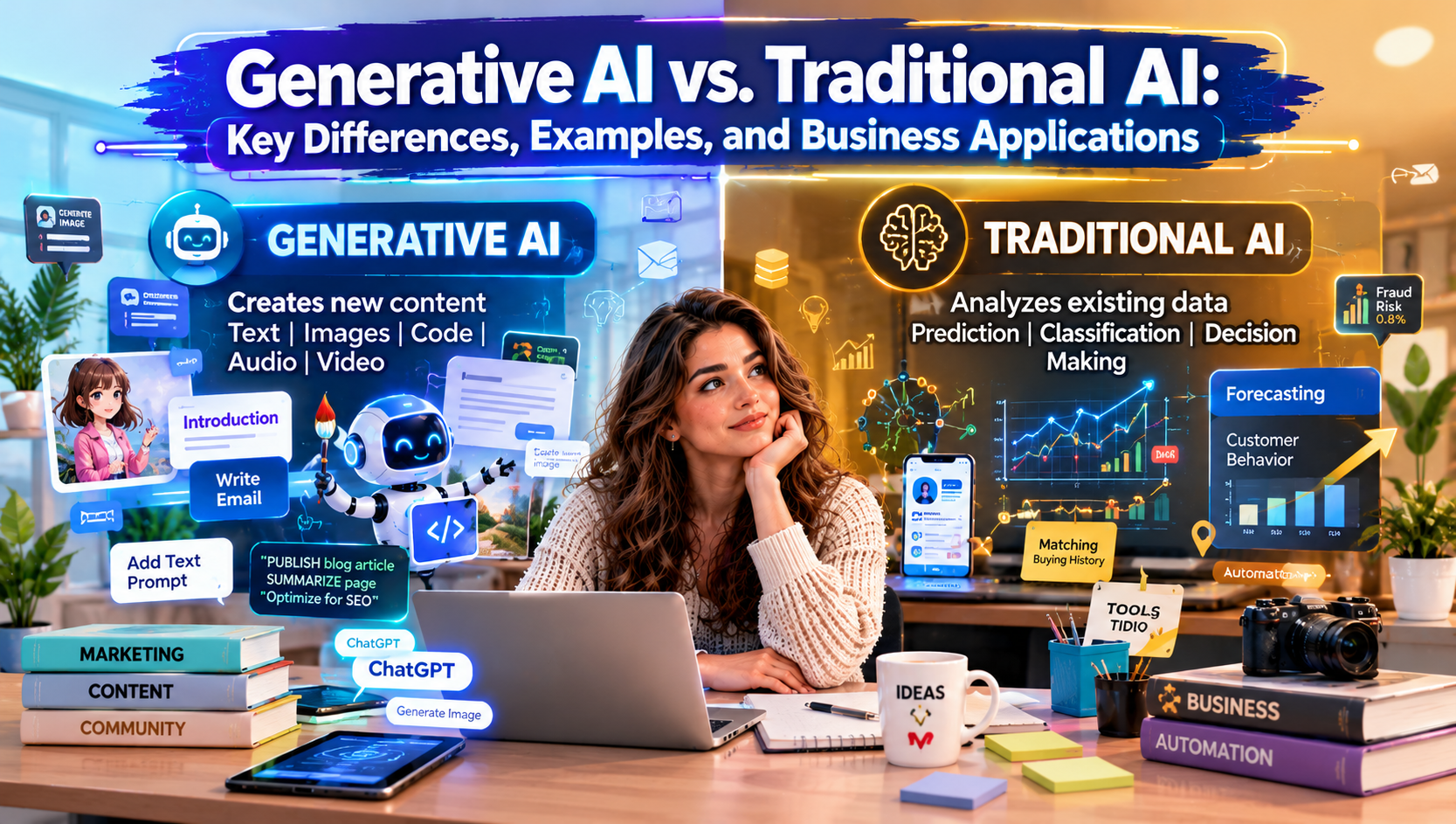
Artificial intelligence is transforming how businesses operate, how people access information, and how organizations make decisions. From chatbots and content generation to fraud detection and predictive analytics, AI technologies are becoming part of everyday digital experiences.
However, not all artificial intelligence systems work in the same way.
Two important categories are generative AI and traditional AI. Both use data and computational models to perform intelligent tasks, but their purposes and capabilities are different.
Traditional AI is generally designed to analyze information, identify patterns, classify data, make predictions, and support decisions. Generative AI, on the other hand, can create new content, including text, images, audio, video, and computer code.
Understanding the difference between these technologies can help businesses, professionals, and individuals choose the right AI solution for their needs.
In this guide, we explore how generative AI and traditional AI work, their major differences, practical examples, advantages, limitations, and future business applications.
What Is Traditional AI?
Traditional AI refers to artificial intelligence systems designed to perform specific tasks by analyzing data, identifying patterns, following rules, and producing predictions or decisions.
These systems are commonly developed for clearly defined objectives.
For example, a bank can use traditional AI to identify suspicious transactions. An online retailer can use it to recommend products based on customer purchasing behavior.
Traditional AI does not necessarily create new content. Instead, it processes existing information to produce a classification, prediction, recommendation, or action.
How Traditional AI Works
Traditional AI systems generally follow a structured process:
Data Collection: The system receives information from databases, applications, sensors, or other sources.
Data Processing: The collected information is cleaned and prepared for analysis.
Model Training: Machine learning algorithms identify patterns in historical data.
Prediction or Classification: The trained model analyzes new information and produces an output.
Evaluation: Developers and organizations measure performance and improve the system when necessary.
Examples of Traditional AI
Traditional AI is already used across many industries.
1. Fraud Detection
Financial institutions use machine learning models to identify unusual transaction patterns and flag potentially fraudulent activity.
2. Recommendation Systems
Streaming platforms and online stores analyze user behavior to recommend relevant movies, products, and services.
3. Email Spam Detection
Email services classify incoming messages as legitimate or potentially unwanted based on patterns and other signals.
4. Predictive Maintenance
Manufacturing companies analyze equipment data to identify possible failures before machines stop working.
5. Demand Forecasting
Retail businesses use historical sales information to estimate future product demand.
6. Customer Segmentation
Marketing teams group customers according to purchasing patterns, interests, and other available information.
These applications demonstrate how traditional AI helps organizations analyze information and make more informed decisions.
What Is Generative AI?
Generative AI is a category of artificial intelligence that creates new content based on patterns learned from training data.
It can generate different types of outputs, including:
Written articles and summaries.
Images and illustrations.
Computer code.
Audio and speech.
Music.
Video.
Synthetic data.
Generative AI models learn relationships and structures within large datasets. They then use those learned patterns to produce new outputs in response to user instructions or other inputs.
For example, a business owner can ask an AI assistant to draft a marketing email, generate product descriptions, summarize a report, or create an image for a campaign.
How Generative AI Works
Although different generative models use different architectures, the general process involves several stages.
Training Data: The model is trained using large datasets relevant to its intended capabilities.
Pattern Learning: The model learns statistical relationships, structures, and representations within the training data.
User Input: A user provides a prompt, instruction, image, or other input.
Content Generation: The model generates a new response based on its learned patterns and the input.
Human Review: The output can be checked, edited, and refined before use.
Many modern generative AI systems use deep learning architectures, including transformers and diffusion models.
Examples of Generative AI
1. AI Text Generation
Tools such as ChatGPT can generate explanations, summaries, emails, marketing content, and other written material.
2. AI Image Generation
Image-generation systems can create illustrations, product concepts, marketing graphics, and visual designs from text prompts.
3. AI Code Generation
Generative AI coding assistants can help developers write code, explain programming concepts, and identify potential errors.
4. AI Video Generation
Generative video tools can create or modify video content using text, images, or other inputs.
5. AI Audio Generation
AI systems can generate speech, synthetic voices, sound effects, and other audio content.
6. AI Document Summarization
Generative AI can summarize lengthy documents, extract important points, and help users understand complex information.
Generative AI vs. Traditional AI: Key Differences
The most important difference is their primary purpose. Traditional AI generally analyzes existing information to produce predictions or decisions, while generative AI creates new content based on learned patterns.
The following table highlights their major differences.
Comparison | Traditional AI | Generative AI |
|---|---|---|
Primary purpose | Analyze and predict | Create new content |
Main output | Scores, classifications, predictions | Text, images, audio, video, code |
Common techniques | Machine learning, decision trees, classification models | Transformers, diffusion models, generative neural networks |
Typical input | Structured or unstructured data | Prompts, text, images, audio, and other inputs |
Main applications | Fraud detection, forecasting, recommendations | Content creation, image generation, coding |
Learning objective | Identify patterns for specific tasks | Learn data distributions and generate outputs |
Human involvement | Often used for monitoring and decisions | Often used for prompting, review, and refinement |
Common risks | Bias, inaccurate predictions, data quality issues | Hallucinations, bias, copyright and privacy concerns |
Note: These are general distinctions. Modern AI systems can combine predictive and generative capabilities.
Traditional AI vs. Generative AI: Real-World Examples
Understanding the technologies becomes easier when comparing how they are used in the same industry.
1. Banking and Finance
Traditional AI:
Detects unusual financial transactions.
Identifies suspicious account activity.
Estimates credit risk.
Supports financial forecasting.
Generative AI:
Summarizes financial reports.
Drafts customer communication.
Explains financial information.
Helps employees search internal knowledge resources.
Example: A bank may use traditional machine learning to identify a potentially fraudulent transaction while using generative AI to summarize the investigation for an employee.
2. Healthcare
Traditional AI:
Analyzes medical images for patterns.
Supports risk prediction.
Helps identify potential disease indicators.
Assists with patient data classification.
Generative AI:
Summarizes clinical documents.
Drafts administrative notes.
Helps explain medical information.
Supports research and documentation workflows.
Example: A healthcare organization might use a predictive model to flag a potential clinical risk and generative AI to summarize relevant documentation for professional review.
AI outputs in healthcare require appropriate clinical oversight and should not replace qualified medical judgment.
3. E-Commerce
Traditional AI:
Recommends products.
Forecasts customer demand.
Identifies unusual purchasing behavior.
Supports inventory optimization.
Generative AI:
Creates product descriptions.
Generates marketing content.
Produces product concept images.
Drafts customer support responses.
Example: An online store can use traditional AI to recommend products based on shopping behavior and generative AI to produce product descriptions.
4. Education
Traditional AI:
Tracks learning performance.
Identifies knowledge gaps.
Recommends learning resources.
Supports automated assessment.
Generative AI:
Explains difficult concepts.
Creates practice questions.
Generates study summaries.
Helps teachers prepare lesson materials.
Example: An educational platform can use traditional AI to identify topics where students struggle and generative AI to create additional practice exercises.
5. Marketing
Traditional AI:
Segments customer audiences.
Predicts customer behavior.
Analyzes campaign performance.
Supports advertising optimization.
Generative AI:
Writes marketing copy.
Creates campaign images.
Drafts email newsletters.
Produces content variations.
Example: A marketing agency can use traditional AI to identify promising audience segments and generative AI to prepare customized campaign content.
Popular Generative AI Tools and Platforms
Generative AI is available through several platforms designed for different types of tasks.
1. ChatGPT
<Entity value="ChatGPT" category="software" disambig="OpenAI conversational AI assistant"/> can assist with writing, research, brainstorming, coding, summarization, and other knowledge-based tasks.
Official website: https://chatgpt.com/
2. Google Gemini
<Entity value="Google Gemini" category="software" disambig="Google generative AI assistant"/> supports text-based assistance, reasoning, content generation, and multimodal capabilities.
Official website: https://gemini.google.com/
3. Claude
<Entity value="Claude" category="software" disambig="Anthropic AI assistant"/> is designed for tasks such as writing, document analysis, coding, and working with lengthy information.
Official website: https://claude.ai/
4. Midjourney
<Entity value="Midjourney" category="software" disambig="AI image generation platform"/> is used to create visual concepts and images from text prompts.
Official website: https://www.midjourney.com/
5. Adobe Firefly
<Entity value="Adobe Firefly" category="software" disambig="Adobe generative AI creative tools"/> provides generative capabilities for creative workflows, including image generation and editing.
Official website: https://www.adobe.com/products/firefly.html
6. GitHub Copilot
<Entity value="GitHub Copilot" category="software" disambig="AI coding assistant"/> helps developers write, explain, and improve code through AI-assisted development features.
Official website: https://github.com/features/copilot
Popular Traditional AI Applications and Technologies
Traditional AI is often embedded inside business applications rather than offered as a standalone content-generation product.
Common examples include:
1. Fraud Detection Systems: Machine learning models analyze transaction patterns to identify suspicious activity.
2. Recommendation Engines: Predictive algorithms recommend products, videos, and services based on user behavior.
3. Predictive Analytics: Businesses use historical data and machine learning to estimate future outcomes.
4. Classification Systems: AI models classify emails, documents, images, and other information into predefined categories.
5. Forecasting Models: Organizations predict sales, inventory requirements, and demand using historical patterns.
Traditional AI solutions may use technologies such as decision trees, random forests, regression models, support vector machines, and neural networks.
Benefits of Traditional AI
Traditional AI provides several important advantages for organizations.
1. Improved Predictions
Machine learning models can identify patterns in historical data and support forecasting activities.
2. Better Decision Support
Organizations can use AI-generated predictions and classifications to support operational decisions.
3. Efficient Data Analysis
Traditional AI can process large amounts of information more efficiently than manual analysis in many situations.
4. Fraud and Risk Detection
Financial institutions and other organizations can use machine learning to identify suspicious patterns and potential risks.
5. Consistent Automation
Once properly developed and monitored, task-specific models can perform repetitive classification and prediction activities consistently.
Benefits of Generative AI
Generative AI offers a different set of advantages, especially for content-intensive and knowledge-based work.
1. Faster Content Creation
Businesses can generate first drafts of articles, emails, product descriptions, and marketing materials.
2. Improved Productivity
Employees can use AI assistants to summarize information, brainstorm ideas, and complete routine writing tasks.
3. Creative Support
Generative models can produce visual concepts, design variations, and other creative materials.
4. Personalized Communication
Businesses can use generative AI to prepare tailored communication based on relevant customer information and approved business rules.
5. Coding Assistance
Developers can use AI tools to generate code suggestions, explain existing code, and accelerate certain development tasks.
Limitations of Generative AI and Traditional AI
Both technologies have limitations. Understanding their risks is essential before implementing them in business operations.
Limitations of Traditional AI
1. Data Dependency: Traditional AI models often require relevant, reliable, and sufficiently representative training data.
2. Limited Generalization: A model developed for one specific task may not perform well when applied to a different problem.
3. Bias: Historical data can contain biases that affect model predictions.
4. Maintenance Requirements: Models may need monitoring and retraining when real-world conditions change.
5. Limited Creative Capabilities: Traditional predictive systems are generally not designed to generate original content.
Limitations of Generative AI
1. Hallucinations: Generative AI can produce incorrect information that sounds convincing.
2. Data Privacy: Sharing confidential business or customer information with AI systems can create privacy risks if appropriate protections are not in place.
3. Copyright Concerns: Generated content may raise questions about intellectual property, training data, and permitted commercial use.
4. Inconsistent Outputs: The same prompt may produce different results, and output quality can vary.
5. Human Review Requirements: Generated content may require fact-checking, editing, and approval before publication or business use.
Can Generative AI and Traditional AI Work Together?
Yes. Generative AI and traditional AI can complement one another within the same business system.
Traditional AI can analyze information, detect patterns, and make predictions. Generative AI can use relevant information to create summaries, explanations, recommendations, or communication.
Example: An Intelligent E-Commerce System
Consider an online retailer that wants to improve customer experiences and manage inventory.
The system could use traditional AI to:
Predict customer demand.
Recommend products.
Identify unusual purchasing activity.
Forecast inventory requirements.
Generative AI could then:
Generate product descriptions.
Draft customer responses.
Summarize sales reports.
Create marketing campaign content.
Together, these technologies can support a more intelligent and efficient business operation.
Example: AI-Powered Customer Support
A customer support system could combine both approaches.
Traditional AI classifies an incoming customer request.
The system identifies its category and urgency.
Generative AI drafts a response using approved company information.
A human representative reviews the response when required.
The system records the interaction for future analysis.
This combination can improve response efficiency while maintaining human oversight.
Which Is Better: Generative AI or Traditional AI?
Neither technology is universally better. The appropriate choice depends on the problem a business wants to solve.
Business Requirement | Recommended Technology |
|---|---|
Detect fraudulent transactions | Traditional AI |
Predict future sales | Traditional AI |
Recommend products | Traditional AI |
Generate blog articles | Generative AI |
Create marketing images | Generative AI |
Summarize business documents | Generative AI |
Classify customer inquiries | Traditional AI |
Draft customer responses | Generative AI |
Analyze customer behavior | Traditional AI |
Generate software code | Generative AI |
Some business requirements benefit from combining both technologies.
For example, an organization may use traditional AI to analyze customer behavior and generative AI to create personalized marketing messages.
How Businesses Can Choose the Right AI Technology
Before investing in AI software, businesses should evaluate their actual requirements.
Step 1: Identify the Problem
Determine whether the main objective is to analyze data, predict outcomes, classify information, or generate new content.
Step 2: Evaluate Available Data
Traditional AI often depends on relevant historical data. Generative AI may work through prompts and connected information sources, but business-specific applications still require reliable context.
Step 3: Consider Integration Requirements
Check whether the AI solution can connect with existing applications, databases, customer management systems, and internal workflows.
Step 4: Evaluate Costs
Consider subscription fees, API usage, implementation, maintenance, employee training, and ongoing monitoring.
Step 5: Review Security and Privacy
Assess data access permissions, information retention, security controls, and compliance requirements.
Step 6: Test Before Scaling
Start with a small project, measure the results, and expand only after evaluating performance and reliability.
The Future of Generative AI and Traditional AI
Artificial intelligence continues to evolve, and the distinction between generative and traditional AI is becoming less rigid as systems combine multiple capabilities.
Several developments are likely to influence the future of AI.
1. Multimodal AI: AI systems increasingly work across different types of information, including text, images, audio, and video.
2. AI Agents: AI agents can combine reasoning, tool use, and workflow automation to complete multi-step tasks with varying levels of human supervision.
3. Predictive and Generative Integration: Businesses can combine predictive models with generative systems to turn analytical results into useful explanations and actions.
4. Personalized AI Experiences: Organizations can use AI to provide more relevant services, recommendations, and communication.
5. Responsible AI Development: Security, transparency, privacy, reliability, and human oversight will remain important as organizations expand their use of AI.
The future of artificial intelligence will likely involve systems that combine analytical intelligence with content-generation capabilities.
Frequently Asked Questions (FAQs)
1. What is the main difference between generative AI and traditional AI?
Traditional AI primarily analyzes information to make predictions, classifications, or decisions. Generative AI creates new content, including text, images, audio, video, and code.
2. Is ChatGPT generative AI or traditional AI?
ChatGPT is a generative AI assistant. It uses generative models to produce responses, explanations, summaries, and other content based on user inputs.
3. Is machine learning the same as traditional AI?
No. Machine learning is a subset of artificial intelligence. It includes techniques that allow systems to learn patterns from data. Machine learning is used in many traditional AI applications and also plays an important role in generative AI.
4. Can traditional AI generate content?
Some traditional AI systems can produce structured outputs or templates, but conventional predictive and classification models are generally not designed to generate complex new content like modern generative models.
5. Which AI is better for businesses?
It depends on the business objective. Traditional AI is useful for forecasting, classification, and fraud detection. Generative AI is useful for content creation, summarization, and creative assistance. Many organizations can benefit from both.
6. Is generative AI more advanced than traditional AI?
Not necessarily. Generative AI offers different capabilities, but traditional AI can be more appropriate and reliable for specific prediction and classification tasks.
7. Can generative AI replace traditional AI?
Generative AI can perform some tasks that previously required other AI approaches, but it does not replace the need for specialized predictive models, statistical methods, or rule-based systems.
8. What are some examples of generative AI tools?
Examples include ChatGPT, Google Gemini, Claude, Midjourney, Adobe Firefly, and GitHub Copilot.
Conclusion
Generative AI and traditional AI are two important parts of the modern artificial intelligence landscape.
Traditional AI focuses on analyzing data, identifying patterns, making predictions, and supporting decisions. Generative AI focuses on creating new content, including text, images, audio, video, and software code.
Both technologies offer valuable benefits, but their applications are different.
Businesses that need accurate forecasting, fraud detection, and data classification may benefit from traditional AI. Organizations looking to improve content creation, communication, and creative workflows may find generative AI more useful.
The strongest opportunity is often combining both approaches. By using traditional AI for analysis and generative AI for content creation and communication, organizations can develop more capable and efficient business systems.
Understanding these differences is an important step toward making smarter AI investment decisions.
Disclaimer
This article is intended for educational and informational purposes only. AI capabilities, products, and platform features may change over time. Businesses should independently evaluate AI tools, security requirements, and suitability before implementing them.
Suggested Internal Links
How AI Workflow Automation Is Transforming Businesses
AI Agents Explained: How They Work and Why Businesses Need Them
Best AI Automation Tools for Small Businesses
Best AI Tools for Business Productivity and Efficiency
How to Implement AI in Your Business: A Complete Guide
Suggested External Resources
Google Cloud AI: https://cloud.google.com/ai
Microsoft AI: https://www.microsoft.com/en-us/ai
OpenAI: https://openai.com/
NVIDIA AI: https://www.nvidia.com/en-us/ai/
Publishing Checklist
Add a featured image with descriptive SEO alt text.
Include the primary keyword in the SEO title and introduction.
Add relevant internal links to other Bullnext articles.
Link to authoritative external resources.
Add Article schema markup.
Optimize image size and loading performance.
Review the article for factual accuracy before publication.