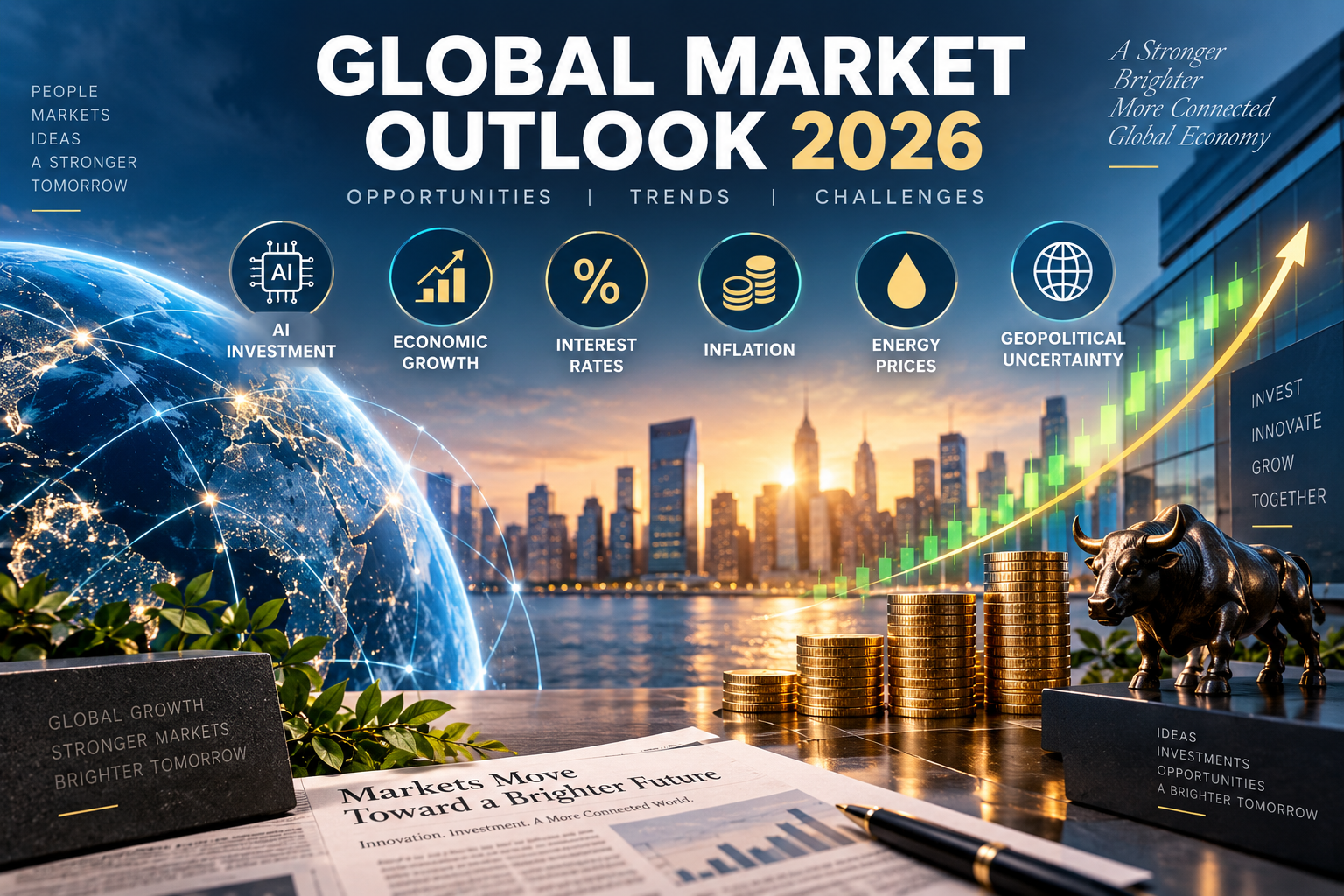
The global market in 2026 is experiencing a combination of growth, innovation, uncertainty and changing investor expectations. From artificial intelligence and technology investment to inflation, interest rates, energy prices and geopolitical developments, several forces are influencing financial markets around the world.
Businesses and investors are entering an environment where opportunities can emerge quickly, but risks can also change just as rapidly. Understanding the major market trends can help investors, business owners and consumers make more informed decisions about the future.
This article explores the most important factors shaping the global market in 2026, including economic growth, artificial intelligence, stock markets, interest rates, inflation, energy prices and emerging investment opportunities.
What Is the Global Market?
The global market refers to the interconnected network of financial markets, businesses, commodities, currencies and investment opportunities operating across different countries and regions.
It includes stock markets, bond markets, foreign exchange markets, commodity markets and real estate markets. Because economies are increasingly connected, an economic or political event in one country can have consequences for markets around the world.
For example, changes in interest rates in major economies can influence currency values, borrowing costs and investment flows in developing markets. Similarly, changes in oil prices can affect transportation, manufacturing and consumer prices internationally.
This interconnected nature makes the global market both attractive and complex.
Global Economic Growth in 2026
Economic growth remains one of the most important factors influencing financial markets. When economies expand, businesses generally have more opportunities to increase sales, hire employees and invest in new products and services.
However, growth is not evenly distributed across countries. Some economies are benefiting from technology investment, strong consumer demand and infrastructure development, while others continue to face challenges related to inflation, debt and geopolitical uncertainty.
Investors are therefore paying close attention to economic indicators such as:
Gross domestic product growth
Employment levels
Consumer spending
Business investment
Manufacturing activity
Inflation
Interest rates
Government spending
A stronger-than-expected economy can support corporate earnings and stock prices. On the other hand, weaker economic growth can reduce business confidence and increase concerns about recession.
Artificial Intelligence Is Reshaping the Market
Artificial intelligence has become one of the biggest investment and business themes of the decade.
Companies across technology, healthcare, finance, manufacturing, retail and logistics are investing in AI systems to automate processes, analyze information and improve productivity.
The growth of AI is also creating demand for supporting infrastructure. Data centers require advanced processors, cloud computing systems, networking equipment and large amounts of electricity.
This means the economic impact of AI extends beyond software companies. Semiconductor manufacturers, cloud providers, energy companies, utilities, data-center developers and infrastructure businesses can also benefit from increasing AI demand.
At the same time, investors should consider the risks. Companies associated with AI may face high valuations if market expectations become excessive. If future earnings fail to meet those expectations, individual stocks or entire market sectors could experience significant volatility.
Stock Market Trends
Stock markets remain an important destination for investors seeking long-term growth. However, market performance can vary significantly between sectors and countries.
Technology companies have attracted substantial attention because of AI, cloud computing and digital transformation. Meanwhile, financial institutions, healthcare companies, industrial businesses and energy firms can also play important roles in a diversified portfolio.
One major trend is the increasing importance of earnings. Investors are looking beyond headlines and examining whether companies can actually convert technological investment and economic growth into sustainable profits.
Important factors influencing stock markets include:
Corporate earnings
Interest-rate expectations
Economic growth
Investor sentiment
Company valuations
Government policies
Geopolitical developments
Commodity prices
Market rallies can continue when earnings and economic conditions remain strong. However, periods of correction are normal, particularly when valuations become elevated or unexpected economic risks appear.
Interest Rates and Their Impact
Interest rates remain one of the most closely watched economic indicators.
When interest rates are high, borrowing becomes more expensive for consumers and businesses. Higher financing costs can reduce spending, investment and demand for certain assets.
Lower interest rates can have the opposite effect. Cheaper borrowing may encourage businesses to invest and consumers to spend. Lower rates can also make stocks and other risk assets more attractive compared with traditional savings and fixed-income investments.
Central banks therefore play an important role in global markets.
Investors closely monitor central-bank decisions and economic data to determine whether interest rates could rise, fall or remain stable.
The direction of monetary policy can influence:
Stock prices
Bond yields
Currency markets
Real estate
Business investment
Consumer borrowing
Corporate profits
Because interest rates affect so many parts of the economy, even a small change in expectations can create significant market movements.
Inflation Remains a Key Concern
Inflation occurs when the general prices of goods and services increase over time. Moderate inflation can be part of a healthy growing economy, but persistently high inflation can reduce consumer purchasing power.
Higher inflation can also create challenges for businesses. Companies may face rising costs for wages, raw materials, transportation and energy.
Businesses have several ways to respond. They may increase prices, reduce expenses, improve productivity or invest in technology.
For investors, inflation is important because it can influence central-bank decisions and interest rates.
Energy prices are particularly important because fuel and electricity costs can affect many industries simultaneously.
Energy Markets and Oil Prices
Energy remains a critical component of the global economy. Oil, natural gas and electricity influence transportation, manufacturing, agriculture and household expenses.
Changes in oil prices can therefore have a broad economic impact.
When energy prices rise sharply, businesses may face higher operating costs. Transportation companies may pay more for fuel, manufacturers may face increased production expenses and consumers may have less disposable income.
Energy producers, however, can benefit from higher prices if their production costs remain controlled.
The energy market is also undergoing a long-term transformation as countries invest in renewable energy, electric vehicles, battery technology and modern power infrastructure.
This creates opportunities in both traditional and emerging energy industries.
Geopolitical Uncertainty
Geopolitical events can have a major effect on financial markets. Conflicts, trade disputes, sanctions, political instability and changes in international relationships can influence investor confidence.
Markets generally dislike uncertainty because businesses and investors have difficulty predicting future conditions.
Geopolitical developments can affect:
Oil and gas prices
Global trade
Currency values
Supply chains
Defense spending
Commodity prices
Investor sentiment
Companies with international supply chains may face higher costs or delays when trade routes are disrupted.
For investors, diversification across regions and industries can help reduce exposure to a single geopolitical event.
Emerging Markets and New Opportunities
Emerging markets continue to attract attention because of their growing populations, expanding middle classes, increasing digital adoption and infrastructure development.
Countries across Asia, the Middle East, Africa and Latin America are investing in technology, transportation, energy and financial services.
Digital banking and mobile payments are particularly important in regions where traditional financial infrastructure is still developing.
However, emerging markets can also carry additional risks. Currency fluctuations, political instability, higher borrowing costs and regulatory changes can create greater volatility.
Investors considering emerging markets should therefore evaluate both growth potential and risk.
The Role of Diversification
One of the most important principles for managing investment risk is diversification.
Diversification means spreading investments across different assets, industries, regions or companies rather than relying heavily on one opportunity.
For example, an investor could have exposure to different sectors such as technology, healthcare, financial services, energy and industrials.
Diversification does not eliminate risk, and it cannot guarantee profits. However, it can reduce the impact of poor performance in one particular investment or sector.
The appropriate strategy depends on an individual's financial goals, risk tolerance, investment timeframe and circumstances.
Market Volatility in 2026
Volatility is likely to remain an important feature of global markets.
Markets can move quickly when investors receive unexpected information about inflation, interest rates, company earnings, geopolitical events or economic growth.
Short-term market movements can sometimes be dramatic, but they do not necessarily represent the long-term direction of the economy.
Investors should distinguish between short-term market noise and long-term fundamental changes.
Rather than attempting to predict every daily market movement, many long-term investors focus on asset allocation, diversification, risk management and fundamental economic trends.
Real Estate and the Broader Market
Real estate is another important part of the global economy. Housing, commercial property, warehouses, offices and industrial facilities are closely connected to interest rates and economic growth.
Higher interest rates can make mortgages and commercial property financing more expensive. This can reduce demand in some markets.
However, strong population growth, urbanization and infrastructure investment can support real estate demand in selected regions.
The growth of e-commerce and data centers is also changing commercial real estate. Warehouses, logistics facilities and specialized technology infrastructure are becoming increasingly important.
What Investors Should Watch in 2026
Several indicators can provide useful signals about the direction of global markets.
1. Inflation Data
Inflation reports can influence interest-rate expectations and investor sentiment.
2. Central-Bank Decisions
Interest-rate decisions can affect stocks, bonds, currencies and real estate.
3. Corporate Earnings
Strong earnings can support stock valuations, while disappointing results can lead to market corrections.
4. AI Investment
The pace of AI spending can influence technology companies and the broader economy.
5. Oil and Energy Prices
Energy prices can affect inflation, business costs and consumer spending.
6. Employment
Employment and wage growth provide important information about economic health and consumer demand.
7. Geopolitical Developments
International conflicts and trade policies can rapidly affect commodities, currencies and investor confidence.
Opportunities and Risks for Businesses
Businesses operating in 2026 have both significant opportunities and challenges.
Technology can help companies automate tasks, reduce costs and improve customer experiences. AI can also help businesses analyze data and identify new opportunities.
However, companies must manage rising operating costs, cybersecurity threats, changing regulations and unpredictable consumer demand.
Businesses that invest in innovation while maintaining strong financial management may be better positioned to adapt to changing market conditions.
How Technology Is Changing Financial Markets
Technology has transformed the way people access financial markets.
Online brokerage platforms, mobile banking applications, digital payments and automated investment tools have made financial services more accessible.
Artificial intelligence is also increasingly being used for financial analysis, fraud detection, customer service and risk management.
However, technological progress introduces new challenges, including cybersecurity threats, data privacy concerns and the need for stronger regulation.
As financial technology continues to develop, investors and businesses will need to balance innovation with security.
Long-Term Outlook for the Global Market
The long-term outlook for global markets will depend on several interconnected factors.
Technology and AI could continue increasing productivity and creating new industries. Infrastructure investment could support economic development, while renewable energy could transform global energy systems.
At the same time, governments and central banks must manage inflation, debt and financial stability.
The global economy is also becoming increasingly interconnected. A major event in one region can quickly influence markets elsewhere.
This makes adaptability particularly important for businesses and investors.
Conclusion
The global market in 2026 presents a mixture of opportunities and challenges. Artificial intelligence, economic growth, technology investment and infrastructure development are creating new possibilities across multiple industries.
At the same time, inflation, interest rates, energy prices, geopolitical uncertainty and market valuations remain important risks.
Rather than focusing on a single market trend, investors and businesses can benefit from understanding the broader economic environment. Monitoring economic data, corporate earnings, monetary policy and global developments can provide a clearer picture of changing market conditions.
The future of the global market will ultimately depend on how businesses, consumers, governments and investors respond to these rapidly changing conditions.
For long-term participants, the key may not be predicting every market movement but maintaining a disciplined approach, understanding risk and identifying sustainable opportunities as the global economy evolves.
Frequently Asked Questions
What is the global market?
The global market is the interconnected system of financial markets, businesses, commodities, currencies and investment activities operating across different countries.
What is driving the market in 2026?
Major drivers include artificial intelligence, economic growth, corporate earnings, interest rates, inflation, energy prices, infrastructure investment and geopolitical developments.
How does AI affect financial markets?
AI is increasing investment in semiconductors, software, cloud computing, data centers and energy infrastructure. It is also changing productivity and business operations across many industries.
Why are interest rates important for markets?
Interest rates affect borrowing costs, consumer spending, business investment, bonds, real estate and stock valuations. Changes in rate expectations can therefore cause significant market movements.
Does inflation affect stock markets?
Yes. High inflation can increase business costs and influence central-bank policy. Changes in inflation expectations can therefore affect stock prices and investor sentiment.
What should investors watch in 2026?
Investors may monitor inflation, interest rates, corporate earnings, AI investment, energy prices, employment data, economic growth and geopolitical developments.
Is market volatility normal?
Yes. Financial markets naturally experience periods of rising and falling prices. Short-term volatility does not necessarily indicate a long-term change in economic conditions.
Is diversification important?
Diversification can help reduce the impact of poor performance from a single investment, sector or region. However, it does not eliminate investment risk or guarantee returns.
Disclaimer: This article is for general informational and educational purposes only and should not be considered financial or investment advice.