Financial markets are entering a new phase of digital transformation. Blockchain technology is moving beyond cryptocurrencies and increasingly being explored as infrastructure for representing, transferring, and settling traditional financial and physical assets.
One of the most important developments is real-world asset tokenization.
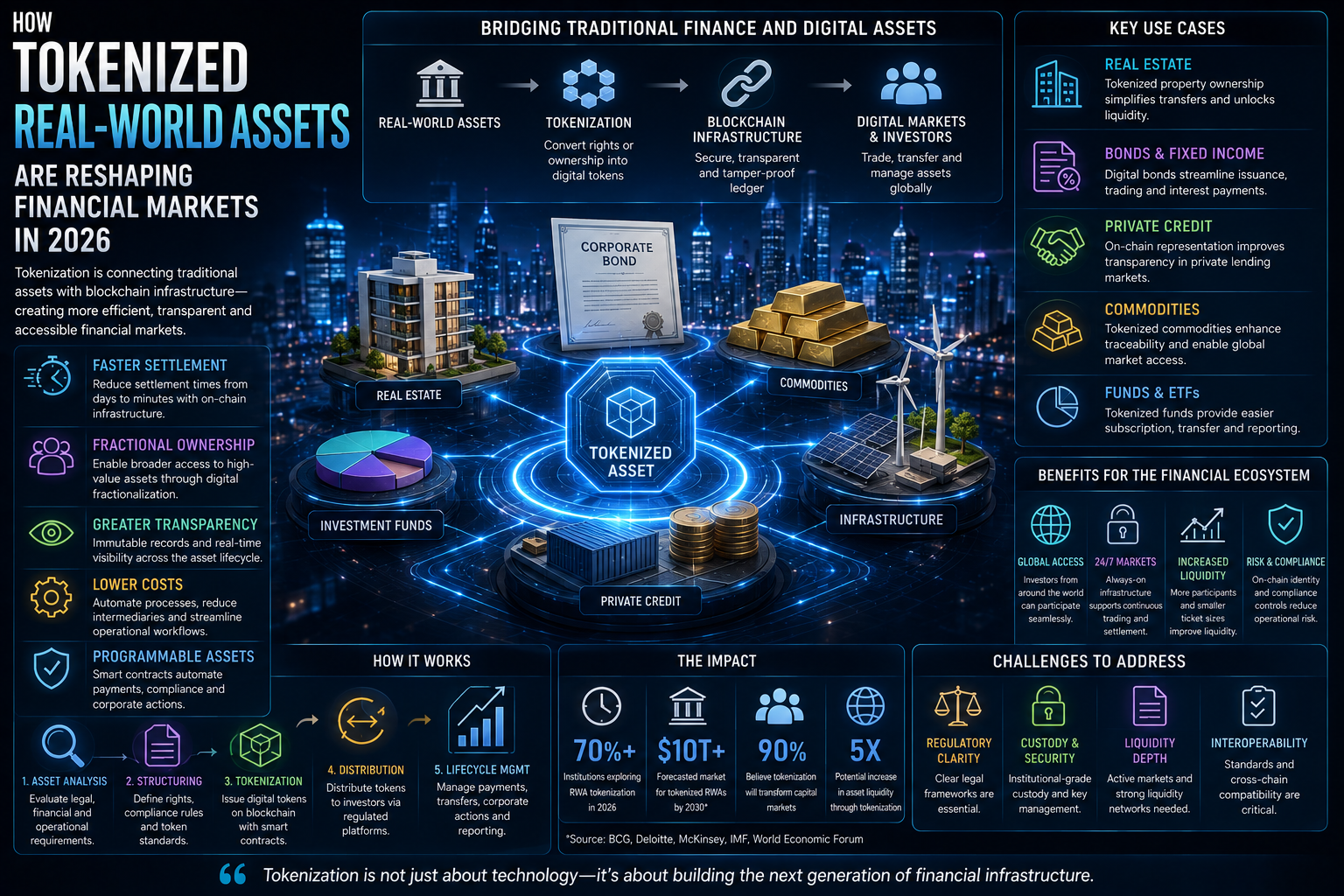
Tokenization refers to creating digital representations of ownership or economic rights connected to assets such as real estate, bonds, commodities, private credit, funds, and other financial instruments. These digital representations can potentially be issued, transferred, and managed using blockchain-based infrastructure.
The concept is gaining attention because it could connect traditional finance with digital-asset markets. BullNext's current coverage reflects this broader convergence, including stories about infrastructure designed to bridge traditional finance and digital assets.
In 2026, tokenized real-world assets are increasingly being discussed not simply as another cryptocurrency trend, but as a potential modernization of financial-market infrastructure.
What Are Tokenized Real-World Assets?
Real-world assets are physical or traditional financial assets that exist outside blockchain networks.
Examples include:
Real estate
Government bonds
Corporate bonds
Private credit
Investment funds
Commodities
Infrastructure assets
Collectibles
Tokenization creates a digital representation connected to ownership, rights, claims, or economic interests associated with such assets.
The blockchain can provide a shared digital record of transactions and ownership-related information, depending on how the particular system is designed.
Importantly, tokenization does not automatically make an asset legally enforceable or guarantee ownership. The legal structure connecting the digital token to the underlying asset remains critical.
Why Tokenization Matters
Traditional financial markets can involve multiple intermediaries.
An asset may require brokers, custodians, clearing systems, settlement institutions, registrars, and other service providers.
Tokenization could potentially simplify parts of this infrastructure.
A digitally represented asset can be transferred through blockchain-based systems, while smart contracts can automate certain administrative functions.
This creates the possibility of faster settlement, more automated processes, and greater transparency.
Faster Settlement
One potential advantage of tokenized assets is faster settlement.
Traditional financial transactions may involve separate stages for trading, clearing, and settlement.
Blockchain-based infrastructure can potentially combine some of these functions into more streamlined digital workflows.
Faster settlement could reduce the time between a transaction and final transfer of the relevant asset or payment.
However, the actual speed depends on the blockchain, legal structure, intermediaries, compliance requirements, and operational processes involved.
Fractional Ownership
Tokenization can also support fractional ownership models.
An expensive asset may traditionally require a large amount of capital from a single investor or a small group of investors.
Digital representations could potentially divide economic interests into smaller units.
For example, a property or investment vehicle could be represented through multiple digital units.
This could potentially broaden access to certain asset classes.
However, fractionalization does not automatically make an investment suitable for everyone. Regulatory requirements, investor eligibility, liquidity, and the legal rights attached to the tokens remain important.
Real Estate Tokenization
Real estate is one of the most frequently discussed applications.
Property transactions can involve significant paperwork, intermediaries, legal processes, and settlement requirements.
Tokenization could represent ownership interests or economic rights associated with properties or property-holding entities.
Investors could potentially access smaller interests in assets that would otherwise require substantial capital.
Blockchain infrastructure could also provide a digital record of transactions.
The biggest challenge remains legal integration.
A token must have clearly defined rights, and the relationship between the blockchain record and the underlying property must be enforceable.
Tokenized Bonds
Traditional bonds are another important application.
Tokenized bonds can represent debt instruments using blockchain-based infrastructure.
This can potentially automate parts of issuance, transfer, interest payments, and recordkeeping.
Financial institutions may also benefit from more programmable settlement processes.
The concept is particularly relevant to institutional finance because bonds already have standardized structures and established legal frameworks.
Tokenization could therefore modernize the infrastructure supporting an existing asset class rather than creating an entirely new financial product.
Tokenized Funds
Investment funds can also be represented digitally.
Tokenized fund structures could provide investors with digital representations of fund interests while using blockchain infrastructure for transfers and recordkeeping.
This could potentially improve administrative efficiency.
It may also allow financial institutions to integrate traditional investment products with digital-asset platforms.
For institutions, the ability to connect existing financial products to modern digital infrastructure could be more important than cryptocurrency speculation itself.
Tokenized Private Credit
Private credit markets have grown significantly as businesses seek alternatives to traditional bank financing.
Tokenization could provide digital infrastructure for representing loans or credit-related interests.
Smart contracts may potentially automate elements such as payment schedules and reporting.
However, private-credit tokenization requires strong underwriting, legal documentation, investor protections, and compliance.
Blockchain does not remove the underlying credit risk.
It simply provides a different technological infrastructure for managing the asset.
Commodities and Other Assets
Tokenization can also be applied to commodities and other assets.
Gold, for example, can potentially be represented through digital claims linked to underlying reserves or custody arrangements.
Other possibilities include infrastructure projects, agricultural assets, and specialized investment products.
The key issue is ensuring that the digital representation has a reliable connection to the underlying asset.
If that connection is unclear, the token may not provide the economic protection investors expect.
Smart Contracts and Programmable Assets
One of the most important advantages of tokenization is programmability.
Smart contracts can execute predefined rules automatically.
For example, a tokenized financial instrument could be designed to distribute payments according to specified conditions.
Corporate actions could potentially be automated.
Transfer restrictions could be encoded into the system.
Compliance checks could be integrated into transaction workflows.
This creates the possibility of financial assets that are not simply digital representations but programmable financial instruments.
Improving Transparency
Blockchain networks can provide shared transaction records.
Depending on the architecture and permissions, participants may be able to verify transaction history more efficiently.
This can potentially improve transparency between market participants.
However, blockchain transparency should not be confused with complete transparency.
Permissioned systems may restrict access.
Off-chain information may still be required.
Legal ownership and beneficial ownership can also involve structures that are not visible directly on-chain.
The value comes from combining blockchain records with reliable legal and financial systems.
Institutional Adoption
The most significant long-term opportunity may come from institutional financial markets.
Banks, asset managers, exchanges, custodians, and other financial institutions are exploring how blockchain infrastructure could improve existing processes.
Rather than replacing traditional financial markets entirely, tokenization could modernize specific parts of them.
This hybrid approach may prove more practical.
Traditional institutions can continue providing custody, compliance, underwriting, and financial expertise while blockchain networks support digital issuance and settlement.
Connecting Traditional Finance and Digital Assets
Tokenization creates a bridge between two financial ecosystems.
Traditional finance provides established assets, legal structures, institutional capital, and regulatory frameworks.
Digital-asset infrastructure provides blockchain-based transfer, programmability, and potentially continuous settlement.
The convergence of these systems could create new financial-market models.
BullNext's recent coverage of infrastructure designed to bridge traditional finance and digital-asset ecosystems illustrates this broader industry direction.
Liquidity: The Biggest Question
Tokenization can make assets easier to represent digitally, but that does not automatically create liquidity.
An asset may be tokenized and still have few buyers.
Real estate, private credit, and other alternative assets can remain difficult to trade.
For tokenized markets to become successful, they need active participants, reliable pricing, compliant trading venues, market makers, custody solutions, and strong investor demand.
Tokenization solves an infrastructure problem.
It does not automatically solve every market-liquidity problem.
Regulatory Considerations
Regulation will play a major role in the future of tokenized assets.
Authorities need to determine how digital representations should be classified and regulated.
Questions include:
Who legally owns the underlying asset?
What rights does the token holder receive?
How are investors protected?
Who can trade the asset?
What KYC requirements apply?
How should transactions be reported?
What happens if the issuer fails?
These questions are especially important for institutional adoption.
Clear legal frameworks can give financial institutions greater confidence to invest in tokenized infrastructure.
Custody and Security
Tokenized assets create new custody requirements.
Traditional financial assets are usually held through established custodians and account structures.
Digital assets may require wallets, private keys, smart contracts, or specialized custody infrastructure.
A security failure could potentially result in financial losses.
Institutions therefore need strong controls around key management, authorization, transaction monitoring, smart-contract security, and recovery procedures.
Security must be designed into tokenized financial systems from the beginning.
AI and Tokenized Markets
Artificial intelligence could further enhance tokenized financial markets.
AI systems can analyze market data, monitor transactions, identify anomalies, and support portfolio management.
AI can also help financial institutions evaluate large amounts of information surrounding tokenized assets.
For example, an AI-powered system could monitor a portfolio of tokenized securities and identify changes in liquidity, pricing, risk, or compliance conditions.
This creates an emerging combination of:
Blockchain infrastructure + tokenized assets + AI-powered financial intelligence.
Tokenization and 24/7 Markets
Traditional financial markets generally operate according to defined trading hours.
Blockchain networks can operate continuously.
Tokenized assets could potentially support more flexible trading and settlement environments.
However, true 24/7 financial markets require more than blockchain technology.
Custody, compliance, liquidity, market-making, customer support, and legal infrastructure also need to operate continuously.
The technology makes continuous operation possible, but the entire financial ecosystem must support it.
The Future of Capital Markets
Tokenization could eventually change how financial assets are issued and managed.
A company might issue a digital security.
Investors could acquire it through a regulated platform.
Ownership could be recorded digitally.
Payments could be automated through smart contracts.
Compliance rules could be integrated into the transfer process.
Settlement could occur through connected digital infrastructure.
This could reduce friction across multiple stages of the financial lifecycle.
How Businesses Can Prepare
Businesses and financial institutions interested in tokenization should begin with a specific use case.
Potential applications include:
Digital bonds
Fund interests
Private credit
Real estate
Treasury instruments
Commodity-linked assets
Institutional settlement
Organizations should first evaluate the legal structure, regulatory requirements, custody model, technology provider, investor eligibility, and liquidity strategy.
A pilot can help demonstrate whether tokenization produces measurable benefits before a larger deployment.
The Road Ahead
The tokenization of real-world assets is unlikely to replace traditional finance overnight.
Instead, adoption will probably happen gradually.
Financial institutions may tokenize selected assets first.
Regulated platforms may develop new trading and settlement infrastructure.
Custodians may integrate blockchain technology.
Investors may gain access to digital versions of familiar financial instruments.
Over time, these developments could create a financial ecosystem where traditional and digital assets operate alongside one another.
Conclusion
Tokenized real-world assets represent one of the most important potential applications of blockchain technology beyond cryptocurrencies.
By creating digital representations of traditional financial and physical assets, tokenization can support programmable transactions, more efficient settlement, fractional ownership models, and new forms of financial infrastructure.
The technology also creates important challenges.
Legal ownership, regulation, custody, liquidity, cybersecurity, and investor protection must all be addressed.
The most successful tokenization projects will therefore combine blockchain technology with strong financial and legal foundations.
As traditional finance and digital assets continue to converge, tokenization could become an important part of the next generation of capital-market infrastructure.
The future may not be a choice between traditional finance and blockchain.
Instead, it may be a hybrid financial system where traditional assets operate through increasingly digital, programmable, and interconnected infrastructure.
In 2026, tokenization is helping build that bridge—and its long-term impact could extend far beyond cryptocurrency markets.