Singapore is one of Asia’s most important financial and business centers, and it is home to a diverse group of wealthy entrepreneurs, investors, property developers, bankers, technology founders, and family business owners.
The country’s wealth landscape includes fortunes built through technology and e-commerce, banking, real estate, hospitality, manufacturing, consumer businesses, and global investments. According to Forbes’ 2026 Singapore 50 Richest list, the combined wealth of the country’s 50 richest people and families stood at approximately US$239 billion. Eduardo Saverin retained the top position for the fourth consecutive year with an estimated fortune of US$32.9 billion.
The 2026 list also shows how Singapore’s billionaire economy combines established family businesses with newer technology fortunes. While property and banking remain important sources of wealth, technology, e-commerce, digital services, and investment management continue to play significant roles.
Who Are Singapore’s Richest People?
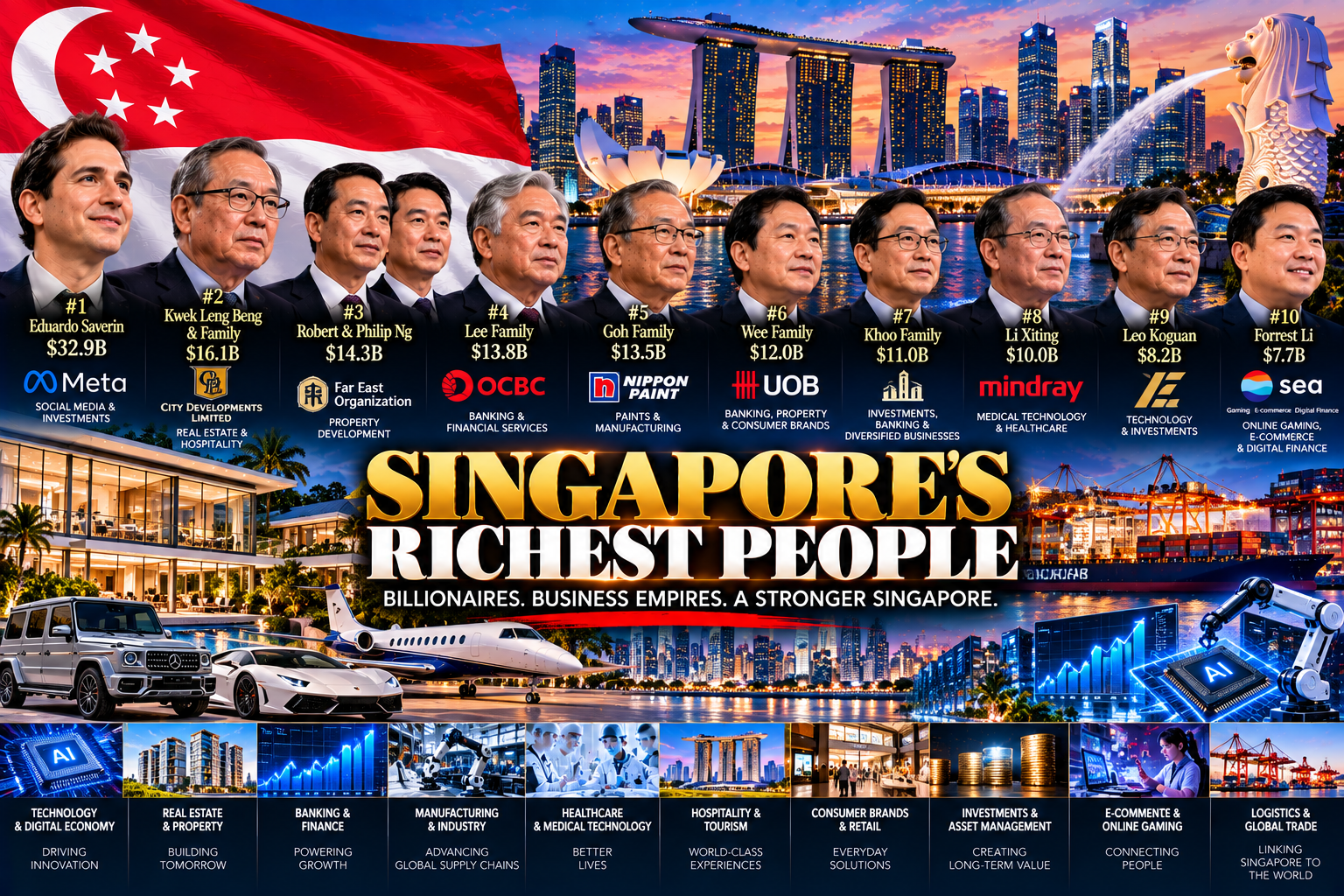
Forbes’ 2026 Singapore 50 Richest list places the following individuals and families among the country's top ten:
Eduardo Saverin — US$32.9 billion
Kwek Leng Beng & Family — US$16.1 billion
Robert & Philip Ng — US$14.3 billion
Lee Family — US$13.8 billion
Goh Family — US$13.5 billion
Wee Family — US$12 billion
Khoo Family — US$11 billion
Li Xiting — US$10 billion
Leo Koguan — US$8.2 billion
Forrest Li — US$7.7 billion
These fortunes come from very different industries, demonstrating the breadth of Singapore’s business economy.
1. Eduardo Saverin: Technology and Venture Capital
Eduardo Saverin is the highest-ranked person on Forbes’ 2026 Singapore list, with an estimated fortune of US$32.9 billion. He is best known as a cofounder of Facebook, now Meta Platforms.
Saverin later became a venture capitalist and co-founded B Capital, an investment firm focused on technology and growing businesses. Forbes identifies Facebook and investment activities as his primary sources of wealth. He is a Singapore resident and Brazilian citizen.
His story demonstrates how ownership in a successful technology company can create enormous long-term wealth and how founders can transition from operating businesses into investment management.
2. Kwek Leng Beng & Family: Real Estate and Hospitality
Kwek Leng Beng and his family rank second on the 2026 Singapore list with approximately US$16.1 billion.
The family’s wealth is closely associated with City Developments Limited (CDL) and a broad property and hospitality portfolio. Singapore real estate has played an important role in the family's business activities.
In 2026, CDL continued reshaping its portfolio through asset divestments and a stronger focus on residential and hospitality markets.
The family's position illustrates the importance of real estate development, hotels, commercial properties, and international property assets in Singapore's wealth economy.
3. Robert & Philip Ng: Property Development
Brothers Robert and Philip Ng rank third with an estimated combined fortune of US$14.3 billion.
Their wealth comes primarily from Far East Organization, one of Singapore's major privately held property groups.
The company has interests spanning residential developments, commercial properties, hospitality, and other real estate businesses. The brothers have remained among Singapore's wealthiest business families for many years.
Their fortune demonstrates the long-term importance of property ownership and development in Singapore.
4. Lee Family: Banking and Financial Services
The Lee family ranks fourth with approximately US$13.8 billion.
A major source of the family's wealth is its stake in OCBC, one of Singapore's major banking groups. Forbes reported that rising OCBC shares and growth in wealth-management activities helped increase the family's fortune in 2026.
Banking remains one of Singapore's most important economic sectors, supported by the country's position as a regional financial center.
The Lee family's wealth illustrates how long-term ownership of a major financial institution can generate substantial family wealth.
5. Goh Family: Paints and Manufacturing
The Goh family ranks fifth on the 2026 Forbes list with approximately US$13.5 billion.
The family controls a major stake in Nippon Paint Holdings, linking its wealth to the global paints and coatings industry.
Manufacturing businesses may not receive the same attention as technology companies, but industrial products can create substantial wealth when businesses achieve international scale.
The Goh family's position highlights the diversity of Singapore's billionaire economy beyond finance and real estate.
6. Wee Family: Banking and Property
The Wee family ranks sixth with approximately US$12 billion.
The family inherited and expanded the business interests of the late banker Wee Cho Yaw. Forbes identifies stakes in United Overseas Bank (UOB), property developers UOL Group and Kheng Leong, and consumer brand Haw Par as important sources of the family's wealth.
UOB's regional banking operations have also expanded beyond Singapore, strengthening the family's exposure to Southeast Asian financial markets.
The Wee family's portfolio demonstrates how banking, property, and consumer businesses can coexist within a diversified family enterprise.
7. Khoo Family: Banking, Healthcare, and Investments
The Khoo family ranks seventh with approximately US$11 billion.
The family's wealth has historically been connected to banking and investments, particularly through its legacy business interests.
Family-owned investment structures can allow wealth to remain diversified across generations, with assets potentially spanning financial services, real estate, hospitality, and other businesses.
Singapore's private wealth-management ecosystem provides an important environment for such family investment structures.
8. Li Xiting: Medical Technology
Li Xiting ranks eighth on the Forbes Singapore list with an estimated fortune of US$10 billion.
He is the cofounder and chairman of Shenzhen Mindray Bio-Medical Electronics, a major medical-device company. Although Mindray is headquartered in Shenzhen, Li is a Singapore citizen and divides his time between China and Singapore.
His fortune demonstrates how Singapore's billionaire population can include internationally based entrepreneurs whose businesses operate primarily outside the city-state.
Medical technology has become an important global industry, covering patient monitoring, diagnostic equipment, medical imaging, and other healthcare technologies.
9. Leo Koguan: Technology and Investments
Leo Koguan ranks ninth with approximately US$8.2 billion.
His wealth has been associated with technology investments, particularly his substantial interest in technology companies.
Technology-related fortunes can experience significant changes because public-company valuations are closely tied to stock-market movements.
This makes technology billionaires different from some traditional property or family-business fortunes, which may be based more heavily on privately held assets.
10. Forrest Li: Gaming, E-Commerce, and Digital Finance
Forrest Li ranks tenth on the 2026 Singapore list with approximately US$7.7 billion.
He founded and leads Sea Limited, a technology company with businesses in online gaming, e-commerce, and digital financial services.
Sea operates major digital platforms across Southeast Asia and other markets. Forbes identifies online gaming and e-commerce as major sources of Li's wealth.
His rise illustrates Singapore's role as a base for technology companies serving the wider Southeast Asian market.
However, technology wealth can also be volatile. Forbes reported that Sea's shares declined substantially compared with the previous year, contributing to a lower ranking for Li in 2026.
Singapore’s Billionaire Economy Is Highly Diverse
Singapore's wealthiest people are not concentrated in a single industry. Instead, their fortunes span several major economic sectors.
Real Estate
Property remains one of Singapore's most important sources of large private fortunes.
Major families have built businesses around:
Residential developments
Commercial buildings
Shopping centers
Hotels
Office towers
Industrial properties
International real estate
The city's limited land availability and position as a global business center have supported long-term interest in property development.
Banking and Finance
Singapore is one of Asia's major financial centers.
Banking fortunes represented by families such as the Lees and Wees demonstrate the importance of financial services to the country's wealth economy.
Singapore also attracts private-equity firms, venture capital, family offices, asset managers, and other investment businesses.
Technology
Technology has created a newer generation of Singapore-based wealth.
Eduardo Saverin's Meta stake and Forrest Li's Sea Limited are examples of fortunes connected to global technology businesses. Singapore's position within Southeast Asia also makes it an attractive headquarters for companies expanding across regional markets.
Manufacturing
The Goh family's connection to Nippon Paint and Li Xiting's medical-device business demonstrate the continuing importance of manufacturing.
Singapore's highly developed infrastructure, skilled workforce, logistics network, and international connections support advanced manufacturing and regional operations.
Hospitality
Hotels and tourism-related properties are important components of several major Singapore fortunes.
Property groups often combine residential and commercial development with hotels, resorts, and hospitality businesses.
This creates exposure to both property values and international tourism.
Why Singapore’s Richest Rankings Change
Billionaire rankings can change significantly from year to year because wealth is often linked to publicly traded stocks.
Forbes' 2026 Singapore list used stock prices and exchange rates from August 14, 2026. Private companies were valued using comparisons with similar publicly traded businesses. The methodology also includes family fortunes and people with significant business, residential, or other ties to Singapore.
Consequently, a person's ranking does not necessarily mean their cash holdings changed by the same amount.
A change in a company's share price can significantly alter the estimated value of a billionaire's ownership stake.
Singapore’s Technology Wealth
Technology has become an increasingly visible part of Singapore's wealth landscape.
Digital commerce, online gaming, fintech, artificial intelligence, venture capital, and software businesses are creating new opportunities for entrepreneurs and investors.
Forrest Li's Sea Limited is an example of a Singapore-based technology company serving multiple international markets. Gang Ye, another Sea cofounder, ranked 14th on the 2026 Singapore list with approximately US$4.3 billion.
At the same time, the 2026 list shows that technology fortunes can move quickly. Sea's share-price decline reduced the fortunes of several of its executives and founders compared with the previous year.
Family Businesses Remain Important
One of the most distinctive features of Singapore's wealth landscape is the importance of family businesses.
The Forbes list includes several families rather than only individual billionaires. These include the Kwek, Ng, Lee, Goh, Wee, and Khoo families.
Family-controlled businesses can operate across multiple generations and industries.
They may own stakes in:
Banks
Property companies
Hotels
Consumer brands
Manufacturing businesses
Investment companies
Financial institutions
This structure means that Singapore's wealth economy includes both entrepreneurial fortunes and multigenerational family wealth.
Singapore’s Role as a Global Wealth Center
Singapore's location gives wealthy individuals and companies access to Southeast Asia, China, India, and international markets.
The country has developed a strong ecosystem around:
International banking
Asset management
Private wealth
Venture capital
Family offices
Technology
Logistics
Real estate
International trade
This combination helps explain why people whose businesses operate across Asia may choose Singapore as a residence or business base.
The Forbes methodology itself recognizes this international character by allowing people with significant business or residential connections to Singapore to appear on the country's richest list.
Singapore’s Billionaires and the Future
The future of Singapore's wealth landscape is likely to remain connected to both traditional industries and emerging technologies.
Real estate, banking, manufacturing, and consumer businesses continue to support established fortunes. At the same time, artificial intelligence, digital finance, e-commerce, data infrastructure, healthcare technology, and venture capital could create new sources of wealth.
The country's role as a regional headquarters location may also remain important as companies expand across Southeast Asia.
However, billionaire wealth will continue to fluctuate with stock markets, currency movements, property valuations, business performance, and economic conditions.
Final Thoughts
Singapore's richest people represent a broad cross-section of the modern Asian economy.
Eduardo Saverin's technology fortune, the Kwek and Ng families' property businesses, the Lee and Wee families' banking interests, Li Xiting's medical technology business, and Forrest Li's digital platforms demonstrate how different industries can create substantial wealth.
Forbes' 2026 Singapore 50 Richest list places the combined wealth of its members at approximately US$239 billion, with the minimum fortune required to enter the list at US$1 billion.
Rather than representing one single path to wealth, Singapore's billionaire landscape reflects the interaction of technology, finance, property, manufacturing, healthcare, consumer businesses, and international investment.
FAQs
Who is the richest person in Singapore in 2026?
According to Forbes' 2026 Singapore 50 Richest list, Eduardo Saverin ranks first with an estimated fortune of US$32.9 billion.
How much are Singapore's 50 richest people worth?
Forbes estimates the combined wealth of Singapore's 50 richest people and families at approximately US$239 billion in 2026.
Who is Eduardo Saverin?
Eduardo Saverin is a cofounder of Facebook and later became a venture capitalist. Forbes identifies Facebook and investment activities as his primary sources of wealth.
Who is Forrest Li?
Forrest Li is the founder and CEO of Sea Limited, a technology company involved in online gaming, e-commerce, and digital financial services. He ranked tenth on Forbes' 2026 Singapore 50 Richest list.
Is Singapore's wealth mostly based on real estate?
No. Real estate is an important source of wealth, but Singapore's richest people also have major interests in technology, banking, manufacturing, healthcare, consumer businesses, and investments.
Why do billionaire rankings change?
Rankings can change because public-company share prices, exchange rates, private-company valuations, and business conditions change. Forbes' 2026 Singapore list uses a specific valuation date, so later market movements can produce different real-time estimates.