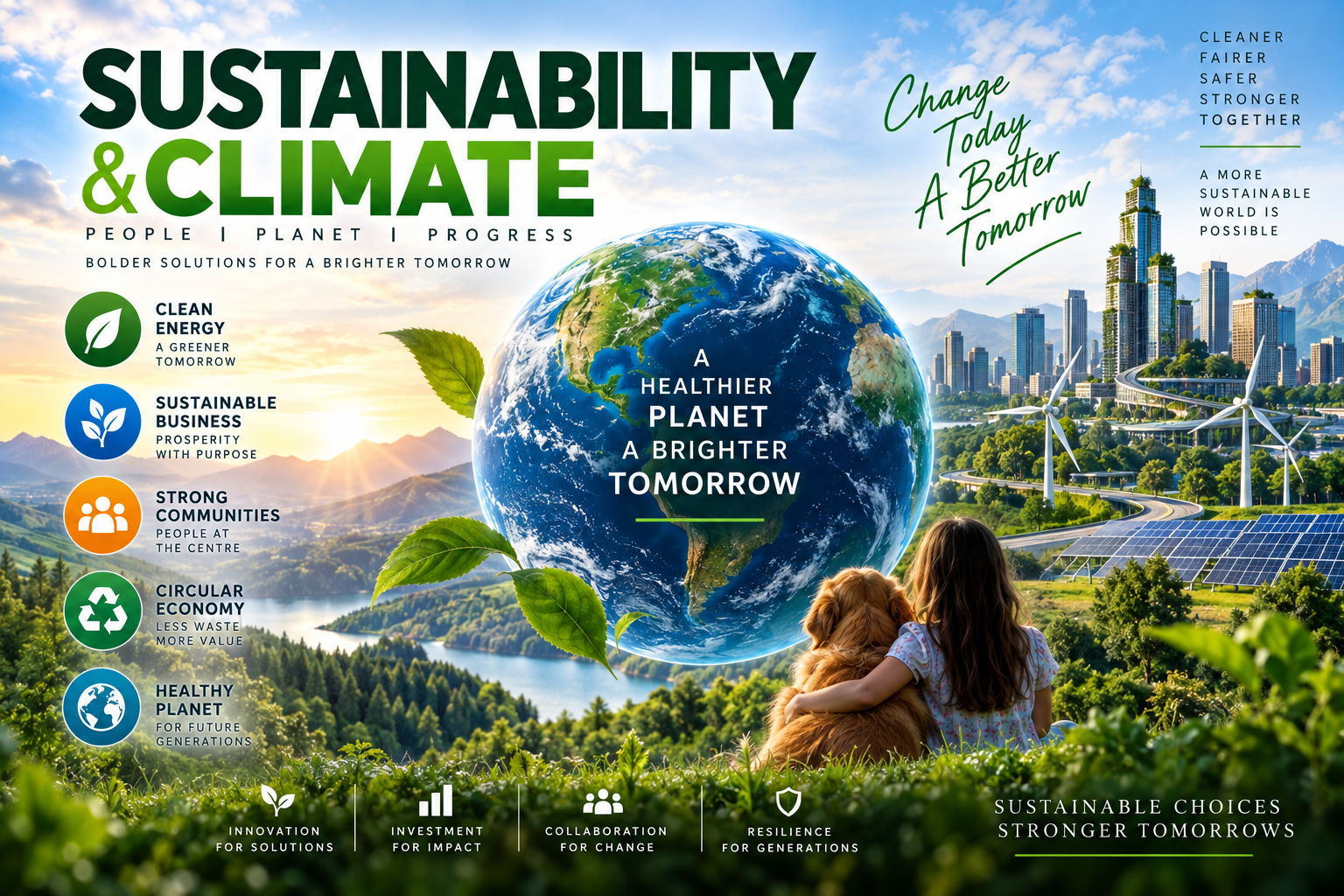
Sustainability and climate change have become two of the most important issues shaping the future of the global economy and society. Rising temperatures, extreme weather events, biodiversity loss, resource shortages, and growing pressure on natural systems are forcing governments, businesses, investors, and individuals to rethink how economic growth is achieved.
For decades, economic development often depended on intensive use of natural resources. Fossil fuels powered industries, transportation, and cities, while large-scale agriculture and manufacturing helped meet the needs of a growing global population. These systems generated enormous economic progress, but they also contributed to greenhouse gas emissions, pollution, deforestation, and environmental degradation.
Today, sustainability is increasingly viewed not simply as an environmental responsibility but as an economic and strategic priority. Companies are looking for cleaner technologies, investors are evaluating environmental risks, and governments are developing policies designed to support lower-carbon economies. The transition will be challenging, but it also presents opportunities for innovation, investment, and long-term economic growth.
Understanding Sustainability
Sustainability is fundamentally about meeting today's needs without compromising the ability of future generations to meet their own needs. It involves balancing environmental protection, economic development, and social well-being.
Environmental sustainability focuses on protecting ecosystems, reducing pollution, conserving water, managing waste, and using natural resources responsibly. Economic sustainability involves creating businesses and economic systems that can remain productive and resilient over the long term. Social sustainability includes issues such as decent employment, access to essential services, equality of opportunity, and healthy communities.
These areas are closely connected. A business that damages the environment may eventually face higher costs, regulatory pressure, supply disruptions, or reputational damage. Similarly, communities affected by climate-related disasters can experience economic losses that extend well beyond the initial environmental impact.
Climate Change and the Global Economy
Climate change is already influencing economies around the world. Changes in temperature and weather patterns can affect agriculture, infrastructure, energy systems, insurance markets, tourism, and supply chains.
Extreme heat can reduce worker productivity and increase demand for cooling. Floods and storms can damage roads, factories, homes, and power systems. Droughts can place pressure on agricultural production and water supplies.
These risks make climate change an important consideration for businesses and investors. Companies increasingly need to understand not only their environmental impact but also how climate-related disruptions could affect their operations.
The economic response to climate change therefore has two major dimensions: reducing greenhouse gas emissions and preparing communities and businesses for climate impacts that can no longer be avoided.
The Transition to Clean Energy
Energy is at the center of the sustainability transition. Fossil fuels have historically provided much of the world's electricity, heating, and transportation energy, but renewable technologies are becoming increasingly important.
Solar and wind power have expanded significantly, while battery storage is helping address the challenge of variable renewable generation. Hydropower, nuclear energy, geothermal systems, and other technologies can also contribute to lower-carbon energy systems depending on local conditions.
The transition is not simply about replacing one energy source with another. Electricity grids need modernization, energy storage needs to expand, and industries that depend on high-temperature processes require new technologies.
Transportation is another major area of change. Electric vehicles are becoming more common, while researchers and companies are exploring alternative fuels and technologies for aviation, shipping, and heavy industry.
Sustainable Business
Businesses play a central role in the sustainability transition because they control major parts of global production, supply chains, investment, and innovation.
Companies can improve sustainability by reducing energy consumption, using renewable electricity, minimizing waste, improving water efficiency, designing products for longer lifespans, and sourcing materials responsibly.
Sustainability can also improve business efficiency. Reducing energy and material consumption can lower operating costs, while efficient logistics can reduce both expenses and environmental impacts.
Consumers are also influencing corporate behavior. Many customers increasingly want information about how products are manufactured, where materials come from, and whether companies operate responsibly.
However, businesses need to distinguish genuine sustainability efforts from superficial marketing. Claims about environmental performance should be supported by credible evidence and measurable results.
The Circular Economy
Traditional economic systems often follow a linear model: resources are extracted, products are manufactured, goods are consumed, and waste is discarded. The circular economy seeks to reduce this waste by keeping products and materials in use for as long as possible.
Circular strategies include repairing products, reusing materials, refurbishing equipment, recycling components, and designing products so they can be easily disassembled.
This approach can reduce pressure on natural resources while creating new business opportunities. Companies can develop repair services, resale platforms, recycling technologies, and product-as-a-service models.
The circular economy is particularly relevant as demand for minerals, metals, energy, and other resources continues to grow. More efficient use of existing materials can help reduce environmental pressure and improve supply-chain resilience.
Sustainable Finance and Investment
Financial markets have an increasingly important role in supporting sustainability. Banks, asset managers, institutional investors, and other financial institutions are considering environmental and climate-related risks when making investment decisions.
Capital can support renewable energy projects, energy-efficient buildings, sustainable transportation, climate-resilient infrastructure, and innovative technologies.
At the same time, investors are increasingly examining whether companies are prepared for changing regulations, physical climate risks, resource constraints, and shifts in consumer demand.
Sustainable finance is not without challenges. Investors need reliable information to distinguish meaningful environmental performance from exaggerated claims. Standardized reporting and transparent data can help markets evaluate companies more effectively.
The broader goal is to ensure that capital flows toward projects and businesses capable of creating long-term economic value while managing environmental risks.
Climate Adaptation and Resilience
Reducing emissions is essential, but societies must also prepare for climate impacts. This process is known as climate adaptation.
Adaptation can include strengthening flood defenses, improving drainage systems, developing heat-resistant infrastructure, protecting water supplies, improving agricultural practices, and creating early-warning systems for extreme weather.
Cities have a particularly important role. Urban populations are growing, and cities often experience higher temperatures because buildings and roads absorb and retain heat.
Urban planning can improve resilience through green spaces, tree planting, efficient public transportation, better water management, and energy-efficient buildings.
Climate resilience is ultimately an investment in economic stability. Preventing or reducing damage before disasters occur can be significantly more effective than rebuilding after a major event.
Agriculture and Food Systems
Agriculture is both affected by climate change and connected to environmental sustainability. Changes in rainfall, temperature, drought frequency, and extreme weather can affect crop yields and food security.
Farmers are therefore exploring techniques that improve soil health, conserve water, reduce erosion, and increase resilience. Precision agriculture can use sensors, satellite data, and digital tools to help farmers apply water, fertilizer, and other inputs more efficiently.
Food waste is another major issue. A significant amount of food is lost or wasted between farms, processing facilities, retailers, restaurants, and households. Reducing waste can improve food security while lowering the environmental resources associated with producing food that is never consumed.
Sustainable food systems will require cooperation among farmers, governments, businesses, researchers, and consumers.
The Importance of Biodiversity
Climate change is only one part of the environmental challenge. Biodiversity loss and ecosystem degradation can also threaten economic and social stability.
Forests, wetlands, oceans, grasslands, and other ecosystems provide services that economies depend on, including clean water, pollination, soil fertility, coastal protection, and carbon storage.
Businesses are increasingly recognizing that nature-related risks can affect supply chains and long-term growth. Agriculture, food production, tourism, pharmaceuticals, and many other industries depend directly or indirectly on healthy ecosystems.
Protecting biodiversity therefore has economic as well as environmental value.
Technology and Innovation
Technology will play a major role in the sustainability transition. Artificial intelligence, advanced materials, energy storage, smart grids, satellite monitoring, and digital infrastructure can help organizations use resources more efficiently.
Artificial intelligence can analyze large amounts of environmental and operational data, helping businesses identify energy-saving opportunities or improve supply-chain planning. Satellite technologies can monitor forests, agricultural land, oceans, and other ecosystems.
Innovation is also important in areas where existing solutions are not yet sufficient. Heavy industry, aviation, shipping, and other difficult-to-decarbonize sectors require continued research and investment.
Technology alone, however, cannot solve every environmental challenge. Effective policies, responsible business practices, infrastructure investment, and changes in consumer behavior are equally important.
Governments and Climate Policy
Governments influence the pace of the sustainability transition through regulation, taxation, investment, infrastructure planning, and incentives.
Policies can encourage renewable energy, energy efficiency, clean transportation, sustainable agriculture, recycling, and climate-resilient infrastructure. Governments can also establish environmental standards and reporting requirements for businesses.
International cooperation is particularly important because climate change crosses national borders. Emissions produced in one country can affect the entire global climate system, while supply chains often span multiple continents.
Effective climate policy must also consider economic realities. Workers and communities dependent on traditional industries may need retraining, investment, and new employment opportunities as economies transition.
The Role of Individuals
Although governments and corporations have significant responsibilities, individuals also influence sustainability through everyday decisions.
People can reduce waste, conserve energy and water, choose durable products, use public transportation where practical, and consider the environmental impact of consumption.
More importantly, consumers can influence businesses through their purchasing decisions and expectations. When demand shifts toward efficient, durable, and responsibly produced products, companies have stronger incentives to adapt.
Individual action should not be viewed as a substitute for systemic change. The largest environmental challenges require coordinated action from governments, industries, financial institutions, and communities.
Challenges Ahead
The transition toward a more sustainable economy will not be simple. Clean technologies require investment, infrastructure must be upgraded, and industries may need to redesign established production systems.
There are also concerns about the availability of critical minerals, the cost of new technologies, differences between developed and developing economies, and the potential impact of climate policies on workers and consumers.
Another challenge is maintaining public trust. Sustainability policies are more effective when environmental claims are transparent, measurable, and supported by credible evidence.
The transition must therefore be both ambitious and practical. Economic opportunity, social inclusion, environmental protection, and technological innovation need to move together.
The Future of Sustainability
Sustainability is increasingly becoming part of mainstream economic strategy rather than a separate environmental concern. Companies are considering climate risks in long-term planning, investors are examining environmental exposure, and governments are investing in clean energy and resilient infrastructure.
The coming decades will likely bring major changes in how energy is produced, how cities are designed, how products are manufactured, and how resources are managed.
The organizations that adapt early may gain competitive advantages through lower operating costs, stronger resilience, innovation, and access to emerging markets.
Conclusion
Sustainability and climate action represent one of the defining challenges and opportunities of the 21st century. Climate change is creating physical and economic risks, but the transition toward a more sustainable economy can also generate innovation, investment, employment, and new industries.
Achieving meaningful progress will require more than individual lifestyle changes. Governments must establish effective policies, businesses must make credible commitments, investors must allocate capital responsibly, and communities must participate in building resilient systems.
The ultimate objective is not simply to reduce environmental damage. It is to create an economy capable of supporting prosperity while respecting the limits of the natural world.
A sustainable future will depend on decisions made today. The choices surrounding energy, infrastructure, finance, technology, production, and consumption will shape the resilience of economies and communities for generations to come.