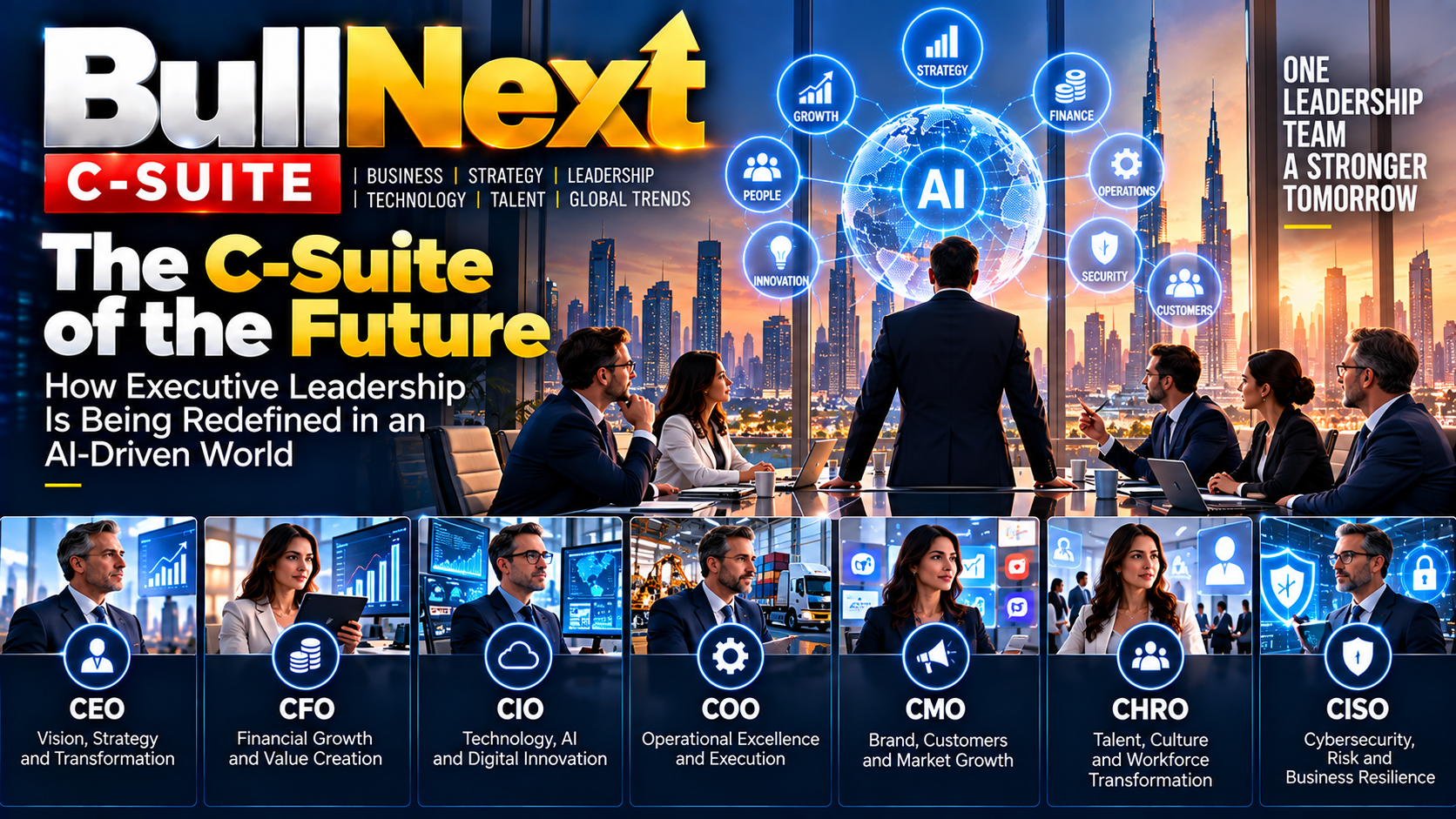
The modern C-suite is entering a period of fundamental change.
For decades, executive leadership was largely organized around specialized functions. The CEO focused on overall direction, the CFO managed capital and financial performance, the CIO oversaw technology, the CMO led marketing, the COO managed operations, and the CHRO focused on people and organizational culture.
Those boundaries are becoming less meaningful.
Artificial intelligence, geopolitical uncertainty, cybersecurity threats, changing customer expectations, workforce transformation and rapidly evolving business models are creating challenges that cannot be solved by one department alone.
A technology decision can affect finance. A cybersecurity issue can damage customer trust. An AI investment can change workforce requirements. A supply-chain disruption can affect marketing, operations and financial performance simultaneously.
This is why the future C-suite will need to operate less like a collection of individual departments and more like an integrated leadership system.
The World Economic Forum has highlighted the need for C-suite executives to move beyond functional silos, develop greater curiosity and understand business performance more broadly.
At the same time, AI is becoming an enterprise-level leadership issue rather than simply a technology project. McKinsey reports that 89% of organizations are regularly using AI in at least one business function, yet the share of organizations achieving significant AI-driven impact remains relatively small.
The implication is clear: the future C-suite will not simply manage functions. It will orchestrate transformation.
The C-Suite Is Moving Beyond Functional Silos
Traditional executive structures were designed for a world where departments could operate with relatively clear boundaries.
That model is increasingly difficult to sustain.
Consider an organization introducing an AI-powered customer service platform.
The CIO may oversee implementation. The CFO may evaluate the investment. The CMO may consider customer experience. The COO may redesign workflows. The CHRO may address employee training. The legal team may assess compliance. The CISO may evaluate security.
The project touches almost every part of the company.
If each executive looks only at their own department, the organization can end up with disconnected decisions.
The modern C-suite therefore needs shared accountability.
Executives must ask:
What does this decision mean for the customer?
How does it affect employees?
What financial value can it create?
What risks does it introduce?
What capabilities will the organization need?
How does it support the long-term strategy?
The World Economic Forum argues that future C-suite leaders must think beyond their individual functions and engage in broader conversations about organizational performance and the future.
This does not mean eliminating specialization.
It means connecting specialization to enterprise strategy.
AI Has Changed the Executive Agenda
Few technologies have affected the C-suite agenda as quickly as artificial intelligence.
AI is now influencing customer service, marketing, software development, finance, cybersecurity, operations, human resources, research and strategic planning.
But adoption alone does not guarantee business value.
PwC's 2026 Global CEO Survey found that only 12% of CEOs reported that AI had delivered both increased revenue and reduced costs, while 56% reported neither significant revenue nor cost benefits from AI.
This creates a major responsibility for senior executives.
The question is no longer:
"Should we use AI?"
The more important questions are:
Where can AI create meaningful competitive advantage?
Which processes should be redesigned?
What should humans continue to own?
How should investment be measured?
What new risks need to be governed?
AI strategy is therefore becoming a leadership responsibility.
McKinsey's latest research similarly argues that CEOs cannot delegate several critical aspects of AI transformation, including raising organizational ambition, redesigning how work is performed and resetting organizational culture.
The CEO Becomes the Chief Transformation Leader
The CEO's role has traditionally centered on setting vision, allocating resources and communicating with stakeholders.
In the AI era, the role is expanding.
CEOs increasingly need to act as transformation leaders.
That means understanding how technology changes competitive dynamics, identifying opportunities before competitors, making difficult trade-offs and ensuring that the organization can execute.
The CEO does not need to become a software engineer.
But the CEO does need enough technological understanding to ask the right questions.
For example:
What business problem are we solving?
Why is AI the right solution?
What data does the system require?
What happens if the model produces an incorrect result?
How will we measure ROI?
What jobs and workflows will change?
How will employees be prepared?
What governance is required?
Strong CEOs do not need to know everything about AI.
They need to know enough to lead the people who do.
The CFO Is Becoming a Strategic Value Architect
The CFO role is also expanding.
Finance leaders have traditionally been responsible for financial reporting, budgeting, forecasting, capital allocation and financial controls.
Those responsibilities remain important.
But modern CFOs are increasingly expected to help determine where the organization should invest for future growth.
PwC describes CFOs as enterprise strategists and architects of reinvention, with increasing responsibility for linking finance, technology, strategy, risk and talent.
This is particularly important when companies invest heavily in AI and digital transformation.
Executives need to distinguish between:
technology spending
and
strategic investment.
Buying software is not transformation.
Transformation occurs when technology changes how the organization creates value.
The CFO therefore needs to ask whether AI investments are improving productivity, customer experience, decision-making, revenue generation, risk management or other measurable outcomes.
Financial discipline can become an accelerator of innovation rather than an obstacle to it.
CIOs Are Becoming Strategy Architects
The CIO is another role undergoing significant change.
For many years, the CIO was primarily associated with infrastructure, systems, IT operations and technology delivery.
That is no longer enough.
Technology has become central to business strategy.
McKinsey's 2026 Global Tech Agenda describes leading CIOs as increasingly becoming strategy architects, integrating AI and data into operating models and helping shape the future direction of their companies.
The modern CIO must therefore understand more than technology.
They need to understand:
customers
revenue models
operations
workforce capabilities
cybersecurity
data governance
competitive strategy
AI economics
The strongest CIOs will increasingly sit at the intersection of business and technology.
The CISO Has Become a Business Leader
Cybersecurity can no longer be treated as a technical issue that belongs only to the security department.
A major cyberattack can interrupt operations, expose customer data, create regulatory problems and damage a company's reputation.
This makes cybersecurity a board-level business concern.
PwC's 2026 CISO outlook emphasizes the need to connect cybersecurity directly with enterprise strategy and treat security as an enabler of resilience and innovation.
The modern CISO must therefore communicate risk in business language.
Instead of simply saying:
"This system has a security vulnerability."
The executive conversation should explain:
"This vulnerability could interrupt a critical revenue-generating process, expose sensitive information and increase regulatory exposure."
That translation from technical risk to business impact is increasingly valuable.
The CHRO Is Becoming a Transformation Partner
Technology can change workflows quickly.
People cannot always adapt at the same speed.
This makes the CHRO increasingly important to enterprise transformation.
AI can change job descriptions, skill requirements, organizational structures and career paths.
PwC's 2026 CEO and workforce research highlights skills gaps, workforce confidence and trust as important factors in successful reinvention.
The CHRO's responsibility therefore extends beyond traditional human resources.
Future-focused HR leaders will help executives answer:
Which skills will become more valuable?
Which roles will change?
Where should employees be reskilled?
How should internal mobility work?
How can AI improve employee productivity?
How can organizations maintain trust during transformation?
The best organizations may increasingly view workforce strategy as a growth strategy.
The CMO Must Understand Technology and Data
Marketing leadership is also changing.
Customers increasingly interact with brands through digital platforms, personalized experiences, AI-powered recommendations and automated communication.
That means the CMO must understand data and technology while maintaining a deep understanding of customer psychology.
The future marketing leader will need to connect:
brand + data + technology + customer experience + revenue.
AI can help generate content, analyze customer behavior and personalize campaigns.
But automation alone does not create a strong brand.
Customers still respond to relevance, credibility, trust and emotional connection.
The CMO's challenge is therefore to use technology without allowing the brand to become generic.
The COO Becomes the Architect of Execution
Strategy has little value without execution.
This makes the COO increasingly important in an organization undergoing continuous transformation.
The modern COO must connect strategy to everyday operations.
That could involve redesigning workflows, integrating AI agents, improving supply chains, reducing unnecessary processes and coordinating multiple departments.
AI transformation frequently requires changes to the operating model itself.
McKinsey research emphasizes that organizations seeking significant AI value need to rethink how decisions are made, how work is performed and how capabilities are developed.
The COO can therefore become one of the most important leaders in converting executive ambition into operational reality.
Trust Becomes a C-Suite Responsibility
Technology can move quickly.
Trust takes longer to build.
This creates a major challenge for executive teams.
Customers want to know how their data is being used. Employees want to know how AI will affect their jobs. Investors want confidence that management understands emerging risks. Regulators increasingly expect stronger governance.
PwC reported that 66% of CEOs experienced stakeholder trust concerns to at least a moderate extent during the previous year, including concerns related to AI safety, data privacy and corporate transparency.
Trust can no longer belong to one department.
It must become a shared executive responsibility.
The C-suite should regularly discuss:
AI governance
cybersecurity
data privacy
transparency
customer protection
employee confidence
regulatory risk
corporate reputation
Trust should be treated as an enterprise asset.
C-Suite Leaders Need a Shared View of Performance
One of the biggest changes in executive leadership is the definition of performance itself.
A CEO cannot evaluate the organization only through revenue.
A CFO cannot evaluate success only through cost reduction.
A CMO cannot evaluate performance only through marketing metrics.
A CIO cannot evaluate technology only through system uptime.
A CHRO cannot evaluate workforce performance only through hiring numbers.
Enterprise performance is interconnected.
For example, reducing employee numbers might improve short-term costs while damaging innovation and customer service.
Increasing marketing spending might reduce short-term margins while generating long-term customer growth.
Investing heavily in cybersecurity may not create immediate revenue but could prevent significant future losses.
This is why the C-suite needs a more sophisticated performance conversation.
Leaders need to understand both short-term results and long-term organizational health. The World Economic Forum has highlighted this broader approach to executive performance as an important part of the future C-suite.
The C-Suite Needs Better Questions
Executive leadership is often associated with having answers.
But in an uncertain environment, asking better questions may be more valuable.
A strong C-suite should regularly ask:
What is changing faster than expected?
Markets, technology and customer behavior can shift before traditional planning cycles detect the change.
What assumptions are we making?
Every strategy contains assumptions. Executives need to identify which assumptions are becoming outdated.
Where are we too slow?
Slow decision-making can become a competitive disadvantage.
Where are we moving too quickly?
Speed without governance can create unnecessary risk.
What should we stop doing?
Transformation is not only about adding new initiatives. It is also about eliminating outdated processes.
What capabilities will we need in three years?
Future competitiveness depends on capabilities that may not exist inside the organization today.
Curiosity is therefore becoming an executive capability.
C-Suite Collaboration Will Define Competitive Advantage
The strongest executive teams will increasingly operate as interconnected systems.
The CEO provides direction.
The CFO evaluates value and capital.
The CIO builds technological capabilities.
The CISO protects trust and resilience.
The COO drives execution.
The CHRO develops organizational capability.
The CMO understands customers and markets.
The result should not be a collection of individual strategies.
It should be one enterprise strategy.
This requires executives to spend more time understanding each other's priorities.
The CFO should understand technology.
The CIO should understand customers.
The CMO should understand economics.
The CHRO should understand business strategy.
The CISO should understand operations.
The COO should understand digital transformation.
This cross-functional fluency can make the organization faster and more coherent.
AI Requires a New Executive Operating Model
AI may ultimately change not only what executives decide but how executive teams operate.
Instead of waiting for quarterly reports, leaders can increasingly work with real-time information.
Instead of relying entirely on historical performance, executives can use AI-assisted scenario analysis.
Instead of treating planning as an annual event, organizations can move toward continuous strategic adjustment.
Instead of sending information through multiple organizational layers, AI can help executives access insights more directly.
But this does not eliminate the need for human leadership.
AI can process information.
Executives still need to determine what matters.
AI can identify patterns.
Leaders still need to decide what those patterns mean.
AI can generate scenarios.
Executives still need to choose which future to pursue.
The future C-suite will therefore combine machine intelligence with human judgment.
The Board and C-Suite Must Work Differently
The changing executive environment also affects corporate boards.
Boards increasingly need to understand AI, cybersecurity, data governance, workforce transformation and technology-driven business models.
At the same time, executives need boards that can challenge strategy constructively without slowing innovation.
The relationship should be based on informed oversight.
Boards should ask:
What is our AI strategy?
What value are we generating?
What risks are we accepting?
How prepared is our workforce?
How resilient is our technology?
What happens if our assumptions are wrong?
What capabilities will determine competitiveness five years from now?
The boardroom of the future will increasingly become a place where technology, strategy, risk and organizational capability intersect.
The Human Side of Executive Leadership
Technology may be transforming business, but executive leadership remains deeply human.
Employees still need clarity.
Customers still need trust.
Teams still need motivation.
Partners still need confidence.
Investors still need credible communication.
During periods of uncertainty, people look to senior leaders for direction.
This is why communication remains one of the most important C-suite capabilities.
Executives must explain not only what is changing but why it is changing.
They must communicate the opportunity while acknowledging the risks.
They must provide ambition without creating unrealistic expectations.
They must be honest about uncertainty while giving employees confidence that the organization has a plan.
In an AI-driven economy, credibility may become even more valuable.
The Future C-Suite Will Be Smaller in Silos and Bigger in Scope
The executive roles themselves are unlikely to disappear.
Instead, their boundaries will become more connected.
The CEO will remain responsible for enterprise direction.
The CFO will remain responsible for financial stewardship.
The CIO will remain responsible for technology.
The CMO will remain responsible for brand and customer growth.
The COO will remain responsible for execution.
The CHRO will remain responsible for people and organizational capability.
The CISO will remain responsible for security and resilience.
But every one of these leaders will increasingly influence enterprise strategy.
That is the fundamental shift.
The future C-suite is not about removing specialization.
It is about making specialization work together.
Five Priorities for the Modern C-Suite
1. Build a shared enterprise strategy
Every executive should understand how their function contributes to the organization's overall objectives.
2. Make AI a business transformation agenda
AI should not remain isolated within IT. Executives need to connect AI investments with customers, operations, workforce strategy and measurable business outcomes. PwC and McKinsey research both point toward operating-model redesign and stronger executive ownership as critical to capturing AI value.
3. Invest in people
Technology creates value only when people can use it effectively.
Reskilling, internal mobility and leadership development should therefore become strategic investments.
4. Treat trust as a competitive asset
Cybersecurity, responsible AI, transparency and data governance should be part of executive strategy rather than isolated compliance activities.
5. Build organizational adaptability
The next disruption may not look like the previous one.
Organizations need leaders who can recognize change early, make decisions quickly and adjust strategy without losing direction.
What the C-Suite of 2030 May Look Like
The C-suite of the future could look very different from the traditional executive structure.
Technology and business strategy may become increasingly inseparable.
AI may be embedded into executive decision-making.
Data may become a shared organizational language.
Workforce development may become central to transformation.
Cybersecurity may become part of every major investment decision.
Boards may demand stronger technology and AI expertise.
And executives may spend less time protecting departmental boundaries and more time building enterprise capabilities.
The defining executive skill may not be expertise in one function.
It may be the ability to connect everything.
Conclusion
The C-suite is being redesigned by the forces reshaping business itself.
AI is changing how organizations operate. Geopolitical uncertainty is changing how companies plan. Cybersecurity is changing how executives think about risk. Workforce transformation is changing how leaders approach talent. Customers are demanding greater transparency and personalization.
These changes are too interconnected for executives to manage separately.
The future belongs to leadership teams that can think across functions, act with speed, protect trust and invest in capabilities that create long-term value.
The strongest C-suite will not be the one with the most impressive collection of titles.
It will be the one that works most effectively as a team.
The future of executive leadership is not about managing individual functions better. It is about connecting the entire organization more intelligently.
FAQs
What is the C-suite?
The C-suite refers to an organization's senior executive leadership team. Common positions include CEO, CFO, COO, CIO, CMO, CHRO and CISO.
Why is the C-suite changing?
Rapid developments in AI, technology, cybersecurity, geopolitics, workforce expectations and customer behavior are creating challenges that cross traditional departmental boundaries.
Why is AI important for C-suite leaders?
AI can affect nearly every major business function. Senior executives therefore need to understand how AI can influence strategy, operations, employees, customers, risk and financial performance.
What skills will future C-suite leaders need?
Important capabilities include strategic thinking, curiosity, technology literacy, cross-functional collaboration, communication, adaptability, risk management and the ability to make decisions under uncertainty.
Should every C-suite executive understand AI?
Executives do not need to become AI engineers, but they increasingly need enough AI literacy to understand opportunities, risks, investments, governance and organizational impact.
How can C-suite leaders build trust?
They can build trust through transparent communication, responsible AI governance, strong cybersecurity, reliable data practices, clear accountability and consistent leadership behavior.
What is the biggest challenge facing the modern C-suite?
One of the biggest challenges is coordinating multiple forms of transformation at the same time while maintaining financial performance, employee confidence, customer trust and long-term strategic direction.
Disclaimer
This article is intended for general informational and educational purposes only. It does not constitute business, financial, investment, legal, employment or management advice. Organizations and executives should evaluate their individual circumstances and consult appropriate professional advisers before making significant strategic decisions.