AI-powered cybersecurity is changing how organizations detect threats, protect sensitive information, and respond to cyberattacks. Artificial intelligence can analyze enormous volumes of security data, identify unusual activity, detect suspicious emails, and help security teams investigate incidents faster.
But AI is also being used by cybercriminals to improve phishing, automate reconnaissance, and accelerate attacks. The result is a new cybersecurity environment in which businesses must use AI carefully while strengthening the security of their own AI systems.
In 2026, artificial intelligence has become an important part of modern cybersecurity strategies. Businesses, financial institutions, healthcare organizations, governments, and technology companies are exploring AI-powered security solutions to improve digital protection and reduce cyber risks.
This article explores how AI-powered cybersecurity works, its major applications, benefits, challenges, emerging trends, and the future of artificial intelligence in digital security.
What Is AI-Powered Cybersecurity?
AI-powered cybersecurity refers to the use of artificial intelligence and machine learning technologies to identify, prevent, investigate, and respond to digital security threats.
Traditional cybersecurity systems often depend on predefined rules, known threat signatures, and manual monitoring. Although these methods remain important, they can struggle to identify new or rapidly changing attack patterns.
AI-powered systems can examine large amounts of information, learn from patterns, and identify activities that may indicate a security problem.
For example, an AI security platform may detect that an employee account is suddenly accessing unusual files, logging in from an unfamiliar location, or transferring an unusually large amount of data.
Instead of relying only on previously identified attack signatures, AI can help identify suspicious behavior that deserves further investigation.
AI-powered cybersecurity commonly uses:
Machine learning to identify suspicious patterns.
Deep learning to analyze complex data.
Natural language processing to examine emails and messages.
Behavioral analytics to identify unusual user activity.
Automated response systems to support security operations.
Generative AI to assist analysts with investigations and reporting.
AI does not replace every traditional security measure. Firewalls, encryption, identity management, secure software development, and regular updates remain essential parts of a strong cybersecurity strategy.
Why AI Is Becoming Important in Cybersecurity
Cyberattacks are becoming increasingly complex, while organizations generate more digital information than ever before.
Businesses use cloud platforms, mobile applications, connected devices, online payment systems, and remote working environments. Each technology creates additional opportunities for cybercriminals if it is not properly protected.
Security teams must monitor networks, applications, devices, user accounts, and data systems continuously.
AI can help manage this complexity by processing information at a scale that would be difficult for human analysts alone.
The World Economic Forum's Global Cybersecurity Outlook 2026 identified AI as a major driver of change in cybersecurity. Its survey found that 94% of respondents expected AI to be the most significant driver of cybersecurity change in the year ahead.
The report also highlighted the dual nature of AI: organizations can use it to improve digital protection, while attackers can use similar technologies to increase the speed and scale of malicious activity.
How AI-Powered Cybersecurity Works
AI-powered cybersecurity systems collect and analyze information from different digital environments. They use algorithms and trained models to recognize patterns, identify unusual activity, and help security professionals decide what action to take.
1. Data Collection
The first stage involves collecting information from systems such as:
Network traffic.
User login activity.
Cloud applications.
Endpoint devices.
Email security platforms.
Firewalls and security tools.
Application logs.
Identity and access management systems.
The information provides visibility into how an organization's digital environment is operating.
2. Pattern Recognition
Machine learning models analyze collected information to identify normal and unusual behavior.
For example, a system may learn that an employee normally accesses business applications during working hours from a particular region.
If the account suddenly attempts unusual access or performs activities inconsistent with its previous behavior, the system may flag the activity for investigation.
3. Threat Detection
AI can compare suspicious activity against known indicators, behavioral patterns, and other available security information.
It can help identify phishing attempts, malware activity, unusual network connections, suspicious account access, and potential data theft.
4. Risk Assessment
Not every security alert represents an actual cyberattack.
AI can help prioritize alerts by considering factors such as affected systems, unusual activity, asset importance, and possible consequences.
This allows security teams to focus on incidents that may present the greatest risk.
5. Incident Response
Some AI security systems can recommend or perform approved defensive actions.
Depending on configuration and permissions, these may include:
Flagging suspicious emails.
Requesting additional authentication.
Isolating a potentially compromised device.
Blocking a suspicious connection.
Creating an incident report.
Sending alerts to security personnel.
High-impact actions should have appropriate authorization, monitoring, and human oversight.
Major Applications of AI in Cybersecurity
AI is being used across several areas of digital security. Its applications continue to expand as organizations adopt more advanced technologies.
1. AI-Powered Threat Detection
Threat detection is one of the most important applications of artificial intelligence in cybersecurity.
Traditional security tools may identify attacks using known signatures or predefined rules. AI systems can also analyze behavioral patterns and recognize suspicious activity that does not match previously documented threats.
For example, AI may detect unusual network traffic, unexpected account activity, or suspicious connections between systems.
This can help organizations identify potential attacks earlier and investigate them more effectively.
2. Phishing and Email Security
Phishing remains a major cybersecurity risk because attackers use fraudulent emails and messages to trick people into sharing passwords, opening malicious attachments, or visiting unsafe websites.
AI-powered email security tools can examine:
Email language and context.
Sender information.
Suspicious links.
Unexpected attachments.
Unusual communication patterns.
Signs of impersonation.
Natural language processing can help identify messages that appear deceptive, even when they do not contain obvious spelling mistakes or familiar warning signs.
However, AI-generated phishing messages may also appear highly convincing. Employee awareness and independent verification remain important.
3. Malware Detection
Malware is software designed to damage systems, steal information, disrupt operations, or gain unauthorized access.
AI can help security systems identify suspicious software behavior and unusual file activity.
For example, an endpoint protection platform may identify an application behaving differently from legitimate programs.
Machine learning can support the detection of previously unseen malware, although no detection system can guarantee that every malicious file will be identified.
4. Network Security Monitoring
Organizations depend on networks to connect employees, applications, servers, and digital services.
AI-powered network security tools can analyze traffic patterns and identify unusual communication between devices or systems.
They may help detect:
Unexpected data transfers.
Suspicious connection attempts.
Unusual access patterns.
Potential unauthorized devices.
Abnormal network behavior.
This type of monitoring can improve visibility across complex business networks.
5. Identity and Access Protection
Identity theft and compromised accounts are common sources of cybersecurity incidents.
AI-powered identity security tools can analyze login behavior, device information, location patterns, and access requests.
If an account behaves unusually, the system may request additional verification or alert security personnel.
Organizations can combine AI-based monitoring with multi-factor authentication, strong passwords, and least-privilege access controls.
6. Fraud Detection
Financial institutions and online businesses process large numbers of transactions every day.
AI can analyze transaction patterns to identify activity that may indicate payment fraud, account misuse, or suspicious behavior.
For example, a payment system may flag an unusual transaction based on the account's historical activity and other risk indicators.
Financial organizations still need human investigation and appropriate controls to avoid incorrectly blocking legitimate customers.
7. Vulnerability Management
Software vulnerabilities can expose organizations to cyberattacks when they remain unpatched.
AI can help security teams prioritize vulnerabilities by examining factors such as severity, asset importance, exposure, and available threat intelligence.
This can support more effective patch management and risk reduction.
Microsoft's 2026 Digital Defense Report highlights the growing speed of AI-assisted vulnerability discovery and the challenge of fixing exposed systems quickly enough.
8. Security Operations Automation
Security Operations Centers, commonly called SOCs, monitor systems and investigate potential cyber incidents.
AI-powered tools can assist SOC teams by summarizing alerts, correlating related events, analyzing logs, and preparing incident reports.
This can reduce repetitive work and help analysts spend more time investigating complex security problems.
AI-Powered Cybersecurity Trends in 2026
Artificial intelligence is influencing cybersecurity in several important ways. The following trends are particularly relevant to organizations in 2026.
1. Agentic AI in Security Operations
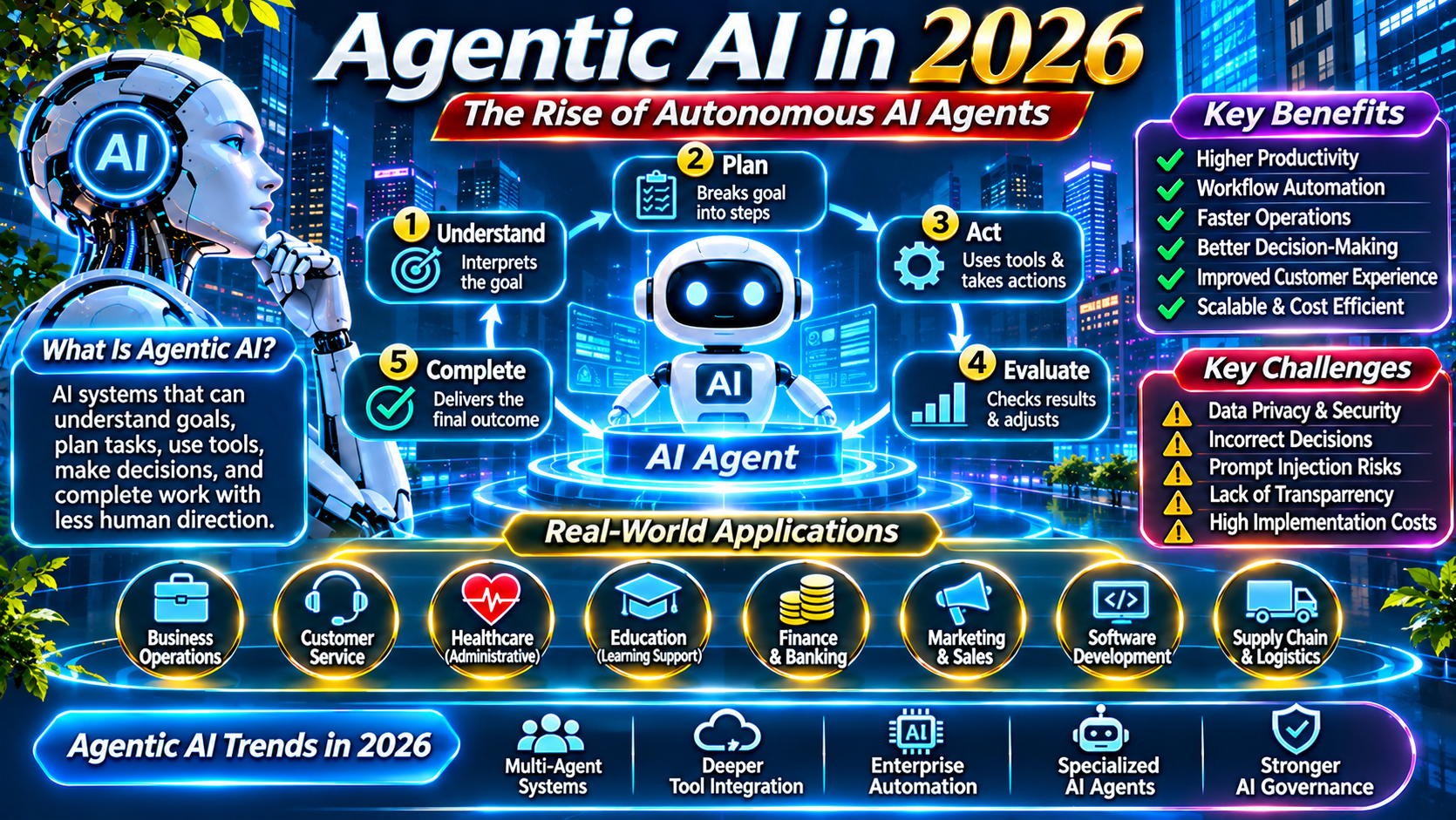
Agentic AI refers to AI systems that can perform multi-step tasks toward a defined objective, sometimes using tools and external systems.
In cybersecurity, agentic systems may help investigate alerts, gather relevant information, summarize incidents, and recommend defensive actions.
However, greater autonomy introduces additional risks. An AI agent with excessive permissions could make incorrect changes, access sensitive information, or take actions beyond its intended purpose.
Organizations need clear permission boundaries, audit logs, testing, and human approval for sensitive operations.
2. AI-Powered Security Analytics
Security analytics platforms are increasingly using AI to process information from different systems.
By combining network activity, identity information, endpoint alerts, and cloud logs, these systems can help identify relationships between events that might otherwise be difficult to recognize.
This improves security visibility and supports more informed investigations.
3. Generative AI for Security Teams
Generative AI can help cybersecurity professionals understand technical information and complete routine tasks.
Potential applications include:
Summarizing security alerts.
Explaining suspicious activity.
Drafting incident reports.
Organizing threat intelligence.
Supporting security documentation.
Assisting with defensive code reviews.
Generative AI outputs must be checked for accuracy. Security professionals should not treat an AI-generated explanation as proof that an incident has occurred or been resolved.
4. AI-Powered Vulnerability Management
AI can help organizations understand which vulnerabilities deserve attention first.
Rather than relying only on a vulnerability score, security teams can consider whether a system is exposed, how important the affected asset is, and whether relevant exploitation activity has been observed.
This can help organizations make better decisions when they cannot immediately fix every vulnerability.
5. Securing AI Systems Themselves
Businesses are increasingly using AI assistants, models, agents, and connected applications.
These systems create new security concerns, including prompt injection, sensitive data exposure, insecure integrations, and excessive permissions.
Organizations must protect AI applications just as carefully as other business systems.
6. Zero-Trust Security
Zero-trust security is based on the principle that access should not be automatically trusted because a user or device is already inside a network.
Every access request should be evaluated using appropriate identity, device, context, and permission controls.
AI can support zero-trust systems by identifying unusual behavior and helping adjust risk assessments.
How Cybercriminals Are Using Artificial Intelligence
AI is not exclusively a defensive technology. Cybercriminals can also use it to make certain malicious activities faster and more convincing.
Understanding these risks helps organizations develop stronger protection strategies.
AI-Generated Phishing
Generative AI can produce convincing messages that imitate business communication, customer support, or trusted organizations.
This may make fraudulent messages harder to recognize through spelling and grammar checks alone.
Deepfake Impersonation
AI-generated audio and video can be used to impersonate individuals.
Criminals may attempt to use these technologies to manipulate employees, request unauthorized payments, or obtain confidential information.
Businesses should verify sensitive requests through established communication channels rather than relying only on a voice or video message.
Automated Reconnaissance
Attackers may use AI to process publicly available information and organize research about potential targets.
This can help them identify exposed systems, understand organizations, and prioritize possible attack opportunities.
Faster Vulnerability Research
AI can assist with identifying software weaknesses and analyzing technical information.
Microsoft's October 2026 Digital Defense Report describes how AI is accelerating vulnerability discovery and reducing the time between discovering weaknesses and their potential exploitation.
AI-Assisted Social Engineering
Social engineering involves manipulating people into revealing confidential information or performing unsafe actions.
AI can help attackers create personalized messages, imitate communication styles, and produce convincing fraudulent content.
Organizations should strengthen employee awareness and require independent verification for sensitive requests.
Benefits of AI-Powered Cybersecurity
AI can provide several advantages when it is implemented responsibly and combined with established security controls.
Faster threat detection: AI can process large amounts of information and help identify suspicious activity more quickly.
Continuous monitoring: Automated systems can analyze activity across digital environments without depending entirely on manual reviews.
Improved threat prioritization: AI can help security teams identify which alerts and vulnerabilities may require urgent attention.
Reduced repetitive work: Automated analysis and reporting can help security professionals focus on complex investigations.
Better fraud detection: Machine learning can recognize unusual transaction patterns and support fraud prevention.
Improved scalability: AI can help organizations monitor growing networks, applications, and digital services.
Enhanced security insights: AI can connect information from different sources and support more informed security decisions.
These benefits depend on data quality, model performance, proper configuration, and ongoing human supervision.
Challenges and Risks of AI-Powered Cybersecurity
Although AI can strengthen digital protection, it also creates technical and organizational challenges.
1. False Positives
AI security systems may incorrectly identify legitimate activity as suspicious.
Too many false alerts can waste analysts' time and make it harder to identify genuine threats.
Organizations should regularly evaluate detection quality and adjust system configurations.
2. Data Privacy Concerns
AI security tools may process sensitive information, including user activity, business records, and network data.
Companies must establish appropriate data handling policies, access restrictions, and privacy protections.
3. Adversarial Attacks
Attackers may attempt to manipulate AI systems by providing misleading inputs or exploiting weaknesses in their design.
Security teams should test models against adversarial behavior and monitor systems continuously.
4. Model Accuracy and Reliability
AI systems can make incorrect predictions or generate inaccurate explanations.
Security teams should validate important findings through additional evidence and avoid relying on AI alone for critical decisions.
5. High Implementation Costs
Advanced AI cybersecurity platforms may require investment in software, infrastructure, training, and specialist personnel.
Smaller businesses may face difficulties adopting sophisticated systems without a clear understanding of their needs and budgets.
6. Skills and Workforce Gaps
AI-powered security requires people who understand cybersecurity, data analysis, AI systems, and risk management.
Organizations may need to provide additional training and recruit professionals with specialized skills.
7. Overdependence on Automation
Relying too heavily on automated security decisions can create new risks.
Organizations should maintain human oversight, particularly when systems can block accounts, isolate devices, change permissions, or affect business operations.
How Businesses Can Implement AI-Powered Cybersecurity
Organizations should approach AI cybersecurity as part of a broader security strategy rather than treating it as a standalone solution.
Step 1: Assess Existing Security Risks
Businesses should begin by reviewing their networks, applications, devices, cloud environments, and sensitive information.
A risk assessment can help identify areas where AI-supported monitoring or automation may provide the most value.
Step 2: Choose Appropriate Security Tools
Organizations should evaluate AI security platforms based on their requirements.
Important considerations include integration, detection quality, data protection, reporting capabilities, scalability, and vendor security practices.
Step 3: Strengthen Identity Protection
Companies should implement multi-factor authentication, role-based access, strong password policies, and least-privilege permissions.
These measures reduce the risk associated with compromised accounts.
Step 4: Protect Business Data
Sensitive information should be classified and protected through encryption, access controls, backup systems, and appropriate retention policies.
Organizations should also understand how their AI security providers collect, process, and store data.
Step 5: Train Employees
Employees should learn how to identify phishing, verify unusual requests, report suspicious activity, and use AI tools responsibly.
Training should include awareness of deepfake impersonation and AI-generated fraudulent messages.
Step 6: Monitor and Evaluate AI Systems
AI models and security platforms should be tested regularly.
Organizations should measure detection accuracy, false positives, response times, and system reliability.
Step 7: Maintain Human Oversight
Security teams should establish clear rules about which actions AI can perform independently and which require human approval.
High-impact decisions should remain subject to appropriate review and accountability.
Leading Companies and Technologies in AI Cybersecurity
Several technology companies provide security platforms that use AI and machine learning to support threat detection and response.
Microsoft Security
Microsoft offers security technologies across identity protection, endpoint security, cloud security, and threat intelligence.
Its security ecosystem includes Microsoft Defender, Microsoft Sentinel, and related security services.
These tools help organizations monitor threats and manage security operations across different environments.
Google Cloud Security
Google Cloud provides security services and threat intelligence capabilities through its cloud security ecosystem.
Google's Mandiant and Threat Intelligence teams research emerging threats and help organizations understand evolving attack techniques.
Its AI security research also addresses the risks created by increasingly autonomous AI systems.
CrowdStrike
CrowdStrike provides cloud-based cybersecurity solutions focused on endpoint protection, threat intelligence, and security operations.
Its Falcon platform uses AI and behavioral analysis to help identify suspicious activity and support incident response.
Palo Alto Networks
Palo Alto Networks offers cybersecurity technologies across network security, cloud protection, and security operations.
Its platforms use automation and AI-supported capabilities to help organizations manage security threats.
IBM Security
IBM provides cybersecurity solutions and consulting services for enterprise organizations.
Its security technologies include threat detection, identity management, data protection, and AI-supported security operations.
Businesses should evaluate security platforms according to their technical requirements rather than assuming that one provider is suitable for every environment.
The Future of AI-Powered Cybersecurity
The future of cybersecurity will increasingly involve cooperation between human professionals, artificial intelligence, and automated security systems.
AI agents may help investigate security alerts, correlate threat intelligence, and support defensive operations with less manual intervention.
At the same time, organizations will need stronger controls to protect autonomous systems and prevent unauthorized actions.
The growing use of generative AI will also make identity verification, secure software development, and data protection increasingly important.
Cloud environments, connected devices, and AI applications will continue to expand the digital attack surface. Security strategies will therefore need to evolve alongside new technologies.
Future cybersecurity systems may become more predictive, helping organizations identify weaknesses and suspicious patterns before they develop into major incidents.
However, technology alone cannot guarantee security. Strong governance, reliable processes, skilled professionals, regular testing, and responsible AI use will remain essential.
Frequently Asked Questions About AI-Powered Cybersecurity
What is AI-powered cybersecurity?
AI-powered cybersecurity uses artificial intelligence and machine learning to detect threats, analyze suspicious activity, identify vulnerabilities, and support security responses.
How does AI help prevent cyberattacks?
AI can analyze network traffic, user behavior, emails, and system activity to identify suspicious patterns. It can also help prioritize security alerts and support faster investigations.
Can AI detect phishing attacks?
Yes. AI-powered email security tools can analyze message content, sender information, suspicious links, and communication patterns to identify possible phishing attempts.
Can hackers use AI for cyberattacks?
Yes. Cybercriminals can use AI to generate convincing phishing messages, automate research, create deepfake impersonations, and accelerate certain stages of cyberattacks.
What are the benefits of AI in cybersecurity?
Major benefits include faster threat detection, continuous monitoring, improved alert prioritization, automated analysis, and better security visibility.
What are the risks of AI-powered cybersecurity?
Risks include false positives, inaccurate predictions, data privacy concerns, adversarial manipulation, implementation costs, and excessive reliance on automation.
Which industries use AI-powered cybersecurity?
Banking, healthcare, retail, telecommunications, manufacturing, government, education, and technology companies use or explore AI-supported cybersecurity solutions.
Does AI replace cybersecurity professionals?
No. AI can automate repetitive tasks and support investigations, but human professionals remain essential for strategic decisions, incident management, risk assessment, and oversight.
What is the future of AI in cybersecurity?
AI is expected to play a growing role in threat detection, security automation, vulnerability management, identity protection, and the security of AI applications and autonomous agents.
Conclusion
AI-powered cybersecurity is transforming how organizations protect their digital systems, sensitive information, and online operations.
Artificial intelligence can improve threat detection, analyze unusual behavior, identify phishing attempts, support fraud prevention, and help security professionals respond to incidents more efficiently.
However, AI also introduces new security challenges. Cybercriminals can use it to improve attacks, while poorly protected AI systems may expose organizations to additional vulnerabilities.
In 2026, businesses need a balanced approach that combines AI-powered security tools with traditional cybersecurity practices, strong identity controls, employee training, and human oversight.
Organizations that adopt AI responsibly and continuously evaluate their security systems will be better prepared to manage emerging digital threats and protect their long-term business operations.