America has produced some of the world's most successful self-made entrepreneurs, investors, entertainers, technology founders, and business leaders. Their journeys are remarkably different: some started companies from modest beginnings, some arrived in the United States as immigrants, and others built fortunes by turning professional skills into businesses.
In 2026, Forbes expanded its Self-Made 250 project to recognize 250 living Americans who built significant success through entrepreneurship, professional achievement, business ownership, or other forms of upward mobility. Forbes uses a self-made score from 1 to 10 and included people scoring 9 or 10 in this particular ranking, emphasizing the distance individuals traveled from their starting circumstances.
While not every person on that list is a billionaire, many are. Their stories provide a fascinating look at how wealth can be created in technology, finance, entertainment, manufacturing, retail, energy, and other industries.
What Does “Self-Made” Mean?
The term self-made does not necessarily mean that someone started with absolutely nothing.
Forbes' methodology recognizes different starting points and attempts to measure how far an individual traveled economically and socially before reaching major success. Its 2026 Self-Made 250 ranking focuses heavily on people who overcame significant obstacles and achieved substantial impact.
This distinction matters because successful people can have very different backgrounds.
Some grew up in poverty. Others came from middle-class families. Some received educational opportunities or other forms of support before building successful businesses.
Therefore, “self-made” is best understood as building substantial personal success rather than simply inheriting a fortune.
Elon Musk: Technology, Cars and Space
Elon Musk is one of the most prominent examples of modern American entrepreneurial wealth.
His fortune has been built primarily through ownership and leadership connected to companies including Tesla and SpaceX, along with other technology ventures.
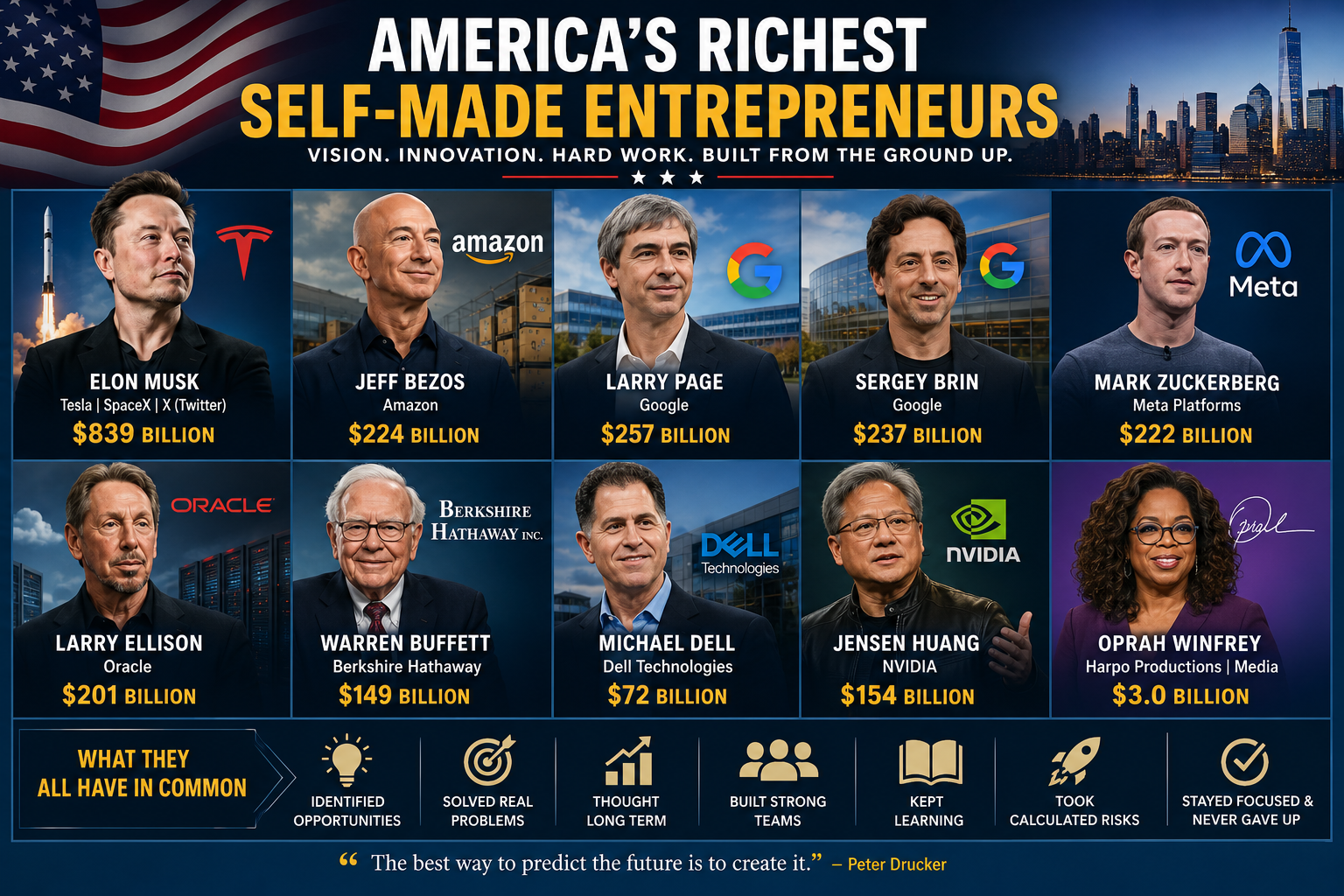
Forbes' 2026 billionaire list placed Musk at the top globally, with an estimated net worth of $839 billion based on March 1, 2026 valuations.
His businesses operate in industries that require significant technological investment, including electric vehicles, space technology, artificial intelligence, and advanced engineering.
Musk's story demonstrates how entrepreneurs can build enormous businesses by targeting industries with potentially transformative technologies.
Jeff Bezos: From Online Bookstore to Global Business
Jeff Bezos founded Amazon in 1994, initially operating the company as an online bookstore.
Amazon eventually expanded far beyond books into e-commerce, cloud computing, logistics, entertainment, advertising, and other businesses.
Forbes' 2026 annual ranking estimated Bezos' wealth at $224 billion as of March 1, 2026.
One of the most important lessons from Bezos' career is the value of long-term thinking.
Instead of treating Amazon simply as a retailer, the company continually expanded its infrastructure and technology.
Larry Page and Sergey Brin: Building Google
Larry Page and Sergey Brin co-founded Google, which became one of the world's most influential technology companies.
Google's original search technology eventually developed into a much broader ecosystem involving online advertising, cloud computing, mobile software, artificial intelligence, hardware, and other services.
Forbes' 2026 list estimated Page's wealth at $257 billion and Brin's at $237 billion based on March 1 valuations.
Their journey demonstrates how solving a fundamental information problem can create a company with enormous global reach.
Mark Zuckerberg: Building a Global Social Platform
Mark Zuckerberg founded Facebook while he was a teenager at Harvard.
The platform expanded rapidly and eventually became part of Meta, whose portfolio includes Facebook, Instagram, WhatsApp, and other technology products.
Forbes estimated Zuckerberg's wealth at $222 billion in its March 2026 annual ranking.
His story illustrates the power of digital platforms that can scale to hundreds of millions or billions of users.
Larry Ellison: The Software Entrepreneur
Larry Ellison co-founded Oracle and helped turn it into one of the world's major enterprise technology companies.
Oracle became particularly important in database technology and later expanded into enterprise software and cloud computing.
Forbes included Ellison among its highest-ranking self-made Americans. Its 2026 Self-Made 250 described him as a technology titan who experienced significant challenges early in life before building Oracle.
His career demonstrates that enormous companies can be built by solving complex problems for businesses rather than targeting consumers directly.
Warren Buffett: The Power of Investing
Warren Buffett represents a different type of self-made wealth.
Rather than becoming famous primarily for creating a technology startup, Buffett built his fortune through investing and capital allocation through Berkshire Hathaway.
Forbes estimated his wealth at $149 billion in its March 2026 billionaire ranking.
Buffett's career is frequently associated with patience, disciplined investing, understanding businesses, and long-term ownership.
His story demonstrates that wealth creation can happen through investment as well as entrepreneurship.
Michael Dell: Building a Technology Company
Michael Dell founded Dell Technologies and became one of America's wealthiest technology entrepreneurs.
Dell's early business model focused on selling computers directly to customers, allowing the company to develop a different approach to distribution and customization.
By August 2026, Forbes' real-time billionaire ranking placed Dell among the world's five richest people, illustrating how dramatically technology-company valuations can influence personal wealth.
His career highlights the importance of understanding customers and finding more efficient ways to deliver products.
Jensen Huang: The Rise of Semiconductor Wealth
Jensen Huang co-founded Nvidia in 1993 and has remained closely associated with the company's growth.
Nvidia became a major force in graphics processing and later became central to the infrastructure supporting artificial intelligence.
Forbes estimated Huang's wealth at $154 billion in its March 2026 annual ranking.
His career is an example of how technological infrastructure can become extraordinarily valuable when an emerging industry expands rapidly.
Thomas Peterffy: From Immigrant to Financial Technology Pioneer
Thomas Peterffy provides another remarkable American self-made story.
According to Forbes, Peterffy arrived in the United States from Hungary in 1965 with very little money. He began working as a programmer and eventually became a pioneer in automated digital trading through Interactive Brokers.
His story demonstrates how technical expertise can become the foundation for a major financial business.
David Steward: Building an IT Services Giant
David Steward grew up in Missouri in a family where his father worked several jobs to support eight children.
Steward later co-founded World Wide Technology, which became one of the world's largest IT services companies.
Forbes' 2026 Self-Made 250 ranked Steward third overall among its greatest living self-made Americans.
His story demonstrates the importance of persistence, business relationships, and building a company around a growing industry.
Harold Hamm: Building an Energy Empire
Harold Hamm grew up as the 13th child of Oklahoma sharecroppers.
He started a trucking company that transported water to and from oilfields before taking out a loan to drill his first oil well.
Forbes ranked Hamm second on its 2026 list of the greatest living self-made Americans.
His journey demonstrates how an entrepreneur can identify opportunities within an established industry and build a much larger business over time.
Oprah Winfrey: Building a Media Empire
Oprah Winfrey's story extends beyond traditional entrepreneurship.
She grew up in difficult circumstances in Mississippi and eventually became one of America's most influential media personalities.
She took over a struggling Chicago morning television program in 1984 and transformed it into a nationally recognized media brand. Forbes ranked her No. 1 on its 2026 list of the greatest living self-made Americans.
Her career demonstrates the value of communication skills, personal branding, audience trust, and intellectual property.
Diane Hendricks: Building a Construction Business
Diane Hendricks is another prominent American self-made entrepreneur.
She and her late husband, Ken, co-founded ABC Supply, which became one of America's major construction-supply businesses.
Forbes ranked Hendricks ninth on its 2026 Self-Made 250 list.
Her story highlights an important point: enormous businesses do not have to come from Silicon Valley.
Construction, manufacturing, distribution, and other traditional industries can also create significant wealth.
What These Self-Made Americans Have in Common
Although their careers are dramatically different, several themes appear repeatedly.
1. They Identified Opportunities
Successful entrepreneurs often recognize opportunities before they become obvious to everyone else.
2. They Built or Owned Valuable Businesses
Ownership is particularly important when studying billionaire wealth. A person's net worth can increase substantially when the value of a company they own rises.
3. They Adapted
Markets change constantly. Entrepreneurs who remain flexible can respond to new technology, customer behavior, and competition.
4. They Took Risks
Building a company almost always involves uncertainty.
However, successful entrepreneurs generally have to make decisions without knowing exactly what the future will bring.
5. They Continued Learning
Technology, finance, consumer behavior, and business models evolve. Continuous learning can help entrepreneurs remain competitive.
Why Technology Has Created So Much Wealth
Technology is particularly powerful because successful digital products can reach enormous markets.
Software, online platforms, artificial intelligence, cloud computing, semiconductors, and e-commerce can scale far beyond the physical limitations of many traditional businesses.
The 2026 Forbes billionaire ranking illustrates this trend: many of America's wealthiest individuals are connected to technology companies.
However, technology is not the only route to wealth.
Energy, finance, construction, retail, entertainment, manufacturing, and professional services have also produced major fortunes.
What Entrepreneurs Can Learn
The biggest lesson from America's self-made billionaires is not that everyone can become a billionaire.
There is no guaranteed formula.
Business outcomes depend on opportunity, timing, resources, competition, market conditions, execution, and sometimes luck.
Instead, entrepreneurs can study the principles behind these stories:
Solve meaningful problems
Build something valuable
Understand customers
Take calculated risks
Learn from mistakes
Think long term
Build strong teams
Protect ownership when appropriate
Adapt to technological change
Stay focused on execution
Frequently Asked Questions
Who are America's richest self-made entrepreneurs?
America's richest self-made entrepreneurs include prominent figures such as Elon Musk, Jeff Bezos, Larry Page, Sergey Brin, Mark Zuckerberg, Larry Ellison, Michael Dell, Warren Buffett, and Jensen Huang. Exact rankings and fortunes change as asset values change.
Who is the richest self-made American?
Elon Musk has been the world's wealthiest person in current Forbes rankings, although billionaire rankings can change quickly because they are influenced by company valuations and market prices.
What does self-made billionaire mean?
It generally refers to someone who built substantial wealth through entrepreneurship, business ownership, investment, or professional achievement rather than primarily inheriting the fortune.
Are all self-made billionaires entrepreneurs?
No. Some built companies, while others accumulated wealth through investing, executive leadership, entertainment, finance, or other careers.
Which industries produce the most self-made billionaires?
Technology is especially prominent, but finance, investments, retail, energy, manufacturing, real estate, entertainment, and professional services have also produced major fortunes.
Can a person become wealthy without starting a technology company?
Absolutely. People such as Warren Buffett, Harold Hamm, Diane Hendricks, and others demonstrate that significant wealth can be created in finance, energy, construction, and other traditional industries.
Why do billionaire net worth figures change so frequently?
Much of a billionaire's wealth may be connected to company shares or private-business valuations. When those values change, estimated net worth can change as well.
Is becoming a billionaire realistic for every entrepreneur?
No. Billionaire status is extremely rare, and there is no guaranteed formula. Entrepreneurs should focus on creating sustainable value rather than assuming that a particular strategy will produce billionaire-level wealth.
What is the biggest lesson from America's self-made billionaires?
One major lesson is that valuable businesses can be built by solving important problems, understanding customers, adapting to change, and maintaining a long-term focus.
Who are some self-made Americans who started with very little?
Forbes' 2026 Self-Made 250 highlights people including Oprah Winfrey, Harold Hamm, David Steward, Thomas Peterffy, Jan Koum, Diane Hendricks, Larry Ellison, and others who overcame significant obstacles before achieving major success.
Conclusion
America's self-made billionaires and entrepreneurs come from remarkably different backgrounds.
Some built technology companies. Others developed energy businesses, financial platforms, construction companies, media brands, or investment empires.
Their stories demonstrate that there is no single path to extraordinary success.
The most valuable lesson is not simply to study how much money these individuals have.