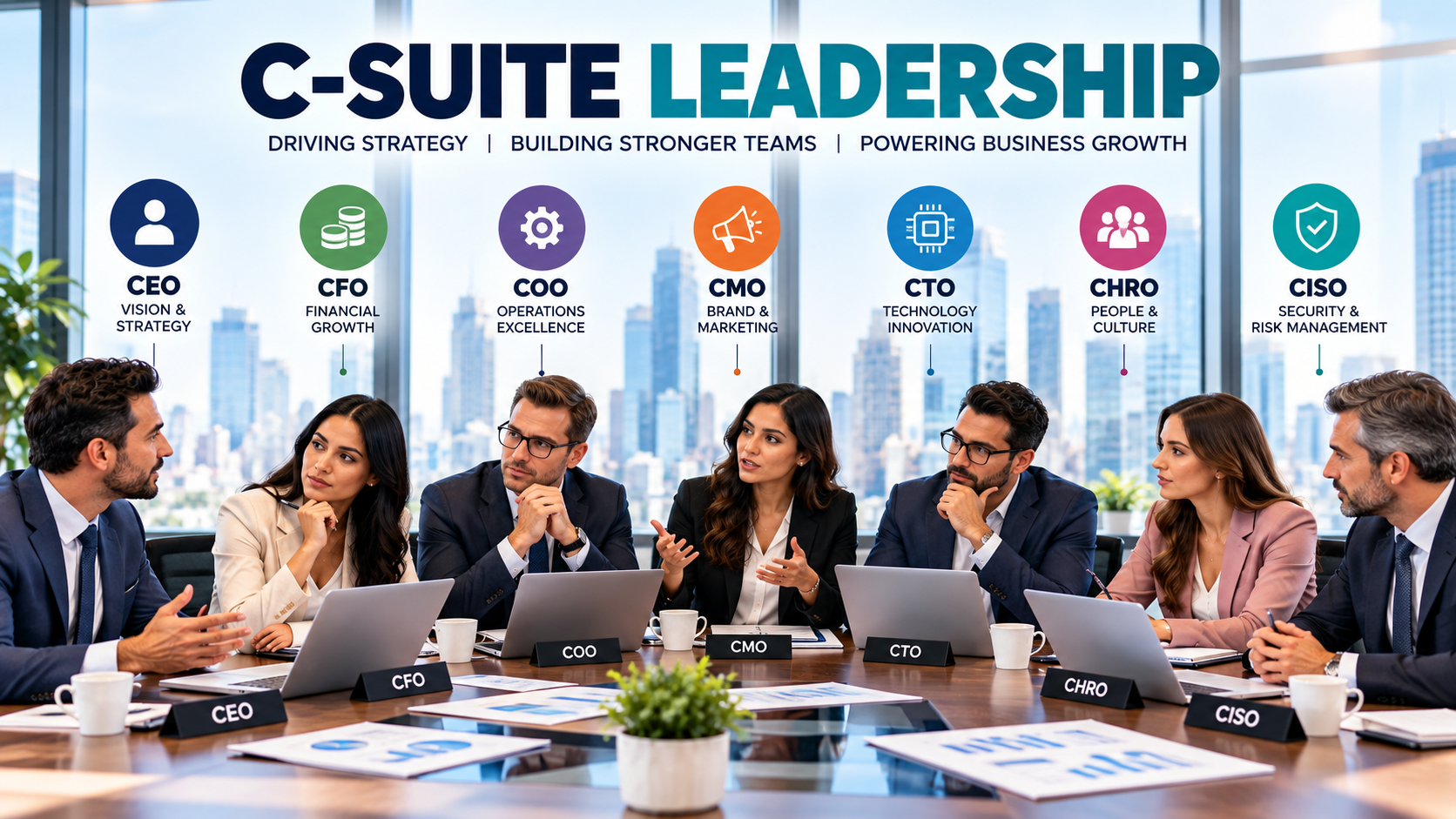
C-suite leadership plays a critical role in shaping the direction, performance, and long-term success of modern organizations. The term refers to senior executives whose job titles typically begin with the word “Chief,” such as Chief Executive Officer (CEO), Chief Financial Officer (CFO), Chief Operating Officer (COO), and Chief Marketing Officer (CMO). These executives occupy some of the most influential positions within a business, making decisions that affect company strategy, financial performance, operations, technology, employees, and customer relationships.
In today's competitive business environment, organizations must respond to rapidly changing markets, technological developments, evolving customer expectations, and economic uncertainty. C-suite executives are responsible for helping businesses navigate these challenges while identifying opportunities for growth and maintaining operational stability.
Effective C-suite leadership requires more than professional experience or technical knowledge. Senior executives must demonstrate strategic thinking, sound judgment, communication skills, financial awareness, and the ability to lead teams through change. They must also coordinate with other executives to ensure that different departments work toward shared organizational objectives.
As businesses expand and become more complex, the importance of executive leadership continues to grow. A well-aligned C-suite team can improve decision-making, encourage innovation, strengthen accountability, and establish a clear vision for the future.
This article explores the meaning of C-suite leadership, the responsibilities of key executive positions, the skills required for effective leadership, common challenges faced by senior executives, and practical strategies for building a successful executive team.
What Is C-Suite Leadership?
C-suite leadership refers to the strategic direction, management, and oversight provided by an organization's highest-ranking executives. The name comes from the word “Chief,” which appears in the titles of many senior corporate leaders.
Unlike managers who concentrate primarily on individual departments or operational activities, C-suite executives are generally responsible for broader organizational outcomes. Their decisions may influence business strategy, resource allocation, risk management, workforce planning, technology investments, and relationships with shareholders or other stakeholders.
For example, a company planning to enter a new international market may require the CEO to establish the overall strategy, the CFO to assess financial feasibility, the COO to evaluate operational readiness, and the CMO to develop a market-entry plan.
Each executive contributes specialized expertise, but the decision must support the company's overall objectives.
C-suite leadership is therefore both a strategic and collaborative responsibility. Executives must understand their individual roles while recognizing how their decisions affect other departments.
The most effective executive teams balance independent expertise with shared accountability. Rather than operating as separate departments, they work together to create a consistent direction for the organization.
Why C-Suite Leadership Matters
Strong C-suite leadership can influence nearly every aspect of business performance. Its importance becomes particularly clear when organizations face significant growth opportunities, financial pressure, technological change, or competitive challenges.
1. Establishing Business Strategy
A company's strategy defines its long-term priorities, competitive positioning, and approach to achieving sustainable growth.
C-suite executives evaluate the organization's strengths, weaknesses, resources, and market opportunities before establishing strategic priorities. They must determine which initiatives deserve investment and which activities should receive less attention.
For instance, an e-commerce company may need to decide whether to expand into a new product category, improve its existing website, enter another country, or invest in customer retention.
Executive leaders must compare the potential benefits, costs, and risks of these alternatives.
A clear strategy helps employees understand the organization's priorities and ensures that resources are directed toward initiatives with meaningful business value.
2. Improving Financial Performance
Financial performance is a central responsibility of executive leadership. Although the CFO typically leads financial management, the entire C-suite must understand how strategic decisions affect revenue, expenses, profitability, and cash flow.
Executives need to evaluate whether business initiatives generate sufficient value to justify their costs.
For example, increasing advertising expenditure may generate more website visits, but higher traffic does not automatically produce higher profits. Leadership must also consider conversion rates, customer acquisition costs, repeat purchases, and profit margins.
By reviewing financial indicators alongside operational performance, C-suite teams can make better investment decisions and reduce unnecessary spending.
3. Encouraging Innovation
Innovation helps businesses respond to changing customer needs and develop new sources of competitive advantage.
C-suite leaders influence innovation by deciding how much to invest in research, technology, product development, and employee capabilities.
They must create an environment where teams can test promising ideas while maintaining appropriate financial and operational controls.
Innovation also requires a willingness to reconsider established practices. Executives who continuously evaluate customer feedback, market developments, and emerging technologies are better positioned to identify opportunities for improvement.
4. Strengthening Organizational Culture
Senior executives establish expectations for ethical behavior, communication, accountability, and employee development.
Their actions influence how managers and employees behave throughout the organization.
If executives encourage transparency and accept responsibility for mistakes, they can help create a culture in which employees feel more comfortable reporting problems and suggesting improvements.
However, if senior leaders reward results regardless of how they are achieved, employees may receive conflicting signals about the organization's values.
Strong C-suite leadership aligns business objectives with responsible conduct and consistent organizational standards.
5. Managing Risk and Uncertainty
Businesses face numerous risks, including financial instability, cybersecurity threats, regulatory changes, supply-chain disruptions, and reputational damage.
C-suite executives must identify significant risks, establish appropriate controls, and prepare for situations that could threaten business continuity.
Risk management requires cooperation across departments. For example, a cybersecurity incident may involve technology teams, legal advisers, communications professionals, finance leaders, and the CEO.
An effective executive team establishes clear responsibilities and ensures that major risks receive appropriate attention before they become serious problems.
Key C-Suite Roles and Their Responsibilities
C-suite structures vary according to company size, industry, ownership, and business model. However, several executive positions are common across many organizations.
Chief Executive Officer (CEO)
The CEO is generally the highest-ranking executive and is responsible for the overall direction and performance of the business.
The CEO works with the board of directors, establishes strategic priorities, evaluates major investments, and coordinates the work of senior executives.
Important responsibilities include:
Defining the company's vision and strategic direction.
Making major business decisions.
Building and guiding the executive leadership team.
Monitoring overall organizational performance.
Representing the company to key stakeholders.
Establishing expectations for culture and accountability.
An effective CEO must understand how different departments contribute to business success. The role requires strategic judgment, communication, leadership, and the ability to make difficult decisions under uncertainty.
Chief Financial Officer (CFO)
The CFO oversees financial planning, financial reporting, budgeting, and financial risk management.
This executive helps the company understand its financial position and evaluate the consequences of major business decisions.
Typical responsibilities include managing budgets, monitoring cash flow, reviewing financial performance, supporting investment decisions, and coordinating financial reporting.
A strong CFO does more than record financial results. They provide insights that help other executives understand business performance and allocate resources effectively.
For example, the CFO may help determine whether the company can afford a new facility, whether a marketing campaign offers an acceptable return, or how much financial flexibility is available during an economic slowdown.
Chief Operating Officer (COO)
The COO generally oversees important operational activities and helps translate business strategy into execution.
Responsibilities may include process improvement, production, logistics, service delivery, supply-chain management, and coordination across departments.
The COO works to ensure that the organization can deliver products or services efficiently and consistently.
For a growing e-commerce business, this may involve improving order fulfillment, managing inventory, reducing delivery delays, and establishing processes that can support higher sales volumes.
The COO's effectiveness often depends on the ability to identify operational bottlenecks and develop systems that improve performance without creating unnecessary complexity.
Chief Marketing Officer (CMO)
The CMO leads marketing strategy, brand positioning, customer acquisition, and market communication.
This executive helps the organization understand its target audiences, communicate its value proposition, and develop strategies for attracting and retaining customers.
Responsibilities may include brand management, digital marketing, advertising, customer research, public relations, and campaign performance measurement.
A successful CMO connects marketing activities with broader business objectives. Rather than focusing exclusively on impressions or social media followers, the executive evaluates whether marketing contributes to qualified leads, customer relationships, revenue, and brand reputation.
Chief Technology Officer (CTO)
The CTO typically oversees technology strategy, technical innovation, and the development or implementation of technology products and systems.
The role is particularly important for software companies, technology startups, digital platforms, and organizations that depend heavily on technical capabilities.
Responsibilities may include technology architecture, product engineering, technical research, system scalability, and evaluation of emerging technologies.
A CTO must understand both technical possibilities and business priorities. Technology investments should solve meaningful problems, support customers, or improve the organization's ability to compete.
Chief Information Officer (CIO)
The CIO generally focuses on internal information systems, business technology, digital infrastructure, and the effective use of information across the organization.
Although responsibilities sometimes overlap with those of the CTO, the distinction often lies in emphasis. A CTO may concentrate on technology products and technical innovation, while a CIO may focus more on internal systems and technology-enabled business operations.
The exact division varies by company.
A CIO may oversee enterprise software, data management, IT service delivery, technology procurement, and internal digital transformation.
Chief Human Resources Officer (CHRO)
The CHRO leads the organization's people strategy, including recruitment, employee development, compensation, performance management, and workplace policies.
This executive helps ensure that the business has the skills and organizational structure needed to achieve its objectives.
Responsibilities may include workforce planning, leadership development, employee engagement, succession planning, and talent retention.
The CHRO also helps senior executives understand how organizational changes affect employees and what support may be necessary during periods of transformation.
Chief Information Security Officer (CISO)
The CISO leads information security and helps protect the organization's systems, data, and digital assets.
Responsibilities often include cybersecurity strategy, threat assessment, incident response planning, security awareness, and coordination with technology and compliance teams.
As businesses collect and process increasing amounts of digital information, security has become an important executive concern.
An effective CISO helps senior leadership understand cyber risks in business terms and recommends appropriate investments in protection, monitoring, and recovery capabilities.
Chief Strategy Officer (CSO)
In organizations that use this title for strategy, the CSO helps develop and evaluate long-term business plans, growth opportunities, competitive positioning, and strategic initiatives.
Responsibilities may include market analysis, business transformation, strategic partnerships, acquisitions, and performance monitoring.
The CSO often works closely with the CEO and other executives to connect long-term ambitions with practical implementation plans.
The title can have different meanings across organizations, so responsibilities should always be understood within the company's specific structure.
Essential Skills of Successful C-Suite Executives
Senior executives need a broad range of capabilities because their decisions affect multiple departments and stakeholders.
Strategic Thinking
Strategic thinking helps executives look beyond immediate operational concerns and evaluate the long-term implications of their choices.
A strategic executive examines market conditions, competitive threats, customer needs, financial resources, and organizational capabilities.
They also recognize that not every attractive opportunity deserves investment. Prioritization is essential because companies have limited time, money, and talent.
Financial Literacy
Every C-suite executive should understand the financial implications of their decisions, even when finance is not their primary responsibility.
Financial literacy includes understanding revenue, expenses, profit margins, cash flow, budgets, and return on investment.
A marketing executive, for example, should understand how campaign costs relate to customer acquisition and revenue. An operations executive should understand how process improvements affect costs and service quality.
Shared financial awareness improves cooperation and supports more disciplined decision-making.
Communication and Collaboration
C-suite executives must communicate complex information clearly to employees, board members, investors, customers, and other stakeholders.
They must also collaborate across departments that may have different priorities.
For example, marketing may seek rapid growth, finance may emphasize profitability, and operations may focus on delivery capacity. Effective executives discuss these competing concerns and develop plans that balance business needs.
Emotional Intelligence
Emotional intelligence helps executives manage relationships, respond constructively to disagreement, and understand how decisions affect people.
Senior leaders frequently face stressful situations, including organizational restructuring, financial pressure, and disagreements over strategic direction.
Remaining calm, listening carefully, and responding thoughtfully can help prevent unnecessary conflict and support better outcomes.
Decision-Making Under Uncertainty
Executive decisions often involve incomplete information. Leaders may need to make choices before market conditions, customer reactions, or financial outcomes are fully known.
Strong decision-makers identify the most important uncertainties, assess potential consequences, establish acceptable risk limits, and determine how results will be evaluated.
They also remain willing to revise their approach when new evidence becomes available.
Change Management
Business transformation can create uncertainty for employees and disrupt established workflows.
C-suite executives must explain why change is necessary, communicate expected outcomes, allocate resources, and monitor implementation.
They should also consider employee training, stakeholder concerns, and operational risks.
Successful change management combines a clear strategic purpose with practical support for the people responsible for carrying out the change.
How C-Suite Executives Work Together
Executive effectiveness depends not only on individual talent but also on the quality of collaboration among senior leaders.
Each executive brings a different perspective. Finance focuses on financial sustainability, marketing emphasizes customers and market positioning, operations concentrates on execution, and technology leaders assess technical opportunities and risks.
These perspectives can complement one another, but they can also create disagreements.
A well-functioning C-suite establishes shared objectives and clear decision-making processes.
Establish Shared Business Goals
Executives should agree on the organization's most important priorities and understand how their departmental objectives contribute to them.
If the company wants to improve customer retention, marketing may develop customer engagement programs, technology may improve the digital experience, operations may improve service reliability, and finance may evaluate the economics of retention initiatives.
Shared goals help departments avoid working toward conflicting outcomes.
Create Clear Decision Rights
Not every decision needs approval from the entire executive team.
Organizations should establish which decisions belong to individual executives, which require consultation, and which need collective approval.
Clear decision rights reduce unnecessary delays and prevent confusion over accountability.
Review Performance Regularly
Executive teams should review business performance using reliable data and agreed indicators.
These reviews can cover revenue, profitability, customer satisfaction, operational efficiency, employee retention, and strategic project progress.
The purpose is not simply to report numbers. Executives should identify significant changes, understand their causes, and agree on appropriate actions.
Encourage Constructive Disagreement
Different viewpoints can improve decision quality when disagreements are handled professionally.
Executives should challenge assumptions, examine evidence, and discuss risks without turning differences into personal conflicts.
Once a decision is made, the team should communicate it consistently and work together to implement it, unless new information requires reconsideration.
Common Challenges Faced by C-Suite Leaders
Despite their authority, senior executives face considerable pressure and uncertainty.
Balancing Short-Term Results With Long-Term Growth
Businesses must meet immediate financial obligations while investing in future capabilities.
Excessive focus on short-term results may lead organizations to reduce essential training, delay technology improvements, or neglect customer relationships.
Conversely, pursuing ambitious long-term initiatives without appropriate financial discipline can threaten stability.
Effective executives evaluate how present decisions affect both immediate performance and future competitiveness.
Managing Organizational Change
Mergers, restructuring, digital transformation, and international expansion can create uncertainty throughout a company.
Employees may worry about their roles, responsibilities, or future opportunities.
Senior leaders should communicate the purpose of change, explain what is known, acknowledge genuine uncertainty, and provide appropriate support.
Clear communication cannot eliminate every concern, but it can reduce confusion and help employees understand what to expect.
Avoiding Executive Silos
An executive silo develops when senior leaders focus exclusively on their own departments rather than considering the needs of the entire organization.
This can lead to duplicated work, conflicting priorities, slow decisions, and inefficient resource allocation.
Shared goals, cross-functional projects, and transparent performance reviews can help reduce these problems.
Responding to Technological Disruption
New technologies can change business models, customer expectations, and competitive dynamics.
Executives must decide which technologies are relevant, how they should be implemented, and whether the organization has the skills to use them effectively.
Responsible adoption requires evaluation of costs, benefits, privacy, cybersecurity, employee training, and operational reliability.
Preventing Leadership Burnout
C-suite positions often involve long working hours, high accountability, and complex decisions.
Sustained pressure can impair judgment, reduce effectiveness, and affect relationships.
Executive teams can address this risk by delegating appropriately, maintaining clear priorities, building capable management teams, and creating realistic expectations around availability and workload.
C-Suite Leadership in Small Businesses and Startups
C-suite leadership is not limited to large corporations. Startups and growing businesses also need clear ownership of strategy, finance, operations, marketing, and technology.
However, smaller organizations often operate with limited budgets and fewer employees. One individual may perform several executive functions until the business grows.
For example, a startup founder may initially lead strategy, marketing, and customer relationships while an accountant supports financial management.
As the business expands, the founder may delegate operational responsibilities or appoint executives with specialized expertise.
The key is to establish the necessary capabilities rather than adopting senior job titles for appearance alone.
Small businesses can benefit from clear responsibilities, regular financial reviews, documented processes, and measurable objectives even when they do not have a formal C-suite.
As the organization becomes more complex, a well-defined executive structure can improve coordination and support sustainable growth.
The Role of Artificial Intelligence in C-Suite Leadership
Artificial intelligence is creating new opportunities for executive teams to analyze information, automate routine activities, and improve business processes.
AI tools can assist with forecasting, customer analysis, document processing, operational planning, and internal knowledge management.
However, adopting AI requires more than purchasing software. Executives must identify useful business applications, evaluate implementation costs, establish appropriate data safeguards, and train employees.
The CEO may oversee the strategic importance of AI, the CFO may evaluate financial returns, the CTO or CIO may guide technical implementation, and the CISO may assess security risks.
Human oversight remains essential when AI outputs influence important financial, employment, legal, or customer decisions.
Executives should also consider the reliability of generated information, data privacy, bias, and accountability.
Businesses that approach AI strategically can explore efficiency improvements while maintaining responsible governance.
How to Build an Effective C-Suite Leadership Team
Building an effective executive team requires deliberate planning, clear expectations, and continuous evaluation.
Define Executive Responsibilities
Each executive should understand the scope of their role, the decisions they own, and the outcomes for which they are accountable.
Responsibilities should be documented clearly enough to reduce overlap while allowing collaboration where necessary.
Recruit Complementary Skills
A successful executive team does not require every leader to have the same background or working style.
Organizations benefit from a combination of financial expertise, operational experience, market understanding, technical knowledge, and people leadership.
The goal is to create a team whose collective capabilities meet the organization's needs.
Establish a Culture of Accountability
Executives should agree on measurable objectives and review progress consistently.
When targets are missed, the team should investigate the causes, identify corrective actions, and clarify responsibilities.
Accountability should apply to senior leaders as well as other employees.
Invest in Leadership Development
Even experienced executives need opportunities to learn and improve.
Leadership development may involve mentoring, executive education, peer discussions, coaching, and exposure to different areas of the business.
Succession planning is equally important. Organizations should identify and develop future leaders before critical vacancies arise.
Align Incentives With Long-Term Goals
Executive compensation and performance evaluations can influence decision-making.
If incentives reward only short-term revenue, leaders may overlook profitability, customer satisfaction, risk management, or employee development.
A balanced approach considers several outcomes and aligns rewards with the organization's long-term priorities.
Measuring C-Suite Leadership Effectiveness
Evaluating executive performance requires a combination of financial, operational, strategic, and organizational indicators.
Depending on the business, useful measures may include:
Revenue growth and profitability.
Cash flow and financial stability.
Customer satisfaction and retention.
Operational efficiency and service quality.
Progress on strategic initiatives.
Employee engagement and retention.
Risk management and regulatory compliance.
Innovation outcomes and technology adoption.
Leadership succession and talent development.
These indicators should be interpreted in context. Revenue growth alone, for example, may not indicate success if it comes with unsustainable costs or deteriorating customer satisfaction.
Organizations should also consider external conditions and the time required for strategic initiatives to produce results.
A balanced performance framework helps boards and executive teams assess whether leadership decisions are creating sustainable value.
Conclusion
C-suite leadership is central to the strategic direction, financial health, and long-term development of modern organizations. Senior executives influence how businesses allocate resources, respond to market changes, manage risk, develop employees, and pursue growth opportunities.
Effective C-suite teams combine specialized expertise with collaboration, strategic thinking, financial awareness, and ethical decision-making. The CEO establishes overall direction, while executives such as the CFO, COO, CMO, CTO, CIO, CHRO, and CISO contribute to critical business functions according to their responsibilities.
However, executive titles alone do not guarantee success. Organizations need clear decision rights, shared objectives, transparent communication, measurable accountability, and a commitment to continuous improvement.
As technology and competitive pressures continue to reshape business, C-suite leaders must remain adaptable while protecting the organization's long-term interests.
Ultimately, strong C-suite leadership is about aligning people, resources, and strategy to achieve meaningful business outcomes. Companies that develop capable executive teams and establish effective leadership practices can improve resilience, strengthen performance, and create lasting value for stakeholders.
Frequently Asked Questions About C-Suite Leadership
What does C-suite leadership mean?
C-suite leadership refers to the strategic leadership provided by senior executives whose titles typically begin with “Chief,” including the CEO, CFO, COO, and CMO.
What are the main C-suite positions?
Common positions include Chief Executive Officer, Chief Financial Officer, Chief Operating Officer, Chief Marketing Officer, Chief Technology Officer, Chief Information Officer, Chief Human Resources Officer, and Chief Information Security Officer. The exact structure varies by organization.
What skills are important for C-suite executives?
Important skills include strategic thinking, financial literacy, communication, collaboration, decision-making, emotional intelligence, change management, and risk assessment.
What is the difference between a CEO and other C-suite executives?
The CEO generally has overall responsibility for the company's direction and performance. Other C-suite executives lead specialized business functions and contribute to the company's broader strategy.
Do small businesses need a C-suite?
Not necessarily. Small businesses can assign executive responsibilities to founders or managers without creating formal C-suite positions. As the business grows, specialized executive roles may become more useful.
How can companies improve C-suite collaboration?
Companies can improve collaboration by establishing shared goals, defining decision rights, reviewing performance regularly, encouraging constructive disagreement, and ensuring executives remain accountable for organizational outcomes.
How does AI affect C-suite leadership?
AI can help executives analyze information, improve processes, and explore new business opportunities. Leaders must also evaluate costs, data privacy, cybersecurity, reliability, employee training, and appropriate human oversight.