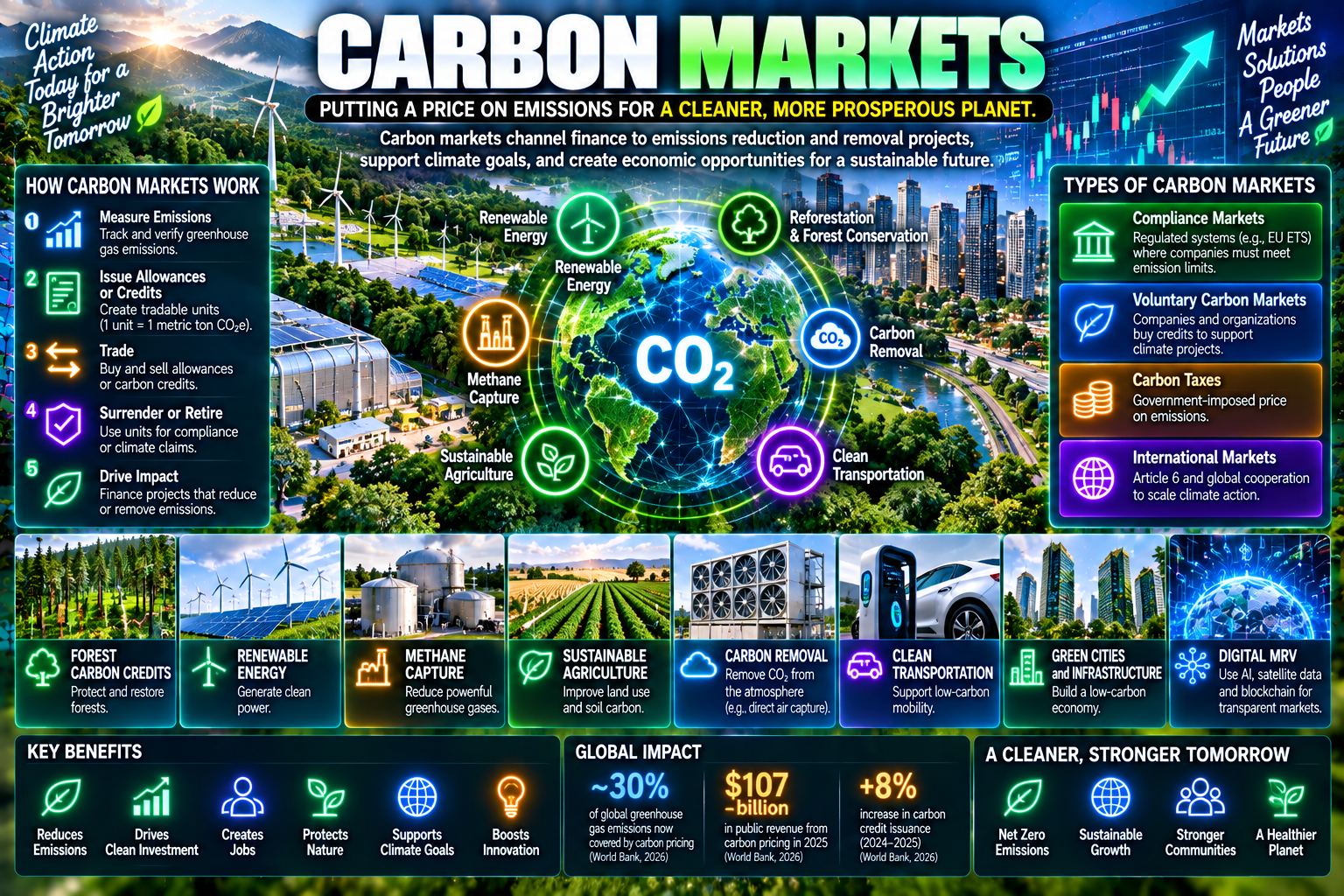
Carbon markets have become an increasingly important part of the global effort to reduce greenhouse-gas emissions while directing capital toward lower-carbon technologies, conservation, and emissions-reduction projects.
At their simplest, carbon markets put a financial value on greenhouse-gas emissions. Depending on the system, companies may have to surrender allowances for their emissions, purchase carbon credits to meet defined requirements, or voluntarily buy credits to support climate-related projects and claims.
The market is becoming more sophisticated. Governments are expanding emissions-trading systems, companies are facing carbon-related costs in international trade, and voluntary carbon markets are developing stronger requirements around measurement, verification, transparency, and environmental integrity.
According to the World Bank's State and Trends of Carbon Pricing 2026, direct carbon pricing now covers nearly 30% of global greenhouse-gas emissions across 87 implemented policies, while carbon-pricing instruments mobilized more than $107 billion in public revenue during 2025. The report also says carbon-credit issuance increased 8% between 2024 and 2025.
What Are Carbon Markets?
Carbon markets are systems in which emissions allowances or carbon credits can be issued, purchased, sold, transferred, or retired.
A common unit is a metric ton of carbon-dioxide equivalent (tCO₂e).
The concept is straightforward:
One tradable unit generally represents one metric ton of greenhouse-gas emissions covered by the relevant market mechanism.
However, not all carbon units are interchangeable.
An emissions allowance created under a government emissions-trading system is different from a carbon credit generated by a forest, renewable-energy, methane-capture, or carbon-removal project.
Carbon markets can therefore include several different mechanisms.
Major categories include:
Compliance emissions-trading systems
Carbon taxes and carbon-pricing systems
Voluntary carbon markets
Carbon-crediting mechanisms
International carbon markets
Sector-specific mechanisms
Cross-border carbon-market arrangements
The World Bank tracks emissions-trading systems, carbon taxes, and carbon-crediting mechanisms as major components of the global carbon-pricing landscape.
How Do Carbon Markets Work?
Carbon markets generally work by assigning economic value to emissions.
A simplified process looks like this:
Measure emissions → establish a carbon obligation or project baseline → issue allowances or credits → trade units → surrender or retire units → verify results
The exact process depends on the market.
In a compliance market, regulators establish rules that determine which companies are covered and how many emissions allowances they receive or must obtain.
In a voluntary carbon market, a project developer may implement an emissions-reduction or removal activity, have it validated and verified according to a carbon standard, receive credits, and sell those credits to buyers.
The credits can eventually be retired, meaning they are taken out of circulation and cannot be sold again.
Carbon Allowances vs. Carbon Credits
One of the most important concepts in carbon markets is the difference between allowances and credits.
Feature | Carbon Allowance | Carbon Credit |
|---|---|---|
Origin | Usually created by a government or regulatory system | Usually generated by a mitigation project |
Main use | Compliance with an emissions cap or obligation | Financing or claiming emissions reductions/removals, depending on rules |
Example | EU ETS allowance | Verified project credit |
Supply | Determined by market rules | Depends on eligible project activity |
Trading | Common in compliance markets | Common in voluntary and some compliance markets |
Retirement | Used/surrendered for compliance | Retired to prevent further use |
An allowance generally represents permission to emit under a specific regulatory framework.
A credit generally represents a quantified emissions reduction or removal associated with a particular project or activity.
The two concepts should not be treated as identical.
Compliance Carbon Markets
Compliance markets are established by governments or regulatory authorities.
Companies covered by a system have legally defined obligations.
One of the best-known models is an Emissions Trading System (ETS).
Under an ETS, regulators establish rules around emissions allowances. Companies must generally surrender enough allowances to cover their regulated emissions.
Companies that reduce emissions may need fewer allowances, while companies with higher emissions may need more.
This creates a market price for emissions allowances.
The European Union Emissions Trading System
The EU ETS is one of the world's largest and most established carbon markets.
It covers major sectors including electricity generation, industry and aviation, with maritime transport also incorporated into the system.
In July 2026, the European Commission proposed targeted revisions to the EU ETS intended to support industrial competitiveness and the EU's 2040 climate target. The proposal includes changes involving industrial decarbonization, free allocation, CBAM, aviation and maritime transport.
The EU ETS is important internationally because carbon pricing can influence investment decisions, production costs, electricity markets, industrial competitiveness and international trade.
Voluntary Carbon Markets
The Voluntary Carbon Market (VCM) operates differently from a government-mandated emissions-trading system.
Companies, organizations and other buyers can voluntarily purchase carbon credits generated by eligible projects.
Projects can involve:
Reforestation
Forest conservation
Renewable energy
Methane capture
Waste management
Clean cooking
Energy efficiency
Agricultural practices
Carbon removal
Industrial emissions reduction
The purpose of purchasing a credit can vary.
A company may use credits as part of a broader climate strategy, while another organization may purchase credits to support a particular environmental project.
However, voluntary carbon claims require careful attention to accounting, disclosure, project quality and the distinction between reducing a company's own emissions and financing reductions elsewhere.
What Is a Carbon Credit?
A carbon credit is generally a quantified unit representing an emissions reduction or removal recognized under a particular carbon-crediting program.
For example, a project might capture methane that otherwise would have entered the atmosphere.
If the project meets the applicable methodology, monitoring requirements and verification procedures, credits may be issued based on the verified climate benefit.
Other projects can remove carbon dioxide from the atmosphere through biological or engineered approaches.
The important question is not simply how many credits exist.
It is whether the underlying climate benefit is real, measurable, additional, appropriately monitored, and properly verified under the applicable standard.
Carbon Credit Project Types
Renewable Energy
Projects may involve solar, wind, geothermal or other renewable-energy systems.
The carbon benefit depends on the applicable methodology and whether the project produces emissions reductions that qualify for crediting.
Forest Conservation
Forest-related projects can seek to prevent deforestation or degradation.
These projects can also involve biodiversity and community considerations.
Reforestation
Reforestation projects can remove carbon as trees grow.
Measurement can be complicated because carbon storage changes over time and forests face risks such as fire, disease and land-use change.
Methane Capture
Methane has a much stronger warming effect than carbon dioxide over relevant time horizons.
Projects that capture methane from landfills, agriculture or other sources can therefore generate potentially significant climate benefits.
Carbon Removal
Carbon-removal projects seek to remove carbon dioxide from the atmosphere and store it.
Approaches include:
Reforestation
Soil carbon
Biochar
Direct air capture
Mineralization
Other engineered removal technologies
Removal projects are attracting increasing attention as markets seek ways to address residual emissions.
Why Carbon Credit Quality Matters
Carbon markets depend heavily on trust.
If a credit does not represent the claimed environmental benefit, its market value and climate usefulness can be undermined.
Important quality concepts include:
Additionality
Would the emissions reduction or removal have happened without carbon-market revenue?
If an activity would have occurred anyway, its additional climate impact may be questionable.
Permanence
Will the carbon benefit remain for the period assumed by the methodology?
This is particularly important for forestry and other biological carbon-storage projects.
Measurement
Can emissions reductions or removals be accurately quantified?
Verification
Has an independent process checked the project's claims?
Leakage
Does reducing emissions in one location simply cause emissions to increase elsewhere?
Double Counting
Is the same emissions reduction being claimed more than once?
These issues are central to the integrity of carbon markets.
Carbon Market Integrity in 2026
Market integrity has become one of the most important themes in the voluntary carbon market.
The Integrity Council for the Voluntary Carbon Market (ICVCM) has developed Core Carbon Principles (CCPs) intended to identify carbon credits that meet defined standards for integrity.
In August 2026, the ICVCM announced additional CCP-Eligible program decisions for BioCarbon Standard, Cercarbono and Plan Vivo. It said CCP-Eligible programs then represented more than 95% of cumulative voluntary carbon-market issuances.
The organization has also been working on market infrastructure, transparency, standardization and oversight of validation and verification bodies.
This reflects a broader movement toward greater transparency and differentiation between higher- and lower-quality carbon credits.
Carbon Pricing
Carbon markets are part of the broader concept of carbon pricing.
Carbon pricing can take several forms:
Emissions trading systems
Carbon taxes
Carbon-crediting mechanisms
A carbon price changes the economics of emissions.
If emitting carbon becomes more expensive, businesses have a financial incentive to examine alternatives such as:
Energy efficiency
Renewable energy
Electrification
Process improvements
Low-carbon fuels
Carbon capture
Supply-chain changes
The World Bank's 2026 report says direct carbon pricing covers nearly 30% of global greenhouse-gas emissions and that all large middle-income economies now have either implemented or are planning direct carbon-pricing instruments.
Carbon Markets and International Trade
Carbon pricing increasingly intersects with international trade.
One important example is the European Union's Carbon Border Adjustment Mechanism (CBAM).
The basic idea is to address the carbon content of certain imported products while supporting the EU's domestic carbon-pricing framework.
This means carbon considerations can become relevant not only to environmental teams but also to:
Exporters
Importers
Manufacturers
Supply-chain managers
Financial institutions
Trade specialists
Companies exporting carbon-intensive goods may increasingly need reliable emissions data.
This is contributing to the development of corporate carbon accounting and emissions-monitoring systems.
Article 6 and International Carbon Markets
The Paris Agreement's Article 6 provides a framework for international cooperation involving emissions reductions and carbon markets.
Article 6 includes mechanisms for countries to cooperate through internationally transferred mitigation outcomes and a Paris Agreement crediting mechanism.
An important challenge is avoiding double counting.
If an emissions reduction is transferred internationally, accounting systems need to establish which country can count that reduction toward its climate target.
In 2026, the UN's Article 6.4 mechanism continued developing practical rules and methodologies. In July 2026, the UNFCCC announced that eligible grid-connected renewable electricity projects could seek credits under the Paris Agreement's carbon-market mechanism following adoption of a new methodology.
This development illustrates how international carbon markets are moving from framework design toward practical implementation.
Carbon Markets and Aviation
Aviation is another important area where carbon markets are being used.
The International Civil Aviation Organization's Carbon Offsetting and Reduction Scheme for International Aviation (CORSIA) is a global market-based measure for international aviation.
CORSIA allows participating aircraft operators to meet applicable offsetting requirements through eligible emissions units.
ICAO's 2026 information lists eligible programs for different compliance periods, including the 2024–2026 first phase and the 2027–2029 second phase.
ICAO also applies eligibility criteria intended to address the environmental and social integrity of emissions units used within the system.
How Carbon Credits Are Created
A typical project lifecycle can look like this:
Step 1: Project Development
A developer designs a project intended to reduce or remove greenhouse-gas emissions.
Step 2: Methodology
The project selects an applicable carbon-crediting methodology.
Step 3: Validation
An approved third party assesses whether the project meets relevant requirements.
Step 4: Implementation
The project operates and collects emissions data.
Step 5: Monitoring
Project performance is measured according to the methodology.
Step 6: Verification
An independent validation and verification body reviews the results.
Step 7: Credit Issuance
If the project satisfies the applicable requirements, credits can be issued.
Step 8: Trading
Credits can be transferred or sold.
Step 9: Retirement
A buyer can retire credits, preventing them from being used again.
Carbon Market Prices
Carbon prices vary considerably.
There is no single global carbon price.
Prices can differ according to:
Market type
Location
Regulation
Allowance supply
Credit methodology
Project technology
Carbon-removal type
Permanence
Verification
Demand
Vintage
Co-benefits
Eligibility for specific compliance systems
The World Bank reported that carbon-credit prices declined slightly overall in 2025, while certain categories continued to receive price premiums, including credits eligible for international aviation and highly rated forest conservation and reforestation projects.
This demonstrates why simply comparing the price of two carbon credits can be misleading.
A low-priced credit and a higher-priced removal credit may represent very different projects, risks and market uses.
Carbon Markets and Businesses
Companies increasingly need to understand carbon markets because climate regulation can affect operating costs and market access.
Businesses can respond by:
Measuring Scope 1 emissions
Measuring Scope 2 emissions
Improving Scope 3 data
Increasing energy efficiency
Using renewable energy
Electrifying operations
Reducing waste
Redesigning supply chains
Evaluating carbon prices
Monitoring regulatory requirements
Assessing carbon-credit procurement policies
Carbon-market exposure can also become relevant to corporate financial planning.
For example, an energy-intensive manufacturer may need to consider how a rising carbon price could affect production costs.
Carbon Markets and Technology
Technology is transforming carbon markets.
Modern carbon-market infrastructure increasingly uses:
Satellite monitoring
Remote sensing
Artificial intelligence
Blockchain-based registries
Digital measurement systems
Automated data collection
Internet of Things sensors
Geographic information systems
Digital MRV systems
One important trend is digital Measurement, Reporting and Verification (dMRV).
Digital MRV can potentially make carbon projects more transparent and reduce the time and cost associated with monitoring emissions.
The ICVCM published work in September 2026 examining integrity requirements for digital MRV, reflecting growing attention to technology-enabled carbon-market infrastructure.
Carbon Markets and AI
Artificial intelligence can affect carbon markets in several ways.
AI can help with:
Satellite-image analysis
Forest monitoring
Methane detection
Energy optimization
Emissions forecasting
Industrial efficiency
Carbon-accounting automation
Fraud detection
Project monitoring
Market analytics
However, AI does not automatically guarantee accurate carbon accounting.
Data quality, methodology, verification and independent oversight remain important.
Technology can improve measurement, but market participants still need robust standards and governance.
Carbon Markets and Climate Finance
Carbon markets can help channel private capital toward climate-related activities.
Potential areas include:
Renewable energy
Forest protection
Reforestation
Methane reduction
Clean cooking
Industrial efficiency
Carbon removal
Sustainable agriculture
Waste management
The World Bank describes carbon pricing as a tool that can mobilize finance and support development outcomes.
However, carbon-market finance is only one component of the much broader climate-finance system.
Major Challenges Facing Carbon Markets
Market Fragmentation
Different markets can have different standards, methodologies, registries and regulations.
Quality Differences
Carbon credits can vary significantly in environmental quality.
Verification
Accurate monitoring and independent verification are essential.
Double Counting
The same climate benefit should not be improperly claimed by multiple parties.
Price Volatility
Carbon prices can move in response to regulation, economic conditions and changes in supply and demand.
Regulatory Uncertainty
Carbon-market rules continue to evolve.
Corporate Greenwashing Risks
Companies need to distinguish between genuine emissions reductions and unsupported environmental claims.
Social and Community Issues
Projects involving forests, land and natural resources can affect Indigenous Peoples and local communities. High-integrity systems therefore need appropriate safeguards and stakeholder engagement.
The Future of Carbon Markets
Carbon markets are moving toward a more structured and differentiated future.
Several trends are particularly important.
1. Greater Quality Differentiation
Buyers are increasingly interested in the actual quality and characteristics of credits rather than simply the number of tonnes represented.
2. Stronger Regulation
Governments are developing rules for carbon markets, environmental claims, emissions reporting and international transfers.
3. Growth of Carbon Removal
Technologies and projects that permanently remove carbon dioxide could become increasingly important.
4. Digital MRV
Satellite imagery, sensors, AI and automated data systems can improve monitoring.
5. International Market Integration
Article 6 and other international frameworks may create additional pathways for cross-border carbon-market activity.
6. Corporate Carbon Accounting
Companies will increasingly need accurate emissions data for regulatory, financial and supply-chain purposes.
7. Carbon Border Policies
Carbon-related trade rules can influence international supply chains and manufacturing decisions.
8. Increased Transparency
Registries, ratings, verification systems and digital infrastructure may make carbon markets easier to evaluate.
Carbon Markets in 2026
The carbon market landscape in 2026 is characterized by expansion alongside increasing scrutiny.
The World Bank reports that direct carbon pricing now covers nearly 30% of global emissions and that carbon pricing generated more than $107 billion in public revenue during 2025. At the same time, carbon-credit issuance increased 8% from 2024 to 2025.
Meanwhile, voluntary-market organizations are developing stronger integrity frameworks, international mechanisms under the Paris Agreement are becoming more operational, and sector-specific systems such as CORSIA are developing eligibility rules for carbon units.
This suggests that the carbon market is evolving from a relatively fragmented collection of mechanisms toward a more complex ecosystem involving governments, corporations, financial institutions, project developers, verification bodies, technology companies and international organizations.
How to Evaluate a Carbon Market or Carbon Credit
Before evaluating a carbon credit, businesses should examine:
Which market is it part of?
What standard or program issued it?
What project generated it?
What methodology was used?
How were emissions reductions calculated?
Was the project independently verified?
Is additionality demonstrated?
How is permanence addressed?
Are leakage risks considered?
Could the reduction be double counted?
Has the credit already been retired?
What claims can legally and accurately be made using it?
What environmental and social safeguards apply?
Is the credit eligible for the intended compliance system?
These questions are more informative than looking only at the price per tonne.
Carbon Markets vs. Carbon Taxes
Feature | Carbon Market | Carbon Tax |
|---|---|---|
Basic mechanism | Trading allowances or credits | Direct charge on emissions |
Price | Determined by market conditions or rules | Set by government |
Quantity certainty | Can depend on market design | Less direct |
Price certainty | Can fluctuate | Generally more predictable |
Trading | Central feature in ETS systems | Usually not required |
Revenue | Depends on system design | Direct government revenue |
Example | Emissions Trading System | Carbon tax |
Some countries use one approach, while others combine carbon pricing mechanisms.
Frequently Asked Questions
What is a carbon market?
A carbon market is a system where emissions allowances or carbon credits can be issued, traded, transferred or retired under defined rules.
What is a carbon credit?
A carbon credit generally represents a quantified emissions reduction or removal recognized under a specific carbon-crediting program.
What is a carbon allowance?
A carbon allowance is generally a unit created within a regulatory emissions-trading system that permits a specified amount of emissions under that system's rules.
What is the voluntary carbon market?
The voluntary carbon market allows organizations and other buyers to purchase carbon credits voluntarily rather than solely to meet a mandatory emissions obligation.
What is an emissions trading system?
An emissions trading system is a regulatory market mechanism in which covered entities trade emissions allowances under an established framework.
Are all carbon credits the same?
No. Credits can differ significantly in project type, methodology, permanence, additionality, verification, social safeguards, market eligibility and other characteristics.
Why is carbon pricing important?
Carbon pricing can create an economic incentive to reduce emissions and can generate funding or market demand for lower-carbon technologies and projects.
What is Article 6?
Article 6 of the Paris Agreement establishes frameworks for international cooperation on emissions reductions, including mechanisms related to international transfers and carbon crediting.
What is CORSIA?
CORSIA is ICAO's global market-based measure for addressing CO₂ emissions from international aviation. It uses eligible emissions units alongside other aviation emissions-reduction measures.
What is the future of carbon markets?
The market is developing toward stronger integrity requirements, improved measurement and verification, more digital infrastructure, expanding compliance systems, carbon-removal projects, international cooperation and greater corporate emissions accountability.