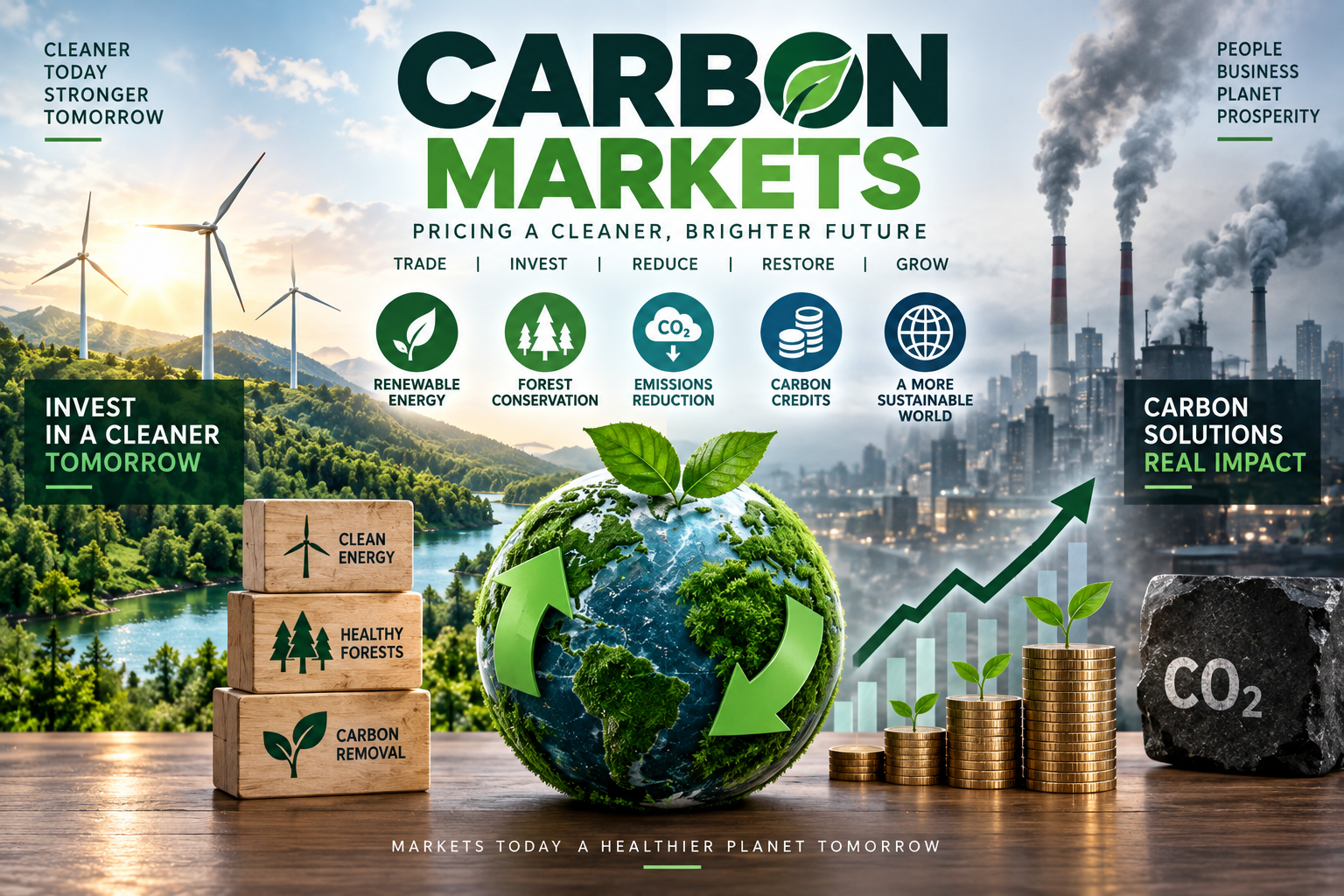
Carbon markets have become an increasingly important part of the global response to climate change. Governments, businesses and investors are looking for ways to reduce greenhouse gas emissions while supporting economic growth and the transition toward cleaner technologies.
A carbon market creates a financial value for reducing or avoiding greenhouse gas emissions. In simple terms, it allows organizations to buy, sell or trade instruments connected to emissions reductions.
The concept is based on a straightforward economic idea: if emitting carbon has a cost, businesses have a stronger financial incentive to reduce emissions. At the same time, companies and projects that reduce or remove emissions can potentially generate financial value through carbon credits.
Carbon markets have expanded significantly in recent years. According to the World Bank's 2026 State and Trends of Carbon Pricing report, direct carbon pricing now covers nearly 30% of global greenhouse gas emissions, across 87 implemented policies. Carbon pricing also generated more than $107 billion in public revenue during 2025.
What Are Carbon Markets?
Carbon markets are systems that allow emissions reductions to be measured, priced and traded.
A carbon market can involve governments, companies, financial institutions, project developers and other participants.
The market generally operates around the concept of a carbon unit. Depending on the system, one unit may represent a specified amount of greenhouse gas emissions, often measured in tonnes of carbon dioxide equivalent, or tCO2e.
There are two broad areas of carbon markets:
Compliance carbon markets
Voluntary carbon markets
Although both involve carbon-related units, their purposes and rules can be very different.
Compliance markets are created through laws or regulations, while voluntary markets allow organizations to purchase carbon credits voluntarily.
Understanding the difference is essential for anyone researching carbon markets.
How Do Carbon Markets Work?
Carbon markets work by creating a financial incentive for emissions reductions.
A government or regulatory authority may establish a limit or price for greenhouse gas emissions. Companies covered by the system then have obligations related to their emissions.
Depending on the design, companies may receive or purchase allowances, reduce their emissions or acquire eligible units to meet their obligations.
In a separate carbon-crediting system, a project may reduce or remove emissions and generate carbon credits after meeting specific requirements for measurement, verification and certification.
A buyer can then purchase those credits.
This creates a connection between climate action and financial markets.
For businesses, reducing emissions can potentially lower future compliance costs. For project developers, carbon finance can provide an additional source of revenue for activities such as renewable energy, forest conservation, methane reduction or carbon removal.
Compliance Carbon Markets
Compliance carbon markets operate under government or regulatory requirements.
One of the best-known forms is an Emissions Trading System, commonly called an ETS.
An ETS establishes a framework in which covered companies must surrender eligible allowances or units for their emissions.
The total number of allowances can be limited, creating a market price for emissions.
Companies that reduce emissions more than required may have surplus allowances, while companies that need additional units may have to purchase them.
This creates a financial incentive for companies to reduce emissions where doing so is economically efficient.
The World Bank reported in 2026 that there were 87 direct carbon-pricing policies globally, including carbon taxes and emissions trading systems.
Carbon Taxes
A carbon tax is another form of direct carbon pricing.
Instead of creating a market for tradable emissions allowances, a government establishes a price on emissions or on fuels associated with greenhouse gas emissions.
The objective is to make carbon-intensive activities more expensive and encourage businesses and consumers to consider lower-emission alternatives.
Carbon taxes can also generate government revenue.
That revenue may be used for public spending, climate programs, infrastructure, tax reductions or other policy priorities, depending on the country.
Carbon taxes and ETSs are different policy instruments, but both aim to create an economic incentive to reduce emissions.
Voluntary Carbon Markets
Voluntary carbon markets operate differently from compliance systems.
In a voluntary market, companies, organizations or individuals may purchase carbon credits without being legally required to do so.
Organizations may use voluntary carbon credits as part of broader climate strategies, although claims about offsetting emissions need to be carefully considered.
Voluntary carbon markets can support projects that reduce or remove greenhouse gas emissions.
Examples include:
Reforestation
Forest conservation
Renewable energy
Methane capture
Clean cooking
Energy efficiency
Carbon removal
Agricultural projects
Waste management
The quality of credits can vary considerably, which is why measurement, verification and transparency are critical.
What Is a Carbon Credit?
A carbon credit generally represents a quantified emissions reduction or removal that has been verified according to the rules of a particular carbon-crediting program.
The basic idea is that a project takes an action that reduces or removes greenhouse gases compared with an established baseline.
For example, a project might capture methane from a landfill that would otherwise enter the atmosphere.
If the project meets the relevant requirements, it may generate carbon credits that can be purchased by another organization.
However, a carbon credit should not automatically be treated as equivalent to a guaranteed permanent removal of carbon dioxide.
Different projects have different characteristics, risks and levels of environmental integrity.
Carbon Allowances vs Carbon Credits
Carbon allowances and carbon credits are related but not identical.
A carbon allowance is generally associated with a compliance system and represents permission to emit a specified quantity under that system's rules.
A carbon credit generally represents a verified emissions reduction or removal generated by a project.
The distinction matters because the rules governing each instrument can be very different.
Investors, companies and policymakers need to understand exactly what a particular unit represents, where it can be used and what standards apply to it.
Why Carbon Markets Matter
Carbon markets can provide an economic mechanism for supporting climate action.
Traditional environmental regulations can require companies to reduce emissions through specific technologies or standards.
Carbon pricing takes a somewhat different approach by creating an economic signal.
If emitting greenhouse gases becomes more expensive, companies have greater incentives to find cost-effective ways to reduce emissions.
Carbon markets can also help direct capital toward projects that require funding.
The World Bank notes that carbon pricing can help mobilize finance and support development outcomes while encouraging emissions reductions.
Carbon Markets and Renewable Energy
Renewable energy is closely connected to carbon markets.
Solar, wind and other low-carbon energy projects can help reduce dependence on fossil fuels.
Some eligible projects may also generate carbon credits under applicable standards or mechanisms, although whether a project qualifies depends on the rules of the relevant market.
In 2026, the UN body overseeing the Paris Agreement's Article 6.4 mechanism adopted a methodology allowing eligible grid-connected renewable electricity projects to seek UN-backed carbon credits. The methodology is intended to establish requirements for measuring emissions reductions and ensuring projects meet specified criteria.
This development illustrates how international carbon-market infrastructure is continuing to evolve.
Carbon Markets and Forests
Forests are another major area of carbon-market activity.
Trees and ecosystems can absorb carbon dioxide from the atmosphere, while deforestation and land degradation can release stored carbon.
Carbon-finance projects may support forest conservation, reforestation or restoration activities.
However, forest-based carbon projects face unique challenges.
Carbon stored in forests can be affected by wildfires, drought, disease, illegal logging and changes in land use.
For this reason, project quality, monitoring and long-term permanence are important considerations.
The World Bank's 2026 report noted that highly rated forest conservation and reforestation projects continued to receive price premiums in carbon-credit markets.
Carbon Removal Markets
Carbon removal has become another important part of carbon markets.
Carbon removal involves taking carbon dioxide from the atmosphere and storing it through biological, geological or technological processes.
Examples can include:
Reforestation
Soil carbon projects
Biochar
Direct air capture
Enhanced weathering
Certain forms of carbon mineralization
Carbon removal is different from simply avoiding an emission.
For example, preventing a tonne of carbon dioxide from being emitted from a new source is an emissions-reduction activity, while removing carbon dioxide already present in the atmosphere is a carbon-removal activity.
The distinction is increasingly important as companies and governments develop long-term climate strategies.
Carbon Market Standards and Verification
One of the biggest challenges facing carbon markets is ensuring that credits represent genuine climate benefits.
A carbon project generally needs to establish a baseline, measure its results and demonstrate that the claimed emissions reduction or removal occurred.
Independent verification can be used to increase confidence in project claims.
Important concepts include:
Additionality
Additionality asks whether the emissions reduction would have happened without the financial incentive provided by the carbon-credit project.
Permanence
Permanence considers how long a carbon removal or stored carbon is expected to remain out of the atmosphere.
Leakage
Leakage occurs when emissions reductions in one location lead to increased emissions elsewhere.
Measurement
Projects need credible systems for measuring emissions reductions or removals.
Verification
Independent assessment can help determine whether projects meet applicable standards.
These concepts are important because the environmental value of a carbon credit depends heavily on the quality and credibility of the underlying project.
The Challenge of Carbon Credit Quality
Not all carbon credits are equal.
Two credits may represent the same nominal quantity of emissions reductions but have very different levels of environmental integrity.
Factors such as project methodology, additionality, permanence, monitoring and verification can influence quality.
This has become a major issue for voluntary carbon markets.
The World Bank reported that global carbon-credit issuances increased by 8% between 2024 and 2025, while average credit prices declined slightly. At the same time, certain categories continued to receive price premiums.
This suggests that the market is increasingly differentiating between types and qualities of carbon credits.
Carbon Markets and the Paris Agreement
International cooperation is an important part of the future of carbon markets.
Article 6 of the Paris Agreement provides a framework for countries to cooperate in reducing emissions.
The UNFCCC identifies three components:
Article 6.2, covering internationally transferred mitigation outcomes and accounting arrangements
Article 6.4, establishing a UN mechanism for carbon-credit trading
Article 6.8, covering non-market approaches to international cooperation
The Article 6.4 mechanism is particularly relevant to the development of an international carbon-credit market.
As countries develop their national climate plans, Article 6 could become increasingly important for international carbon-market activity.
Carbon Markets in Developing Economies
Carbon markets can provide an opportunity for developing countries to attract climate finance.
Projects involving renewable energy, forests, agriculture, waste management and industrial efficiency can potentially generate additional sources of investment.
International carbon-market participation may also support technology transfer and new employment opportunities.
Pakistan, for example, is strengthening its focus on carbon markets as part of efforts to support its climate goals and mobilize climate finance. A UNFCCC workshop held in Islamabad in July 2026 focused on Article 6 mechanisms, carbon-market participation, reporting, registries and project authorization.
For developing economies, strong domestic institutions and transparent rules will be important for ensuring that carbon-market revenues create meaningful economic and environmental benefits.
Carbon Markets and Businesses
Businesses are increasingly paying attention to carbon markets because climate policies can affect operating costs, supply chains and access to international markets.
Companies may face direct carbon costs if they operate within a compliance market.
Even companies outside such systems can be affected indirectly.
For example, manufacturers may face pressure from customers that have emissions-reduction targets. Exporters may also need to provide information about the carbon intensity of their products.
As climate-related regulation becomes more widespread, companies may need better systems for measuring and reporting emissions.
Carbon Markets and International Trade
Carbon pricing is increasingly connected to international trade.
One example is the European Union's Carbon Border Adjustment Mechanism, or CBAM.
The mechanism is designed to address the carbon content of certain imported goods and reduce the risk that production shifts to jurisdictions with weaker carbon constraints.
The World Bank has noted that carbon-pricing developments are increasingly influencing sectors such as steel, aluminum, cement, fertilizers and electricity.
For exporters, carbon-related requirements can therefore become an important part of international competitiveness.
Benefits of Carbon Markets
Carbon markets can offer several potential benefits.
1. Economic Incentives
They can make emissions reductions financially valuable.
2. Private Investment
Carbon finance can help attract private capital to climate-related projects.
3. Innovation
Carbon pricing can encourage businesses to develop cleaner technologies and processes.
4. Flexibility
Companies may be able to identify the most cost-effective ways to reduce emissions.
5. Government Revenue
Carbon taxes and certain compliance systems can generate public revenue.
6. International Cooperation
Carbon markets can facilitate cooperation between countries on climate objectives.
Risks and Challenges
Despite their potential benefits, carbon markets face important challenges.
Market Volatility
Carbon prices can rise and fall based on policy changes, economic conditions and supply and demand.
Credit Quality
Poor-quality credits can undermine confidence in the market.
Greenwashing
Companies may make environmental claims that are not adequately supported by actual emissions reductions.
Regulatory Uncertainty
Changing climate policies can create uncertainty for businesses and investors.
Measurement Problems
Some projects are difficult to measure accurately, particularly activities involving forests and soil.
Oversupply
A large supply of credits relative to demand can put downward pressure on prices.
These challenges mean that transparency and strong market rules are essential.
The Future of Carbon Markets
The carbon market is likely to become more sophisticated over the coming years.
Governments are expanding carbon-pricing systems, while international institutions are developing rules for cross-border carbon trading.
The World Bank's 2026 report shows that direct carbon pricing has expanded significantly over the past decade, with coverage now approaching one-third of global emissions.
At the same time, the UN is continuing to develop the Paris Agreement's Article 6 mechanisms.
The future market may place greater emphasis on high-quality credits, transparent measurement and verified climate outcomes.
Demand could also evolve as companies move from broad offsetting strategies toward more targeted investments in emissions reduction and carbon removal.
What Investors and Businesses Should Watch
Several developments will be important for carbon markets:
Expansion of national emissions trading systems
Carbon-tax reforms
Article 6 implementation
Carbon-credit quality standards
Demand for carbon removals
Renewable-energy projects
Forest and nature-based credits
International trade policies
Corporate climate commitments
Carbon-price movements
Understanding these factors can help businesses identify both risks and opportunities.
Conclusion
Carbon markets are becoming an increasingly important part of the global financial and climate landscape.
They create mechanisms for pricing emissions, trading carbon-related instruments and directing capital toward emissions-reduction projects.
Compliance markets, carbon taxes and voluntary carbon markets all have different structures and purposes. Their effectiveness depends heavily on strong rules, accurate measurement, credible verification and transparent reporting.
The market is still developing, but recent progress is significant. Direct carbon pricing now covers nearly 30% of global greenhouse gas emissions, while international mechanisms under the Paris Agreement continue to evolve.
For businesses, investors and governments, understanding carbon markets is increasingly important because climate policy is becoming connected to finance, trade, energy and competitiveness.
The future of carbon markets will ultimately depend on whether they can deliver what they promise: credible emissions reductions while mobilizing capital for a lower-carbon economy.
Frequently Asked Questions About Carbon Markets
What is a carbon market?
A carbon market is a system that allows carbon-related units, such as emissions allowances or verified carbon credits, to be priced and traded.
What is a carbon credit?
A carbon credit generally represents a verified emissions reduction or removal generated by an eligible project.
What is the difference between a carbon market and a carbon tax?
A carbon market can allow emissions units to be traded, while a carbon tax directly establishes a price or tax on emissions or carbon-intensive fuels.
What is an emissions trading system?
An emissions trading system, or ETS, is a compliance market in which covered entities must manage emissions through allowances or other eligible units under established rules.
What is a voluntary carbon market?
A voluntary carbon market allows organizations to purchase carbon credits voluntarily rather than because they are legally required to do so.
Why are carbon markets important?
Carbon markets can create financial incentives for reducing emissions, mobilize climate finance and encourage investment in cleaner technologies.
Are all carbon credits the same?
No. Carbon credits can vary significantly depending on the project, methodology, additionality, permanence, monitoring and verification.
What is Article 6 of the Paris Agreement?
Article 6 provides a framework for international cooperation on climate action, including internationally transferred mitigation outcomes and a UN carbon-crediting mechanism.
Can developing countries benefit from carbon markets?
Yes. Carbon markets can potentially help developing countries attract investment for renewable energy, forestry, waste management and other climate-related projects.
What is the future of carbon markets?
Carbon markets are expected to become increasingly regulated and focused on transparency, high-quality credits, emissions reductions, carbon removal and international cooperation.