Commodities are among the oldest and most important markets in the global economy. Oil powers transportation and industry, natural gas supports electricity and heating, metals are essential for construction and technology, and agricultural commodities provide food and raw materials for billions of people.
Unlike financial assets such as company shares, commodities generally represent physical resources or products that can be produced, stored, transported, processed, and consumed.
The commodities market is also closely connected to inflation, interest rates, currencies, international trade, geopolitics, economic growth, manufacturing, climate conditions, and technological change.
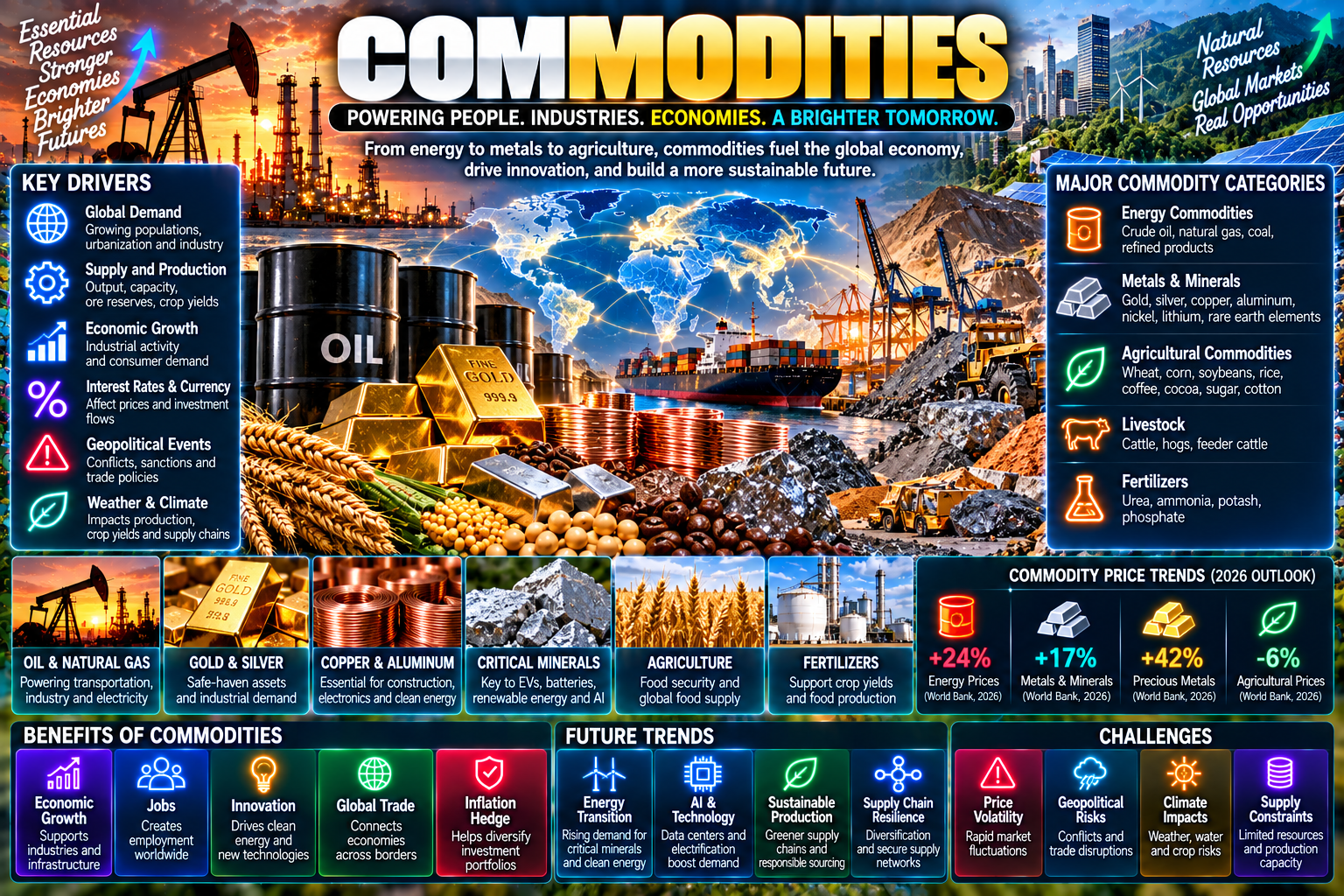
In 2026, commodity markets are experiencing significant changes. The World Bank's April 2026 Commodity Markets Outlook projected overall commodity prices to rise 16% in 2026, with energy prices projected to increase 24%, metals and minerals 17%, and precious metals 42%. Agricultural commodity prices, by contrast, were projected to decline 6%.
These figures illustrate an important characteristic of commodities: different commodity groups can move in very different directions at the same time.
What Are Commodities?
Commodities are basic goods or raw materials that can generally be bought and sold in standardized markets.
Major commodities include:
Crude oil
Natural gas
Coal
Gold
Silver
Copper
Aluminum
Iron ore
Wheat
Corn
Soybeans
Coffee
Cocoa
Sugar
Cotton
Livestock
Fertilizers
Critical minerals
Commodities can be traded through physical markets as well as financial markets.
Businesses may purchase physical commodities for production, while investors and traders can obtain exposure through futures contracts, options, exchange-traded products, and other financial instruments.
Major Types of Commodities
Commodities are commonly divided into several major categories.
1. Energy Commodities
Energy commodities include:
Crude oil
Natural gas
Coal
Refined petroleum products
Electricity in certain markets
Energy markets are especially important because transportation, manufacturing, agriculture and electricity generation depend heavily on energy.
2. Metals and Minerals
Metals include both industrial and precious metals.
Industrial metals
Copper
Aluminum
Nickel
Zinc
Tin
Lead
Precious metals
Gold
Silver
Platinum
Palladium
Metals are used in construction, electronics, automobiles, renewable-energy systems, batteries, data centers and consumer products.
3. Agricultural Commodities
Agricultural commodities include:
Wheat
Corn
Soybeans
Rice
Sugar
Coffee
Cocoa
Cotton
Palm oil
Livestock
Agricultural markets are highly sensitive to weather, crop yields, fertilizer costs, transportation, inventories and global food demand.
4. Livestock
Livestock markets include products such as:
Cattle
Hogs
Feeder cattle
These markets are influenced by feed costs, animal health, weather, consumer demand and supply conditions.
5. Fertilizers
Fertilizers are strategically important because they influence agricultural productivity.
Major fertilizer products include:
Urea
Ammonia
Potash
Phosphate fertilizers
The World Bank projected fertilizer prices to increase 31% in 2026, driven particularly by a projected 60% increase in urea prices.
How Commodity Markets Work
Commodity markets connect producers, processors, consumers, governments, financial institutions and traders.
A simplified supply chain is:
Production → Processing → Transportation → Storage → Wholesale Market → End Consumer
For example:
Oil field → refinery → fuel distributor → gas station → consumer
Or:
Copper mine → smelter → manufacturer → electronics producer → consumer
The financial market operates alongside the physical supply chain.
Companies can use financial contracts to manage price risks before the physical commodity is delivered.
Physical Commodity Markets
Physical commodity markets involve the actual buying and selling of commodities.
Examples include:
An airline purchasing jet fuel
A power company purchasing natural gas
A manufacturer purchasing copper
A food company purchasing wheat
A jewelry manufacturer purchasing gold
Physical commodity markets depend heavily on logistics.
Important factors include:
Transportation
Storage
Warehousing
Ports
Pipelines
Shipping
Refining
Processing capacity
A commodity can be abundant globally but temporarily expensive in a particular region because of transportation or infrastructure constraints.
Commodity Futures
Futures contracts are one of the most important financial instruments in commodity markets.
A futures contract is an agreement involving the purchase or sale of a commodity at a specified price and future date under standardized exchange rules.
Futures allow market participants to manage price exposure.
For example, an airline concerned about rising fuel costs may use financial contracts to reduce uncertainty around future fuel prices.
A producer can similarly use futures to manage the risk of falling prices.
Speculators also participate in futures markets, providing liquidity while taking exposure to price movements.
Commodity Options
Options provide another way to manage commodity-price risk.
A call option generally provides the right, but not the obligation, to buy an asset at a specified price.
A put option generally provides the right, but not the obligation, to sell.
Businesses can use options to create more flexible risk-management strategies.
Commodity options are used across energy, metals, agriculture and other markets.
What Determines Commodity Prices?
Commodity prices are primarily influenced by supply and demand.
However, several factors can change supply and demand simultaneously.
Supply
Commodity supply can be affected by:
Production
Weather
Mining capacity
Oil drilling
Crop yields
Factory output
Transportation
Storage
Inventory levels
Government policies
Export restrictions
Geopolitical events
Demand
Demand can be affected by:
Economic growth
Industrial production
Consumer spending
Population growth
Infrastructure investment
Technology
Energy consumption
Weather
Government policies
When demand rises faster than supply, prices can increase.
When supply grows faster than demand, prices can decline.
The Role of Inventories
Inventory is one of the most important concepts in commodity markets.
If inventories are high, markets may have a larger buffer against supply disruptions.
If inventories are low, even a relatively small disruption can cause significant price movements.
This is particularly important for:
Oil
Natural gas
Metals
Grains
Inventory data can therefore influence market expectations even before a physical shortage occurs.
Oil Markets
Crude oil is one of the world's most important commodities.
Oil is used for:
Transportation
Petrochemicals
Plastics
Industrial processes
Aviation
Shipping
Heating
Major benchmark prices include Brent and West Texas Intermediate.
Oil prices can respond rapidly to geopolitical developments.
The IEA's August 2026 Oil Market Report projected global oil demand to decline by 1.6 million barrels per day in 2026, while global oil supply was projected to fall by 4.3 million barrels per day to approximately 102 million barrels per day.
The IEA noted that disruptions involving the Strait of Hormuz and elevated fuel prices were weighing on oil consumption and supply.
The World Bank's April 2026 outlook similarly identified energy markets as a major source of commodity-price pressure.
Natural Gas
Natural gas is used for:
Electricity generation
Heating
Industrial production
Fertilizer manufacturing
Chemical production
Natural gas markets can be highly regional because transportation infrastructure matters.
Liquefied natural gas (LNG) has increased the ability to transport natural gas internationally, although shipping, liquefaction and regasification capacity remain important constraints.
Gold
Gold is one of the world's most widely followed precious metals.
It is used in:
Jewelry
Electronics
Investment
Central-bank reserves
Financial markets
Gold prices can respond to:
Interest rates
Inflation expectations
Currency movements
Geopolitical uncertainty
Investor demand
Central-bank purchases
The World Bank projected precious-metal prices to increase 42% in 2026, reflecting strong demand and geopolitical uncertainty.
Gold can therefore behave differently from industrial commodities.
Silver
Silver has both monetary and industrial uses.
Industrial applications include:
Electronics
Solar technology
Electrical equipment
Medical applications
Advanced manufacturing
This combination means silver can be influenced by both investment demand and industrial demand.
Copper
Copper is one of the most strategically important industrial metals.
It is used in:
Electricity networks
Electric vehicles
Construction
Renewable energy
Electronics
Data centers
Telecommunications
The transition toward electrification and the expansion of digital infrastructure are increasing long-term interest in copper demand.
The World Bank projects strong demand for base metals from renewable energy, electrification and data centers, and expects aluminum, copper and tin prices to reach record levels in 2026.
Aluminum
Aluminum is widely used because it is relatively lightweight and versatile.
Major applications include:
Transportation
Construction
Packaging
Aerospace
Electrical systems
Renewable-energy infrastructure
Its demand is influenced by manufacturing and infrastructure investment.
Supply can be affected by electricity costs, mining, refining capacity and trade restrictions.
Critical Minerals
The global energy and technology transition has increased attention on critical minerals.
These can include:
Lithium
Cobalt
Nickel
Graphite
Rare earth elements
Copper
They are important for:
Batteries
Electric vehicles
Wind turbines
Solar systems
Electronics
Defense technologies
Energy storage
Commodity markets for these materials can become strategically important because production and processing may be concentrated in relatively few countries.
Agricultural Commodities
Agricultural markets are different from metals and energy because biological production is heavily influenced by weather and growing conditions.
Major agricultural commodities include:
Wheat
Corn
Soybeans
Rice
Coffee
Cocoa
Sugar
Cotton
Prices can be affected by:
Drought
Flooding
Temperature
Crop diseases
Fertilizer prices
Fuel prices
Export restrictions
Global food demand
Currency movements
A single poor harvest can create significant price pressure when inventories are already low.
Food Security and Commodities
Commodity markets have a direct relationship with food security.
Higher prices for grains, cooking oils, fertilizers and energy can increase food-production costs.
The World Bank warned in April 2026 that the energy shock was also pushing fertilizer prices higher and could create further pressure on food affordability.
This demonstrates how commodity markets can transmit shocks from one sector into another:
Oil → fertilizer → agriculture → food prices → household purchasing power
Commodities and Inflation
Commodity prices are closely connected to inflation.
Energy prices can influence:
Transportation
Electricity
Manufacturing
Food production
Higher commodity costs can therefore increase the prices businesses charge consumers.
However, commodity-price shocks do not always produce permanent inflation. The broader impact depends on wages, monetary policy, demand conditions and how long the shock lasts.
The World Bank projected that the 2026 commodity-price shock would contribute to higher inflation and weaker growth in developing economies.
Commodities and Interest Rates
Interest rates can influence commodities through several channels.
Higher interest rates can:
Increase financing costs
Reduce economic activity
Affect industrial demand
Strengthen or weaken currencies
Change the attractiveness of holding inventories
Influence investor positioning
Lower interest rates can have the opposite effects, although commodity-specific fundamentals remain important.
Gold is particularly sensitive to interest-rate expectations because it does not generate conventional interest income.
Commodities and the U.S. Dollar
Many globally traded commodities are priced in U.S. dollars.
Therefore, movements in the dollar can influence commodity markets.
A stronger dollar can make dollar-priced commodities more expensive for buyers using other currencies.
A weaker dollar can reduce that currency-related burden.
However, dollar movements are only one factor. Supply, demand, inventories and geopolitical events can dominate commodity pricing.
Commodities and Geopolitics
Geopolitical events can have an immediate effect on commodity markets.
Potential disruptions include:
Wars
Sanctions
Export restrictions
Shipping disruptions
Pipeline disruptions
Port closures
Trade restrictions
Production shutdowns
Energy markets are particularly sensitive to geopolitical developments.
The World Bank reported that the 2026 Middle East conflict caused major disruptions to energy trade and contributed to its forecast for a 24% increase in energy prices.
The report also noted that geopolitical oil-supply shocks can have spillover effects on natural gas and fertilizer markets.
Commodities and AI
Artificial intelligence is becoming an increasingly important commodity-demand driver.
AI data centers require:
Electricity
Copper
Aluminum
Steel
Cooling equipment
Networking equipment
Semiconductor materials
The growth of AI infrastructure therefore affects commodity demand far beyond the technology sector.
Data centers require large amounts of electricity, which can increase demand for energy infrastructure and metals used in transmission and construction.
The World Bank specifically identified data centers, renewable energy and electrification as important sources of demand for base metals in 2026.
Commodities and the Energy Transition
The transition toward lower-carbon energy is changing commodity demand.
Traditional energy commodities remain important, while demand is increasing for materials associated with electrification.
Key materials include:
Copper
Lithium
Nickel
Graphite
Aluminum
Rare earth elements
This creates a complicated commodity landscape.
Some traditional commodities may face long-term demand pressure from electrification, while others can benefit from growing electricity consumption and industrial investment.
Commodity Trading
Commodity trading takes several forms.
Physical Trading
Companies buy and sell actual commodities.
Futures Trading
Participants trade standardized contracts for future delivery or financial settlement.
Options Trading
Participants use options to manage or obtain exposure to price movements.
Exchange-Traded Products
Some financial products provide commodity exposure without requiring investors to directly store physical commodities.
Over-the-Counter Markets
Large institutions can negotiate customized contracts outside centralized exchanges.
Each structure has different risks and costs.
Major Commodity Market Participants
Commodity markets include:
Producers
Mining companies
Oil companies
Agricultural businesses
Manufacturers
Airlines
Utilities
Commodity merchants
Banks
Hedge funds
Asset managers
Governments
Central banks
Individual traders
Each participant may have a different objective.
A farmer may want protection against falling crop prices.
A food company may want protection against rising input costs.
A trader may seek profit from price movements.
A government may focus on energy security or food security.
Commodity Hedging
Hedging is the use of financial instruments to reduce exposure to adverse price movements.
For example, a manufacturer that needs copper could be concerned about rising prices.
It might use futures or options to manage part of that exposure.
Similarly, a producer may hedge against falling prices.
Hedging does not necessarily eliminate risk. Instead, it changes the company's exposure and can make future costs or revenues more predictable.
Commodity Speculation
Speculators attempt to profit from commodity price movements without necessarily having a physical need for the commodity.
Speculators can provide liquidity to markets, but commodity prices can also be highly volatile.
Risks include:
Leverage
Margin requirements
Rapid price movements
Contract expiration
Liquidity risk
Market gaps
Unexpected geopolitical events
Commodity futures can therefore be significantly more complex than buying a physical commodity.
Commodity Supercycles
A commodity supercycle refers to a prolonged period in which commodity prices experience a broad, sustained trend driven by structural changes in supply and demand.
Potential supercycle drivers include:
Industrialization
Urbanization
Infrastructure expansion
Energy transitions
Technology investment
Population growth
Supply constraints
However, commodity markets do not move as one group.
Oil, copper, wheat and gold can experience completely different cycles.
Therefore, analyzing individual commodities is usually more informative than assuming that every commodity will follow the same trajectory.
Commodity Market Risks
Price Volatility
Commodity prices can move sharply in response to unexpected events.
Supply Disruptions
Natural disasters, geopolitical events and production failures can reduce supply.
Demand Shocks
Economic slowdowns can reduce industrial and consumer demand.
Weather Risk
Agricultural commodities are particularly exposed to weather.
Currency Risk
Currency movements can affect internationally traded commodities.
Storage Risk
Physical commodities require infrastructure and can incur storage costs.
Regulatory Risk
Governments can change taxes, export rules, environmental regulations or production policies.
Liquidity Risk
Some commodity contracts and markets are less liquid than major financial markets.
Commodity Market Trends in 2026
Several themes are particularly important in 2026.
Energy Volatility
Geopolitical disruptions have created major uncertainty in oil and gas markets.
Metals Demand
Data centers, renewable energy and electrification are supporting demand for several industrial metals.
Precious Metals
Gold and other precious metals have experienced strong demand amid geopolitical and financial uncertainty.
Fertilizer Costs
Higher fertilizer prices can influence agricultural production and food costs.
AI Infrastructure
The expansion of AI data centers is creating new demand for electricity, metals, construction materials and industrial infrastructure.
Supply-Chain Resilience
Companies and governments are paying greater attention to commodity supply security and diversification.
Global Commodity Markets
Commodity markets are interconnected.
An oil-price shock can affect:
Energy → Transportation → Manufacturing → Fertilizer → Agriculture → Food
Similarly:
AI investment → Data centers → Electricity demand → Grid investment → Copper and aluminum demand
Another chain is:
EV adoption → Battery demand → Lithium/nickel/graphite → Mining investment → Commodity prices
These relationships explain why commodity analysis often requires understanding the broader economy.
Commodities and Emerging Economies
Many emerging economies depend heavily on commodity exports.
Commodity-exporting countries can benefit from high prices through:
Export revenue
Government revenue
Foreign-exchange earnings
Investment
Employment
But they can also become vulnerable when prices fall.
Commodity-importing countries face the opposite situation.
Higher oil, gas or food prices can increase import bills and inflation.
This is why commodity cycles can have significant effects on economic growth and government finances.
Commodities and Sustainability
Environmental considerations are increasingly important in commodity markets.
Mining companies face questions involving:
Water use
Land use
Biodiversity
Energy consumption
Waste
Community relationships
Agriculture faces challenges involving:
Soil health
Water availability
Deforestation
Fertilizer use
Climate change
Energy markets face the transition toward lower-carbon systems.
As a result, sustainability is increasingly connected with commodity supply, investment and regulation.
The Future of Commodity Markets
The commodity markets of the future will likely be shaped by several overlapping trends.
Artificial Intelligence
AI infrastructure can increase demand for electricity and metals while also improving commodity forecasting and supply-chain management.
Electrification
Electric vehicles, renewable energy and grid expansion can increase demand for copper, aluminum and other materials.
Renewable Energy
Solar and wind expansion requires large quantities of industrial materials.
Climate Change
Changing weather patterns can affect agriculture, water availability and energy demand.
Supply Security
Governments may increasingly prioritize domestic production, strategic reserves and diversified supply chains for critical commodities.
Digital Commodity Trading
Technology can improve price discovery, logistics, risk management and market transparency.
Commodity Recycling
Recycling metals and materials can reduce dependence on newly mined resources and become increasingly important as demand grows.
Commodities Outlook
The 2026 outlook demonstrates why commodity markets should be analyzed individually rather than as a single asset class.
The World Bank's April forecast expected overall commodity prices to rise 16%, but the components differed sharply: energy was projected to rise 24%, metals and minerals 17%, precious metals 42%, while agricultural commodity prices were projected to decline 6%.
The World Bank's latest commodity data also show how quickly conditions can change. Its September 2026 update reported an 8.8% monthly increase in the energy price index, a 4.0% increase in metals prices and an 8.8% increase in precious metals prices, while fertilizer prices declined 1.9%.
This variation highlights the importance of monitoring supply, demand, inventories, weather, geopolitical developments, currency movements and industrial trends for each commodity.
Commodities vs. Stocks
Feature | Commodities | Stocks |
|---|---|---|
Represents | Physical goods/raw materials | Ownership in companies |
Examples | Oil, gold, wheat, copper | Apple, banks, manufacturers |
Main drivers | Supply and demand | Earnings, growth, valuation |
Income | Usually no dividend | Possible dividends |
Storage | Physical commodities may require storage | No physical storage |
Volatility | Can be very high | Varies by company/market |
Inflation sensitivity | Often significant | Depends on company |
Geopolitical exposure | Often high | Varies by company |
Trading | Spot, futures, options | Shares, options |
Commodities vs. Currencies
Currencies represent national or regional units of money, while commodities are physical goods or resources.
However, the two markets are closely connected.
For example:
A stronger dollar can affect commodity prices.
Commodity exports can influence a country's currency.
Oil prices can affect the trade balance of energy-importing countries.
Commodity revenues can influence commodity-exporting economies.
Understanding these relationships is important for international markets.
Conclusion
Commodities form the physical foundation of the global economy.
Oil powers transportation and industry. Natural gas supports electricity and manufacturing. Metals provide the materials required for construction, electronics, renewable energy and AI infrastructure. Agricultural commodities provide food and industrial inputs.
Commodity prices are influenced by an unusually broad range of forces, including supply and demand, inventories, weather, economic growth, inflation, interest rates, currencies, geopolitics, trade policy, technological innovation and climate change.
The 2026 market demonstrates this complexity particularly clearly. Energy and fertilizer markets have been affected by major supply disruptions, while metals have benefited from demand linked to electrification, renewable energy and data centers. Precious metals have also experienced strong demand, while agricultural commodities have followed a different trajectory.
Looking ahead, commodities will remain closely connected to the major transformations shaping the world economy: artificial intelligence, electrification, renewable energy, infrastructure development, food security and global supply-chain restructuring.
Understanding commodities therefore means understanding more than price charts. It means understanding the physical resources that power businesses, feed populations, build cities and support the technologies of the future.
Frequently Asked Questions
What are commodities?
Commodities are standardized physical goods or raw materials that can be produced, traded and consumed, including oil, natural gas, gold, copper, wheat and coffee.
What are the main types of commodities?
The major categories are energy, metals and minerals, agricultural commodities, livestock and fertilizers.
How are commodities traded?
Commodities can be traded physically or through financial instruments such as futures, options, exchange-traded products and over-the-counter contracts.
What determines commodity prices?
Supply, demand, inventories, weather, production costs, economic growth, interest rates, currencies, geopolitics and government policies can all affect commodity prices.
Why are commodities important for the economy?
Commodities provide the energy, food and raw materials required by households, businesses, industries and governments.
Why is oil important in commodity markets?
Oil is a major source of transportation and industrial energy and also serves as a feedstock for many petrochemical products.
Why is copper important for the future?
Copper is heavily used in electricity networks, construction, electric vehicles, renewable energy and digital infrastructure. Demand from data centers and electrification is an increasingly important market theme.
Are commodities risky?
Yes. Commodity markets can experience substantial price volatility because of supply disruptions, weather, geopolitical events, economic cycles, leverage and changing inventories.
How does AI affect commodities?
AI increases demand for data centers, electricity, semiconductors, networking infrastructure and construction materials, which can influence demand for energy and industrial metals.
What is the commodity outlook for 2026?
The outlook differs significantly by commodity. The World Bank's April 2026 forecast projected overall commodity prices to rise 16%, with particularly strong projected increases in energy and precious metals, while agricultural commodity prices were expected to decline.