
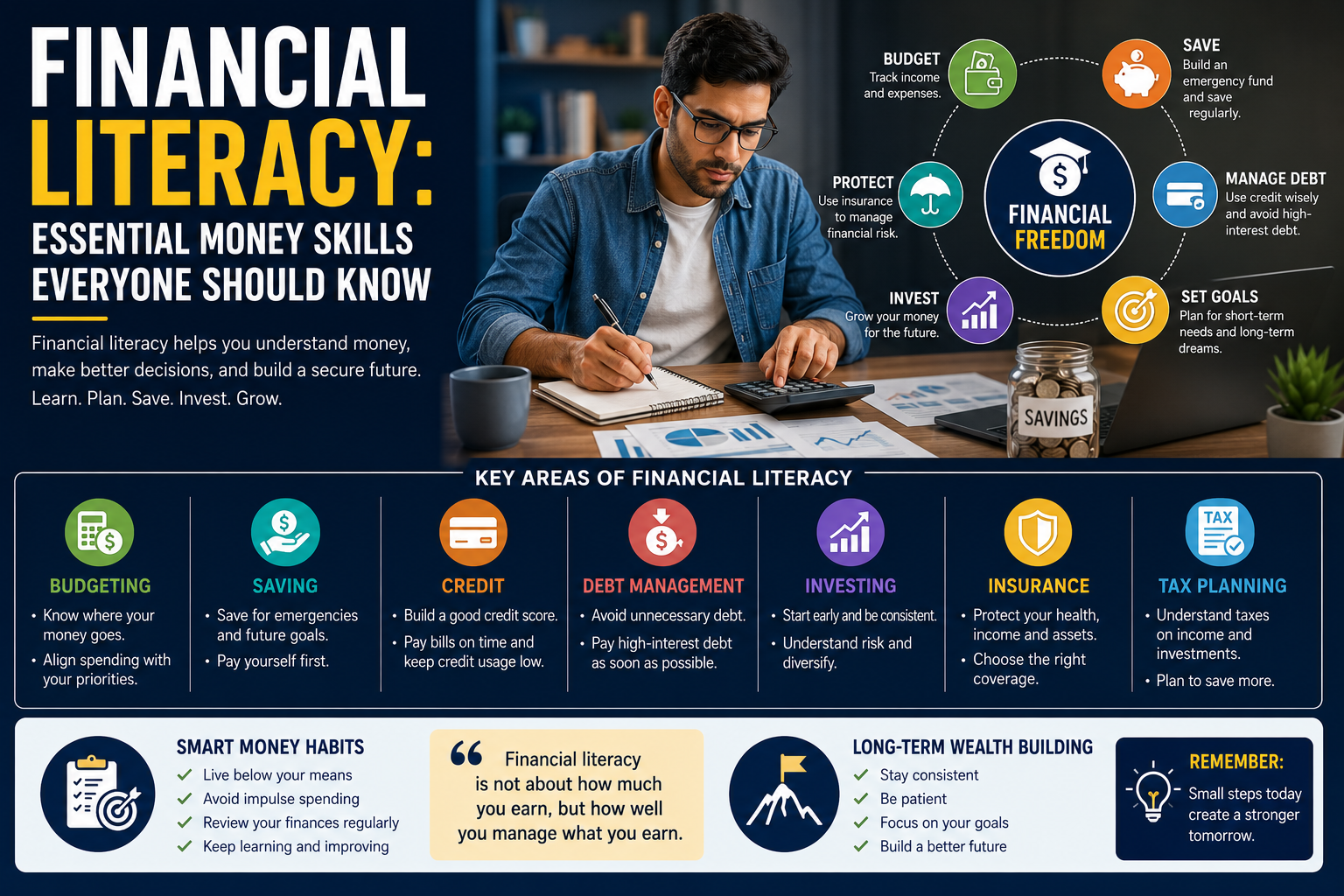
Money plays an important role in everyday life. People make financial decisions when they earn income, pay bills, use credit, save money, invest, buy property, or plan for the future.
Yet financial knowledge is not always taught systematically.
Financial literacy can help people understand these decisions and make more informed choices. It doesn't require becoming a professional investor or financial expert. Instead, it begins with understanding basic concepts and developing healthy financial habits.
Whether someone is starting their first job, managing a family budget, building a business, or preparing for long-term goals, financial literacy can provide a stronger foundation for decision-making.
What Is Financial Literacy?
Financial literacy is the ability to understand and manage money effectively.
It includes knowledge of:
Budgeting
Saving
Credit
Debt
Investing
Insurance
Taxes
Financial risk
Long-term planning
The purpose of financial literacy is not simply to accumulate money.
It is about understanding financial choices and their potential consequences.
Why Financial Literacy Matters
People make financial decisions every day.
A lack of financial knowledge can make it difficult to understand interest rates, loan terms, investment risks, or recurring expenses.
Financial literacy helps people ask better questions before making important decisions.
For example, instead of focusing only on the monthly payment for a loan, a financially informed person may consider the total amount that will be repaid, the interest rate, fees, and the length of the loan.
Understanding the complete picture can lead to better decisions.
Start With a Budget
A budget is one of the simplest financial tools.
It provides a clear picture of how money comes in and where it goes.
A basic budget can include:
Income
Money received from employment, business activities, investments, or other sources.
Essential expenses
Housing, utilities, food, transportation, and other necessary costs.
Financial obligations
Debt payments, insurance, taxes, and other commitments.
Savings
Money set aside for emergencies and future goals.
Discretionary spending
Entertainment, dining, shopping, travel, and other optional expenses.
A budget doesn't need to be complicated.
Its main purpose is awareness.
Understand Cash Flow
Income and expenses are only part of the picture.
Cash flow refers to the movement of money over a period of time.
Someone may have a good annual income but still experience financial pressure if large expenses arrive before income is received.
Understanding cash flow helps people plan for upcoming obligations.
This is particularly important for freelancers, entrepreneurs, and people with irregular income.
Build an Emergency Fund
Unexpected expenses are part of life.
A vehicle may need repairs.
A household appliance may stop working.
A temporary reduction in income may occur.
An emergency fund provides a financial buffer for unexpected situations.
The appropriate amount depends on individual circumstances, income stability, expenses, and financial responsibilities.
The important principle is to build emergency savings gradually.
Even small contributions can help create a stronger financial cushion over time.
Understand the Difference Between Needs and Wants
One of the most useful financial habits is distinguishing between needs and wants.
Needs are essential expenses.
Wants are purchases that improve comfort, convenience, or enjoyment but aren't necessary for basic living.
This doesn't mean people should eliminate all discretionary spending.
Instead, understanding the difference can help people make conscious choices.
A budget becomes more effective when spending reflects personal priorities.
Understand Credit
Credit can be a useful financial tool when managed responsibly.
It can help people purchase goods, finance education, manage business expenses, or handle certain large costs.
However, credit also creates obligations.
Before borrowing, understand:
Interest rate
Fees
Repayment period
Minimum payment
Total repayment
Consequences of missed payments
A low monthly payment doesn't necessarily mean a loan is inexpensive.
The total cost matters.
Manage Debt Carefully
Not all debt has the same purpose or risk.
Some borrowing may support long-term goals, while high-cost consumer debt can become difficult to manage.
People should understand how debt affects their monthly cash flow.
A practical approach is to keep track of outstanding balances, interest rates, payment dates, and total obligations.
Avoiding unnecessary high-cost debt can make it easier to direct money toward savings and long-term goals.
Understand Interest
Interest can work in two directions.
When you borrow money, interest increases the amount you repay.
When you save or invest money, returns can potentially increase the value of your assets.
This makes understanding interest an essential financial skill.
The concept of compounding is particularly important.
When returns are reinvested, future returns can potentially build on previous gains.
Over long periods, consistent saving and investing can therefore have a significant effect.
Saving for Short-Term Goals
Not every financial goal is long term.
People may save for:
Education
Travel
A vehicle
Home improvements
Major purchases
Emergency expenses
Short-term savings should generally be separated from money intended for long-term investment goals.
Keeping financial goals organized can make it easier to determine how much should be saved and when.
Understand Investing
Investing involves putting money into assets with the expectation of earning a return.
Investment categories can include:
Stocks
Bonds
Funds
Real estate
Businesses
Other financial assets
Investments carry different levels of risk.
A higher potential return can involve greater uncertainty.
Before investing, people should understand the asset, its risks, potential costs, liquidity, and time horizon.
Don't Confuse Investing With Speculation
Investing and speculation are not identical.
Investing generally involves evaluating an asset's fundamentals, risks, expected returns, and suitability for a financial goal.
Speculation often involves taking significant risk based on expectations about future price movements.
People should understand the difference before committing money.
Promises of rapid or guaranteed wealth should be treated with caution.
Diversification Matters
Putting all your money into one investment can create significant concentration risk.
Diversification involves spreading investments across different assets, sectors, or markets.
The purpose is to avoid relying entirely on the performance of one investment.
Diversification does not eliminate risk, and it cannot guarantee profits.
But it can reduce the impact of a poor result from a single asset.
Understand Risk Tolerance
Different people can tolerate different levels of financial uncertainty.
Someone saving for a goal in the near future may have different needs from someone investing for a goal many years away.
Risk tolerance depends on factors such as:
Financial goals
Time horizon
Income
Existing assets
Financial obligations
Personal comfort with losses
A suitable financial strategy should reflect the individual rather than simply following popular investment ideas.
Think About Inflation
Inflation affects purchasing power.
If prices rise over time, the same amount of money may buy fewer goods and services in the future.
This is one reason long-term financial planning needs to consider the relationship between savings, investment returns, and inflation.
Simply keeping money aside may not always preserve its purchasing power over long periods.
Understand Taxes
Taxes can influence financial decisions.
Depending on location and circumstances, taxes may apply to income, purchases, investments, property, businesses, or other financial activities.
People should understand the tax implications of major financial decisions and seek qualified professional advice when necessary.
Good financial planning considers both income and after-tax outcomes.
Insurance and Financial Protection
Financial planning isn't only about growing wealth.
Protecting against major financial risks is also important.
Insurance can help manage certain risks involving:
Health
Property
Vehicles
Businesses
Income
Other valuable assets
The appropriate type and amount of insurance depends on individual circumstances.
The main purpose is to prevent a major unexpected event from causing severe financial damage.
Set Financial Goals
Financial goals give money a purpose.
Goals might include:
Building emergency savings
Paying down debt
Buying a home
Funding education
Starting a business
Preparing for retirement
Specific goals are easier to plan for than vague intentions.
Instead of saying, "I want to save more," establish a target, timeline, and regular contribution.
Automate Good Financial Habits
Automation can make financial habits easier to maintain.
People may be able to automate:
Savings transfers
Bill payments
Investment contributions
Debt payments
Automation reduces the need to remember every transaction manually.
However, automated payments should still be reviewed regularly to ensure they remain appropriate.
Be Careful With Financial Scams
The growth of digital finance has also created new opportunities for fraud.
Be cautious about offers involving:
Guaranteed returns
Extremely high profits
Urgent payment requests
Unverified investment platforms
Requests for passwords or financial information
Pressure to invest immediately
Legitimate financial opportunities should be researched carefully.
Never make a major financial decision simply because someone creates a sense of urgency.
Financial Literacy for Young Adults
Learning financial skills early can create useful habits.
Young adults can start by understanding:
Budgeting
Banking
Credit
Saving
Debt
Investing basics
Taxes
Insurance
Small habits developed early can have a long-term effect.
The objective isn't to have perfect finances immediately.
It is to develop responsible decision-making.
Financial Literacy for Families
Financial education can also become a family activity.
Parents can teach children age-appropriate concepts such as:
Saving
Spending
Planning
Delayed gratification
Comparing prices
Setting goals
Children who learn that money represents choices and resources can develop stronger financial awareness as they grow.
Financial Literacy for Entrepreneurs
Business owners need financial knowledge as well.
Entrepreneurs should understand:
Revenue
Expenses
Profit
Cash flow
Pricing
Taxes
Financing
Business debt
A profitable business can still experience financial problems if cash flow is poorly managed.
Financial literacy is therefore important for both personal and business success.
Technology and Personal Finance
Technology has made financial management easier.
Digital banking, budgeting applications, investment platforms, and financial dashboards can help people track their money.
However, technology doesn't replace financial understanding.
A sophisticated app cannot determine whether a financial decision is appropriate for a particular person's goals.
Users still need to understand what the numbers mean.
Avoid Emotional Financial Decisions
Money decisions are often influenced by emotions.
Fear can cause people to sell investments during periods of uncertainty.
Excitement can encourage people to chase rapidly rising assets.
Social pressure can lead to unnecessary spending.
A financial plan can provide structure when emotions become strong.
Having clear goals and rules can make decision-making more disciplined.
Review Your Financial Plan
Financial circumstances change.
Income may increase.
Expenses may change.
Family responsibilities can evolve.
Goals can become different.
Financial plans should therefore be reviewed periodically.
A review can include:
Savings
Debt
Investments
Insurance
Expenses
Goals
Emergency reserves
Regular reviews help keep financial decisions aligned with current circumstances.
The Importance of Long-Term Thinking
Financial progress usually takes time.
Building savings, reducing debt, and developing investments are generally long-term processes.
Trying to become wealthy quickly can encourage unnecessary risk.
A more sustainable approach focuses on consistent habits.
Small improvements repeated over many years can become significant.
Building Financial Confidence
Financial confidence doesn't come from knowing every financial term.
It comes from understanding enough to make informed decisions.
A financially confident person can read a loan agreement, compare costs, understand investment risks, create a budget, and ask appropriate questions.
Confidence should be based on knowledge—not overconfidence.
A Simple Financial Framework
A practical financial framework can be:
Earn → Budget → Protect → Save → Invest → Review
Earn income.
Create a realistic budget.
Protect against major risks.
Build savings.
Invest according to your goals and risk tolerance.
Review the plan regularly.
This simple framework can provide structure for long-term financial management.
Final Thoughts
Financial literacy is an essential life skill.
It helps people understand money, evaluate choices, manage risk, and plan for the future.
The goal isn't to make perfect financial decisions every time.
It is to develop habits that make better decisions more likely.
Budget carefully.
Understand debt.
Build emergency savings.
Learn about investing.
Protect yourself from financial scams.
Set clear goals.
Continue learning.
Most importantly, understand that financial progress is a long-term journey.
Good financial decisions are rarely about getting rich quickly. They are about creating stability, making informed choices, and building a stronger future one decision at a time.