
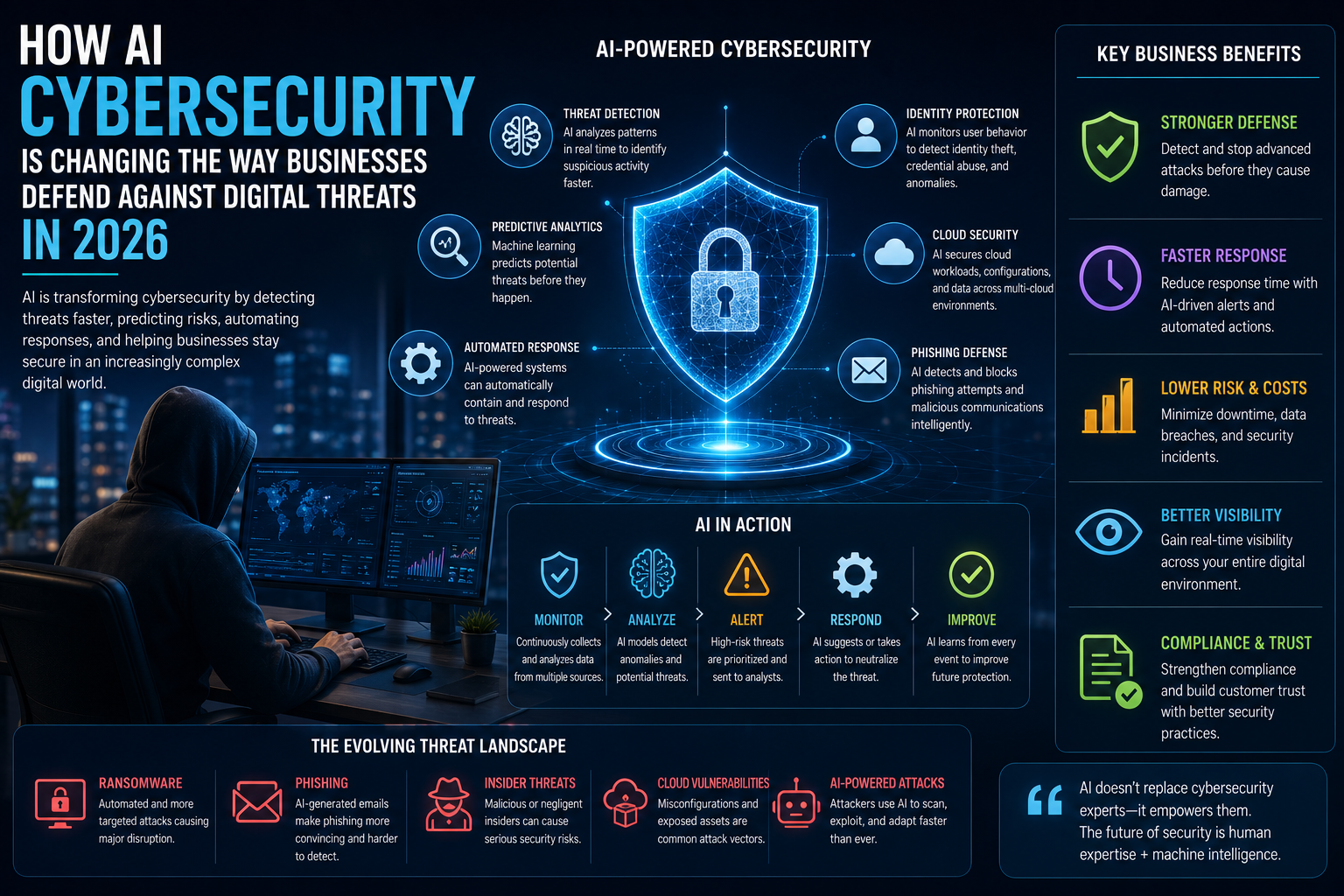
Cybersecurity has become one of the most important priorities for modern businesses. As organizations move more operations into cloud platforms, connected applications, digital infrastructure, and AI-powered systems, the number of potential attack surfaces continues to expand.
At the same time, cybercriminals are also gaining access to increasingly sophisticated technologies. Automated attacks, social engineering, credential theft, ransomware, and identity-based threats can be launched at greater speed and scale than traditional security teams were designed to handle.
In 2026, artificial intelligence is changing this equation.
AI-powered cybersecurity systems can analyze enormous amounts of information, identify unusual activity, prioritize potential threats, and support security teams in responding faster. Instead of relying entirely on predefined rules and manual investigation, organizations can use AI to continuously examine digital environments and identify patterns that may indicate an attack.
The result is a shift from reactive cybersecurity toward more intelligent, predictive, and automated defense.
The Growing Complexity of Cybersecurity
Modern businesses rarely operate from a single technology environment.
A typical organization may use cloud infrastructure, remote-access systems, SaaS applications, mobile devices, APIs, databases, employee endpoints, connected devices, and third-party platforms.
Each connection can introduce additional security considerations.
Traditional cybersecurity tools can generate alerts when suspicious activity is detected, but security teams may receive thousands of alerts every day. Determining which events represent genuine threats can become difficult when human analysts have limited time.
AI can help address this problem by analyzing large volumes of security information and identifying patterns that deserve attention.
Instead of treating every alert equally, intelligent systems can help prioritize threats according to potential risk.
AI-Powered Threat Detection
One of the most important applications of AI in cybersecurity is threat detection.
AI systems can examine network traffic, login activity, endpoint behavior, application events, and other signals to identify unusual patterns.
For example, an employee may normally access company systems from one location during regular business hours. If the same account suddenly attempts to access sensitive information from an unfamiliar location while displaying unusual behavior, an AI security system can flag the activity for investigation.
The value comes from analyzing multiple signals together rather than relying on a single rule.
AI can identify relationships between events that may appear harmless individually but become suspicious when considered as part of a larger pattern.
Moving From Reactive to Predictive Security
Traditional cybersecurity often responds after suspicious activity has already occurred.
AI creates an opportunity to become more proactive.
Machine-learning systems can study historical incidents, attack patterns, vulnerabilities, and system behavior to identify conditions associated with potential threats.
Security teams can then use these insights to strengthen defenses before an incident develops.
Predictive cybersecurity does not mean that AI can perfectly predict every future attack. Cyber threats are constantly evolving, and attackers can deliberately change their behavior.
However, AI can help organizations identify risk signals earlier and prepare more effectively.
AI and Identity Security
Identity has become a major component of modern cybersecurity.
Employees, customers, contractors, applications, and automated systems may all require access to digital resources.
Compromised credentials can therefore create significant risks.
AI can monitor authentication patterns and identify unusual account behavior.
A system may detect repeated login failures, unexpected access attempts, unusual device activity, or sudden changes in the type of information an account accesses.
This can help security teams investigate potentially compromised identities before attackers move deeper into the organization.
As businesses deploy more AI agents, identity management becomes even more important because automated systems themselves may require access to business applications and data.
Defending Against AI-Enhanced Attacks
AI is not only being used by defenders.
Attackers can also use automation and intelligent tools to improve phishing campaigns, generate convincing messages, identify potential targets, and accelerate reconnaissance.
This creates an environment in which traditional defenses may need to become more adaptive.
Security teams can use AI to analyze suspicious communications, detect unusual patterns, identify potentially manipulated content, and prioritize investigations.
The cybersecurity industry is therefore entering a period in which AI is being used on both sides of the security equation.
The organizations that can deploy defensive AI responsibly and effectively may gain an important advantage.
AI-Powered Security Operations Centers
Security operations centers, or SOCs, are responsible for monitoring and responding to cybersecurity events.
These teams can face enormous amounts of information.
AI-powered security operations can help automate parts of the investigation process.
When an alert appears, an AI system may gather relevant information, examine related events, summarize the situation, and suggest possible next steps.
Security analysts can then review the findings rather than starting every investigation from scratch.
This can reduce repetitive work and allow experienced security professionals to focus on complex incidents.
Automating Incident Response
AI can also support incident response.
When a potential threat is identified, organizations may need to determine what systems are affected, whether credentials have been compromised, and what actions should be taken.
AI-powered systems can help collect and organize this information quickly.
For lower-risk situations, organizations may allow automated systems to perform predefined actions, such as isolating a suspicious endpoint or temporarily restricting access.
For high-impact actions, human approval should remain part of the process.
The objective is to increase response speed without allowing automated systems to make uncontrolled decisions.
Protecting Cloud Environments
Cloud adoption has transformed business infrastructure, but it has also created new security challenges.
Organizations may operate workloads across multiple cloud platforms, creating complex environments that require continuous monitoring.
AI can help analyze cloud configurations, user activity, network behavior, and application events.
It can identify unusual changes or patterns that may indicate misconfiguration or malicious activity.
This is particularly valuable for organizations that operate large cloud environments where manual monitoring would be difficult.
Securing AI Systems Themselves
As businesses adopt AI, cybersecurity must also protect the AI systems.
AI applications can interact with sensitive data, internal systems, and external tools.
Generative AI applications may also face risks involving malicious inputs, unauthorized data exposure, manipulated information, and inappropriate access.
Businesses therefore need security controls specifically designed for AI environments.
This can include access management, monitoring, input validation, data protection, model evaluation, and human oversight.
AI security should be considered part of the organization's broader cybersecurity strategy rather than treated as a separate issue.
The Importance of Human Expertise
Despite the growing capabilities of AI, cybersecurity will remain a human-centered discipline.
AI can process information quickly, but security professionals understand business context, organizational priorities, and the consequences of different actions.
An AI system may identify suspicious activity, but an experienced analyst needs to determine whether the activity represents a genuine threat.
Human oversight is particularly important when automated systems are allowed to take defensive actions.
The most effective cybersecurity model is therefore likely to combine machine speed with human judgment.
Data Quality Determines AI Security Performance
AI cybersecurity systems depend heavily on data.
If security logs are incomplete, outdated, or poorly integrated, AI models may have difficulty identifying meaningful patterns.
Organizations need reliable visibility across their digital infrastructure.
Security teams should ensure that important systems generate useful logs and that relevant information can be analyzed together.
The better the visibility, the more effectively AI can identify abnormal behavior.
AI Cybersecurity and Business Resilience
Cybersecurity is no longer simply an IT concern.
A major security incident can affect operations, revenue, customer trust, regulatory compliance, and corporate reputation.
AI-powered security can contribute to broader business resilience by helping organizations identify threats earlier and respond more quickly.
The goal is not merely to prevent attacks.
Organizations also need the ability to continue operating and recover when incidents occur.
AI can support this process by improving monitoring, prioritizing risks, and helping security teams understand incidents more rapidly.
Building an AI-Powered Cybersecurity Strategy
Businesses should not attempt to automate cybersecurity overnight.
A practical approach is to begin by identifying areas where security teams experience the greatest workload.
Alert prioritization, threat detection, identity monitoring, security investigations, and incident analysis can provide useful starting points.
Organizations should establish clear rules for what AI systems can monitor and what actions they are allowed to take.
Performance should also be measured using practical indicators such as detection accuracy, response time, false-positive rates, and investigation efficiency.
As organizations gain confidence, AI capabilities can gradually be expanded.
The Future of AI Cybersecurity
The future of cybersecurity will likely involve increasingly intelligent systems that continuously monitor business environments.
AI agents may eventually work alongside security analysts, investigating incidents, gathering evidence, recommending responses, and monitoring systems around the clock.
Multiple specialized AI systems could collaborate across identity security, endpoint protection, cloud security, network monitoring, and threat intelligence.
However, governance will become increasingly important as these systems gain greater autonomy.
Businesses will need clear policies defining permissions, accountability, escalation procedures, and human oversight.
Conclusion
AI cybersecurity is transforming how businesses defend themselves against increasingly complex digital threats in 2026.
Artificial intelligence can help organizations analyze enormous amounts of security information, identify unusual behavior, prioritize threats, support incident response, and improve the efficiency of security teams.
Its greatest value may come from combining continuous machine analysis with human expertise.
AI can monitor digital environments at a scale that would be difficult for human teams to achieve alone, while cybersecurity professionals can provide the judgment necessary to interpret threats and make high-impact decisions.
As businesses become more dependent on digital infrastructure, cybersecurity will become increasingly connected to overall business resilience.
The organizations that successfully combine AI, strong security practices, reliable data, and human expertise will be better positioned to defend their operations in an increasingly complex digital environment.
In 2026, the future of cybersecurity is not simply about building stronger digital walls. It is about creating intelligent security systems that can see threats earlier, understand them faster, and help organizations respond before small problems become major disruptions.