Workforce planning has traditionally been a complex process based on historical data, employee surveys, management forecasts, and long-term business assumptions. Companies have had to estimate how many employees they will need, which skills will become important, and where talent shortages might emerge.
In 2026, artificial intelligence is changing that process.
AI-powered workforce planning is giving organizations new ways to analyze employee data, forecast talent requirements, identify skills gaps, and prepare for changing business conditions. Instead of treating workforce planning as an annual HR exercise, companies can increasingly approach it as a continuous strategic process.
The shift is particularly important as businesses adopt automation, AI agents, cloud technologies, and new digital operating models. The workforce of the future may require very different skills from the workforce of the past.
What Is AI-Powered Workforce Planning?
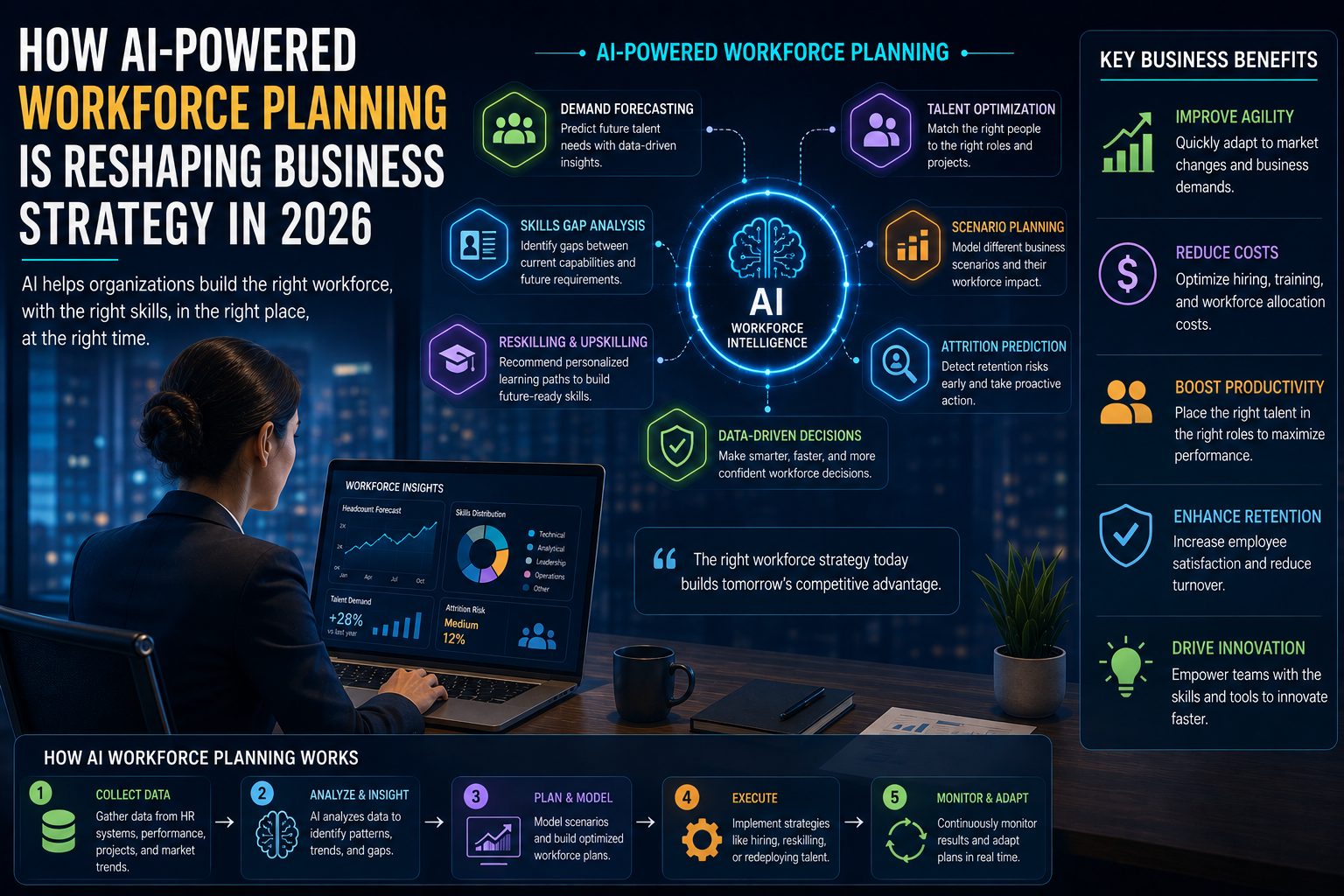
AI-powered workforce planning uses artificial intelligence, analytics, and business data to help organizations make better decisions about their workforce.
Traditional planning may rely on spreadsheets and historical staffing patterns. AI-enabled systems can analyze much larger collections of information, including employee skills, business performance, turnover patterns, project requirements, hiring trends, and market conditions.
An AI system can then identify potential workforce gaps and help managers explore different scenarios.
For example, a company planning to expand into a new market could use AI to estimate the number of employees required, identify missing skills, evaluate internal talent, and determine whether hiring, training, or outsourcing would be the most appropriate strategy.
The goal is not to allow AI to make every HR decision. Instead, AI can provide decision-makers with faster and more comprehensive insights.
Why Workforce Planning Is Changing
Business conditions can change much faster than traditional workforce planning cycles.
A company may launch a new product, enter a new market, adopt automation, restructure operations, or experience unexpected changes in customer demand.
A workforce plan created at the beginning of the year may no longer reflect business needs several months later.
AI can help organizations continuously analyze changing conditions.
Instead of asking only, “How many employees will we need next year?” companies can begin asking more dynamic questions:
Which skills will we need over the next six months?
Where are our biggest talent gaps?
Which roles are likely to change because of automation?
Which employees could be trained for emerging responsibilities?
What happens to workforce requirements if business growth accelerates or slows?
This makes workforce planning more flexible and strategic.
Identifying Skills Gaps
One of the most valuable applications of AI in workforce planning is skills analysis.
Organizations often know the job titles they have but may not have a complete understanding of the skills available across their workforce.
AI can analyze employee profiles, project histories, certifications, training records, and other relevant information to create a more detailed picture of organizational capabilities.
It can then compare existing skills with projected business requirements.
For example, a company expanding its AI capabilities may discover that it has strong software-development talent but lacks expertise in AI governance, data engineering, or model evaluation.
Instead of immediately hiring externally, the company could identify employees with related skills who may be suitable for targeted training.
This approach can help organizations make better use of their existing talent.
AI and Internal Mobility
Internal mobility is becoming increasingly important as businesses try to retain experienced employees.
Employees may have skills that are not being fully used in their current positions.
AI-powered workforce platforms can identify potential connections between employees and internal opportunities.
For example, an employee working in operations may have analytical and project-management skills that could make them suitable for a new business role.
AI can help identify these possibilities by analyzing skills rather than relying only on job titles.
This can create new career opportunities for employees while helping businesses fill important positions internally.
Predicting Workforce Demand
AI can also help organizations forecast future workforce requirements.
Demand forecasting can consider factors such as business growth, seasonal patterns, product launches, customer demand, project pipelines, and operational changes.
A manufacturing company, for example, may expect higher demand during a particular period. AI can analyze historical production data and current market signals to estimate how many workers and which skills may be required.
A technology company preparing to launch a major product may use similar analysis to estimate demand for engineers, customer-support professionals, sales representatives, and technical specialists.
Forecasting does not eliminate uncertainty, but it can give leaders a stronger basis for planning.
Preparing for AI-Driven Job Changes
The rise of artificial intelligence is also changing the nature of work.
Some tasks are becoming automated, while other responsibilities are expanding.
This does not necessarily mean that entire occupations will disappear. In many cases, individual jobs may change as employees begin working alongside AI systems.
Workforce planning therefore needs to consider tasks and skills, not just job titles.
Organizations can use AI to identify which activities within a role are likely to become automated and which require human judgment, creativity, communication, or leadership.
This can help companies redesign roles and prepare employees for changing responsibilities.
Reskilling Instead of Replacing
One major opportunity created by AI workforce planning is more targeted reskilling.
Companies often struggle to determine which employees should receive training and which skills should be prioritized.
AI can analyze existing employee capabilities and compare them with future requirements.
Suppose an organization expects increasing demand for data analysis. AI could identify employees with strong numerical, business, or technical backgrounds who may be able to transition into data-focused roles with additional training.
This can be more efficient than relying entirely on external recruitment.
Reskilling can also help employees remain relevant as technology changes.
Improving Recruitment Strategy
AI-powered workforce planning can support recruitment by helping organizations understand where external hiring is genuinely necessary.
Instead of automatically opening new positions whenever a skill gap appears, companies can evaluate several options.
They might train existing employees, move people between teams, use contractors, automate certain tasks, or recruit new talent.
AI can help compare these scenarios based on business requirements and available workforce information.
Recruitment teams can then focus on roles where external hiring provides the greatest strategic value.
However, organizations must ensure that AI-assisted recruitment does not introduce unfair bias or make decisions without appropriate human review.
Scenario Planning for Business Leaders
Workforce planning becomes particularly powerful when combined with scenario analysis.
Executives can explore different business situations and examine their potential workforce consequences.
For example:
What if revenue grows faster than expected?
What if a new AI system automates part of an existing workflow?
What if the company enters another geographic market?
What if employee turnover increases?
What if a major project is delayed?
AI can help model the potential workforce implications of these scenarios.
This allows leadership teams to prepare multiple strategies instead of relying on a single forecast.
Supporting Employee Retention
Employee turnover can be expensive, particularly when organizations lose experienced employees with specialized knowledge.
AI can analyze workforce patterns to identify potential areas of concern.
Organizations may examine factors such as employee engagement, career progression, workload, compensation structures, training opportunities, and historical turnover.
The purpose should not be to create intrusive employee surveillance.
Instead, businesses can use aggregated and appropriately governed information to identify structural problems that may contribute to employee dissatisfaction.
Human managers can then investigate these issues and determine appropriate responses.
The Importance of Responsible AI
AI-powered workforce planning involves sensitive employee information, making responsible implementation essential.
Companies need clear policies covering data privacy, access permissions, security, transparency, and human oversight.
Employees should understand how AI is being used and what role it plays in workforce decisions.
High-impact decisions involving employment, compensation, promotion, or termination should receive appropriate human review.
AI should support workforce strategy rather than become an unchecked decision-maker.
Building an AI-Ready Workforce Strategy
Organizations can begin with relatively simple use cases.
The first step is to identify the workforce questions that are most important to the business.
Companies can then evaluate the quality of their employee and operational data.
Next, they can introduce AI tools for skills mapping, demand forecasting, internal mobility, or scenario analysis.
Results should be measured against practical outcomes such as reduced hiring delays, improved retention, faster skills development, or better workforce allocation.
Organizations should expand gradually as employees and managers gain confidence in the technology.
The Future of Workforce Planning
The future of workforce planning is likely to become more continuous and connected to overall business strategy.
AI systems may increasingly connect workforce information with financial forecasts, project pipelines, customer demand, operational data, and strategic objectives.
A change in business demand could automatically trigger a workforce analysis.
A new technology investment could generate recommendations about training requirements.
A skills shortage could prompt an evaluation of internal mobility, reskilling, and recruitment options.
This creates a more responsive workforce strategy.
Instead of HR planning being separate from business planning, workforce intelligence could become an integrated part of executive decision-making.
Conclusion
AI-powered workforce planning is changing how organizations prepare for the future of work in 2026.
By analyzing workforce data, forecasting demand, identifying skills gaps, supporting internal mobility, and modeling different scenarios, AI can help companies make more informed talent decisions.
The greatest opportunity may not be replacing employees with technology. It may be helping organizations understand how people and technology can work together more effectively.
Businesses that invest in reskilling, responsible AI governance, and continuous workforce intelligence can become more adaptable as markets and technologies change.
The workforce of the future will not be defined only by the number of employees a company has. It will increasingly depend on whether the organization has the right skills, the right people, and the right technology working together.
In 2026, workforce planning is becoming more than an HR function. It is becoming a strategic capability for building resilient, adaptable, and AI-ready businesses.