Procurement has traditionally been one of the most important yet complex functions inside large organizations. Businesses need to purchase software, equipment, raw materials, professional services, office supplies, and countless other products while maintaining cost control and supplier relationships.
For many companies, procurement still involves spreadsheets, manual approvals, emails, supplier comparisons, and lengthy contract reviews.
In 2026, artificial intelligence is changing this process.
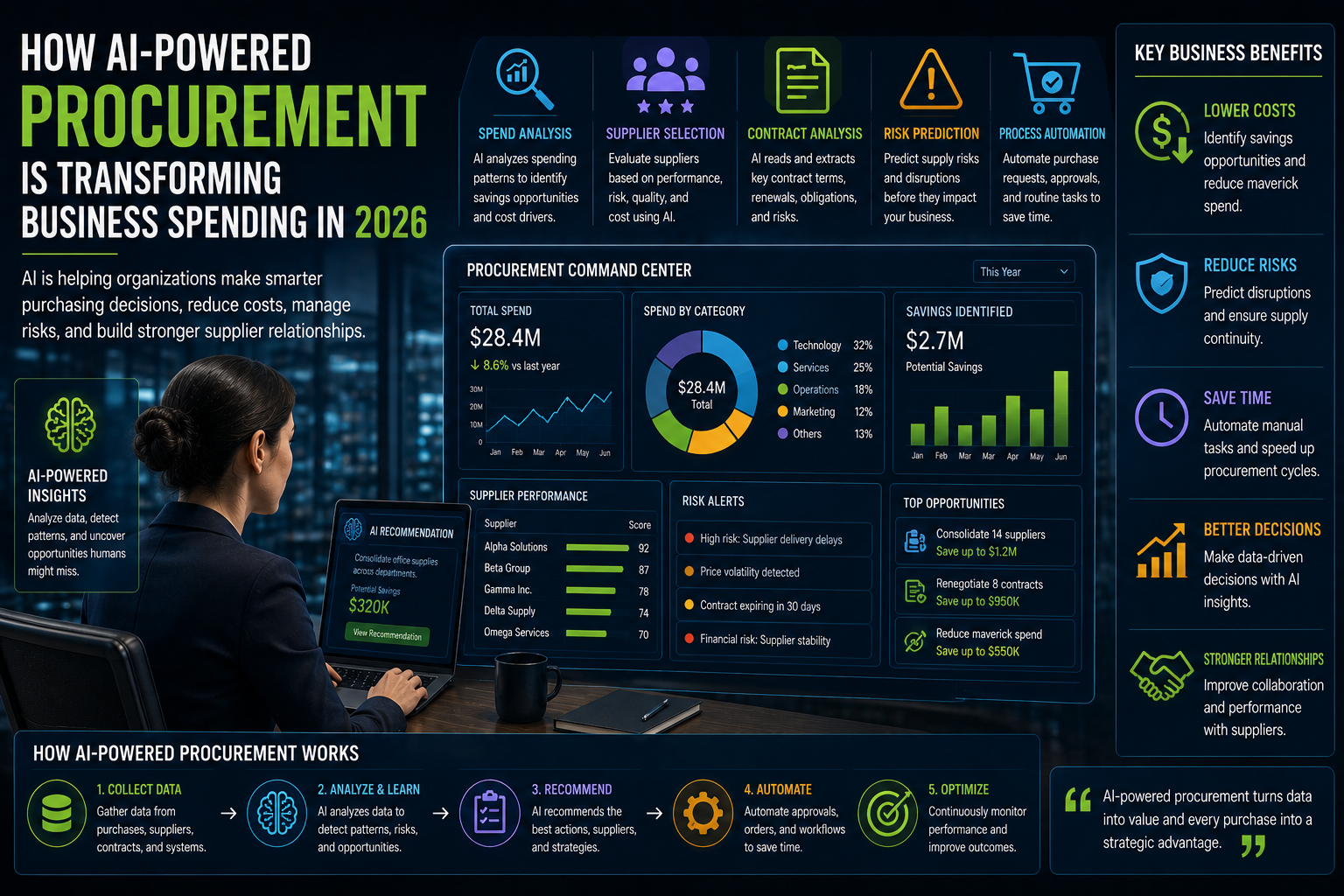
AI-powered procurement systems can analyze spending patterns, compare suppliers, identify cost-saving opportunities, automate repetitive purchasing tasks, and help organizations make faster decisions. Instead of treating procurement as a primarily administrative function, businesses are increasingly using technology to make purchasing a strategic source of efficiency and competitive advantage.
What Is AI-Powered Procurement?
AI-powered procurement combines artificial intelligence, machine learning, data analytics, automation, and business software to improve the purchasing process.
Traditional procurement systems primarily record transactions and manage purchase orders. AI-powered systems can analyze the information behind those transactions.
For example, an AI system can examine years of purchasing records to identify which suppliers receive the most spending, where prices vary, which products are frequently purchased, and where duplicate or unnecessary purchases occur.
This allows procurement teams to move from simply processing purchases to actively optimizing business spending.
Why Procurement Is Becoming an AI Priority
Companies operate under constant pressure to control costs while maintaining quality and business continuity.
Procurement represents a significant portion of operating expenses for many organizations. Even relatively small improvements in purchasing efficiency can create meaningful financial benefits when applied across thousands of transactions.
AI can analyze procurement information at a scale that would be difficult for human teams to manage manually.
Instead of reviewing individual purchases one by one, procurement professionals can use AI to identify broader spending patterns and focus their attention on the areas with the greatest potential impact.
Intelligent Spend Analysis
One of the strongest applications of AI in procurement is spend analysis.
Businesses often purchase similar products or services through different departments and suppliers. Without centralized visibility, organizations may pay different prices for similar items.
AI can examine purchasing records and group transactions into meaningful categories.
For example, a company may discover that several departments are independently purchasing similar software subscriptions.
The procurement team can then investigate whether consolidating those purchases could produce better pricing or reduce unnecessary subscriptions.
AI can also identify unusual spending patterns that deserve additional review.
Smarter Supplier Selection
Choosing the right suppliers involves more than comparing prices.
Businesses also need to consider delivery reliability, product quality, financial stability, geographic coverage, compliance, and previous performance.
AI can evaluate multiple supplier-related factors simultaneously.
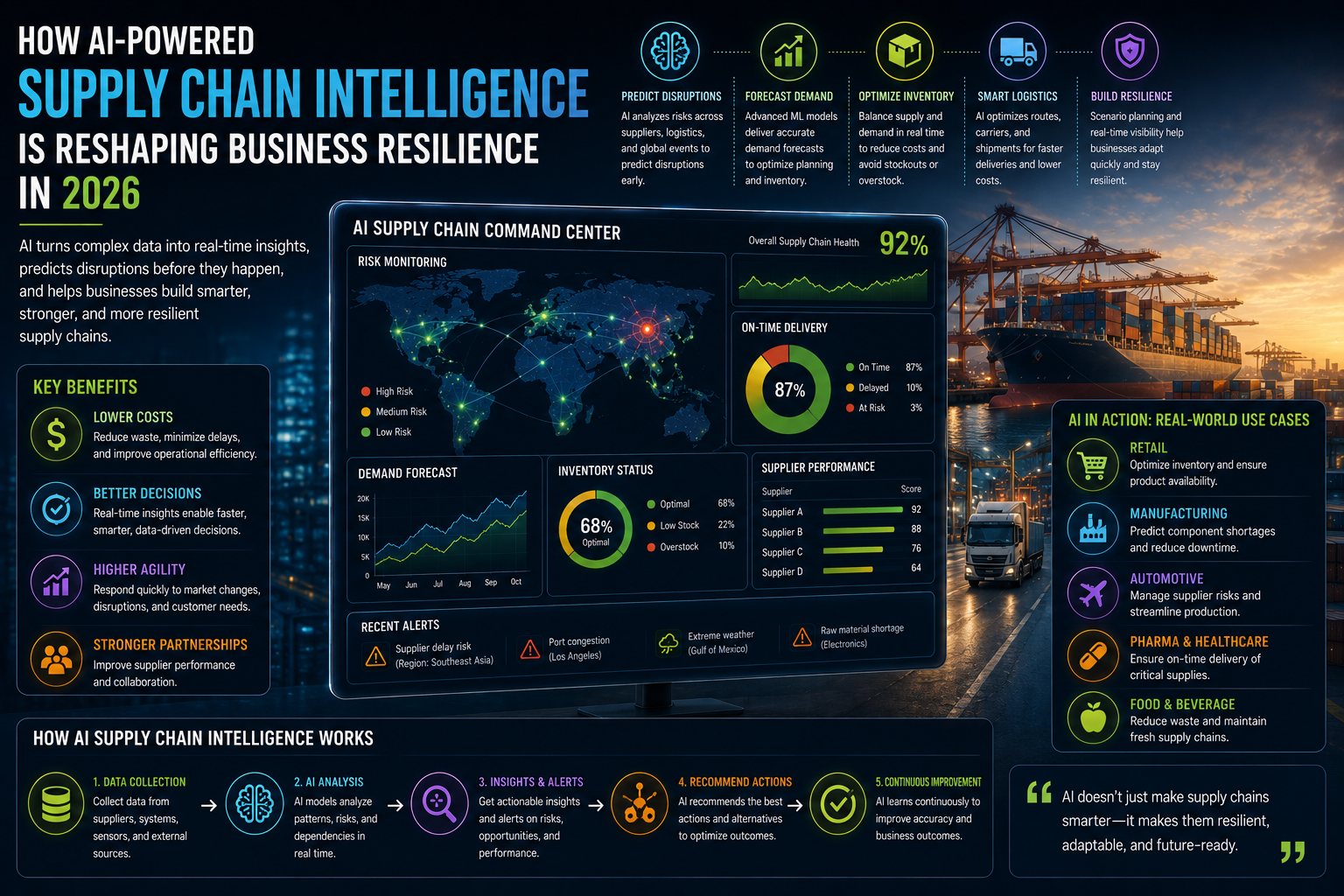
A procurement system could analyze historical delivery records, contract performance, pricing changes, quality reports, and other available information to help identify stronger suppliers.
This can make supplier evaluation more data-driven.
Human procurement professionals can then use those insights when negotiating contracts or selecting vendors.
Predicting Supply Risks
Supply-chain disruptions can create significant operational problems.
A supplier may experience production difficulties, transportation delays, financial stress, or other challenges that affect deliveries.
AI can monitor relevant signals and identify potential risks earlier.
For example, a company could use AI to analyze supplier performance history, delivery delays, market conditions, and purchasing patterns.
If a supplier begins showing unusual changes in performance, the system can alert procurement teams.
Early warning does not eliminate supply risk, but it gives businesses more time to explore alternatives.
Automating Purchase Requests
Procurement often involves repetitive administrative tasks.
Employees may need to submit purchase requests, obtain approvals, compare prices, create purchase orders, and update records.
AI-powered workflows can automate parts of this process.
For routine purchases that meet predefined requirements, an intelligent system can verify the request, identify approved suppliers, check pricing, and route the transaction through the appropriate approval process.
This can reduce processing time while allowing procurement employees to focus on more complex purchases.
AI-Powered Contract Analysis
Contracts contain valuable information about prices, renewal dates, obligations, service levels, and termination conditions.
Reviewing large numbers of contracts manually can take significant time.
AI can analyze contracts and extract important information.
For example, an AI system could identify upcoming renewal dates, compare pricing terms, highlight unusual clauses, and summarize supplier obligations.
This can help procurement and legal teams manage contracts more efficiently.
Human review remains essential for important agreements, but AI can reduce the amount of time required to locate relevant information.
Negotiation Support
AI can also support supplier negotiations.
By analyzing historical purchasing data, market information, supplier performance, and previous agreements, AI can help procurement professionals understand their negotiating position.
For example, a company may discover that it has consistently paid more for a particular service than comparable purchases elsewhere in the organization.
The procurement team can use that information when negotiating with the supplier.
AI does not replace negotiation expertise. Instead, it can provide better information before discussions begin.
Reducing Maverick Spending
Maverick spending occurs when employees purchase products or services outside approved procurement processes.
This can make spending difficult to control and may result in inconsistent pricing.
AI can identify purchasing behavior that falls outside established policies.
If employees repeatedly purchase similar products from unapproved suppliers, an intelligent procurement system can flag the activity.
Businesses can then investigate whether the problem is caused by poor procurement processes, limited supplier availability, or a lack of employee awareness.
Improving Procurement Forecasting
Procurement teams also need to anticipate future purchasing requirements.
AI can analyze historical purchasing patterns, business growth, seasonal demand, inventory information, and other relevant signals to forecast future needs.
For example, a manufacturer can use AI to estimate future demand for raw materials.
A technology company can forecast software and infrastructure requirements based on employee growth and project plans.
Better forecasting can help businesses avoid both shortages and unnecessary purchases.
Connecting Procurement With Finance
Procurement decisions have a direct impact on financial performance.
AI can connect purchasing information with financial data to provide a broader view of business spending.
Finance teams can see how purchasing decisions affect budgets and cash flow.
Procurement teams can better understand which purchasing activities have the greatest financial impact.
This creates stronger coordination between finance and procurement.
Instead of operating as separate departments, the two functions can use shared data to support better financial planning.
Improving Supplier Relationships
AI is not only about reducing supplier costs.
It can also help organizations build stronger supplier relationships.
Businesses can use AI to monitor supplier performance and identify recurring issues.
If a supplier consistently delivers high-quality products on time, the company can recognize that performance when making future decisions.
If problems repeatedly occur, procurement teams can investigate the underlying causes.
Better visibility can create more objective supplier evaluations and support longer-term partnerships.
The Role of Human Procurement Professionals
AI will automate some procurement tasks, but human expertise will remain important.
Procurement professionals understand business priorities, supplier relationships, negotiation strategies, and operational requirements.
AI may identify that a supplier offers the lowest price, but a procurement manager may know that another supplier provides significantly better reliability.
Human judgment is therefore essential when decisions involve complex trade-offs.
The future of procurement is likely to combine AI-driven analysis with human decision-making.
Security and Governance Challenges
Procurement systems can contain sensitive information about suppliers, pricing, contracts, and business spending.
Organizations need strong security controls to protect this information.
AI systems should only have access to the data necessary for their assigned tasks.
Companies should also establish clear rules for automated purchasing decisions.
High-value purchases, unusual transactions, and sensitive contracts may require human approval.
Strong governance can help businesses benefit from AI while reducing operational and security risks.
Building an AI Procurement Strategy
Companies do not need to automate their entire procurement function immediately.
A practical starting point is spend analysis.
Organizations can use AI to identify purchasing patterns, supplier concentration, duplicate spending, and potential savings opportunities.
From there, companies can introduce AI into supplier evaluation, contract analysis, purchase-request automation, and forecasting.
Each application should have measurable goals.
Businesses can track metrics such as processing time, purchasing costs, supplier performance, contract compliance, and procurement savings.
This allows organizations to determine whether AI is producing meaningful business value.
The Future of AI-Powered Procurement
Procurement is likely to become increasingly intelligent and connected.
Future AI systems may monitor purchasing needs continuously, identify potential suppliers, evaluate market conditions, recommend purchases, and initiate routine transactions within predefined rules.
AI agents could coordinate with finance, inventory, supply-chain, and enterprise systems to create more autonomous procurement workflows.
However, human oversight will remain important for high-value and strategic decisions.
The goal is not to remove people from procurement. It is to allow professionals to spend less time processing transactions and more time managing suppliers, negotiating strategically, and supporting business growth.
Conclusion
AI-powered procurement is transforming business spending in 2026 by turning purchasing data into actionable intelligence.
From spend analysis and supplier selection to contract management, forecasting, risk detection, and workflow automation, AI can help organizations make procurement faster and more strategic.
The biggest opportunity is not simply reducing prices. It is creating greater visibility across the entire purchasing process.
Businesses that combine AI with experienced procurement professionals can identify inefficiencies earlier, respond to supplier risks faster, and make more informed spending decisions.
As enterprise AI continues to mature, procurement may become one of the areas where intelligent automation produces measurable financial value.
The future of procurement will therefore not be defined by how many transactions a company can process. It will be defined by how intelligently the organization can decide what to buy, from whom, when, and at what value.