Businesses across manufacturing, transportation, energy, logistics, healthcare, construction, and other industries depend on physical equipment to keep operations running. When machines fail unexpectedly, the consequences can extend far beyond repair costs. Production can stop, deliveries can be delayed, customers can be affected, and employees may be forced to work around unexpected disruptions.
For decades, companies have relied on preventive maintenance to reduce these risks. Equipment is inspected and serviced according to fixed schedules, regardless of whether a machine actually needs attention.
In 2026, artificial intelligence is changing that approach.
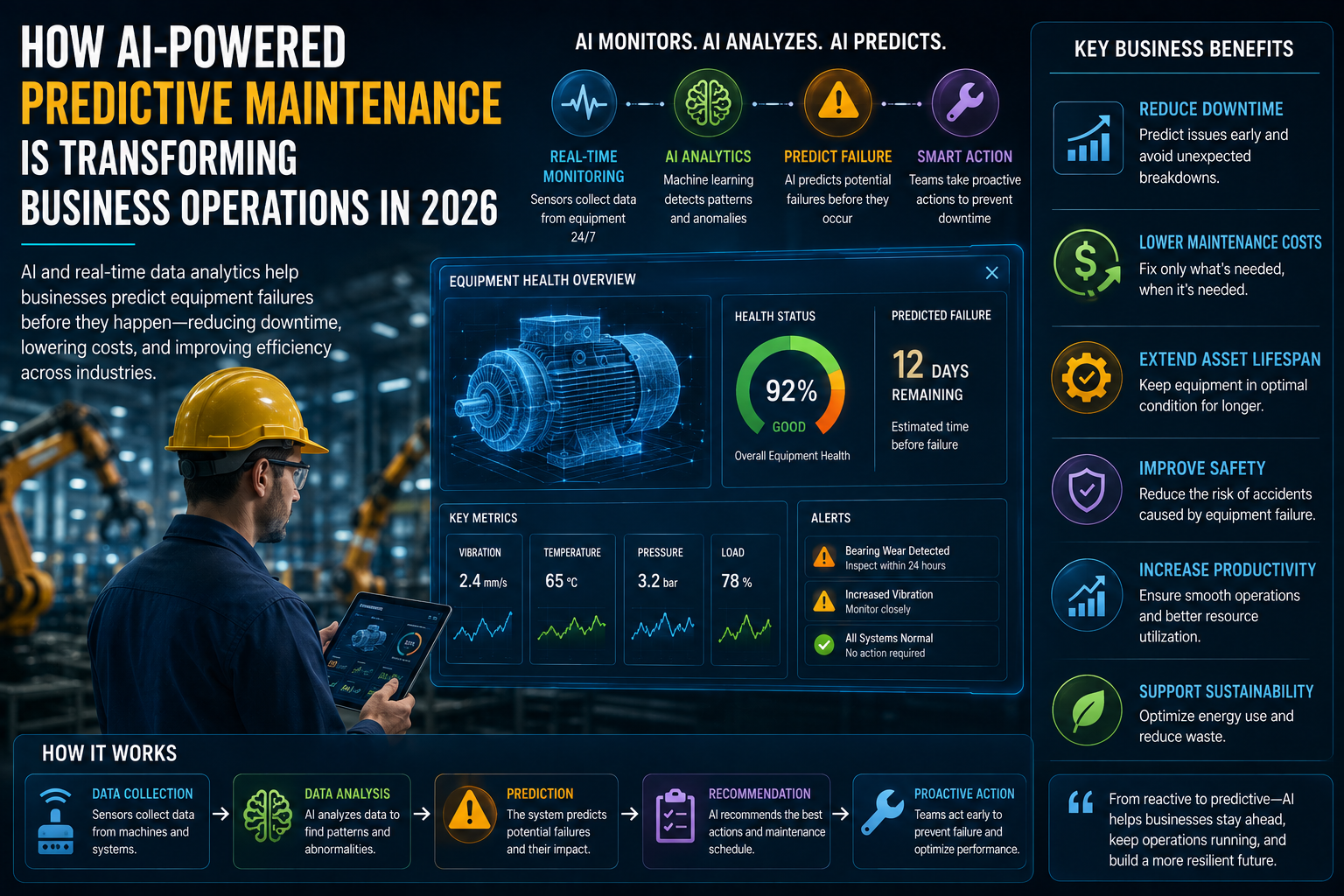
AI-powered predictive maintenance enables organizations to monitor equipment continuously, analyze operational data, identify unusual patterns, and estimate when maintenance may be required. Instead of servicing every machine according to a predetermined calendar, businesses can increasingly make maintenance decisions based on actual equipment conditions.
This shift is creating a more intelligent and data-driven approach to industrial operations.
What Is AI-Powered Predictive Maintenance?
Predictive maintenance uses sensors, machine-learning models, analytics, and operational data to identify signs that equipment may develop a problem.
Machines can generate enormous amounts of information, including temperature, vibration, pressure, energy consumption, operating speed, noise, and other performance indicators.
AI systems can analyze these signals and compare them with historical patterns.
If a machine begins behaving differently from its normal operating profile, the system can identify the change and alert maintenance teams.
For example, a manufacturing machine may normally operate within a particular vibration range. If its vibration gradually increases, an AI system could recognize the pattern as a potential indication of component wear.
Maintenance teams can then inspect the equipment before a serious failure occurs.
Moving Beyond Scheduled Maintenance
Traditional preventive maintenance is based largely on time.
A machine may receive servicing every three months or after a specific number of operating hours.
While this approach can reduce some risks, it also has limitations.
Equipment does not always deteriorate according to a predictable schedule. Some components may remain in good condition longer than expected, while others may develop problems earlier.
Predictive maintenance focuses on condition rather than simply time.
AI can continuously evaluate equipment performance and determine when intervention may be necessary.
This can help companies avoid unnecessary maintenance while reducing the likelihood of unexpected breakdowns.
Real-Time Equipment Monitoring
One of the biggest advantages of AI-powered maintenance is continuous monitoring.
Modern industrial environments can contain thousands of machines and sensors. Human employees cannot manually examine every data point in real time.
AI systems can.
They can monitor equipment continuously and identify changes that might otherwise be overlooked.
For large organizations, this creates a shift from periodic inspections toward continuous operational intelligence.
Maintenance teams can focus their attention on equipment that actually shows signs of potential problems rather than spending equal amounts of time inspecting every machine.
Reducing Unexpected Downtime
Unexpected downtime can be extremely expensive.
A production line may stop because of a damaged component, an overheating motor, a failed bearing, or an electrical problem.
The direct repair cost is only one part of the impact. Companies may also lose production capacity, miss delivery deadlines, and face customer dissatisfaction.
Predictive maintenance can help reduce these risks by identifying potential failures earlier.
When an AI system detects an abnormal pattern, maintenance teams have an opportunity to investigate the issue before the equipment reaches a critical failure point.
This does not guarantee that every breakdown can be prevented, but it can improve preparedness and reduce some avoidable disruptions.
Improving Maintenance Costs
Maintenance itself can be expensive.
Companies must purchase replacement parts, schedule technicians, stop equipment, and manage inventories.
Performing unnecessary maintenance can increase costs, while delaying essential maintenance can create much larger expenses later.
AI can help organizations find a better balance.
By analyzing equipment conditions, businesses can prioritize maintenance based on risk and urgency.
A machine operating normally may require no immediate action, while another showing multiple warning signals may require inspection.
This allows maintenance resources to be allocated more strategically.
Predicting Component Failures
AI systems can also help identify which components are most likely to fail.
A machine may contain dozens or hundreds of parts, but not every component presents the same level of risk.
Machine-learning models can analyze historical failure records and operational conditions to identify patterns associated with specific components.
Over time, these systems can become more useful as additional data becomes available.
This can help companies move from broad maintenance schedules toward more targeted interventions.
AI in Manufacturing
Manufacturing is one of the industries most likely to benefit from predictive maintenance.
Factories often rely on highly interconnected production equipment. A failure in one machine can affect multiple stages of a production process.
AI-powered monitoring can analyze machinery across the production environment and identify problems before they affect the wider system.
Manufacturers can also combine equipment information with production schedules and inventory data.
This allows maintenance decisions to consider the broader business context.
For example, if a machine requires servicing, the system could help identify an appropriate maintenance window that minimizes disruption to production.
Predictive Maintenance in Transportation
Transportation companies also depend heavily on equipment reliability.
Airlines, rail operators, shipping companies, trucking fleets, and public transportation systems can use AI to monitor vehicle performance.
Sensors can collect information about engines, brakes, tires, batteries, fuel systems, and other components.
AI can then identify unusual patterns and help maintenance teams prioritize inspections.
For fleet operators, this can improve vehicle availability and reduce unexpected failures.
The same principles can also apply to electric vehicles, where battery performance and charging behavior generate valuable operational data.
Energy and Utilities
Energy infrastructure presents another important use case.
Power plants, wind turbines, solar installations, pipelines, and electrical networks contain equipment that requires continuous monitoring.
A failure can have significant operational and financial consequences.
AI can analyze sensor information and environmental conditions to identify potential equipment problems.
For example, wind turbine operators can use operational data to identify changes in turbine performance and determine when maintenance may be needed.
This can help organizations manage large infrastructure networks more efficiently.
Predictive Maintenance in Healthcare
Healthcare organizations also depend on sophisticated equipment.
Imaging machines, medical devices, laboratory equipment, and hospital infrastructure need to remain operational.
Unexpected equipment failures can disrupt workflows and potentially delay services.
AI-powered predictive maintenance can monitor equipment performance and alert technical teams when unusual conditions appear.
This can help hospitals schedule maintenance proactively and reduce unexpected equipment downtime.
However, healthcare applications require especially strong safety, privacy, and regulatory controls.
Combining AI With Digital Twins
Predictive maintenance can become even more powerful when combined with digital twins.
A digital twin is a virtual representation of a physical asset or system.
Organizations can use operational data to create digital models that reflect how equipment behaves under different conditions.
AI can analyze these models and simulate potential scenarios.
For example, a company could estimate how a machine might perform under increased workloads or determine how a component failure could affect production.
This combination of AI, sensors, and digital simulation can provide businesses with a more comprehensive understanding of their physical infrastructure.
The Importance of High-Quality Data
Predictive maintenance depends heavily on data quality.
If sensors produce inaccurate information or equipment records are incomplete, AI models may produce unreliable predictions.
Organizations therefore need to establish strong data-management processes.
Sensor calibration, data validation, historical maintenance records, and consistent equipment identification can all improve the quality of AI analysis.
The goal is not simply to collect more data.
Businesses need to collect the right data and ensure that it can be interpreted reliably.
Human Expertise Still Matters
AI can identify patterns, but experienced maintenance professionals remain essential.
A prediction does not automatically explain why equipment is behaving differently.
Technicians can provide contextual knowledge that AI may not have.
For example, a maintenance professional may know that a particular machine behaves differently during seasonal temperature changes or after specific production adjustments.
The most effective approach combines AI-generated insights with human expertise.
AI can identify where attention is needed, while experienced professionals determine the appropriate response.
Cybersecurity Considerations
Connected equipment also creates cybersecurity challenges.
As more machines connect to networks and cloud-based monitoring systems, businesses need to protect operational technology from unauthorized access.
Predictive maintenance platforms may have access to sensitive operational information and, in some cases, connected control systems.
Organizations should therefore implement strong authentication, network segmentation, access controls, monitoring, and security policies.
AI adoption should not create new vulnerabilities in critical infrastructure.
Building a Predictive Maintenance Strategy
Businesses interested in predictive maintenance should begin with equipment where failures have significant consequences.
Organizations can identify machines that experience frequent breakdowns, generate high repair costs, or create major production disruptions.
Next, businesses can evaluate available sensor and maintenance data.
A pilot project can then be developed around a specific equipment category.
The company should measure outcomes such as reduced downtime, maintenance costs, equipment availability, and response times.
Successful applications can later be expanded across the organization.
The Future of Intelligent Maintenance
The future of maintenance is likely to become increasingly autonomous.
AI systems may eventually monitor equipment, identify potential problems, recommend maintenance actions, schedule service appointments, and automatically order replacement components within predefined rules.
Maintenance teams could then focus on complex repairs, strategic planning, and infrastructure improvements.
This does not mean physical operations will become completely automated.
Instead, AI can become an intelligent layer connecting equipment, data, maintenance teams, and business operations.
Conclusion
AI-powered predictive maintenance is transforming how businesses manage physical infrastructure in 2026.
By continuously analyzing equipment data, identifying unusual patterns, forecasting potential failures, and prioritizing maintenance, AI can help organizations improve reliability and operational efficiency.
The biggest opportunity is not simply repairing machines faster. It is changing the entire maintenance philosophy from reacting to failures toward anticipating potential problems.
Businesses that combine AI with high-quality sensor data, experienced technicians, cybersecurity, and strong operational processes can build more resilient infrastructure.
As connected equipment becomes increasingly common, predictive maintenance may become a fundamental component of intelligent business operations.
The future of industrial efficiency will increasingly depend on a simple principle: understand equipment before it fails, rather than waiting for failure to reveal the problem.