Artificial intelligence is becoming deeply integrated into modern business operations. Companies are using AI to analyze information, automate tasks, support employees, personalize customer experiences, improve forecasting, and develop new products. However, as organizations become more dependent on AI, one issue is becoming increasingly important: how businesses manage the data behind their AI systems.
AI systems depend on data. The quality, accuracy, security, and reliability of that data can directly influence the quality of AI-generated insights and decisions. If businesses use incomplete, outdated, biased, or poorly protected information, even sophisticated AI models may produce unreliable results.
This is why AI data governance is becoming an essential business priority in 2026.
What Is AI Data Governance?
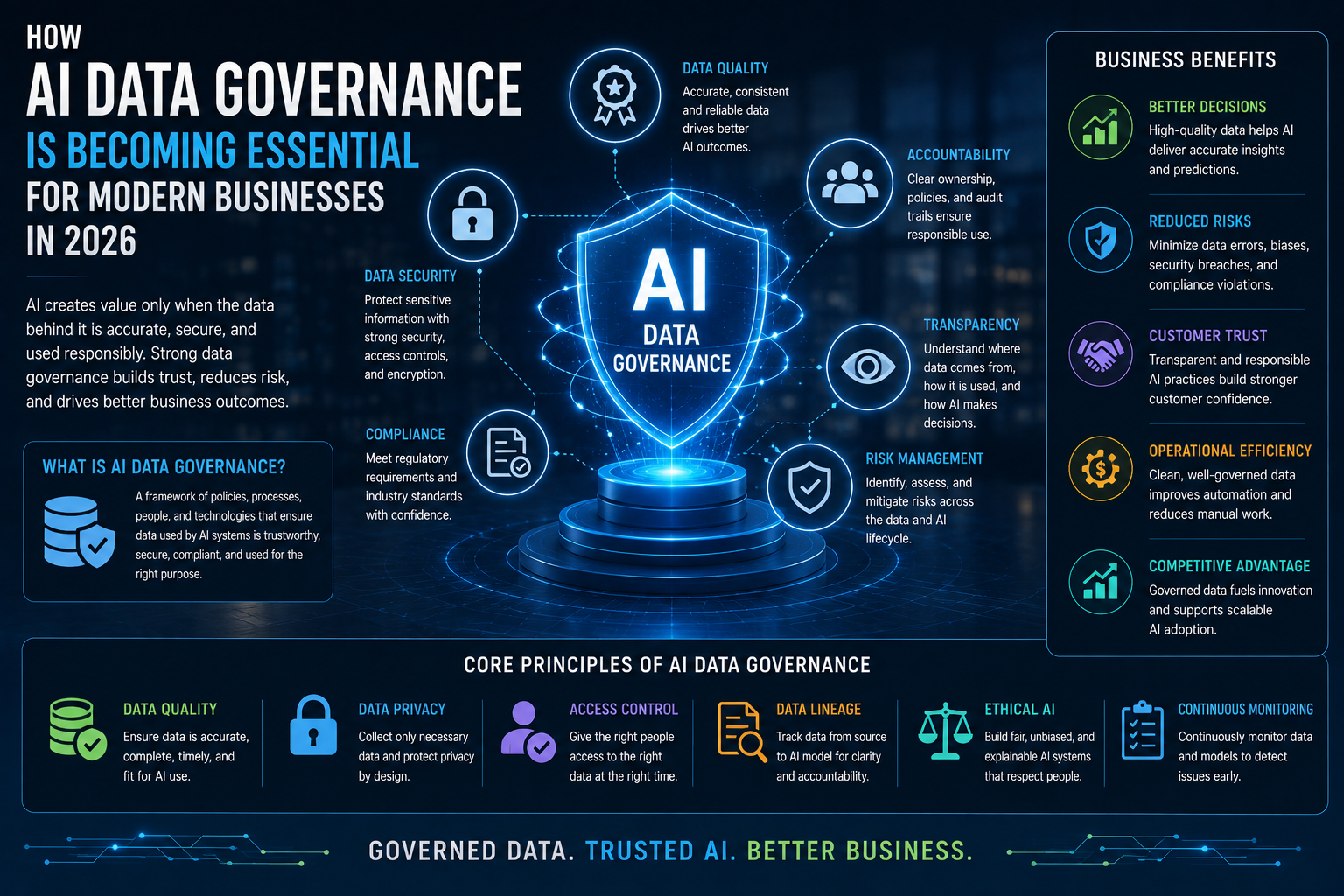
AI data governance refers to the policies, processes, technologies, and responsibilities organizations use to manage data throughout its lifecycle when that data is used by artificial intelligence systems.
It includes questions such as where data comes from, who can access it, how accurate it is, how it should be stored, and how it can be used.
Traditional data governance has existed for years, but AI introduces additional challenges. AI systems can process enormous quantities of information, including structured databases and unstructured content such as documents, emails, images, audio, and customer conversations.
Businesses therefore need stronger frameworks for understanding how data enters AI systems and how AI uses that information.
Why Data Quality Matters for AI
The saying “garbage in, garbage out” is particularly relevant to artificial intelligence.
If a business provides inaccurate or incomplete information to an AI system, the resulting output may also be inaccurate.
For example, an AI sales system working with outdated customer records may recommend inappropriate products or contact customers who are no longer active. An analytics system using incorrect financial data could produce misleading forecasts.
Data quality therefore becomes part of AI performance.
Businesses need processes for identifying duplicate records, correcting errors, updating outdated information, and establishing authoritative data sources.
The goal is to ensure that AI systems are working with information that is relevant, reliable, and appropriate for the intended purpose.
Protecting Sensitive Business Information
AI adoption also creates new data security challenges.
Businesses may use AI systems to process customer records, financial information, intellectual property, employee information, contracts, internal reports, and strategic documents.
Not every employee or AI application should have unrestricted access to this information.
Organizations need appropriate access controls that determine which users and systems can access specific data.
Security teams should also consider encryption, authentication, monitoring, and secure data storage.
As AI becomes integrated into more business processes, protecting the information used by AI systems becomes an important part of overall cybersecurity strategy.
Managing Data Access
One of the most important principles of AI governance is controlled access.
Employees should generally have access only to information necessary for their responsibilities. AI applications should follow similar principles.
For example, an internal AI assistant used by a marketing department should not automatically have access to confidential financial records simply because those records exist within the company's systems.
Organizations can establish permissions based on departments, roles, projects, and data sensitivity.
This creates a more controlled environment where AI can provide useful information without unnecessarily exposing sensitive business data.
Preventing Biased AI Results
Data governance also has an important role in reducing bias.
AI systems can learn patterns from the data used to train or operate them. If that information contains historical biases or incomplete representation, AI-generated results may reproduce or amplify those problems.
Businesses should therefore examine important datasets for potential quality and representation issues.
Testing AI systems across different scenarios can help organizations identify unexpected outcomes.
Human review is especially important when AI is used in areas such as recruitment, lending, insurance, customer eligibility, or other decisions that can significantly affect individuals.
Responsible governance can help organizations identify risks before they become larger problems.
Tracking Where Data Comes From
Another important aspect of AI governance is data lineage.
Businesses should understand where important information originates, how it has been modified, and where it is ultimately used.
This becomes increasingly difficult as organizations connect multiple databases, cloud applications, third-party platforms, and AI services.
A clear record of data sources can help businesses investigate problems when AI produces an unexpected result.
It can also make it easier to determine whether particular information is appropriate for a specific AI application.
AI Governance and Regulatory Requirements
Businesses are operating in an environment where AI regulation and data protection requirements continue to develop.
Different countries and industries may have different requirements regarding privacy, automated decision-making, data security, and transparency.
Companies therefore need to understand the rules that apply to their operations and customers.
AI governance can help organizations document how information is collected, processed, stored, and used.
Maintaining clear records and internal policies can make it easier to demonstrate responsible practices when required.
Building Trust With Customers
Customers are becoming more interested in how businesses use artificial intelligence.
A company may use AI to personalize recommendations, analyze customer behavior, automate support, or make operational decisions.
If customers do not understand how their information is being used, they may become uncomfortable with the technology.
Transparency can help build trust.
Businesses should communicate clearly about important AI applications and establish appropriate safeguards for customer information.
Trust can become a competitive advantage as AI adoption expands across industries.
AI Data Governance Supports Better Decision-Making
Data governance is not only about compliance and security.
It can also improve business performance.
When organizations establish reliable data standards, employees can spend less time questioning whether information is accurate.
AI systems can also produce more useful insights when they have access to consistent and well-managed information.
For example, a company with reliable customer data can create better sales forecasts, marketing strategies, and customer service experiences.
Strong governance therefore creates a foundation for more effective AI adoption.
Managing Third-Party AI Tools
Many employees now use AI tools provided by external companies.
These applications can improve productivity, but they can also create data-management risks if employees enter confidential information into systems without understanding how that information is handled.
Businesses should establish clear policies for using third-party AI platforms.
Employees should understand which types of information can safely be entered into external systems and which information should remain inside approved corporate environments.
Training is essential.
Employees do not need to become AI engineers, but they should understand basic data-security principles and the organization's AI policies.
AI Governance Requires Human Responsibility
Technology cannot solve every governance problem automatically.
Businesses need people who are responsible for data quality, security, compliance, and AI usage.
Depending on the organization's size, these responsibilities may involve data teams, IT departments, cybersecurity professionals, legal specialists, compliance teams, and business leaders.
Clear ownership is important.
If nobody is responsible for maintaining a dataset or reviewing an AI application, problems can remain unnoticed.
Effective governance therefore combines technology with clear organizational accountability.
Creating an AI-Ready Data Foundation
Companies preparing for wider AI adoption should begin by reviewing their existing data environment.
They can identify where important information is stored, which systems contain sensitive data, and where duplicate or outdated information exists.
Organizations can then establish data standards and access policies.
It may also be useful to create an inventory of AI applications being used across the business.
This helps management understand which AI systems are processing company information and whether they meet internal security and governance requirements.
Starting with a manageable number of high-value applications can make the process easier.
The Role of AI in Data Governance
Interestingly, AI can also help businesses manage their data.
Intelligent systems can identify duplicate records, detect unusual patterns, classify documents, monitor data quality, and identify potentially sensitive information.
This creates a feedback loop.
Businesses can use AI to improve data governance while using stronger governance to improve their AI systems.
However, automated data-management processes still require appropriate monitoring.
An AI system that incorrectly classifies sensitive information could create additional risk.
Human oversight remains necessary for important decisions.
The Future of AI Data Governance
As businesses deploy more AI applications, data governance is likely to become part of core technology strategy rather than a separate compliance function.
Organizations may increasingly establish centralized AI governance frameworks covering data quality, privacy, security, model management, access control, transparency, and employee usage.
AI systems may also become more connected to governance platforms that automatically monitor data flows and identify potential problems.
This could make responsible AI management more continuous and proactive.
Conclusion
AI is becoming one of the most important technologies in modern business, but its effectiveness depends heavily on the quality and management of the information behind it.
AI data governance gives organizations a framework for ensuring that data is accurate, secure, accessible to the right people, and used responsibly.
Strong governance can help businesses reduce risk, improve AI performance, protect sensitive information, support regulatory requirements, and build customer trust.
The goal is not to slow down AI adoption. Instead, effective governance allows companies to scale AI with greater confidence.
In 2026, businesses that treat data as a strategic asset and establish strong governance around AI will be better positioned to take advantage of intelligent technologies. The organizations that succeed will not simply be those with the most advanced AI models, but those that build the reliable, secure, and well-managed data foundations that allow those models to deliver meaningful business value.