
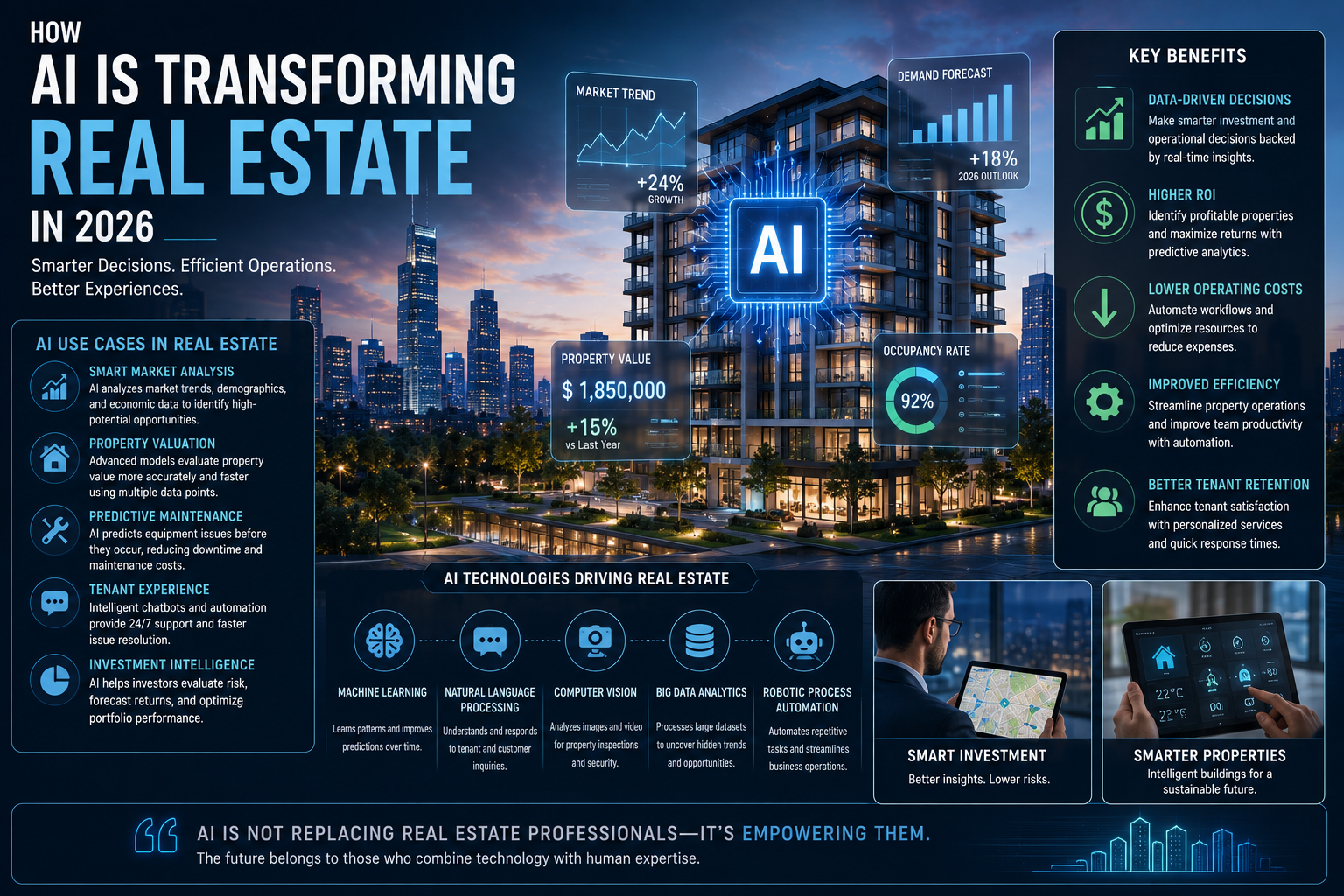
Artificial intelligence is changing industries across the global economy, and real estate is becoming one of its most interesting applications. Property companies, investors, developers, brokers, and property managers are increasingly using AI to analyze markets, evaluate opportunities, automate administrative work, and improve the experience of tenants and customers.
For decades, real estate decisions depended heavily on location, historical data, market experience, financial models, and professional judgment. These factors remain important, but the volume of information available to modern investors has increased dramatically.
AI can process large amounts of information much faster than traditional analytical methods. It can identify patterns across property data, market conditions, rental activity, demographic trends, economic indicators, and customer behavior.
In 2026, the combination of AI, real-time analytics, automation, and digital property platforms is creating a more data-driven approach to real estate.
AI Is Changing Property Market Analysis
Understanding a real estate market requires examining many different variables.
Investors may consider property prices, rental demand, population growth, employment conditions, interest rates, development activity, transportation infrastructure, and neighborhood trends before making a decision.
Traditional analysis can take considerable time, particularly when information comes from multiple sources.
AI can help organize and analyze these signals.
An intelligent system can compare large datasets and identify patterns that may be difficult to recognize manually. Investors can use these insights to explore potential opportunities and understand how different market conditions could affect a property.
AI does not eliminate uncertainty, but it can help decision-makers work with more information.
Predictive Analytics for Property Investment
One of the most valuable applications of AI in real estate is predictive analytics.
Investors want to understand how a property or market could perform in the future. Historical performance can provide useful information, but changing economic conditions can make forecasting difficult.
AI models can analyze historical property prices, rental activity, local development, demographic information, and other relevant variables to identify potential trends.
For example, an investor could use predictive analytics to compare several locations and identify areas showing signs of increasing demand.
These insights can support investment research, but they should not be treated as guaranteed predictions. Real estate markets can be influenced by unexpected economic, regulatory, political, and social changes.
Human expertise remains essential when interpreting AI-generated forecasts.
Smarter Property Valuation
Property valuation is another area where AI can assist professionals.
Traditional valuation methods consider factors such as location, size, condition, comparable properties, rental income, and market conditions.
AI can analyze larger datasets and identify relationships between these factors.
Automated valuation systems can help estimate property values and identify properties that may require additional review.
For large real estate portfolios, this can reduce the time required to evaluate individual assets.
However, automated valuation should complement professional assessment rather than replace it. Physical property conditions, unique characteristics, legal considerations, and local market knowledge may not always be captured completely by a model.
AI-Powered Property Management
AI is also changing the day-to-day management of properties.
Property managers handle numerous repetitive activities, including tenant communication, maintenance requests, scheduling, document processing, payment reminders, and reporting.
AI-powered systems can automate some of these tasks.
For example, an intelligent assistant can respond to common tenant questions, categorize maintenance requests, schedule appointments, and direct urgent issues to the appropriate team.
This can reduce administrative workloads and allow property managers to focus on more complex responsibilities.
Automation can also improve response times, which may contribute to better tenant experiences.
Predictive Maintenance for Buildings
Maintenance is one of the most important operational costs associated with property management.
Traditional maintenance often follows a fixed schedule or occurs after a problem becomes visible.
AI enables a more predictive approach.
Connected building systems can collect information about equipment, temperature, energy consumption, water systems, elevators, heating and cooling equipment, and other assets.
AI can analyze these signals and identify unusual patterns that may indicate a developing problem.
A property manager could receive an alert that an important system is operating outside its normal range and arrange an inspection before a major failure occurs.
Predictive maintenance can potentially reduce downtime, emergency repair costs, and disruption for occupants.
AI and Smart Buildings
Buildings are becoming increasingly connected.
Smart sensors can monitor occupancy, lighting, temperature, energy usage, security, and equipment performance.
AI can analyze this information to help buildings operate more efficiently.
For example, a smart office could adjust heating and cooling according to occupancy patterns rather than maintaining the same settings throughout the day.
Lighting systems could respond to room usage, while energy management platforms could identify areas of unnecessary consumption.
These applications can improve operational efficiency and potentially reduce energy costs.
They may also support sustainability goals as property owners look for ways to reduce resource consumption.
Improving Tenant Experience
Customer experience is becoming increasingly important in real estate.
Residential tenants, office occupants, hotel guests, and commercial customers expect faster communication and more convenient services.
AI can help property operators provide more responsive experiences.
Chat-based assistants can answer frequently asked questions, provide information about building services, help schedule maintenance, and guide customers through administrative processes.
AI can also analyze tenant feedback to identify recurring problems.
If many residents report the same issue, property managers can identify the pattern more quickly and prioritize an appropriate response.
AI in Real Estate Marketing
Marketing property effectively requires understanding what potential buyers or tenants are looking for.
AI can analyze customer behavior and help marketers identify relevant audiences.
Real estate companies can use AI to personalize communications, recommend properties, generate marketing content, and analyze campaign performance.
For example, an AI system may identify that a particular customer consistently views properties within a specific price range and location.
The company can then provide more relevant recommendations.
AI can also help generate property descriptions and marketing materials, although human review remains important to ensure that information is accurate.
Virtual Property Experiences
AI is also contributing to more advanced digital property experiences.
Potential buyers and tenants increasingly use online platforms to explore properties before scheduling physical visits.
AI can support virtual property searches by helping users identify properties based on preferences such as budget, location, size, amenities, and lifestyle requirements.
Combined with virtual tours and digital visualization, these systems can make property discovery more convenient.
The technology may be particularly useful for international investors or customers searching for properties in locations they cannot easily visit.
AI Can Help Manage Real Estate Portfolios
Large investors may own or manage hundreds of properties.
Managing such portfolios requires monitoring rental income, occupancy, maintenance, expenses, market conditions, and asset performance.
AI can help consolidate this information and identify properties that may require attention.
For example, an investment manager could use analytics to compare occupancy trends across properties or identify assets with unusually high maintenance costs.
This allows portfolio managers to prioritize their attention.
AI can also support scenario analysis by helping investors explore how changes in rental rates, operating costs, or market conditions could affect portfolio performance.
Real Estate Development and Planning
AI is also influencing property development.
Developers need to evaluate potential locations, construction costs, demand, infrastructure, regulations, and future market conditions before beginning a project.
AI can help analyze these factors and compare different scenarios.
For example, developers could evaluate how changing the mix of residential, retail, or office space might affect potential demand.
AI can also support design and planning by analyzing building layouts, energy efficiency, space utilization, and operational requirements.
This can help developers make more informed decisions before construction begins.
Data Privacy and Security
The increased use of AI creates important privacy considerations.
Real estate companies may handle sensitive information about tenants, buyers, employees, property owners, and financial transactions.
AI systems need to be designed with appropriate security and access controls.
Companies should determine which data can be used for AI analysis and ensure that sensitive information is handled responsibly.
Transparency is also important. Customers should understand how their information is being used when AI systems interact with them.
Strong governance can help businesses benefit from AI without compromising customer trust.
Human Expertise Still Matters
AI can analyze information quickly, but real estate remains a relationship-driven industry.
Successful investors, brokers, developers, and property managers rely on local knowledge, negotiation skills, experience, communication, and judgment.
AI should therefore be viewed as an assistant rather than a complete replacement for professionals.
An investor may use AI to identify an interesting opportunity, but a professional still needs to investigate the property, understand the local market, review financial information, and assess risks.
The best results are likely to come from combining machine intelligence with human expertise.
How Real Estate Businesses Can Start Using AI
Real estate companies do not need to transform their entire operations at once.
A practical approach is to begin with a specific problem.
Property managers could start with automated tenant communication or predictive maintenance. Investors could experiment with market analysis and portfolio analytics. Developers could use AI for scenario planning and design optimization.
Companies should establish measurable objectives before implementing a system.
Useful metrics may include reduced administrative costs, faster response times, lower maintenance expenses, improved occupancy, increased productivity, or better investment analysis.
Successful applications can then expand across the organization.
The Future of AI in Real Estate
AI is likely to become an increasingly important part of the real estate ecosystem.
Future platforms may combine predictive analytics, AI assistants, smart buildings, digital twins, automated property management, and real-time market intelligence.
Investors could receive continuously updated insights about their portfolios. Property managers could use AI systems that automatically identify operational problems. Tenants could interact with intelligent building assistants.
However, technology will not eliminate the importance of professional judgment.
The real advantage will come from using AI to improve the quality and speed of human decision-making.
Conclusion
AI is transforming real estate by making property analysis, valuation, management, maintenance, marketing, and investment decisions more data-driven.
The technology can process large volumes of information, identify patterns, automate repetitive tasks, and provide predictive insights that help professionals respond to changing market conditions.
At the same time, successful AI adoption requires reliable data, strong security, responsible governance, and human oversight.
For real estate companies, the opportunity is not simply to adopt AI because it is a major technology trend. The real opportunity is to use intelligent systems to solve practical problems and create better outcomes for investors, property managers, developers, tenants, and customers.
In 2026, AI is helping real estate move toward a more connected, predictive, and intelligent future. Businesses that combine technology with strong industry expertise can build more efficient operations and make better-informed decisions in an increasingly competitive property market.