Fraud has become increasingly difficult for businesses to manage in a digital economy. As financial transactions move online and customers use mobile applications, digital wallets, e-commerce platforms, and online banking services, criminals have more opportunities to exploit weaknesses.
At the same time, fraudulent activity is becoming more sophisticated. Attackers can use stolen credentials, social engineering, automated tools, fake identities, and increasingly convincing digital communications to target businesses and consumers.
Traditional fraud detection systems remain important, but many organizations are now turning to artificial intelligence to analyze financial activity more intelligently.
AI-powered fraud detection can examine large volumes of transactions, identify unusual patterns, assess risk signals, and help organizations respond more quickly. Instead of relying only on fixed rules, intelligent systems can evaluate behavior and relationships between multiple data points.
In 2026, AI is becoming an increasingly important component of modern financial risk management.
The Limitations of Traditional Fraud Detection
Traditional fraud prevention often relies on predefined rules.
For example, a financial institution may flag transactions above a certain amount, unusual locations, repeated failed login attempts, or activity that matches known fraud patterns.
These rules can be effective, but they have limitations.
Criminals constantly change their tactics, and legitimate customers may also behave in ways that appear unusual. A customer traveling to another country, purchasing an expensive item, or using a new device could trigger a security alert even when the transaction is completely legitimate.
This creates a difficult balance.
Businesses need to identify fraudulent activity without creating excessive friction for legitimate customers.
AI can help make this process more dynamic.
AI Can Analyze More Signals
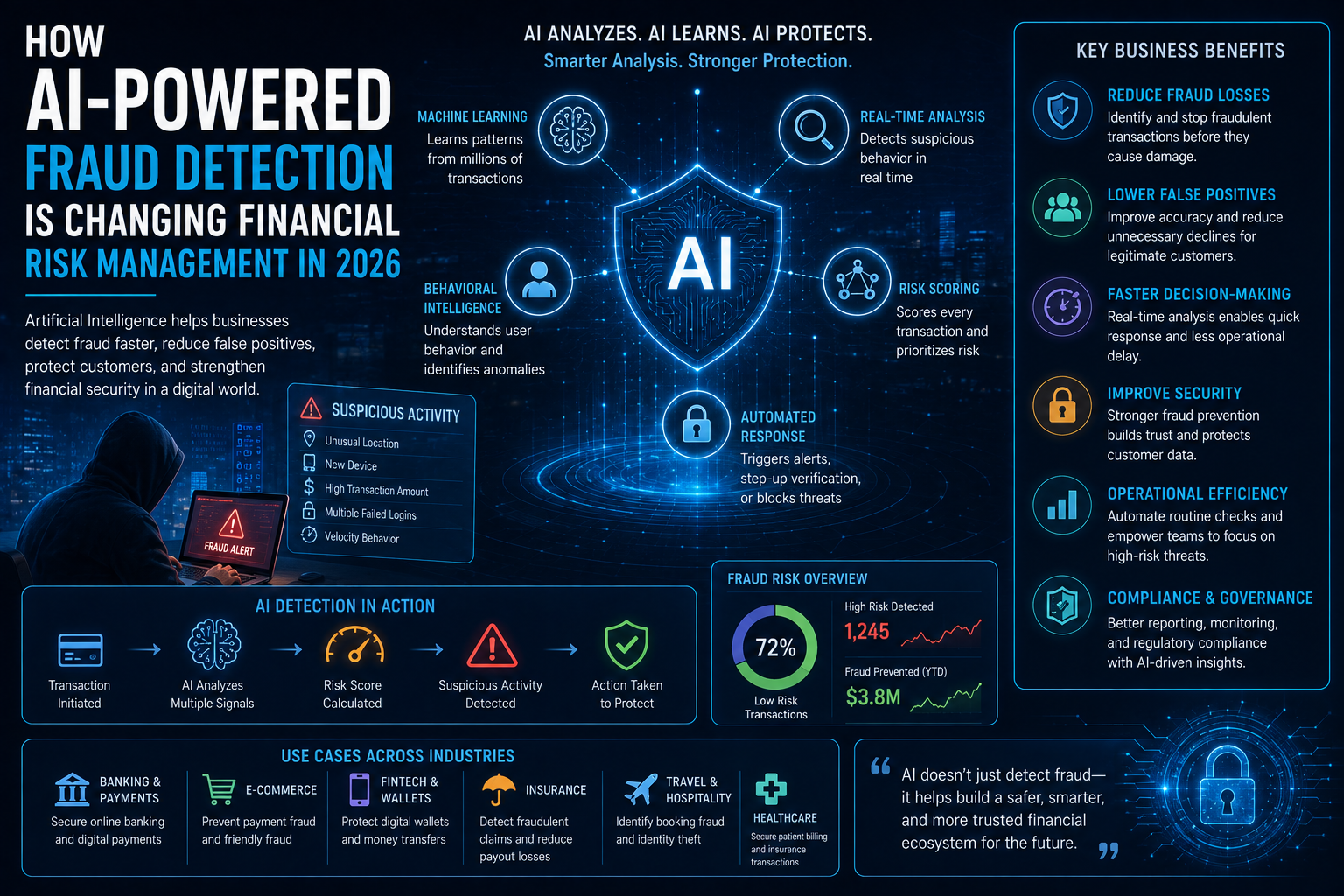
One of the biggest advantages of AI-powered fraud detection is its ability to evaluate multiple signals simultaneously.
A transaction does not exist in isolation. Its risk may depend on the customer's previous behavior, device information, location, transaction history, account activity, and other relevant indicators.
AI systems can examine these relationships much faster than manual teams.
For example, a transaction might appear normal by itself. However, if it occurs immediately after a suspicious login, comes from an unfamiliar device, and follows several unusual account changes, the combined pattern may indicate elevated risk.
AI can help connect these signals and prioritize the activity for further investigation.
Behavioral Analysis Is Becoming More Important
Fraud detection is increasingly moving from transaction-based analysis toward behavioral analysis.
Instead of asking only whether a particular transaction looks suspicious, organizations can examine whether the overall behavior of an account is consistent with its normal activity.
For example, a customer may usually make small purchases during the day from one region. A sudden series of large transactions from unfamiliar devices could represent a significant behavioral change.
AI systems can learn patterns of normal activity and identify meaningful deviations.
This does not automatically mean that unusual behavior is fraudulent. Instead, it provides an additional risk signal that can be evaluated alongside other information.
Reducing False Positives
False positives are a major problem for financial businesses.
A legitimate transaction that is incorrectly identified as fraud can frustrate customers, interrupt purchases, and create unnecessary work for fraud investigation teams.
If security systems become too aggressive, customers may experience repeated account blocks or payment declines.
AI can help improve risk scoring by considering more contextual information.
Rather than applying the same rule to every customer, an intelligent system can evaluate the circumstances surrounding a transaction.
This can allow organizations to focus their strongest security measures on higher-risk activity while reducing unnecessary disruption for legitimate users.
AI and Identity Verification
Identity fraud is another growing concern.
Criminals may attempt to create accounts using stolen personal information or manipulate identity verification processes.
AI can support identity verification by analyzing multiple signals during onboarding and account activity.
Depending on the application, organizations may use automated systems to identify inconsistencies in submitted information, unusual behavior, or suspicious patterns across accounts.
The objective is to make it more difficult for fraudulent identities to enter financial systems while keeping legitimate onboarding convenient.
Human review remains important for complex or high-risk cases.
Fighting Account Takeover
Account takeover occurs when criminals gain unauthorized access to a legitimate user's account.
This can happen through stolen passwords, phishing, malware, social engineering, or compromised credentials.
AI can help identify unusual account behavior.
A sudden password change followed by an unfamiliar login, unusual transaction activity, and changes to account information could create a higher-risk pattern.
An intelligent system can evaluate these events together instead of treating them as unrelated activities.
Businesses can then apply appropriate security measures, such as additional authentication or temporary review.
AI Is Helping Detect Payment Fraud
Digital payments have created enormous convenience for consumers and businesses, but they also create new fraud risks.
Online merchants need to determine whether transactions are legitimate while keeping checkout processes fast.
AI-powered systems can analyze transaction characteristics and assign risk scores in real time.
A low-risk transaction may proceed normally, while a transaction with multiple suspicious indicators may receive additional verification.
This approach can help businesses protect revenue without creating unnecessary barriers for legitimate customers.
For e-commerce companies, this balance is particularly important because excessive payment friction can contribute to abandoned purchases.
Detecting Fraud Networks
Modern fraud is not always carried out by isolated individuals.
Criminal networks can use multiple accounts, devices, payment methods, addresses, and identities.
AI can help identify relationships between these seemingly separate entities.
For example, several accounts may appear independent but share unusual characteristics or activity patterns.
Network analysis can help investigators identify connections that would be difficult to detect by reviewing individual transactions.
This can make fraud detection more proactive.
Instead of focusing only on individual suspicious transactions, organizations can investigate broader patterns that may indicate coordinated activity.
AI Can Improve Fraud Investigation
Fraud detection is only one part of the process.
Once suspicious activity is identified, investigators need to understand what happened.
Large organizations can have enormous amounts of transaction and account information to review.
AI can help investigators summarize relevant activity, identify connected events, organize evidence, and prioritize cases.
This can reduce the amount of repetitive analysis performed manually.
Fraud professionals can then spend more time on complex investigations and decisions that require human judgment.
Real-Time Risk Scoring
The speed of fraud detection can be critical.
If suspicious activity is identified hours or days after it occurs, the organization may have fewer options for preventing losses.
AI can support real-time risk scoring by evaluating transactions as they happen.
A system can consider multiple risk signals and produce an assessment within a short period.
This allows organizations to respond before potentially fraudulent activity develops into a larger problem.
Real-time analysis can be especially valuable for digital payments, online banking, e-commerce, and other high-volume environments.
The Importance of Data Quality
AI-powered fraud detection depends heavily on data.
If information is incomplete, outdated, inaccurate, or poorly connected, intelligent systems may struggle to identify meaningful patterns.
Organizations therefore need strong data infrastructure.
Relevant information needs to be collected consistently, securely stored, and made available to authorized systems.
Businesses should also establish clear definitions for important data fields and maintain appropriate data governance.
The quality of the data directly influences the usefulness of AI-based risk analysis.
Privacy and Responsible AI
Fraud detection involves sensitive information.
Financial activity, identity information, device details, location data, and customer behavior may all be used in risk analysis.
Businesses must therefore consider privacy and responsible data practices.
Customers should have appropriate protections, while organizations need to comply with applicable laws and regulations.
AI systems should also be monitored for inaccurate or unfair outcomes.
An automated risk score should not automatically be treated as proof of fraud.
Human review can be particularly important when a decision could significantly affect a customer.
AI Does Not Eliminate Human Expertise
Despite its capabilities, AI should not completely replace fraud professionals.
Experienced investigators understand financial behavior, business context, regulatory requirements, and the tactics used by criminals.
AI can process information at scale, but humans remain important for interpreting complex cases and deciding how to respond.
The strongest fraud prevention strategies combine automation with human expertise.
AI can identify patterns and prioritize cases, while professionals investigate and make important decisions.
Building a Modern Fraud Prevention Strategy
Businesses do not need to introduce AI across every part of their risk infrastructure immediately.
A practical approach is to identify specific areas where intelligent analysis can provide measurable benefits.
Transaction monitoring, account takeover detection, identity verification, payment risk scoring, and fraud investigation are potential starting points.
Organizations should establish clear performance indicators.
These could include fraud losses prevented, false-positive rates, investigation times, customer friction, and the number of suspicious activities identified.
Regular testing and monitoring can help organizations determine whether their AI systems are actually improving security.
The Future of AI-Powered Risk Management
Fraud prevention is likely to become increasingly intelligent as businesses adopt AI across financial operations.
Future systems may combine behavioral analysis, real-time risk scoring, identity intelligence, network analysis, and automated investigation into connected security environments.
AI agents may eventually assist fraud teams with repetitive investigative tasks while human professionals remain responsible for complex decisions.
The goal will not be to eliminate every fraudulent transaction. No security system can guarantee that.
Instead, organizations will aim to identify threats earlier, reduce losses, minimize customer friction, and respond more effectively when suspicious activity occurs.
Conclusion
AI-powered fraud detection is changing how modern businesses approach financial security.
By analyzing behavioral patterns, transaction signals, identity information, account activity, and relationships between different entities, AI can help organizations identify potential fraud more quickly and accurately.
The technology can also reduce false positives, improve investigation workflows, strengthen payment security, and support real-time risk management.
However, successful implementation requires more than advanced algorithms. Businesses need reliable data, strong cybersecurity, privacy protections, clear governance, and experienced professionals who can evaluate AI-generated insights.
As digital financial activity continues to expand, the ability to detect suspicious behavior quickly will become increasingly important.
In 2026, AI is giving businesses a powerful new way to approach fraud prevention—not by replacing human expertise, but by helping security and risk teams process more information, identify meaningful patterns, and make faster, better-informed decisions.