The software industry is entering another major transformation. For decades, business applications were designed around menus, dashboards, forms, databases, and predefined workflows. Employees were expected to learn the software and follow the processes built into it.
Artificial intelligence is beginning to reverse that relationship.
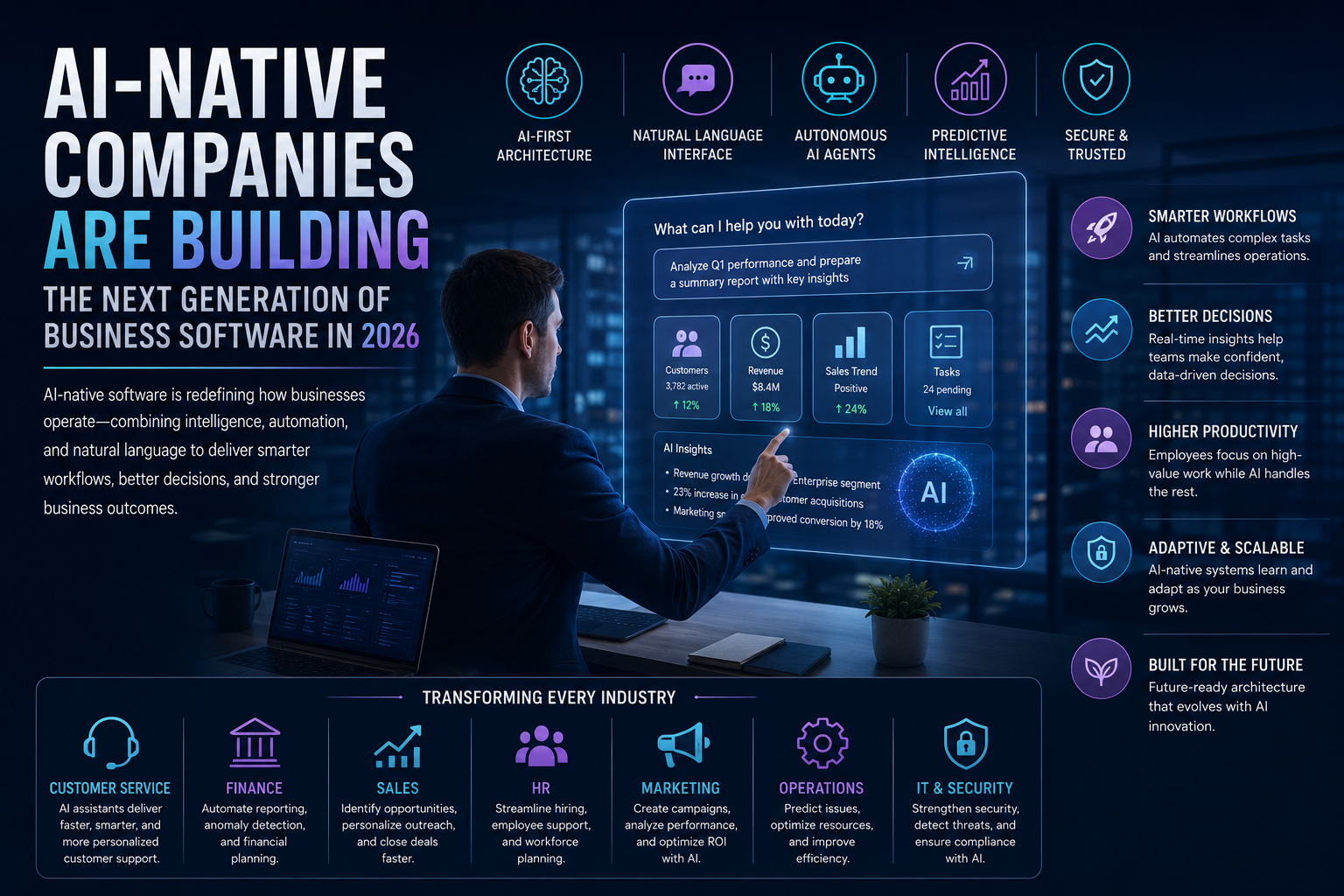
Instead of forcing employees to navigate complicated software, AI-native companies are building applications that can understand business goals, interpret information, make recommendations, and increasingly complete tasks on behalf of users.
This shift is creating a new generation of business software in which AI is not simply an additional feature. It is becoming part of the core architecture.
In 2026, AI-native software is moving beyond basic chatbots and copilots. Companies are experimenting with intelligent agents, natural-language interfaces, automated workflows, multimodal systems, predictive analytics, and software that continuously adapts to business needs.
What Is AI-Native Software?
AI-native software is designed around artificial intelligence from the beginning rather than adding AI to an existing application as an afterthought.
Traditional software typically follows a predictable structure. Users enter information, select options, navigate menus, and manually initiate workflows.
AI-native applications can operate differently.
Users can describe what they want in natural language, provide relevant documents or data, and allow the system to determine the steps required to accomplish the objective.
For example, instead of manually creating a sales report, an employee could ask an AI-native business platform to analyze recent sales performance, identify significant changes, compare results with previous periods, and prepare a summary.
The software becomes less like a tool that users operate and more like an intelligent system that helps users accomplish objectives.
Why the Software Model Is Changing
Traditional enterprise software became increasingly complex as businesses added more processes and requirements.
A single organization may use separate systems for customer relationship management, accounting, human resources, marketing, project management, analytics, communication, and operations.
Employees often have to move information between these systems.
AI creates an opportunity to simplify some of this complexity.
An intelligent layer can potentially connect information across applications and allow employees to interact with multiple systems through a single interface.
Instead of asking, “Which application should I open?” employees may increasingly ask, “What do I need to accomplish?”
The AI system can then determine which tools and information are relevant.
Natural Language Becomes a Software Interface
One of the biggest changes is the growing importance of natural language.
For decades, employees had to learn how enterprise software worked.
They needed to understand where information was stored, which buttons to select, and which workflows to follow.
AI-native software can reduce some of this learning burden.
An employee could say:
“Show me which customers have not renewed their contracts and prepare a follow-up list.”
The system could potentially search approved customer data, identify relevant accounts, organize the results, and prepare the requested information.
Natural language does not eliminate the underlying software.
Instead, it becomes a new interface for accessing it.
AI Agents Are Changing Automation
AI agents are taking this concept further.
A traditional automation system follows predefined rules. If one event occurs, a specific action happens.
AI agents can potentially handle more flexible workflows.
An agent could receive a business objective, determine the necessary steps, use approved tools, evaluate intermediate results, and continue until the task is completed or human approval is required.
For example, an operations agent could identify an inventory shortage, review purchasing information, compare approved suppliers, prepare a recommendation, and send the proposed order to a manager for approval.
This represents a move from workflow automation toward goal-oriented automation.
Software Becomes More Proactive
Traditional applications usually wait for users to initiate actions.
AI-native software can become more proactive.
An intelligent financial platform might identify unusual spending patterns and notify a manager.
A sales platform could recognize that an important customer has become less active.
A project-management system could identify a growing risk of delay.
A cybersecurity platform could prioritize unusual events.
The software becomes an active participant in business operations rather than simply a place where information is stored.
AI-Native CRM Platforms
Customer relationship management is one area where this transformation could be significant.
Traditional CRM systems require salespeople to enter information, update records, schedule activities, and review dashboards.
AI-native CRM systems can potentially automate more of this work.
An AI assistant could summarize customer interactions, identify important opportunities, prepare follow-up messages, and highlight accounts that require attention.
Instead of spending large amounts of time updating the CRM, sales professionals could spend more time communicating with customers.
The system becomes an assistant rather than simply a database.
AI-Native Finance Software
Finance departments also deal with large volumes of structured and unstructured information.
Invoices, transactions, contracts, financial reports, budgets, and emails all contribute to financial operations.
AI-native finance applications can potentially combine these sources.
An employee might ask the system to identify unusual expenses, explain changes in a budget, summarize financial performance, or prepare information for management review.
Human professionals would still need to approve important financial decisions, but AI could reduce the amount of manual analysis required.
AI and Enterprise Search
Another major change is happening in enterprise search.
Traditional search systems rely heavily on keywords.
Employees may know what they need but not exactly where the information is stored.
AI-powered enterprise search can understand natural-language questions and retrieve information from multiple approved sources.
An employee might ask:
“What were the main reasons for the decline in sales in Europe during the last quarter?”
The system could potentially examine approved reports, presentations, sales data, and internal documents before producing a summarized response.
This makes organizational knowledge more accessible.
Multimodal Business Software
AI-native software is also becoming multimodal.
Business information does not exist only as text.
Companies work with photographs, spreadsheets, charts, videos, audio recordings, PDFs, presentations, and diagrams.
Multimodal AI can process several types of information together.
For example, an insurance application could analyze a written claim and photographs of damaged property.
A manufacturing platform could combine machine images with sensor data and maintenance records.
A marketing platform could evaluate campaign text, images, videos, and performance metrics.
This creates a much broader understanding of business context.
Personalized Software Experiences
AI-native applications can also adapt to individual users.
Traditional enterprise software generally provides the same interface to everyone.
AI can personalize workflows based on a user's responsibilities and goals.
A finance executive might see financial risks and forecasts.
A sales manager might see pipeline opportunities.
An operations manager might see supply and productivity information.
The underlying system can remain the same while the experience becomes more personalized.
The End of the Traditional Dashboard?
Dashboards will not disappear overnight, but their role may change.
Traditional dashboards require users to interpret charts and determine what deserves attention.
AI can add an intelligence layer that explains what the data means.
Instead of simply displaying a decline in revenue, an AI system could identify the largest contributing factors and recommend areas for investigation.
The dashboard becomes less about displaying information and more about supporting decisions.
Smaller Teams Can Do More
AI-native software could have an especially significant impact on smaller businesses.
Large enterprises can afford specialized teams for finance, marketing, analytics, customer support, operations, and IT.
Smaller organizations often have employees performing multiple roles.
AI-native applications can provide capabilities that previously required larger teams.
A small business could use AI to analyze marketing performance, prepare financial summaries, answer customer questions, organize documents, and automate administrative workflows.
This could reduce the technology gap between smaller businesses and larger organizations.
The Importance of Human Oversight
AI-native software does not mean businesses should hand every decision to autonomous systems.
AI can make mistakes.
Models can misunderstand information, generate inaccurate conclusions, or act incorrectly when given incomplete instructions.
Businesses therefore need appropriate levels of human oversight.
Low-risk activities may be highly automated.
Higher-risk decisions involving money, legal matters, employment, healthcare, security, or sensitive information may require human approval.
The most effective AI-native companies will likely design their systems around human-AI collaboration, rather than assuming that automation should replace every human decision.
Security Becomes More Important
AI-native applications may have access to significant amounts of business information.
If an AI agent can interact with databases, financial systems, communication tools, and internal documents, controlling its permissions becomes critical.
Organizations need to determine what each AI system is allowed to access and what actions it can perform.
Strong authentication, access controls, monitoring, data protection, and audit trails will become increasingly important.
AI agents should have only the permissions necessary for their specific responsibilities.
The New Economics of Software
AI-native software could also change how businesses pay for applications.
Traditional software is often priced according to users, seats, features, or usage.
AI agents introduce another possibility: pricing based on tasks or outcomes.
A company might pay for the number of automated workflows completed rather than simply the number of employees using the platform.
This could encourage software companies to focus more strongly on measurable business value.
However, organizations will also need to monitor AI usage and computing costs carefully.
The Future of Business Software
The long-term direction is likely to be a combination of traditional software infrastructure and intelligent AI layers.
Databases, APIs, security systems, enterprise applications, and business rules will continue to matter.
AI will increasingly become the interface connecting employees to those systems.
Instead of opening multiple applications, employees may interact with an intelligent business assistant capable of accessing approved information and tools.
This could make enterprise software significantly more accessible.
How Companies Can Prepare
Businesses do not need to replace every application immediately.
A better approach is to identify repetitive, information-heavy, or time-consuming workflows where AI can provide measurable value.
Companies can begin with customer support, document processing, internal search, reporting, sales assistance, or administrative tasks.
Organizations should establish clear security rules and determine when human approval is required.
They should also measure results.
The most important question is not whether an AI feature looks impressive, but whether it improves productivity, reduces costs, increases revenue, or improves customer experience.
Conclusion
AI-native companies are changing the fundamental relationship between people and business software.
For decades, employees learned how to operate software. The next generation of applications is increasingly being designed to understand what employees are trying to accomplish.
Natural-language interfaces, AI agents, multimodal systems, predictive capabilities, and intelligent automation are turning software from a passive tool into a more active business partner.
The transformation will not happen overnight, and traditional software will remain essential.
But as AI becomes more capable, the interface between humans and enterprise technology is likely to become simpler.
Businesses may no longer need employees to navigate dozens of complicated workflows to accomplish routine tasks.
Instead, they may increasingly be able to explain the desired outcome and let intelligent software handle much of the work.
For companies preparing for the next phase of digital transformation, the biggest opportunity may not be simply adding AI to existing software.