Business growth has always depended on understanding what might happen next. Companies need to estimate future demand, plan budgets, manage inventory, allocate employees, anticipate customer behavior, and prepare for changing market conditions.
Traditionally, forecasting relied heavily on historical data, spreadsheets, statistical models, and the experience of business leaders.
Those methods remain useful, but artificial intelligence is changing how organizations approach forecasting.
AI-powered business forecasting can analyze much larger datasets, identify complex patterns, update predictions as conditions change, and help businesses explore multiple possible scenarios. Instead of relying on a single fixed forecast, organizations can increasingly use dynamic predictions that evolve alongside their markets.
In 2026, this technology is becoming an important part of growth planning across industries.
What Is AI-Powered Business Forecasting?
AI-powered forecasting uses artificial intelligence and machine-learning techniques to analyze historical and real-time information and generate predictions about future business conditions.
Depending on the application, an AI forecasting system may analyze:
Sales history
Customer behavior
Market trends
Seasonal patterns
Pricing information
Inventory levels
Economic indicators
Marketing performance
Operational data
External events
The system can identify relationships that may be difficult to detect through manual analysis.
For example, a retailer could use AI to forecast product demand by analyzing previous sales, seasonal behavior, promotions, regional differences, and current customer activity.
The forecast can then be updated as new information becomes available.
Why Traditional Forecasting Is Changing
Traditional forecasting often depends on historical patterns.
Businesses examine what happened in previous months or years and use those patterns to estimate future performance.
The problem is that markets do not always behave like the past.
Customer preferences can change quickly. New competitors can enter a market. Economic conditions can shift. Supply disruptions can affect availability.
AI can help businesses incorporate more variables into their forecasts.
Instead of asking only what happened last year, organizations can analyze multiple signals that may influence what happens next.
This creates a more flexible approach to planning.
AI and Revenue Forecasting
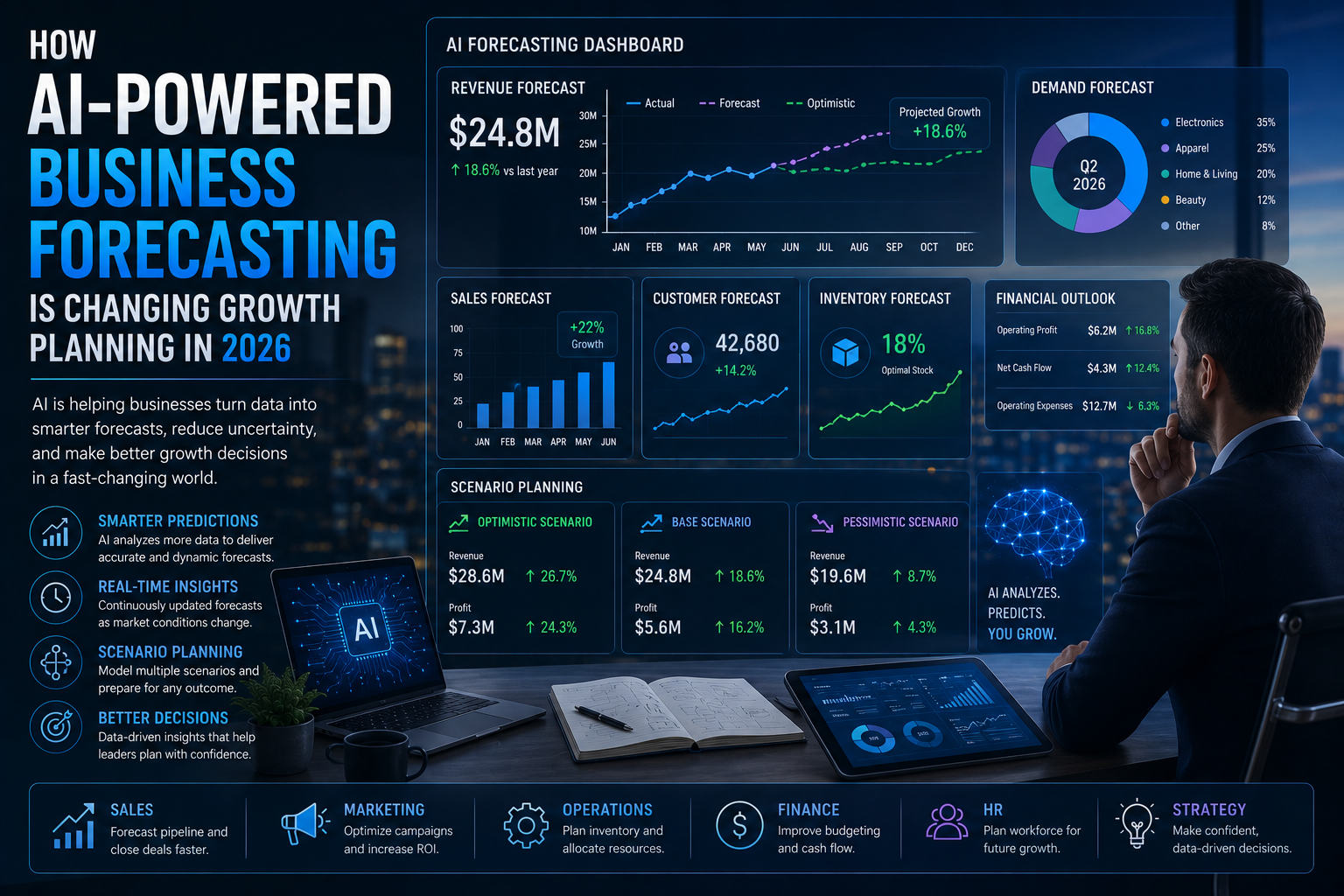
Revenue forecasting is one of the most important applications.
Businesses need reliable revenue estimates to make decisions about hiring, investment, marketing, inventory, and expansion.
AI can analyze historical revenue along with factors such as customer acquisition, retention, sales pipeline activity, pricing, seasonality, and market conditions.
The system can then generate forecasts for different periods.
Sales leaders can use these predictions to identify whether current performance is likely to meet targets.
If a potential shortfall appears, management can investigate the underlying causes and consider corrective actions.
Improving Sales Forecasts
Sales forecasting can be difficult because pipelines are constantly changing.
Deals can be delayed, customers can change requirements, and opportunities can disappear.
AI can analyze sales activity and identify patterns associated with successful or unsuccessful deals.
For example, an AI system could consider customer engagement, communication frequency, deal size, industry, sales-stage duration, and historical outcomes.
This can provide sales teams with a more data-driven view of their pipeline.
Instead of relying entirely on individual salesperson estimates, managers can combine human judgment with AI-generated forecasts.
Demand Forecasting
Demand forecasting is especially important for retailers, manufacturers, distributors, and e-commerce companies.
Too much inventory can increase storage costs and create waste.
Too little inventory can lead to stockouts and lost sales.
AI can analyze demand patterns at a much more detailed level.
It can consider product-level trends, geographic differences, seasonal effects, promotions, customer behavior, and other relevant signals.
This allows businesses to adjust inventory planning as conditions change.
AI Forecasting and Marketing
Marketing performance can also benefit from predictive analytics.
Businesses invest in advertising, content, social media, email campaigns, and other channels.
AI can analyze historical campaign performance and estimate which strategies are likely to generate stronger results.
For example, a company could forecast how changes in advertising budgets might affect customer acquisition.
Marketing teams can use these predictions to compare scenarios before allocating resources.
This does not guarantee campaign success, but it can improve planning.
Predicting Customer Behavior
Understanding future customer behavior is becoming increasingly valuable.
AI can analyze patterns in purchases, website activity, engagement, subscriptions, and customer-service interactions to identify possible changes in behavior.
A company may use forecasting to estimate which customers are more likely to renew a subscription or which products a customer segment may purchase next.
This can support retention and marketing strategies.
Businesses should, however, use customer data responsibly and ensure that forecasting systems comply with applicable privacy requirements.
AI and Workforce Planning
Growth planning also requires organizations to determine how many employees they may need.
Hiring too early can increase costs.
Hiring too late can create capacity problems.
AI can analyze historical staffing levels, business growth, workload patterns, productivity metrics, and expected demand.
The resulting forecasts can help organizations estimate future workforce requirements.
Human-resource teams can use these insights to plan recruitment and training more strategically.
Financial Scenario Planning
One of the strongest advantages of AI forecasting is the ability to explore multiple scenarios.
Businesses rarely know exactly what the future will look like.
Instead of producing one prediction, AI systems can model different possibilities.
For example:
Scenario A: Demand increases significantly.
Scenario B: Demand remains stable.
Scenario C: Demand declines.
Management can then evaluate how each scenario would affect revenue, staffing, inventory, cash flow, and investment requirements.
This creates a more flexible approach to strategic planning.
Real-Time Forecasting
Traditional forecasts may be updated weekly, monthly, or quarterly.
AI makes more frequent updates possible.
As new sales, customer, market, or operational information becomes available, forecasting systems can recalculate their predictions.
This creates a dynamic forecasting environment.
For rapidly changing industries, real-time or near-real-time forecasting can provide a significant advantage.
Businesses can identify emerging changes earlier rather than waiting for the next reporting cycle.
AI Forecasting for Small Businesses
AI-powered forecasting is not limited to large corporations.
Cloud-based business platforms are making predictive capabilities increasingly accessible to smaller companies.
A small retailer could forecast demand.
A service business could estimate future bookings.
An online company could predict subscription growth.
A startup could model cash-flow scenarios.
This can give smaller businesses analytical capabilities that previously required specialized teams.
However, smaller organizations still need to ensure that their underlying data is accurate enough to support useful predictions.
The Importance of Data Quality
AI forecasting depends heavily on data.
Poor-quality information can produce poor forecasts.
If historical records contain errors, missing information, duplicate entries, or inconsistent definitions, the AI system may identify misleading patterns.
Businesses should therefore invest in data quality before relying heavily on AI forecasting.
Important steps include cleaning historical data, establishing consistent definitions, monitoring data sources, and ensuring that critical information is updated regularly.
Better forecasting often begins with better data management.
AI Forecasting Does Not Eliminate Uncertainty
No forecasting system can predict the future perfectly.
Unexpected events can change business conditions rapidly.
A new regulation, economic shock, supply disruption, technological development, or competitor strategy can make previous assumptions less useful.
Businesses should therefore treat AI forecasts as decision-support tools rather than guarantees.
The purpose is to improve preparedness, not create the illusion of certainty.
Human Judgment Still Matters
Experienced business leaders understand factors that may not appear in historical datasets.
A manager may know that a major customer is changing strategy.
A sales leader may understand a competitor's upcoming product launch.
An executive may have information about a partnership that has not yet appeared in the company's databases.
AI can analyze available information, but humans provide context.
The strongest forecasting processes combine both.
AI identifies patterns and scenarios.
Humans evaluate those insights against business knowledge and strategic priorities.
AI Forecasting and Risk Management
Forecasting can also support risk management.
Businesses can identify indicators that may signal potential problems.
For example, an AI system could detect declining customer engagement, rising operating costs, weakening demand, or unusual sales patterns.
Early warnings can give management more time to respond.
The goal is not to eliminate risk.
Instead, forecasting can help organizations identify risks earlier and prepare potential responses.
AI Agents and Automated Forecasting
The next stage of forecasting may involve AI agents.
An AI agent could continuously monitor business data, update forecasts, identify significant changes, and notify relevant decision-makers.
For example, a finance agent could monitor revenue and expenses and alert management when current performance begins to diverge significantly from the approved plan.
An inventory agent could identify demand changes and prepare replenishment recommendations.
Human approval can remain part of the process for important decisions.
Forecasting Across the Entire Business
The greatest opportunity may come from connecting forecasts across departments.
Revenue forecasts affect inventory.
Inventory affects operations.
Operations affect staffing.
Staffing affects costs.
Costs affect financial forecasts.
AI can potentially connect these relationships.
This allows businesses to understand how one change may influence multiple areas of the organization.
Instead of treating each department's forecast as an isolated exercise, companies can move toward integrated business planning.
How Companies Can Start
Businesses interested in AI forecasting should begin with a specific problem.
Good starting points include:
Sales forecasting
Inventory planning
Revenue prediction
Customer retention
Workforce planning
Cash-flow forecasting
Marketing performance
Demand planning
Organizations should define measurable goals before implementation.
For example, a company might measure whether AI forecasting reduces stockouts, improves sales prediction accuracy, reduces inventory costs, or improves budget planning.
Starting with a focused use case makes it easier to evaluate results.
The Future of Growth Planning
As AI forecasting becomes more advanced, growth planning may become increasingly dynamic.
Businesses could continuously evaluate current conditions and automatically update strategic scenarios.
Executives may receive alerts when assumptions change.
AI systems could recommend possible actions based on forecast changes.
Employees could interact with forecasting systems using natural language, asking questions such as:
“What happens to our cash flow if sales decline by 10% next quarter?”
The system could analyze the available information and produce a scenario for management review.
This could make advanced forecasting more accessible across organizations.
Conclusion
AI-powered business forecasting is changing how companies prepare for the future.
By analyzing large amounts of information and identifying complex patterns, AI can help businesses forecast revenue, demand, customer behavior, staffing requirements, marketing performance, and financial conditions.
Its biggest advantage may not be perfect prediction.
Instead, it is the ability to help organizations understand multiple possible futures and prepare for them more effectively.
Successful businesses will continue to combine AI with human expertise.
AI can process information quickly and identify patterns, while leaders provide context, judgment, creativity, and strategic direction.
In 2026, growth planning is becoming less about creating one annual forecast and more about continuously understanding how business conditions are changing.
Companies that build this capability can become more responsive, better prepared, and more confident when making important decisions.