Businesses have access to more information than ever before. Customer behavior, financial data, market trends, operational metrics, employee information, supply conditions, and digital interactions generate enormous quantities of data every day.
Yet having more data does not automatically mean making better decisions.
Executives and managers still need to determine which information matters, what patterns are developing, what risks may be emerging, and which actions could create the greatest business value.
This is where AI-powered decision intelligence is becoming increasingly important.
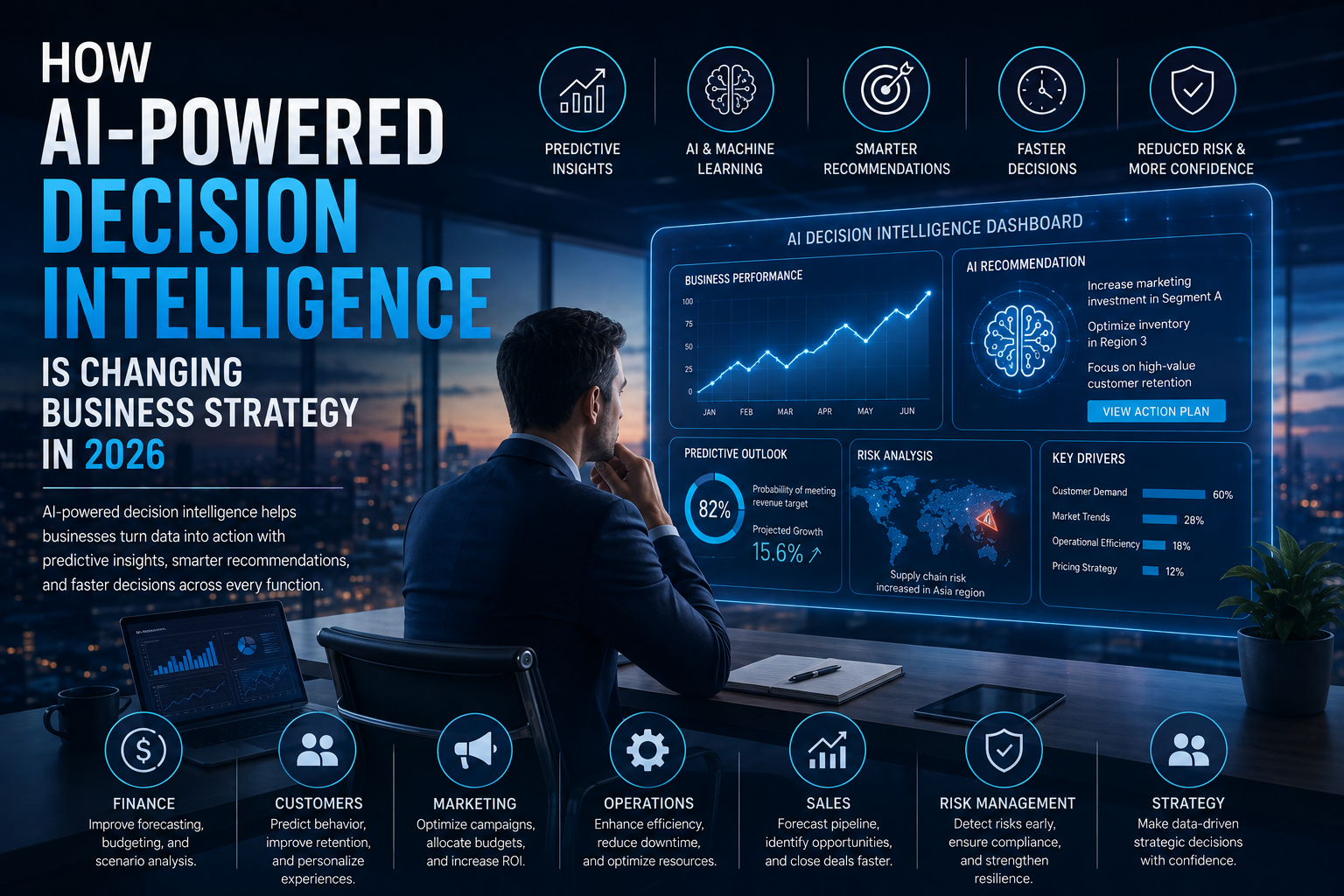
Decision intelligence combines data, analytics, artificial intelligence, predictive models, and business knowledge to help organizations make more informed decisions. Instead of simply reporting what happened, modern systems can help businesses understand what is happening, anticipate what could happen next, and evaluate potential responses.
In 2026, this approach is changing how organizations think about strategy, operations, customers, finance, and growth.
What Is AI-Powered Decision Intelligence?
Traditional business intelligence primarily focuses on reporting and visualization.
A dashboard might show sales performance, revenue, customer numbers, or operational metrics. Managers then analyze the information and decide what action to take.
AI-powered decision intelligence adds another layer.
AI can analyze large quantities of information, identify relationships between variables, detect unusual patterns, generate forecasts, and provide recommendations.
The objective is not simply to replace human decision-makers.
Instead, AI can provide decision-makers with deeper context and faster analysis.
For example, rather than showing that sales declined by 8%, an intelligent system could investigate possible contributing factors, identify the regions and products most affected, compare the change with historical patterns, and highlight areas that deserve management attention.
Why Decision Intelligence Matters in 2026
The speed of business is increasing.
Markets can change quickly, customers can switch preferences, competitors can introduce new products, and unexpected disruptions can affect operations.
Traditional decision-making processes may involve collecting reports from multiple departments and manually analyzing them.
That process can take days or weeks.
AI can process information much faster.
This creates an opportunity for businesses to move from periodic decision-making toward continuous decision support.
Instead of waiting for a monthly report, leaders can receive relevant insights as conditions change.
From Descriptive to Predictive Decisions
One of the biggest differences between traditional analytics and AI-powered decision intelligence is the ability to move from description toward prediction.
Descriptive analytics answers:
What happened?
Predictive analytics asks:
What is likely to happen next?
Decision intelligence goes one step further:
What should we consider doing about it?
For example, a retailer could detect declining demand for a product, forecast future sales, and then evaluate possible responses such as changing inventory levels or adjusting marketing activity.
Human managers can review the recommendations before making the final decision.
This creates a more structured approach to strategic planning.
AI and Executive Decision-Making
Executives often need to make decisions across multiple business areas simultaneously.
A CEO may need to consider revenue, customer retention, operating costs, employee productivity, market conditions, and competitive developments.
AI can help bring these different sources of information together.
An executive assistant powered by AI could summarize important business changes, identify emerging risks, compare performance against strategic goals, and prepare questions for management meetings.
The value is not simply speed.
It is the ability to connect information that may otherwise remain separated across departments.
Improving Financial Planning
Financial planning is another area where decision intelligence can provide significant value.
Finance teams work with budgets, forecasts, expenses, revenue, cash flow, and financial reports.
AI can analyze historical financial information and identify patterns that may influence future performance.
For example, an intelligent system could compare current expenses with historical trends and highlight unexpected increases.
It could also help finance teams model different scenarios.
What happens if revenue grows more slowly than expected?
What happens if operating costs increase?
What happens if a company expands into a new market?
Scenario analysis can help businesses prepare for different possibilities rather than relying on one fixed forecast.
Smarter Marketing Decisions
Marketing teams generate large amounts of data from campaigns, websites, social platforms, email, advertising, and customer interactions.
The challenge is determining which signals actually matter.
AI-powered decision intelligence can analyze campaign performance and identify relationships between audience behavior and business outcomes.
For example, an AI system might identify that a particular customer segment responds better to educational content than promotional messaging.
It could also compare campaign performance across different channels.
This can help marketing teams allocate resources more effectively.
AI does not eliminate the need for creativity or strategic thinking. Instead, it can provide evidence that supports those decisions.
Customer Strategy Becomes More Predictive
Businesses increasingly want to understand what customers may do next.
AI can analyze customer interactions, purchasing patterns, engagement levels, and other permitted signals to identify potential changes in behavior.
A company might identify customers who appear less engaged and investigate whether additional support could improve retention.
Similarly, AI could identify customers who may be interested in complementary products.
The goal is to move from reacting to customer behavior toward anticipating customer needs.
Privacy and responsible data use remain essential when implementing these systems.
AI for Operational Decisions
Decision intelligence can also improve everyday operations.
Manufacturers, logistics companies, retailers, and service businesses make thousands of operational decisions.
Which resources should be allocated where?
Which equipment requires attention?
Which orders should be prioritized?
Which processes are causing delays?
AI can analyze operational data and provide recommendations based on current conditions.
This can help managers respond faster when circumstances change.
Scenario Planning With AI
One of the most powerful applications of decision intelligence is scenario simulation.
Businesses rarely know exactly what the future will look like.
Instead of making one prediction, AI can help organizations explore multiple possibilities.
A company considering expansion could evaluate different market conditions.
A manufacturer could examine how changes in demand might affect production.
A logistics company could model potential disruptions.
The objective is not to predict the future perfectly.
It is to understand possible outcomes and prepare better responses.
Combining Human Judgment With AI
Despite rapid advances in AI, human judgment remains essential.
Business decisions often involve factors that are difficult to quantify.
Leadership, company culture, ethics, customer relationships, reputation, and long-term strategy may not be fully represented in a dataset.
AI can identify patterns and generate recommendations, but humans need to determine whether those recommendations make sense in the broader context.
This is why the most effective decision-intelligence systems are likely to combine machine analysis with human expertise.
The Role of AI Agents
AI agents could make decision intelligence even more powerful.
Instead of simply presenting a recommendation, an AI agent could monitor business conditions continuously and perform approved actions.
For example, an operations agent might detect a supply problem, examine available alternatives, prepare a response, and send a recommendation to a manager.
In lower-risk situations, organizations may eventually allow agents to execute predefined actions automatically.
Higher-risk decisions can remain subject to human approval.
This creates a spectrum of automation rather than a simple choice between manual work and full autonomy.
Data Quality Is Critical
AI-powered decision intelligence is only as reliable as the information it uses.
Poor-quality data can produce misleading conclusions.
If business databases contain duplicate records, outdated information, missing values, or inconsistent definitions, AI systems may struggle to produce accurate insights.
Organizations therefore need strong data governance.
They should establish clear data ownership, quality standards, security controls, and processes for maintaining important information.
Better AI decisions often begin with better data.
Avoiding AI Bias
AI systems can also reproduce biases that exist in historical data.
If previous business decisions were influenced by incomplete or biased information, an AI system trained on that information may repeat those patterns.
Businesses should therefore evaluate important AI recommendations carefully.
High-impact decisions involving employees, customers, lending, healthcare, or other sensitive areas require particularly strong oversight.
AI should support fair and responsible decision-making rather than simply automate historical patterns.
Building Trust in AI Recommendations
Employees will not automatically trust AI-generated recommendations.
Organizations need to explain how systems are being used and establish clear accountability.
When appropriate, AI systems should provide supporting information that helps users understand why a particular recommendation was generated.
For example, instead of saying:
“Reduce inventory.”
A system could identify the demand trend, historical sales pattern, current inventory levels, and forecast that contributed to the recommendation.
This transparency can make AI more useful to decision-makers.
Decision Intelligence Across the Enterprise
The long-term opportunity is to connect decision intelligence across departments.
Marketing, finance, sales, operations, customer service, and leadership often work with different systems and datasets.
An enterprise AI layer could potentially connect these sources and provide a broader view of business performance.
A change in customer demand could influence inventory planning.
Inventory changes could affect financial forecasts.
Financial conditions could influence marketing budgets.
Connecting these relationships can help businesses understand the wider consequences of decisions.
The Future of Business Strategy
As AI becomes more capable, decision intelligence may become a standard component of business strategy.
Executives could have AI systems continuously analyzing markets, customers, operations, and financial performance.
Managers could receive recommendations tailored to their responsibilities.
Employees could use natural-language interfaces to explore business questions without requiring advanced analytics skills.
AI agents could eventually execute approved operational decisions.
The result could be a business environment where intelligence is continuously available rather than limited to occasional reports.
How Businesses Can Start
Organizations do not need to transform their entire decision-making process immediately.
A practical approach is to identify one area where better decisions could create measurable value.
Possible starting points include:
Financial forecasting
Customer retention
Marketing optimization
Inventory planning
Sales forecasting
Operational efficiency
Risk monitoring
Resource allocation
Businesses should define clear performance metrics before deploying AI.
The goal should be measurable improvement rather than simply adding another AI tool.
Conclusion
AI-powered decision intelligence is changing the way businesses turn information into action.
Traditional analytics can explain what happened, while AI-powered systems can help organizations identify patterns, forecast possibilities, evaluate scenarios, and generate recommendations.
This can improve decision-making across finance, marketing, operations, customer strategy, and executive planning.
However, AI should not become an unquestioned authority.
Strong data governance, transparency, security, responsible AI practices, and human judgment remain essential.
The most successful organizations will likely combine the speed and analytical capabilities of AI with the experience, creativity, and strategic judgment of their people.
In 2026, competitive advantage may increasingly depend not on who has the most data, but on who can turn information into better decisions faster.
AI-powered decision intelligence provides a pathway toward that future, helping businesses become more responsive, predictive, and strategically informed.